- Common Questions
- Interview Questions
- How To Answer Tell Me About Yourself?
- Elevator Pitch
- Where Do You See Yourself In 5 Years?
- What Are Your Career Goals?
- When Can You Start?
- How Do You Define Success?
- Describe Your Work Ethic
- Where Are Your Current Duties?
- What Are Your Learning Goals?
- Intrinsic Vs Extrinsic Motivation
- What Is Your Desired Salary?
- What Makes You Unique?
- Why Are You The Best Person For This Job?
- Reasons For Termination
- What Are Your Work Values
- How To Make A Hard Decision?
- What Are You Most Proud Of?
- Personal Code Of Ethics
- Problem Solving Interview Questions
- Taking Initiative Example
- How Do You Prioritize Your Work
- Explain Gaps In Employment
- Most Rewarding College Experience
- What Is Your Work Style
- Tell Me About A Time When You Made A Mistake On The Job
- Tell Me About Gaps In Employment
- What Are You Passionate About
- What Skills Would You Bring To The Job
- Who Is Your Mentor?
- Tell Me About Gaps In Employment
- How To Answer Tell Me About A Time You Disagreed With Your Boss
- How To Answer Common Screening Questions
- How Do You Handle Stress
- Are You Willing To Travel?
- Do You Work Well With Others?
- Why Do You Want To Work Here?
- What Is Your Greatest Weakness?
- Where Else Are You Interviewing?
- Tell Me About A Time You Failed
- How Do You Like To Be Managed?
- Do You Have Any Questions For Me?
- What Gets You Up In The Morning?
- What Do You Know About Our Company?
- What Is Your Greatest Strength?
- What Is Your Dream Job?
- What Is Your Ideal Work Environment?
- Why Are You Looking For A New Job?
- Why Should We Hire You?
- What Motivates You?
- What Else Should We Know About You?
- When Have You Made A Split Second Decision?
- Tell Me About A Challenge You've Faced At Work
- What Sets You Apart From Other Candidates?
- What Is Your Greatest Accomplishment?
- Types Of Questions
- Situational Interview Questions
- Promotion Interview Questions
- Internal Interview Questions
- Open Ended Interview Questions
- Tough Interview Questions
- Leadership Interview Questions
- Teamwork Interview Questions
- Interview Questions About Communication
- Personality Interview Questions
- Internship Interview Questions
- Ice Breaker Questions
- Recruiter Interview Questions
- Brain Teaser Interview Questions
- Group Interview Questions
- Competency Based Interview Question
- Grad School Interview Questions
- Scrum Interview Questions
- Excel Interview Questions
- Common Phone Interview Questions And Answers
- Job Specific Questions
- Why Did You Choose Nursing?
- Why Do You Want To Be A Teacher?
- Why Do You Want To Be A Doctor?
- Why Do You Want To Be A Police Officer?
- Police Officer Interview Questions
- Why Do You Want To Be An Accountant?
- Sales Interview Questions
- Interview Questions For Managers
- Retail Interview Questions
- Teacher Interview Questions
- Accounting Interview Questions
- Teaching Philosophy Examples
- Management Philosophy Examples
- Leadership Philosophy
- What Does Customer Service Mean To You
Find a Job You Really Want In
Mastering the response to “What is your greatest accomplishment?” is crucial as it remains a prevalent interview question in 2026. Utilizing the STAR (Situation, Task, Action, Result) technique can help you effectively illustrate how your skills led to a significant achievement.
In this article, we will explore why interviewers ask about your greatest accomplishments, provide sample answers, offer tips for crafting your response, and conclude with additional examples.
Key Takeaways:
-
When responding to inquiries about your greatest professional achievement, prepare your answer, closely examine the job description, and apply the STAR method.
-
This question is categorized as a behavioral interview question, which means the hiring manager seeks evidence of past behaviors that indicate potential success.
-
Discussing your greatest accomplishment may feel uncomfortable for some, as many are conditioned to avoid self-promotion. However, in a job interview, showcasing your achievements is essential.
- How to Answer “What Is Your Greatest Accomplishment?”
- Example Answers to “What’s Your Greatest Accomplishment?”
- Why Interviewers Ask This Common Interview Question
- How to Choose Just One Example for Your Greatest Accomplishment
- Tips for Answering “What Is Your Greatest Accomplishment?”
- Greatest Accomplishment FAQs
- Final Thoughts
- References
- Sign Up For More Advice and Jobs
How to Answer “What Is Your Greatest Accomplishment?”
To effectively address the question “What is your greatest accomplishment?” you should prepare your response, review the job description, and apply the STAR (Situation, Task, Action, Result) method. Here’s a detailed guide on how to approach this common interview question:
-
Preparation is key. Compile a list of your professional accomplishments, no matter how small. The broader your selection, the better you can customize your stories for various interviews. Other accomplishments may also be relevant when addressing different questions during the interview.
-
Analyze the job description. Identify keywords and key responsibilities to select an accomplishment that aligns well with the job requirements. For example, if the role emphasizes customer service, choose a story highlighting your interpersonal skills over technical expertise.
-
Utilize the STAR method. Since this is a behavioral interview question, structure your response using the STAR framework:
-
Situation. Provide context for your story. Explain the circumstances leading to your accomplishment. Is this typical work for you? If so, why this example? If not, what makes it stand out?
-
Task. Define your role in the situation, often summarized in one or two sentences.
-
Action. Describe what you did. This is the core of your answer; be concise but thorough without excessive detail.
-
Result. Share the outcome of your actions. Since this is about your greatest accomplishment, ensure the result was significantly positive, ideally quantifying it to demonstrate the value you could bring to the prospective employer.
-
Example Answers to “What’s Your Greatest Accomplishment?”
Here are various example answers to the question about your greatest professional achievement, along with a template to assist you in crafting your own response. Remember to customize your answer to fit your personal experiences.
-
Greatest Accomplishment Answer Template
“My team achieved our goal of [goal your team was working toward]. My part of the project was [your duties]. While this project wasn’t revolutionary, I’m proud of it because I learned [skill or concept you learned that relates to the job]. Because of this experience, next time I face a similar challenge, I will utilize my newfound skills with [skill or concept].”
-
Human Resources Manager Example Answer
In my previous role as an HR manager, my greatest accomplishment was redesigning our onboarding process for remote hires, which had been inefficient. Our training materials were outdated, resulting in only 19% positive feedback from new hires.
I researched effective remote training methods and implemented a new onboarding system using XYZ software. By incorporating feedback and best practices, I developed a comprehensive training program. Upon my departure, 97% of new hires reported positive experiences with the onboarding process.
This enhancement significantly improved remote worker retention and reduced the time to productivity, saving the company an average of $2,650 per remote employee.
-
Teacher Example Answer
As a fifth-grade teacher, my greatest accomplishments revolve around my students’ successes. Last year, I worked closely with a student struggling with dyslexia. Knowing he was passionate about drawing and fantasy films like Lord of the Rings, we met during breaks to read the book and create illustrations for each chapter. He became excited about reading and his parents reported a newfound enthusiasm for homework.
By year-end, his reading scores improved by over 15%, but my most rewarding achievement was igniting his interest in learning, something that had previously frustrated him.
-
Sales Representative Example Answer
My greatest achievement occurred last quarter when my team was lagging behind on our sales targets for a new product. Despite our marketing efforts, we struggled to gain traction.
I devised a new marketing strategy that leveraged social media campaigns, which boosted our sales by 155%. Additionally, user engagement on our social platforms surged by 70% in just a month.
This unexpected success led to my company assigning me additional marketing responsibilities, and we have since adopted this strategy for new product launches, significantly reducing time to market.
-
Recent College Graduate Example Answer
As a recent college graduate, my proudest accomplishment is completing my degree in Art History. This required immense dedication and perseverance over several years.
I prioritized academic excellence while seizing opportunities to enhance my learning through internships, research initiatives, and extracurricular engagements.
Moreover, I balanced my studies with leadership roles in student organizations, where I collaborated with diverse teams, organized events, and contributed to the organizations’ growth.
-
Team Leader Example Answer
My greatest achievement was leading a cross-functional team as a team leader to successfully complete a critical project. I ensured every team member understood the project’s objectives and fostered an environment of effective communication and collaboration.
By prioritizing project management best practices, we achieved our goals through collective effort, showcasing the power of teamwork and my leadership.
Why Interviewers Ask This Common Interview Question
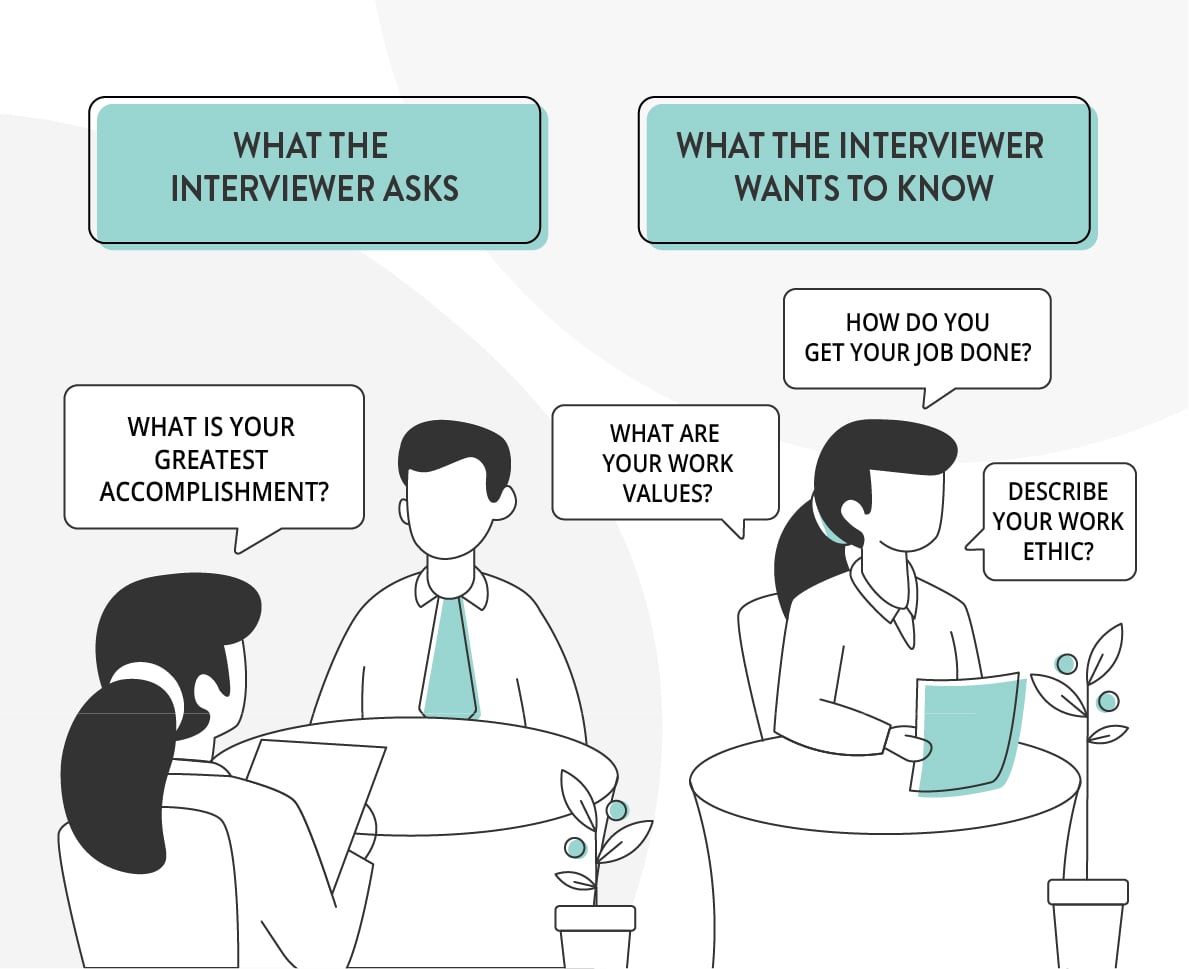
Interviewers pose this question to gauge your work ethic and values. When a recruiter or hiring manager inquires about your greatest accomplishment, they seek to understand three key aspects:
-
Your work ethic. How diligent are you? What does it take for you to feel you’ve made a meaningful contribution?
-
Your values. What do you consider an accomplishment? What level of effort are you willing to invest to achieve workplace success?
-
Concrete examples of your work. Recruiters want specifics to gain insight into your past projects and set expectations for your future contributions.
Your interviewers will evaluate how well your work style and values align with the company culture. While your hard skills may shine in your response, your soft skills will also be evident.
This question is essentially the counterpart to “Tell me about a time you failed,” both being behavioral interview questions that necessitate compelling narratives.
How to Choose Just One Example for Your Greatest Accomplishment
When selecting your greatest accomplishment, focus on professional examples, choose something recent, and maintain honesty. Here’s a closer look at how to decide:
-
Stick to work-related examples. Personal achievements, such as running a marathon, may be impressive but are often unrelated to your professional skills.
-
Choose a recent accomplishment. Favor recent stories over those from a decade ago, especially if the skills showcased are relevant to today’s job market.
-
Avoid exaggeration. Honesty is critical. Select an example that not only impresses you but would also resonate with your audience. Craft your story thoughtfully without fabricating details.
Tips for Answering “What Is Your Greatest Accomplishment?”
When discussing your greatest accomplishment, aim to present a singular, impactful example unless prompted for more. Ensure your example reflects your best work while being an engaging narrative. Consider these additional tips:
-
Highlight the value to your employer. While your accomplishment may be personally significant, interviewers are primarily interested in the benefits you could bring to their organization.
-
Avoid negativity. This question should focus on positivity. Do not criticize others; instead, share a proud moment from your career.
-
Showcase relevant qualifications. An answer that connects your qualifications to the job description can be particularly impactful.
-
Prepare in advance. Don’t wait until the interview to recall your story. Preparation ensures you convey all essential details clearly.
-
Be truthful. Avoid fabrications. If simplifying your narrative is necessary for clarity, that’s acceptable, as long as the core of your accomplishment remains accurate.
Greatest Accomplishment FAQs
-
What are “your greatest accomplishments” examples?
Examples of greatest accomplishments may include:
-
Leading a team project at school or work
-
Delivering a presentation for a significant event
-
Organizing a major event
-
Mentoring a fellow student or employee
-
Receiving an award for academic or professional contributions
-
Completing a challenging training or educational course
-
Surpassing expectations in a performance-based task
-
-
How do I describe my accomplishments?
Describe your accomplishments by emphasizing your abilities and focusing on tangible results. Provide context and demonstrate how your skills contributed positively to the situation, avoiding vague statements.
-
What three elements should I mention for accomplishments?
Three key elements to mention for any accomplishment are:
-
The actions you took
-
The skills you utilized
-
The outcomes achieved
-
-
What if I don’t have any accomplishments?
If you feel you lack accomplishments, engage in self-reflection and seek input from others. Reflecting on your journey can reveal insights into your growth. Utilize materials like journals, your resume, or transcripts for inspiration. Identify actions that positioned you for the interview opportunity.
Additionally, consult friends, family, and former coworkers for their perspectives. Sharing your interest in their insights can yield helpful feedback.
Your selection should reflect your background and be relevant to the job responsibilities for which you are interviewing.
This is why the STAR method is so effective—it helps you frame your answer to illustrate what you did, how you did it, and what the results were.
Final Thoughts
That wraps up our discussion! Remember, regardless of your work history, always prepare an answer to this question.
Claiming “I don’t have any significant accomplishments” can create a negative impression. If you think you lack substantial answers due to limited experience, consider creative examples from school projects, personal challenges, or contributions to others.
While there are instances when a lack of response may be suitable, this is not one of them.
References
- Common Questions
- Interview Questions
- How To Answer Tell Me About Yourself?
- Elevator Pitch
- Where Do You See Yourself In 5 Years?
- What Are Your Career Goals?
- When Can You Start?
- How Do You Define Success?
- Describe Your Work Ethic
- Where Are Your Current Duties?
- What Are Your Learning Goals?
- Intrinsic Vs Extrinsic Motivation
- What Is Your Desired Salary?
- What Makes You Unique?
- Why Are You The Best Person For This Job?
- Reasons For Termination
- What Are Your Work Values
- How To Make A Hard Decision?
- What Are You Most Proud Of?
- Personal Code Of Ethics
- Problem Solving Interview Questions
- Taking Initiative Example
- How Do You Prioritize Your Work
- Explain Gaps In Employment
- Most Rewarding College Experience
- What Is Your Work Style
- Tell Me About A Time When You Made A Mistake On The Job
- Tell Me About Gaps In Employment
- What Are You Passionate About
- What Skills Would You Bring To The Job
- Who Is Your Mentor?
- Tell Me About Gaps In Employment
- How To Answer Tell Me About A Time You Disagreed With Your Boss
- How To Answer Common Screening Questions
- How Do You Handle Stress
- Are You Willing To Travel?
- Do You Work Well With Others?
- Why Do You Want To Work Here?
- What Is Your Greatest Weakness?
- Where Else Are You Interviewing?
- Tell Me About A Time You Failed
- How Do You Like To Be Managed?
- Do You Have Any Questions For Me?
- What Gets You Up In The Morning?
- What Do You Know About Our Company?
- What Is Your Greatest Strength?
- What Is Your Dream Job?
- What Is Your Ideal Work Environment?
- Why Are You Looking For A New Job?
- Why Should We Hire You?
- What Motivates You?
- What Else Should We Know About You?
- When Have You Made A Split Second Decision?
- Tell Me About A Challenge You've Faced At Work
- What Sets You Apart From Other Candidates?
- What Is Your Greatest Accomplishment?
- Types Of Questions
- Situational Interview Questions
- Promotion Interview Questions
- Internal Interview Questions
- Open Ended Interview Questions
- Tough Interview Questions
- Leadership Interview Questions
- Teamwork Interview Questions
- Interview Questions About Communication
- Personality Interview Questions
- Internship Interview Questions
- Ice Breaker Questions
- Recruiter Interview Questions
- Brain Teaser Interview Questions
- Group Interview Questions
- Competency Based Interview Question
- Grad School Interview Questions
- Scrum Interview Questions
- Excel Interview Questions
- Common Phone Interview Questions And Answers
- Job Specific Questions
- Why Did You Choose Nursing?
- Why Do You Want To Be A Teacher?
- Why Do You Want To Be A Doctor?
- Why Do You Want To Be A Police Officer?
- Police Officer Interview Questions
- Why Do You Want To Be An Accountant?
- Sales Interview Questions
- Interview Questions For Managers
- Retail Interview Questions
- Teacher Interview Questions
- Accounting Interview Questions
- Teaching Philosophy Examples
- Management Philosophy Examples
- Leadership Philosophy
- What Does Customer Service Mean To You

Author

Ryan Morris was a writer for the Zippia Advice blog who tried to make the job process a little more entertaining for all those involved. He obtained his BA and Masters from Appalachian State University.