Average CEO Tenure Research Summary: In recent years, the average CEO tenure has significantly declined, revealing a trend of shorter leadership spans in major corporations. As businesses adapt to evolving economic realities and shifting workforce dynamics, the landscape for CEOs has transformed.
If you’re an aspiring entrepreneur interested in understanding the average CEO tenure in 2026, you’re in the right place. Our comprehensive analysis explores average CEO tenure across various industries and over time, and here’s what we found:
-
The average CEO tenure for the S&P 500 is 7.2 years.
-
The median CEO tenure is 4.8 years.
-
The average CEO tenure has decreased by 34% since 2017 (10.9 years).
-
39% of CEOs have a tenure that lasts between 1 and 5 years.
-
The Finance and Insurance industry had the longest average CEO tenure between 2001-2017, at 13 years on average.

Average CEO Tenure by Years
While the average CEO tenure saw a notable decrease in the years following the COVID-19 pandemic, the duration of CEO positions can vary significantly. To gain further insights into the average tenure, consider the breakdown of years employed by the share of CEOs:
CEO Tenure in Years by Share of CEOs
| Years Employed | Share of CEOs (2026) | Share of CEOs (2017) | Percentage Change |
|---|---|---|---|
| <1 Year | 13% | 10% | +30.0% |
| 1-5 Years | 39% | 38% | +2.6% |
| 5-10 Years | 28% | 26% | +7.7% |
| 10-15 Years | 9% | 13% | -30.7% |
| 15-20 Years | 4% | 6% | -33.3% |
| 20+ Years | 8% | 6% | +33.3% |

In 2026, a significant portion of CEOs (67%) have tenures ranging from 1 to 10 years, mirroring trends observed in 2017.
Key trends since 2017 include:
-
A sharp increase in the share of CEOs with tenures of less than 1 year (30% increase).
-
A noticeable decline in the share of CEOs with tenures between 10-20 years (-30.7% and -33.3% decrease, respectively).
CEO Tenure by Industry
From 2001 to 2017, the Finance and Insurance industry had the longest average CEO tenure, recorded at 12.99 years. Here are additional industry averages:
CEO Tenure by Industry
| Industry | Average CEO Tenure |
|---|---|
| Finance & Insurance | 12.99 years |
| Services | 11.36 years |
| Consumer Products | 10.31 years |
| Transport & Communications | 10.20 years |
| Wholesale & Retail | 9.43 years |
| Manufacturing | 8.55 years |
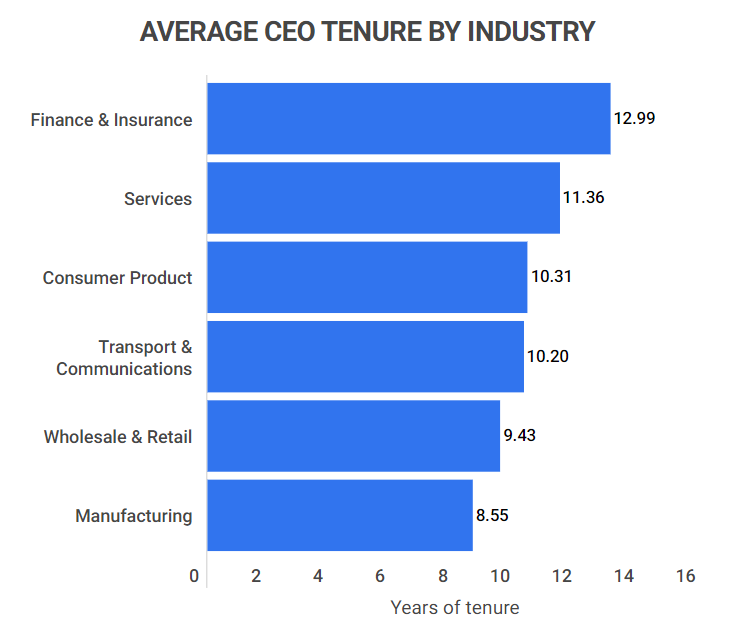
Among the listed industries, the average tenure for a CEO in Finance and Insurance surpasses that of a CEO in Manufacturing by over 50%. While averages may have declined since 2020, similar trends across industries likely persist.
CEO Tenure Over Time
The average CEO tenure has fluctuated over the years, with a marked decline in recent times. Below is a chart illustrating how CEO tenure has evolved:
CEO Tenure Over Time
| Year | Average CEO Tenure |
|---|---|
| 2001 | 9.4 years |
| 2002 | 11.3 years |
| 2003 | 7.4 years |
| 2004 | 9.3 years |
| 2005 | 8.1 years |
| 2006 | 8.0 years |
| 2007 | 8.8 years |
| 2008 | 8.6 years |
| 2009 | 7.2 years |
| 2010 | 7.7 years |
| 2011 | 8.4 years |
| 2012 | 8.1 years |
| 2013 | 9.7 years |
| 2014 | 9.9 years |
| 2015 | 10.8 years |
| 2016 | 9.0 years |
| 2017 | 10.9 years |
| 2018 | 7.6 years |
| 2019 | 7.4 years |
| 2020 | 7.3 years |
| 2021 | 7.3 years |
| 2022 | 7.2 years |
As illustrated, CEO tenure can vary significantly from year to year, with a clear trend of increased tenure from 2009 to 2017, followed by a decrease from 2017 to 2023.
In summary, from the peak of 10.9 years in 2017 to the current 7.2 years, the average length of CEO tenure has plummeted by 34%.
CEO Tenure FAQ
-
What is a good tenure for a CEO?
A good tenure for a CEO in the US in 2026 is around 5-7 years. Historically, this average has been over 10 years; however, currently, any tenure exceeding 5 years is deemed acceptable within the industry. Approximately 28% of CEOs have a tenure of between 5-10 years, compared to 39% serving 1-5 years.
It’s notable that just under half of all CEOs have tenures exceeding 5 years.
-
Can long CEO tenure hurt performance?
Yes, prolonged CEO tenure can negatively impact performance, even after the CEO has been replaced. When a new CEO takes over from a long-serving predecessor, there is often a noticeable decline in operational efficiency and stock performance.
Here are some potential issues:
-
Stagnation and complacency. Long-tenured CEOs may become resistant to change, resulting in a stagnant corporate culture and outdated strategies.
-
Diminished accountability. CEOs who consolidate power may reduce accountability to shareholders and the board of directors, leading to poor decision-making.
-
Risk aversion. Long-serving CEOs may avoid necessary but bold decisions, hindering the company’s ability to capitalize on opportunities or respond to threats.
-
Talent drain. High-potential executives may leave if they perceive limited advancement opportunities, leading to a loss of talent.
-
Succession challenges. Extended CEO tenures can complicate succession planning, potentially causing disruptions during leadership changes.
-
-
Is CEO tenure getting shorter?
Yes, CEO tenure has been decreasing, despite natural year-to-year fluctuations. Since 2017, there has been a 34% decline in average CEO tenure, dropping from 10.9 years to just 7.2 years.
The last significant dip in CEO tenure occurred in 2009 following the housing market crash, which also saw an average tenure of 7.2 years. Economic challenges appear to influence the average CEO tenure.
Conclusion
The average CEO tenure has experienced significant fluctuations over the past two decades, with recent declines being more pronounced than ever. Compared to 2017, average CEO tenure has decreased by 34%, with the current average standing at 7.2 years in 2026.
However, CEO tenures vary widely, with 49% of CEOs serving over 5 years and 51% serving under 5 years. The largest segment of CEOs (39%) remains in their role for 1-5 years.
Ultimately, each organization and industry has its own approach to CEO tenure, and if current trends persist, we may see a continued decrease in CEO tenure moving forward.
References
-
Harvard Law School – CEO Tenure Rates

Author

Jack Flynn is a writer for Zippia. In his professional career he’s written over 100 research papers, articles and blog posts. Some of his most popular published works include his writing about economic terms and research into job classifications. Jack received his BS from Hampshire College.