Black Friday Statistics [2026]: Essential Facts on Sales + Trends
Research Summary. Black Friday remains one of the largest shopping days in the United States, kicking off the holiday shopping season immediately following Thanksgiving. This day offers consumers some of the most attractive deals, both in-store and through online shopping.
Every retail business should consider participating in Black Friday events, especially in light of the statistics below:
-
Global businesses generated an estimated $74.1 billion during the 2023 Black Friday sales.
-
Approximately 15% of all retail sales in the United States occur between Black Friday and Christmas.
-
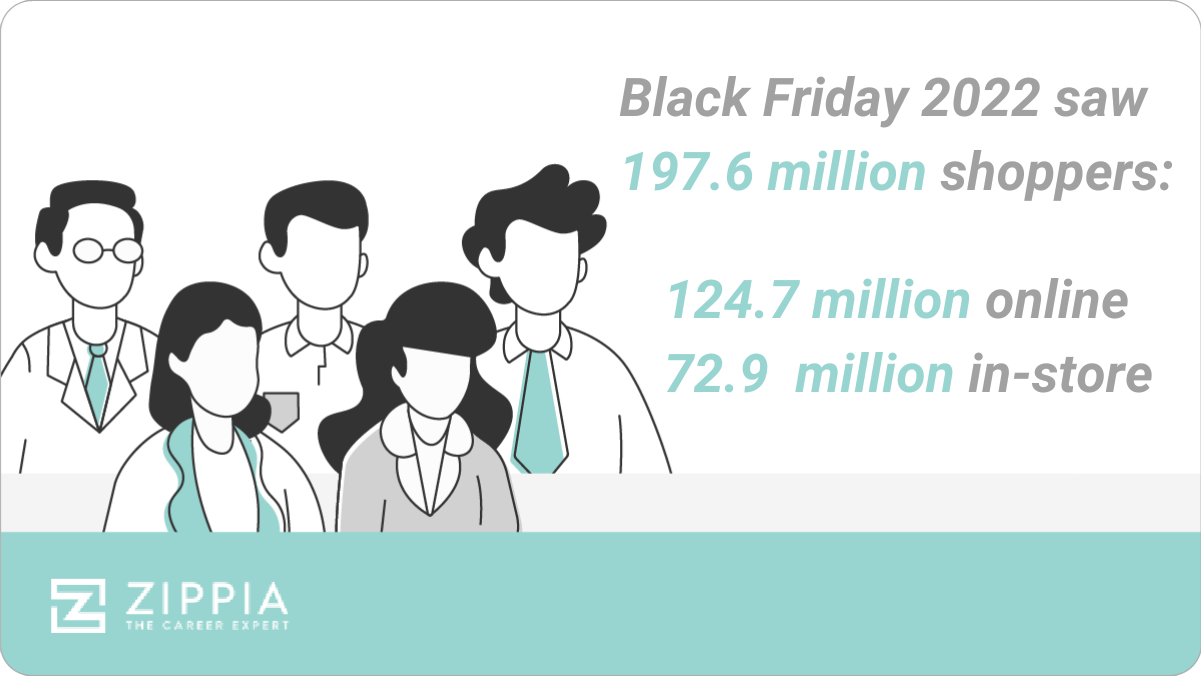
There were 197.6 million shoppers in the United States on Black Friday in 2022.
-
Shoppers spent $10.7 billion online during Black Friday in 2023.
-
50% of Black Friday sales occurred through mobile devices in 2023.
-
Americans saved an average of 26% on Black Friday.
-
Fast shipping and customer service ratings are now more important to Black Friday shoppers than pricing alone.
For more detailed insights, we have categorized the data as follows:
Trends and Projections | Sales | Shoppers | Online Sales and Cyber Monday
Black Friday Trends and Projections
-
In-store shoppers increased by 12% from 2021 to 2022 on Black Friday.
This rise shows a recovery trend following the pandemic years, as consumers began to return to physical retail spaces.
-
Black Friday sales surged by 40% from 2021 to 2023.
Despite economic uncertainties, consumer spending on Black Friday has rebounded strongly.
-
Over 45 million more people, or a 23% increase, shopped on Black Friday in 2023 compared to 2022.
This suggests ongoing recovery and consumer enthusiasm for in-store shopping experiences post-pandemic.
Black Friday Statistics by Sales
-
$208 billion was generated in sales during the entire 2021 Black Friday weekend.
This figure reflects the increasing trend of sales spanning the entire weekend, rather than just on Black Friday itself.
-
Sales during the Black Friday weekend have consistently increased over the past few years, with substantial annual growth.
The following table illustrates the significant sales growth observed each year.
Year Total Sales (billions) 2021 $208 2020 $188.2 2019 $142.4 2018 $90.14 2017 $59.57
Black Friday Statistics by Discounts
-
The average Black Friday discount is around 27%.
While discounts can reach as high as 80%, most retailers offer deals closer to this average to maintain profitability.
-
Jewelry is regarded as the most discounted in-store item by 51% of shoppers.
Electronics follow closely, with 50% of shoppers identifying these as having the best in-store deals.
-
Online, clothing and shoes are perceived as the most discounted items, with 78% of shoppers agreeing.
Video games and home goods also rank high for online discounts, reflecting shifting consumer preferences.
| Item Type | Best Discount In-Store | Best Discount Online |
|---|---|---|
| Clothing and shoes | 25% | 78% |
| Electronics | 50% | 56% |
| Jewelry | 51% | 52% |
| Video games | 29% | 72% |
| Home and kitchen | 47% | 54% |
| Beauty and personal care | 39% | 63% |
| Books and music | 41% | 60% |
Black Friday Statistics by Shoppers
-
60% of consumers believe Black Friday is a marketing gimmick.
Despite this skepticism, around 82% still plan to shop, highlighting the complex relationship shoppers have with this shopping holiday.
-
90% of shoppers compare prices before purchasing on Black Friday.
Such comparison shopping has become essential, as consumers seek the best deals across various platforms.
-
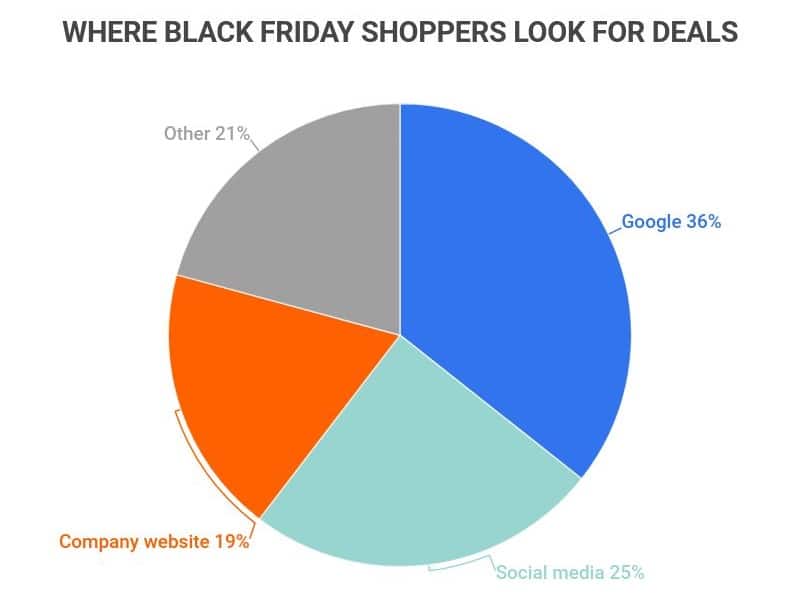
38% of Black Friday shoppers search for deals on Google.
Social media and direct company websites are also common avenues for finding discounts.
-
197.6 million Americans shopped on Black Friday in 2022.
This figure reflects the continued popularity of Black Friday among consumers.
-
The average shopper spends $450 on Black Friday.
Many consumers take advantage of significant discounts, resulting in increased spending during this shopping event.
-
60% of shoppers actively seek Black Friday deals.
This interest drives demand, reinforcing the importance of the shopping holiday.
-
78% of men plan to shop on Black Friday compared to 72% of women.
This indicates a slight edge in shopping participation among men.
-
Adults aged 35 to 44 represent the largest demographic of Black Friday shoppers.
As shown in the table below, this age group is followed closely by younger adults aged 18 to 24.
Age Range Percent 18-24 33% 25-34 25% 35-44 34% 45-54 30% 55-64 25% 65+ 24% -
40% of shoppers regret at least one purchase made on Black Friday.
With numerous discounts available, many shoppers later recognize that some purchases were not necessary.
Black Friday Statistics by Online Sales and Cyber Monday
-
60% of shoppers plan to shop online on Black Friday in 2023.
This reflects a slight increase from previous years, as more consumers favor online shopping.
-
90 million Americans shopped online on Black Friday in 2023.
This shows the growing dominance of online retail, even during a traditionally in-store focused holiday.
-
Online shopping accounted for $10 billion in sales on Black Friday in 2021, representing a significant share of total sales.
This trend highlights the increasing preference for online purchases during this key shopping period.
-
About 35% of shoppers say they plan to shop online exclusively.
This demonstrates the ongoing shift toward a more digital shopping experience.
Black Friday Statistics FAQ
-
How many people shop on Black Friday?
197.6 million Americans shopped on Black Friday in 2022. This is notable, given the adult population of the U.S. is approximately 258 million, indicating that nearly 60% of adults participated in Black Friday.
This immense turnout reinforces Black Friday’s status as a pivotal event for retailers, marking it as the busiest day for both sales volume and foot traffic in physical stores.
-
How much do shoppers spend on Black Friday?
Shoppers spend an average of $450 on Black Friday. This figure highlights the tendency for consumers to maximize their purchases when tempted by discounts.
Consequently, their spending often exceeds expectations, benefiting retailers significantly during this holiday.
-
What is the average Black Friday discount?
The average Black Friday discount is approximately 27%, with some discounts reaching 70% or 80%. Retailers leverage these discounts to attract consumers, who often respond by increasing their spending.
This reciprocal relationship allows retailers to achieve significant profits as long as their revenues surpass the cost of the discounts offered.
-
Who shops the most on Black Friday?
Adults aged 35 to 44 are the most active Black Friday shoppers. Young adults aged 18 to 24 follow closely, indicating that younger demographics are keen on taking advantage of Black Friday sales.
This age group often has the highest disposable income and a pressing need for new products, making them prime targets for retailers during this shopping holiday.
Conclusion
The statistics underscore that Black Friday continues to be a critical event for retail. It presents a unique opportunity for retailers to drive massive traffic and sales in a short window of time, allowing physical stores to compete effectively with online platforms.
As the holiday season approaches, consumers are eager to spend, whether for themselves or for gifting. By offering exceptional deals, retailers can capitalize on high consumer demand, ultimately leading to increased sales and customer loyalty.
Black Friday exemplifies how businesses can thrive by strategically discounting products. When discounts are well-calibrated, retailers can achieve greater growth and profitability.
References
-
Tidio. “Black Friday Facts & Cyber Monday Stats [Report 2023].” Accessed November 4, 2023.
-
Adobe Experience Cloud. “2023 Holiday Shopping Trends & Insights.” Accessed May 11, 2023.
-
Statista. “Holiday retail sales in the United States from 2002 to 2023.” Accessed May 11, 2023.
-
Statista. “Total retail sales in the United States from 1992 to 2023.” Accessed May 11, 2023.
-
New York Times. “Holiday Sales Soared, with e-Commerce Notching Huge Gains, a Report Says.” Accessed May 11, 2023.
-
CNBC. “Black Friday Shopping in Stores Drops 28% from Pre-Pandemic Levels as Shoppers Spread Spending Throughout the Season.” Accessed May 11, 2023.
-
CNBC. “Black Friday Shopping in Stores Craters 52% During Pandemic as e-Commerce Sales Surge.” Accessed May 11, 2023.
-
Finances Online. “78 Black Friday Statistics You Must Read: 2022/2023 Market Share & Data Analysis.” Accessed May 11, 2023.
-
The Ascent. “42% of Consumers Have Regretted Black Friday Purchases. How to Avoid Doing the Same This Year.” Accessed May 11, 2023.
-
Statista. “Share of total offline and online expenditure among Generation Z and millennial consumers in the United States during Black Friday in 2023.” Accessed May 11, 2023.

Author

Conor McMahon is a writer for Zippia, with previous experience in the nonprofit, customer service and technical support industries. He has a degree in Music Industry from Northeastern University and in his free time he plays guitar with his friends. Conor enjoys creative writing between his work doing professional content creation and technical documentation.