- HR Statistics
- Average Labor Cost Percent Of Sales
- Average Time to Reach Profitability At A Startup
- Office Space Per Employee
- Recruitment Statistics
- Employee Engagement Statistics
- Work-Life Balance Statistics
- BYOD Statistics
- Paternity Leave Statistics
- Onboarding Statistics
- Average Paid Maternity Leave In Us
- Average Cost Of A Bad Hire
- Employee Theft Statistics
- Paid Family Leave Statistics
- Cost Of Hiring Statistics
- Employee Turnover Statistics
- Average Cost Of Employer Sponsored Health Insurance Statistics
- Sexual Harassment In The Workplace Statistics
- HR Statistics
- PTO Statistics
- Social Media Recruitment Statistics
- Hiring Statistics
- Out Of Prison Employment Statistics
Research Summary. As the workplace continues to evolve, many organizations have adopted BYOD (Bring Your Own Device) policies, enabling employees to utilize their personal devices for work purposes. Here are some insightful BYOD statistics from our data analysis team:
-
75% of employees report using their personal cell phones for work tasks.
-
Experts predict that the BYOD market will reach $587.3 billion by 2030.
-
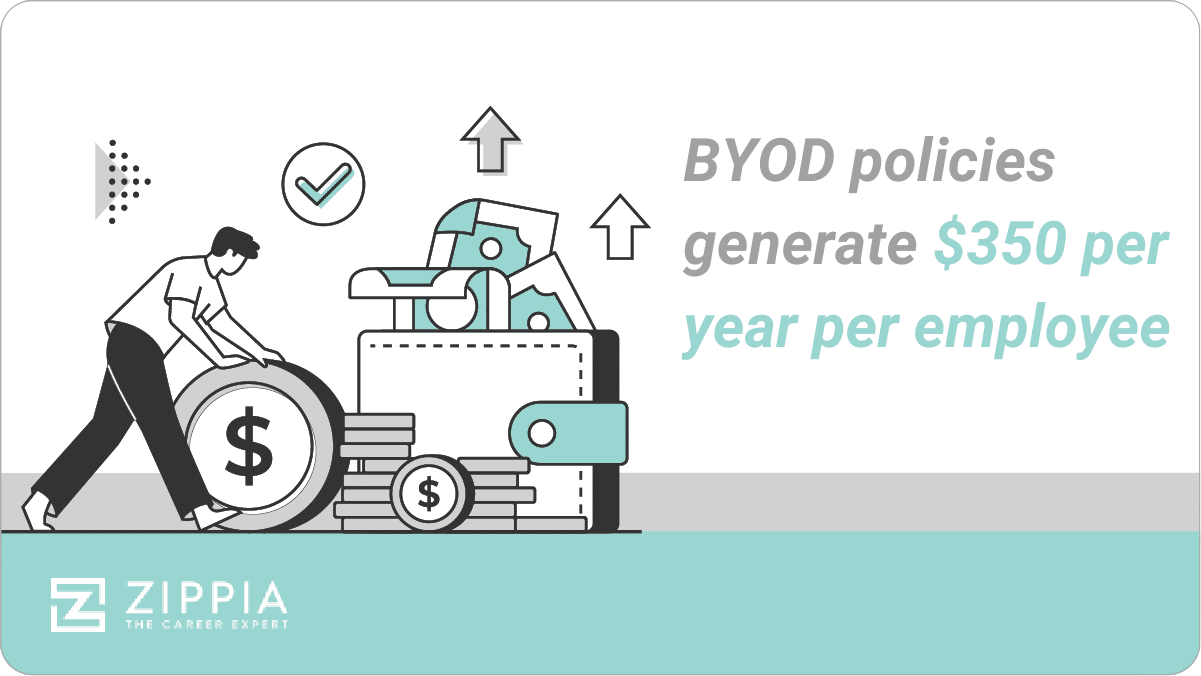
Companies generate an average of $350 in revenue annually per employee through BYOD policies.
-
On average, BYOD employees contribute an additional 2 hours of work each day.
-
83% of companies have implemented some form of BYOD policy.
For further analysis, we’ve categorized the data into the following sections:
Benefits | Challenges | Policies | Employee Insights | Trends and Predictions
General BYOD Statistics
-
80% of companies believe that mobile phones are essential for their employees’ job performance.
-
61% of companies expect their employees to be accessible off-site, regardless of whether they provide devices.
-
75% of the U.S. workforce utilized their personal cell phones for work prior to the major shifts in workplace practices.
-
66% of employees utilize smartphones as part of their work processes.
-
On average, employees use 2.5 devices for work, including computers, smartphones, tablets, and e-readers.
Benefits of BYOD Statistics
-
Respondents from a recent survey stated that their productivity increased by 34% when they began using smartphones for work.
Specifically, they noted a gain of nearly an hour during work hours and another hour during off-hours thanks to their smartphones.
-
Companies have reported earning an average of $350 per employee per year from BYOD policies.
This figure can vary based on the specific policy, the employee, and the industry, highlighting the value that mobile device usage brings to organizations.
-
Companies save approximately $250 per employee over a two-year contract with a BYOD plus stipend policy instead of providing devices.
This figure applies to mid-sized companies and tends to decrease as organization size increases.
Without a stipend, costs can rise significantly, primarily due to security management and stipends needed to assist employees with their cellular and data plans.
Challenges with BYOD Statistics
-
69% of companies with BYOD policies reported satisfaction with the productivity, collaboration, and efficiency improvements, compared to 78% for companies providing devices.
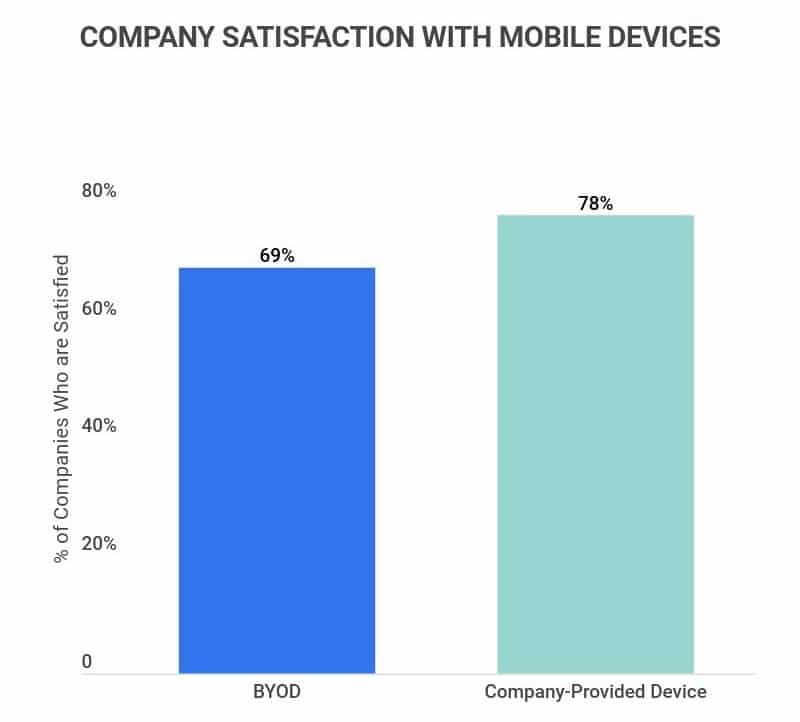
While there are clear advantages to mobile device usage, organizations that do not issue devices may experience diminished benefits.
Companies that provide devices for at least 20% of their workforce and allow BYOD for others often see the most positive outcomes.
-
Only 32% of companies mandate that employees register their personal devices with IT for security software installation.
Despite this, 50% of those surveyed acknowledged the importance of registration, which can lead to significant security and privacy risks if devices are lost.
-
Over 17% of employees use their personal mobile devices for work without informing IT.
This lack of reporting can create serious logistical and security issues, undermining the advantages of a BYOD policy.
Corporate BYOD Policy Statistics
-
71% of companies offer a stipend to cover part of employees’ BYOD mobile service plans.
This trend is growing, with some organizations covering all connectivity costs and even part of device expenses, making BYOD options more appealing while ensuring reliable service for employees.
-
83% of companies allow BYOD for at least some employees.
31% of these organizations do not provide devices for any employees, while 24% offer devices for less than 20%, and 28% for at least 20%. The remaining 17% provide devices for all employees.
-
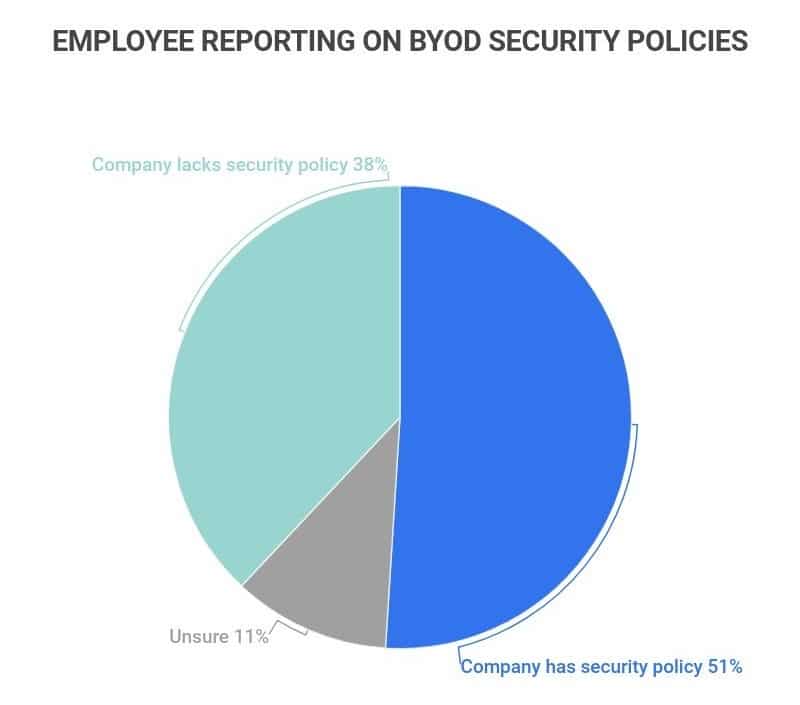
51% of employees report that their employers have defined security policies for mobile devices used for work.
37.9% indicated that their employers lack such policies, and 11.1% were unsure.
Employee BYOD Statistics
-
31% of employees prefer using personal devices for work due to the convenience of having everything in one place.
-
29.3% of employees use personal devices for work because their employer does not provide the necessary devices.
-
28.1% of employees choose to use their own devices because they are of higher quality than those provided by their employer.
-
80% of employees would prefer to keep work and personal devices separate.
-
85% of employees state that their employers secure company-issued devices, while only 49% say the same for personal devices used for work.
BYOD Trends and Predictions
-
The value of the BYOD market is projected to reach approximately $367 billion by 2026.
This marks a significant increase since it was valued at $30 billion in 2014, reflecting a compound annual growth rate (CAGR) of 15% from 2017 to 2022.
-
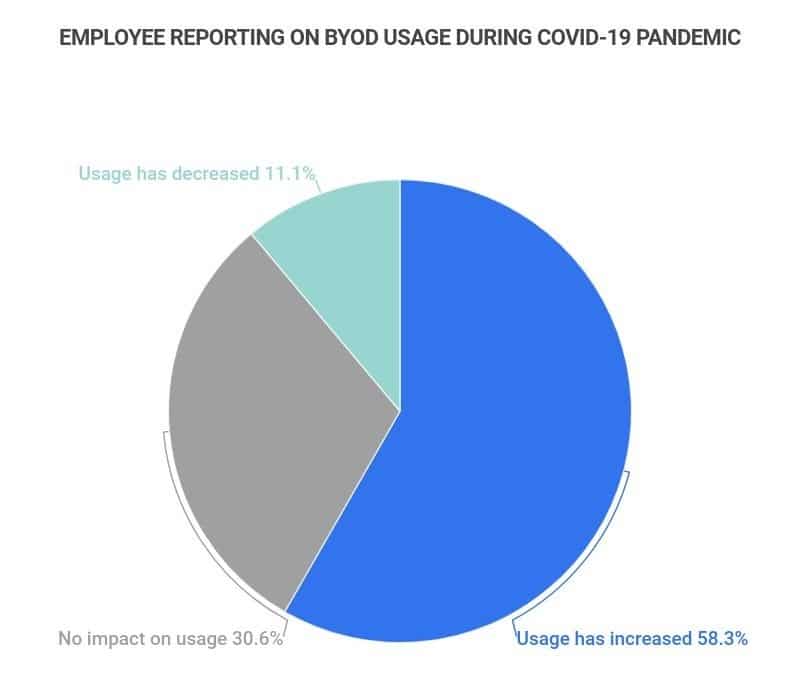
58.3% of surveyed employees indicated that their use of personal devices for work increased post-pandemic.
30.6% reported no change, while 11.1% noted a decrease in usage during this time.
-
It is anticipated that 30% of IT organizations will expand their BYOD policies to include wearable technology in the workplace.
As wearables like smartwatches gain popularity, their utility in work contexts increases, which also raises security concerns necessitating robust IT policies to protect sensitive data.
BYOD FAQ
-
BYOD is highly popular. 83% of companies have implemented some form of BYOD policy.
These policies vary; some companies provide devices for their employees, while others allow employees the choice between company-issued devices or their own, and some require employees to use their personal devices exclusively.
-
Does BYOD improve productivity?
Yes, BYOD does enhance productivity. 69% of surveyed companies expressed satisfaction with the improvements in productivity, collaboration, and timely work attributed to BYOD.
-
BYOD is favored because it saves companies money and facilitates easier employee mobility. Employees do not need to manage additional devices, and employers can avoid the costs of providing devices for all their staff.
-
Do employees prefer BYOD?
Generally, employees do not prefer BYOD. 80% of surveyed employees indicated a preference for separate personal and work devices.
Nonetheless, many still choose to use their personal devices for work due to convenience, lack of employer-provided devices, or superior quality of their personal devices. Notably, 17% do not communicate their use of personal devices to IT, posing potential security risks.
-
Is BYOD growing?
Yes, BYOD adoption is on the rise. The market is expected to continue its upward trajectory, with 83% of companies allowing some level of BYOD. IT departments are increasingly adopting BYOD, with 30% expected to include wearable technology in their policies.
The pandemic further accelerated BYOD adoption, as 58.3% of employees reported increased personal device usage for work during that period.
-
How does BYOD increase productivity?
BYOD enhances productivity by enabling seamless communication and access to work files outside the office. With personal devices always at hand, employees can remain accessible, whether at appointments or conferences. Furthermore, familiarity with personal devices can reduce the learning curve for remote work, leading to higher employee satisfaction.
However, the challenge lies in managing privacy and cybersecurity risks associated with personal devices, necessitating strong policies to safeguard data and mitigate potential breaches.
Conclusion
BYOD policies have become standard practice for 83% of organizations, though the specifics of these policies can vary widely. Employees may have the option to use company devices or be required to use their own, with varying levels of support from their employers.
The primary motivation for employees to use their personal devices is the convenience of having everything in one place, while others cite lack of employer-provided devices or superior quality of their personal devices as reasons for their choice.
Companies can save approximately $300 per employee over a two-year contract through BYOD policies, provided they implement sufficient security measures to protect sensitive data.
Despite recognizing the importance of security, only 51% of employees report being required to adhere to specific security policies, and over 17% use their personal devices without notifying IT.
The shift toward BYOD was reinforced by the pandemic, with 58.3% of employees indicating increased usage of personal devices for work during this time. The market for BYOD was already expected to grow, with a projected value of $367 billion by 2026, up from $30 billion in 2014.
References
-
Samsung. “Maximizing Mobile Value: Is BYOD Holding You Back?” Accessed on September 30, 2021.
-
Dialpad. “How To Safely Allow Employees To Use Their Personal Cell Phones for Work.” Accessed on September 30, 2021.
-
Beyond Identity. “BYOD: Exploring the Evolution of Work Device Practices in a New Remote-Forward Era [Survey].” Accessed on September 30, 2021.
-
Insights. “Employees Say Smartphones Boost Productivity by 34 Percent: Frost Sullivan Research.” Accessed on September 30, 2021.
-
Cisco. “New Analysis: Comprehensive BYOD Implementation Increases Productivity, Decreases Costs.” Accessed on September 30, 2021.
-
Socialbarrel. “Great Tips for a Successful BYOD Implementation.” Accessed on September 30, 2021.
-
BetaNews. “Growth of BYOD Proves It’s No Longer an Optional Strategy.” Accessed on September 30, 2021.
-
Gartner. “Gartner Unveils Top Predictions for IT Organizations and Users in 2020 and Beyond.” Accessed on September 30, 2021.
- HR Statistics
- Average Labor Cost Percent Of Sales
- Average Time to Reach Profitability At A Startup
- Office Space Per Employee
- Recruitment Statistics
- Employee Engagement Statistics
- Work-Life Balance Statistics
- BYOD Statistics
- Paternity Leave Statistics
- Onboarding Statistics
- Average Paid Maternity Leave In Us
- Average Cost Of A Bad Hire
- Employee Theft Statistics
- Paid Family Leave Statistics
- Cost Of Hiring Statistics
- Employee Turnover Statistics
- Average Cost Of Employer Sponsored Health Insurance Statistics
- Sexual Harassment In The Workplace Statistics
- HR Statistics
- PTO Statistics
- Social Media Recruitment Statistics
- Hiring Statistics
- Out Of Prison Employment Statistics

Author

Chris Kolmar is a co-founder of Zippia and the editor-in-chief of the Zippia career advice blog. He has hired over 50 people in his career, been hired five times, and wants to help you land your next job. His research has been featured on the New York Times, Thrillist, VOX, The Atlantic, and a host of local news. More recently, he's been quoted on USA Today, BusinessInsider, and CNBC.