- Workplace Statistics
- Time Management Statistics
- Employee Wellness Statistics
- Employment Discrimination Statistics
- Employee Recognition Statistics
- Employee Referral Statistics
- Workplace Violence Statistics
- Gamification Statistics
- Employee Feedback Statistics
- Agile Statistics
- Productivity Statistics
- Meeting Statistics
- Cell Phones At Work Statistics
- Social Media At Work Statistics
- Workplace Injury Statistics
- Workplace Stress Statistics
- Leadership Statistics
- Workplace Collaboration Statistics
- Job Satisfaction Statistics
- Paid Holiday Statistics
- Communication In The Workplace Statistics
- Wasting Time At Work Statistics
- 4-day Workweek Statistics
43 Incredible Job Satisfaction Statistics [2026]: Average Job Satisfaction In The US
Job Satisfaction Research Summary. As the economy continues to evolve, many Americans remain satisfied with their jobs, despite ongoing changes in the labor market.
However, it is essential to differentiate between general satisfaction and genuine passion for one’s work. This article will explore the current landscape of job satisfaction in the United States.
After thorough data analysis, our team has uncovered the following insights:
-
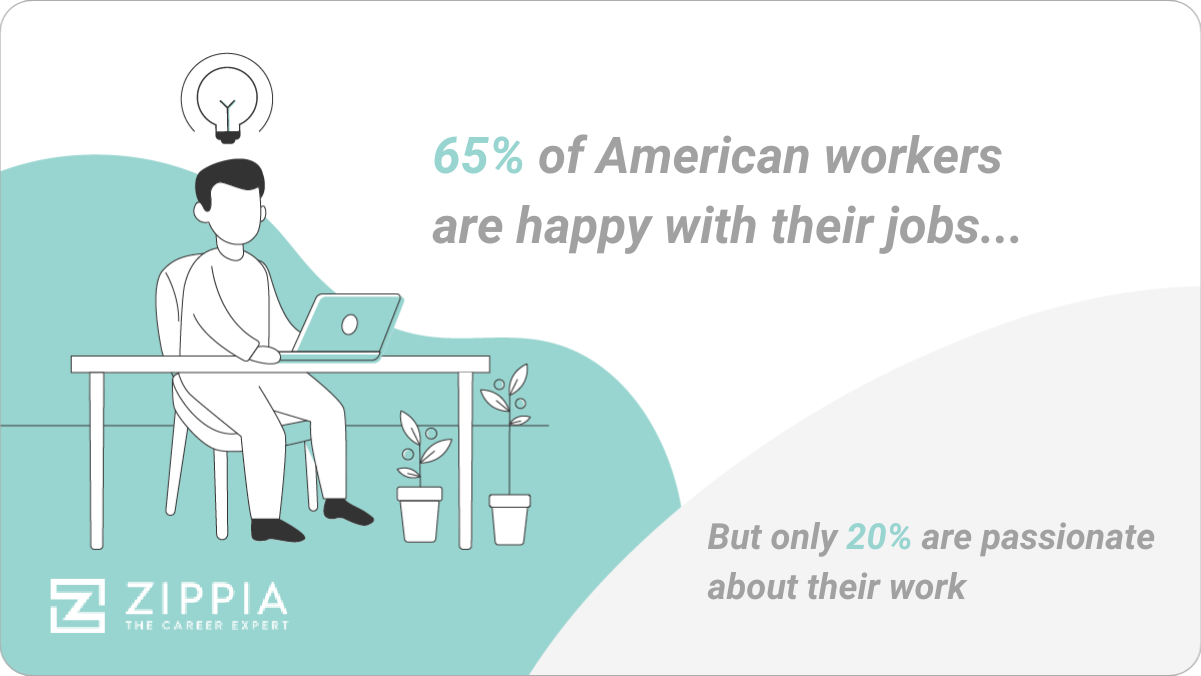
65% of U.S. workers express satisfaction with their jobs.
-
Only 20% report being truly passionate about their roles.
-
Furthermore, only 49% of American workers indicate they are “very satisfied” with their jobs, while 30% are “somewhat satisfied.”
-
More than 100 million U.S. workers feel at least somewhat satisfied with their employment.
-
The primary reason for dissatisfaction among Americans is income—only 28% of those earning less than $24,000 annually consider their jobs to be good.
-
Remote workers report higher job satisfaction levels compared to in-office employees, with a difference of 57% to 50%.
-
61% of American employees are considering leaving their current jobs in 2026.
For more in-depth analysis, we categorized the data as follows:
Company | Age | Compensation | Productivity | Factors
Job Satisfaction by Profession
Job satisfaction is influenced not only by income but also by the type of job. Many positions in public service or the humanities, despite lower pay, report high satisfaction rates, which is often linked to a sense of “meaning” in their work. Here’s the breakdown:
-
Only 20% of Americans consider themselves truly passionate about their work.
Despite the reported job satisfaction, there is a notable lack of workplace passion across the U.S.
Consequently, businesses are increasingly investing to attract job seekers who are passionate about their work and genuinely wish to contribute.
-
The most meaningful jobs are typically in Healthcare or Humanities.
Positions with over 90% of employees reporting high meaning include: Clergy, English Language and Literature Teachers, Surgeons, Elementary Education Administrators, Radiation Therapists, Chiropractors, Psychiatrists, Anesthesiologists, Rehabilitation Counselors, Occupational Therapists, Kindergarten Teachers, and Epidemiologists.
-
High job satisfaction correlates with “high meaning” and income.
All jobs with high satisfaction rates provide either a high salary or a sense of high meaning. Here are jobs where over 85% of employees report job satisfaction: Clergy, Education Administrators, Radiation Therapists, Pediatricians, Cartographers and Photogrammetrists, Rotary Drill Operators, Emergency Management Specialists, and Chief Executives.
-
Pediatricians and Chief Executives often derive satisfaction from their income.
While there are other roles with greater meaning rates than Pediatricians (88%) and Chief Executives (74%), both still report satisfaction rates exceeding 85%. This is likely due to their higher-than-average incomes, with Pediatricians earning $149,000 annually and Chief Executives $126,000.
-
Clergy members report the highest job satisfaction rate (90%).
The high sense of meaning significantly enhances satisfaction for those in this profession.
-
One-third of those earning less than $25,000 have job satisfaction rates below 50%.
Low income negatively impacts job satisfaction. Workers making less than $25,000 annually often report lower satisfaction, with over one-third in this income bracket indicating satisfaction rates below 50%.
Jobs with lower incomes and satisfaction rates of 50% or less include: Hand Packers and Packagers, Fast Food Cooks, Cashiers, Photographic Processing Machine Operators, Short Order Cooks, Parking Lot Attendants, Dishwashers, Cafeteria Attendants, and Dry-Cleaning Workers.
-
Employees express dissatisfaction due to a lack of meaning.
Among positions where less than 30% of employees report their work having high meaning, very few achieve job satisfaction rates above 70%. In fact, out of 22 jobs with high meaning rates below 30%, 16 report satisfaction levels below 60%.
-
Parking lot attendants face significant challenges.
With an average income of just $19,700 and a meaning rate of only 5%, it is unsurprising that Parking Lot Attendants have a low job satisfaction rating of 41%.
-
Cafeteria attendants and dry-cleaning workers report the lowest job satisfaction levels.
Both roles have a notably low job satisfaction rate of just 39%.
Job Satisfaction by Company
The type of company an employee works for significantly affects job satisfaction. Here are key findings regarding company-related job satisfaction:
-
Organizational culture impacts job satisfaction by 42%.
A company’s mission and culture play a substantial role in satisfaction rates. Research indicates that clear company expectations can significantly enhance job satisfaction.
-
Remote work increases satisfaction by at least 7%.
Companies offering remote work options tend to have higher satisfaction rates, as remote employees are, on average, 7% more satisfied with their jobs.
-
U.S. employee engagement remains low, ranging from 30-40%.
In recent years, U.S. employee engagement has fluctuated, with a staggering 51% of employees reporting they are “not engaged” at work.
-
Americans prefer working from home—60% feel more relaxed at home than in the office.
60% of remote employees report feeling “less stressed,” and 66% consider themselves more productive.
-
Job satisfaction is lower in private companies by nearly 25%.
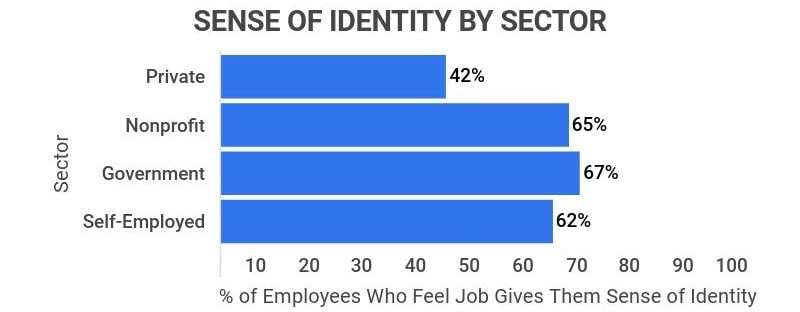
Only 42% of Americans state that their corporate or private positions provide a sense of identity, which significantly impacts job satisfaction.
-
Nonprofit, government, and self-employed roles show similar satisfaction stats.
In terms of identity, these jobs are comparable: Nonprofit (65%), Government (67%), and Self-employed (62%).
Job Satisfaction by Age
Age significantly influences job satisfaction, often due to factors such as education and experience. Here’s what we found about age and job satisfaction:
-
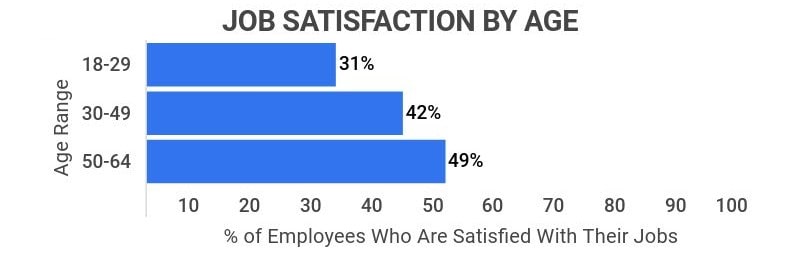
Young adults report the lowest satisfaction, with only 31% feeling completely satisfied with their jobs.
Among respondents aged 18-34, only 31% report complete job satisfaction, while 16% express dissatisfaction.
-
Workers aged 50-64 are the most satisfied, with 49% reporting complete satisfaction.
63% of respondents in this age group view their job as a career, with 49% completely satisfied.
-
Job satisfaction tends to increase with age, rising nearly 20% over time.
Job satisfaction generally improves with age; only 26% of those aged 18-29 consider their job a career, while 60% of those aged 30-49 do.
Job satisfaction is 31% for 18-34-year-olds, increasing to 42% for those aged 30-49, and peaking at 49% for 50-64-year-olds.
-
Job satisfaction declines for those aged 65 and older as they seek retirement.
After age 64, job satisfaction begins to drop again, with 38% of those 65 and older working merely to “get by.”
-
Employees with a bachelor’s degree feel 30% more prepared for career advancement than those with a high school diploma.
67% of employees holding a bachelor’s degree or higher feel their job is secure, compared to 59% with only a high school diploma. Additionally, 69% of college graduates feel equipped with the tools to advance in their field, compared to just 39% of non-degree holders.
Job Satisfaction by Compensation
Understanding how compensation influences job satisfaction is crucial. While higher-paying jobs generally yield increased satisfaction, the relationship is nuanced. Here’s what we found:
-
Jobs paying over $75,000 annually have an average job satisfaction rate of 59%.
While higher salaries typically correlate with increased satisfaction, this isn’t a straightforward relationship. For instance, surgeons—earning an average of $304,000 annually—report a job satisfaction rate of only 83%. Overall, jobs paying above $75,000 have an average satisfaction rate of 59%, indicating that significant pay raises beyond this threshold have diminishing returns on satisfaction.
-
Job satisfaction is lower for those earning below $30,000 annually.
Financial struggles contribute to lower satisfaction; only 39% of employees earning below $30,000 annually report satisfaction, even when jobs are meaningful. Most in this income bracket report satisfaction rates below 75%.
-
54.2% of American employees would consider leaving their current job for a pay raise.
Raises are a significant motivator, with over half (54.2%) of employees indicating they would leave their current job for a pay increase.
-
Salaried workers report a higher job satisfaction rate of 41%, compared to 29% for hourly workers.
While only 29% of hourly workers express satisfaction, that figure rises to 41% for salaried employees.
Job Satisfaction and Productivity
If you’re wondering about the significance of job satisfaction, productivity in the workplace is a critical factor. On average, satisfied employees are more productive. Here are the findings:
-
Unhappy employees cost the U.S. economy at least $550 billion annually.
The U.S. incurs an estimated loss of $550 billion each year due to unhappy employees. For the average company, this translates to 18% lower productivity and 15% reduced profitability.
-
Satisfied employees are on average 13% more productive.
Higher employee satisfaction leads to increased productivity. In turn, this translates into greater output for the same cost. For example, top U.S. companies are estimated to achieve up to 40% higher productivity than smaller firms, resulting in operating margins 30%-50% greater than their competitors.
-
Satisfaction can indirectly influence employee turnover.
Given that the primary reasons for employee turnover include a desire for higher pay and opportunities for career advancement, job satisfaction can impact turnover rates. Higher satisfaction generally correlates with lower turnover.
-
Over half of Americans are considering job changes.
As of 2026, approximately 52% of employees are contemplating changing jobs, with 44% already in the process. At least 15% of Americans report feeling at least somewhat dissatisfied with their current roles.
Important Factors of Job Satisfaction
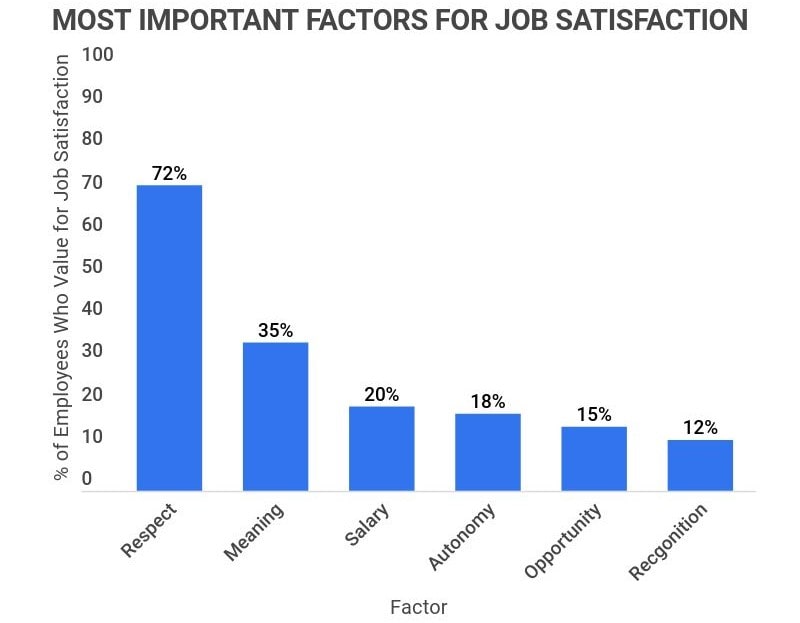
Numerous factors influence job satisfaction, and now that we’ve discussed many, here are additional critical elements: Respect (72%), Meaningfulness (35%), Salary (20%), Autonomy (18%), Opportunity (15%), and Recognition (12%).
-
Respect (72%), meaningfulness (35%), salary (20%), autonomy (18%), opportunity (15%), and recognition (12%) are the most significant contributors to job satisfaction.
-
Health benefits (45%), vacation/PTO (38%), 401k or retirement plans (37%), and paid parental leave (20%) are the most valued employee benefits.
-
Employees earning $75,000 or more report higher job satisfaction compared to those making less than $30,000.
-
Potential for growth and job satisfaction often correlate with age, as younger individuals (18-34) and older employees (65+) are more likely to feel their jobs are “just to get by.” For instance, 38% of those aged 65 and older report working just to survive, compared to 25% of those aged 30-49.
-
Many part-time jobs are perceived as “dead-end” positions, with up to 7 million Americans trapped in such roles, often leading to dissatisfaction.
-
Only 20% of Americans are passionate about their work. While this is unfortunate, it doesn’t heavily impact overall job satisfaction.
-
Jobs with 90% or more respondents reporting “high meaning” typically have satisfaction rates of at least 70% or higher.
-
On average, 37% of Americans fear job loss due to outsourcing or automation.
-
Respect is increasingly important, with a recent survey from the Society for Human Resource Management indicating that 72% of employees rank respectful treatment as a key factor in job satisfaction.
Job Satisfaction FAQ
-
Why does employee satisfaction matter?
Employee satisfaction is crucial because satisfied employees tend to be more productive. Although no state or federal law mandates a specific level of job satisfaction, it significantly impacts performance, commitment, energy levels, and mental health.
-
How do I improve job satisfaction at my company?
You can enhance job satisfaction by addressing factors employees value most. For example, boosting respect (72%), meaningfulness (35%), autonomy (18%), and opportunities (15%) can lead to significant improvements. Additionally, increasing salary or benefits can also be effective.
-
How do you measure job satisfaction in the workplace?
One of the easiest methods for measuring job satisfaction is through employee surveys. These can be annual questionnaires assessing employee attitudes and providing valuable data. Surveys also offer employees a chance to express their needs for higher job satisfaction.
-
Why might I lack job satisfaction?
Several common factors could be impacting your job satisfaction. These may include:
-
Poor working conditions
-
Excessive working hours
-
Low pay
-
Lack of recognition
-
Limited promotion opportunities
While changing jobs isn’t always the solution, some issues can be addressed through personal reflection or by communicating with your manager. However, if you find yourself completely unhappy at work, exploring other opportunities for more satisfying roles is a valid option.
-
-
What percentage of people like their jobs?
65% of people report liking their jobs. However, only 20% of U.S. employees say they are passionate about their work. This suggests that many jobs that might not provide a strong sense of meaning still offer sufficient income to be deemed satisfactory.
Conclusion
Job satisfaction in the U.S. appears to be variable, with some reports indicating high levels while others highlight concerning trends. Much of this variability can be attributed to the diverse factors influencing job satisfaction.
While higher salaries often correlate with increased job satisfaction, they do not always guarantee it. Factors such as meaningfulness, respect, age, job type, and more play significant roles.
Ultimately, measuring job satisfaction can be complex, but trends suggest that increased respect and meaning, along with improved benefits and competitive salaries, consistently enhance job satisfaction.
References
-
Pew Research Center. “How Americans view their jobs | Pew Research Center.” Accessed on August 8, 2021.
-
Gallup. “ U.S. Worker Satisfaction With Job Safety Down Amid COVID .” Accessed on August 8, 2021.
-
Payscale. “ Most and Least Meaningful Jobs Full List – PayScale.” Accessed on August 8, 2021.
-
Google Books. “INCEESS 2020: Proceedings of the 1st International Conference on Economics.” Accessed on August 8, 2021.
-
Gallup. “ U.S. Employee Engagement Reverts Back to Pre-COVID-19 Levels .” Accessed on August 8, 2021.
-
Pew Research Center. “Chapter 5: Young Adults at Work | Pew Research Center.” Accessed on August 8, 2021.
-
Gallup. “ Does Job Satisfaction Really Improve With Age? .” Accessed on August 8, 2021.
-
Gallup. “ Hourly Workers Unhappier Than Salaried on Many Job Aspects .” Accessed on August 8, 2021.
-
Forbes. “How Much Are Your Disengaged Employees Costing You?.” Accessed on August 8, 2021.
-
Justworks. “6 Surprising Statistics About Benefits Employees Want | Justworks.” Accessed on August 8, 2021.
-
CNN Money. “What do employees want most? R-E-S-P-E-C-T .” Accessed on August 8, 2021.
-
Career Vision. “Job Satisfaction Statistics – Career Vision.” Accessed on August 8, 2021.
-
Phys.org. “Happy workers are 13% more productive.” Accessed on August 8, 2021.
-
Fast Company. “How many workers plan to change jobs in 2021?.” Accessed on August 8, 2021.
-
CNBC. “Here is what makes workers the happiest at every age.” Accessed on August 8, 2021.
-
CUNY Academic Works. “ “7 Million Americans Can’t Escape ‘Dead End’ Jobs” by Patrick Gillespie .” Accessed on August 8, 2021.
-
CNBC. “ “Gen Z and millennials are leading ‘the big quit’ in 2023 — why nearly 70% plan to leave their jobs.” Accessed on February 6, 2023.
- Workplace Statistics
- Time Management Statistics
- Employee Wellness Statistics
- Employment Discrimination Statistics
- Employee Recognition Statistics
- Employee Referral Statistics
- Workplace Violence Statistics
- Gamification Statistics
- Employee Feedback Statistics
- Agile Statistics
- Productivity Statistics
- Meeting Statistics
- Cell Phones At Work Statistics
- Social Media At Work Statistics
- Workplace Injury Statistics
- Workplace Stress Statistics
- Leadership Statistics
- Workplace Collaboration Statistics
- Job Satisfaction Statistics
- Paid Holiday Statistics
- Communication In The Workplace Statistics
- Wasting Time At Work Statistics
- 4-day Workweek Statistics

Author

Jack Flynn is a writer for Zippia. In his professional career he’s written over 100 research papers, articles and blog posts. Some of his most popular published works include his writing about economic terms and research into job classifications. Jack received his BS from Hampshire College.