15+ Surprising Late For Work Statistics [2026]: How Often + Why Are Americans Late For Work?
Late for work research summary. Arriving late to work can be a source of anxiety for some, while for others, it may be a frequent occurrence. Regardless, we can all agree that unexpected traffic delays are frustrating. As workplace dynamics evolve, so do the reasons behind tardiness.
This article explores the latest insights into employee lateness in the US. Here are some key findings from our research:
-
29% of employees admit to being late to work at least once per month.
-
25% of Americans report being late due to traffic.
-
6% of hourly workers are late to work on average.
-
Employees who are late to work cost the US an average $3 billion annually.
For further analysis, we broke down the data in the following ways: Frequency of Lateness | Cost of Employee Tardiness and Absenteeism | Opinions on Punctuality
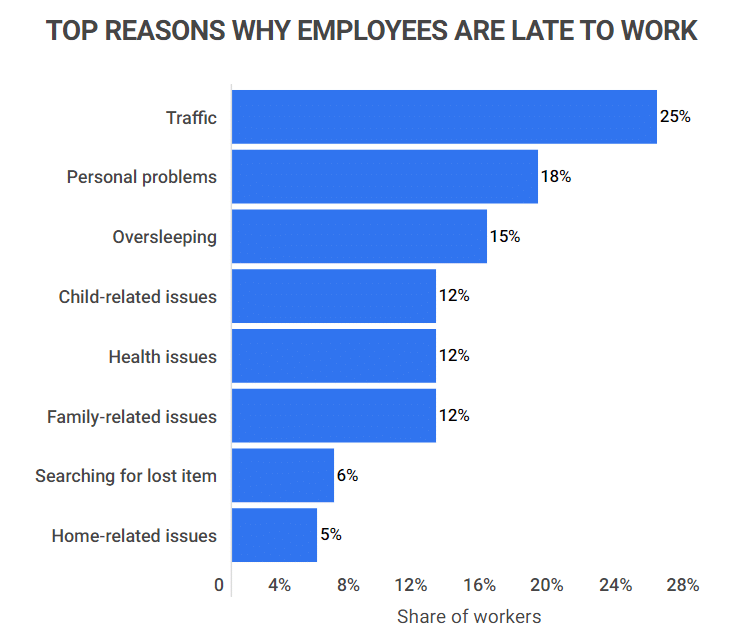
Reasons Employees Are Late to Work
There are many factors that can contribute to an employee’s lateness. While traffic remains the most common reason, you’ll find other surprising causes:
Top Reasons Employees Are Late to Work
| Reason for tardiness | Share of workers |
|---|---|
| Traffic | 25% |
| Personal problems | 18% |
| Oversleeping | 15% |
| Child-related issues | 12% |
| Health issues | 12% |
| Family-related issues | 12% |
| Searching for lost items | 6% |
| Home-related issues | 5% |
-
Traffic remains the leading cause for tardiness, with 25% of respondents citing it.
A quarter of employees find themselves late due to traffic congestion, with personal issues being the next leading cause at 18%.
-
Employees are three times more likely to be late due to oversleeping than home-related issues.
Interestingly, oversleeping ranks as the third most frequent cause of lateness, suggesting a need for improved sleep habits.
-
The average tardy employee arrives 21 minutes late.
This is significantly beyond the typical grace period of 5-7 minutes that most employers are willing to accept.
Lateness by Frequency
Lateness isn’t uniformly distributed among employees; some are late more often than others. Here are some key insights into the frequency of tardiness among American workers:
-
19% of employees are regularly late for work.
Nearly one in five employees are late at least once a week, which can have significant repercussions for both employers and the economy.
-
Around 20% of workers arrive 10 minutes late at least twice a week.
This frequency, while slightly better than the average of 21 minutes, still indicates a concerning trend with potential annual implications.
-
Workers aged 18 to 34 are the most likely to be late, with 13% being late a few times per week.
In contrast, only 8% of those aged 55 and older experience lateness a few times a week, with 55% of them never arriving late (compared to 38% of younger workers).
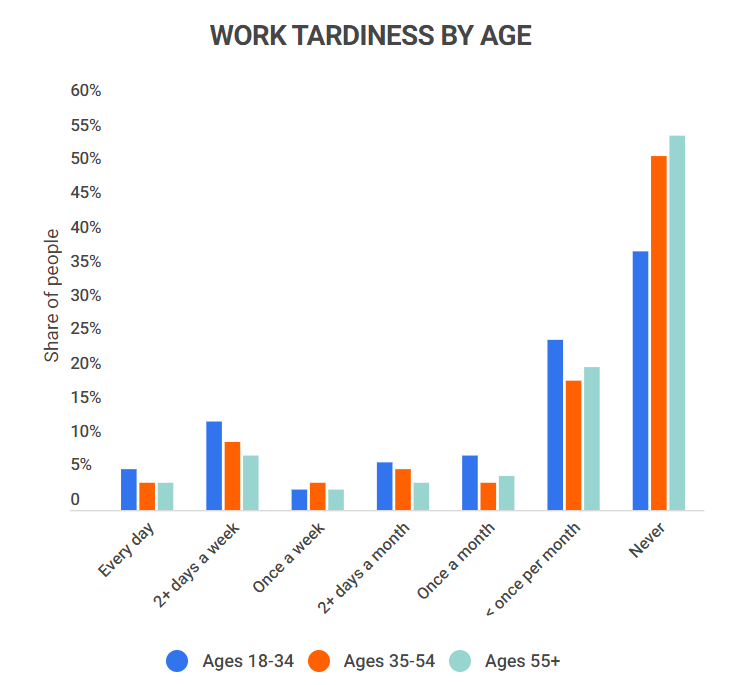
Work Tardiness by Age
Frequency of Tardiness Ages 18-34 Ages 35-54 Ages 55+ Every day 6% 4% 4% A few times per week 13% 10% 8% Once a week 3% 4% 3% A few times per month 7% 6% 4% Once a month 8% 4% 5% Less than once per month 25% 19% 21% Never 38% 52% 55% -
9.6% of shifts have at least one late employee.
This statistic highlights that nearly 1 in 10 shifts experience tardiness, which can negatively impact both productivity and employee morale.
-
The most common time for employees to be late is between 6 a.m. and noon.
Early morning shifts pose a challenge, often due to oversleeping or other morning routines that lead to lateness.
Cost of Employees Being Late to Work
Employee tardiness is costly, impacting businesses and the overall economy. Here are the key financial implications:
-
The average cost of lateness per employee ranges from $500 to $600 annually.
For a company with 500 employees, if 20% are regularly late, this could lead to costs exceeding $50,000 per year.
-
41% of employers have terminated an employee due to lateness.
Replacing a tardy employee can be expensive, averaging about 20% of their annual salary, which adds to the overall costs associated with lateness.
Opinions on Punctuality
While being late to work is generally frowned upon, opinions on its significance vary among employers and employees. Here’s what the data reveals:
-
18% of employers don’t prioritize punctuality as long as work gets done.
This perspective may inadvertently encourage tardiness, exacerbating the associated costs.
-
59% of employees view the traditional 9 to 5 schedule as outdated.
With the rise of remote work, many employees prefer flexible working hours that suit their lifestyles better.
Late for Work FAQ
-
What percentage of people are late for work?
52% of people experience lateness at least once a month or more frequently. Regularly, 29% of employees are late at least once each month, and 19% are consistently late to work.
The average tardy employee is 21 minutes late, which poses challenges for many employers.
-
What percentage of employers have fired someone for being late?
41% of employers have terminated employees due to tardiness. While this figure is substantial, it could be higher given the frequency of lateness among employees.
Many employers, however, adopt a more lenient stance, with 18% stating they prioritize work completion over punctuality.
-
What happens when an employee is consistently late for work?
Employees who are frequently late may face warnings or disciplinary action, depending on company policies. Larger organizations may be stricter regarding punctuality compared to smaller businesses, which may vary in their leniency.
-
How late is acceptable at work?
Most employers allow a grace period of 5-7 minutes for lateness. However, with an average lateness of 21 minutes, this may not be sufficient for some employees.
Additionally, around 20% of employers report that staff arrive 10 minutes late at least twice a week, which exceeds the typical grace period.
Conclusion
Late arrivals can significantly affect not only the workplace but also individual careers. Despite the challenges posed by tardiness, it remains a prevalent issue.
With 29% of employees being late at least once per month and around 20% arriving 10 minutes late multiple times a week, the implications are considerable. While some employers may overlook this behavior, 41% have taken action by terminating employees for tardiness.
Ultimately, employee lateness represents a substantial cost to the US economy, amounting to billions annually. Whether solutions lie in embracing flexible work arrangements or enhancing personal time management skills remains to be seen.
References
-
CBS News – Late For Work? 1 In 4 Employees Say At Least Once A Month, Cite Traffic, Oversleeping
-
Business News Daily – The Real Reasons Employees Are Late to Work
-
KERI Systems – How Much Does Employee Lateness Cost your Business?
-
HCP – True Cost of Firing an Employee: Saying ‘You’re Fired!’ Could Cost You
-
98.1 The Hawk – Employers Chime in on Employees Showing up Late for Work

Author

Jack Flynn is a writer for Zippia. In his professional career he’s written over 100 research papers, articles and blog posts. Some of his most popular published works include his writing about economic terms and research into job classifications. Jack received his BS from Hampshire College.