15+ Compelling Motivation Statistics [2026]: How Motivation Drives Business Success
Motivation research summary. If you’ve ever felt your energy wane on a Friday afternoon, you understand the profound impact motivation has on work performance. Motivation is crucial, often outweighing salary considerations, and businesses are continuously seeking innovative strategies to enhance it.
For employers and job seekers alike, understanding the dynamics of motivation in the workplace is essential. We’ve compiled the latest motivation statistics, and our findings reveal:
-
Motivated employees are 87% less likely to resign.
-
Motivated employees exhibit 17% higher productivity levels.
-
Motivated teams can boost business profitability by 21%.
-
Employees are 4.6x more likely to feel empowered to excel when their voices are acknowledged.
For deeper insights, explore our sections on: How to Motivate Employees | Motivation and Retention | Cost of Demotivation
How to Motivate Employees
While understanding that motivated employees yield better results is valuable, knowing how to inspire your team is crucial. Here are some statistics that illustrate effective motivational strategies:
-
77.9% of employees state they would exert more effort if they received greater appreciation.
Yet, 39% of employees report feeling unappreciated, highlighting a significant gap that can adversely affect productivity.
-
Employees are 2.7x more likely to be highly engaged when they anticipate recognition for their contributions.
Highly engaged employees show 21% higher productivity and are 28% less likely to commit internal theft compared to those with low engagement. This underscores the importance of recognition.
-
83.6% of employees consider recognition a strong motivator.
Most employees agree that recognition significantly motivates them, emphasizing the need for employers to implement recognition practices.
-
80% of employees find well-defined goals and objectives motivating.
Employers can enhance performance by 20-25% simply by establishing clear goals and objectives.
-
20% of employees prioritize opportunities for advancement over salary increases.
Specifically, employees indicated they would choose a title promotion over a 3% pay raise, illustrating the value of career progression.
-
37% of employees believe managers who praise their colleagues contribute more positively to the workplace.
This sentiment is especially strong in remote work environments, with 64% of employees emphasizing its importance in virtual settings.
Motivation and Retention
High turnover rates challenge many employers, and motivated employees are significantly more likely to remain with their organizations. Here are key statistics illustrating the connection between motivation and retention:
-
96% of employees believe increased empathy would enhance retention.
Empathy is vital for motivation and retention, with 86% asserting it boosts morale and 87% considering it essential for fostering an inclusive workplace.
-
30% of employees are contemplating leaving their jobs for better offers.
Despite a slight decline in quit rates, many workers still consider new opportunities. Motivation plays a pivotal role in this decision-making process.
-
69% of employees state that recognition and rewards would encourage them to stay in their roles.
Recognition and rewards rank as the second most significant factor in job retention, following the desire for engaging work (74%).
-
66% of employees are motivated to remain in jobs with incentive programs.
Of these, 85% prefer programs tailored to individual preferences, demonstrating the effectiveness of personalized approaches.
-
Motivation can reduce employee turnover by 18%.
Motivated employees are not only less likely to leave but also experience 81% lower absenteeism rates.
Cost of Demotivation
Demotivation can have dire consequences for both employees and businesses. Reduced productivity and increased turnover can significantly impact a company’s financial health. Here are some revealing insights:
-
Unmotivated workforces cost the global economy $8.8 trillion annually.
This figure accounts for 9% of global GDP, surpassing the combined GDP of Japan and Germany (the 3rd and 4th largest economies).
-
Demotivated employees report 37% higher absenteeism rates.
This statistic underscores the correlation between job dissatisfaction and workplace attendance.
-
A culture of recognition can save a company with 10,000 employees $16.1 million annually in turnover costs.
As company size increases, so do the costs associated with unmotivated employees, highlighting the financial benefits of fostering a positive workplace culture.
Motivation FAQ
-
What motivates employees the most?
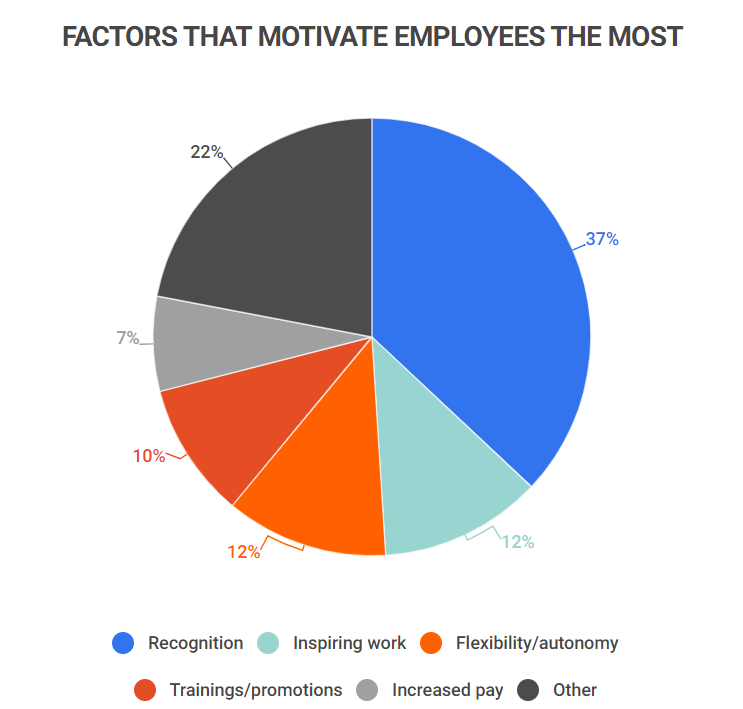
Recognition is the primary motivator, with 37% of employees citing it as the most important. Other significant motivators include inspiring work and flexibility/autonomy, each identified by 12% of employees.
Factors that Motivate Employees the Most
Factor Share of Employees Ranking It as Most Important Recognition 37% Inspiring work 12% Flexibility and autonomy 12% Training and promotion opportunities 10% Increased pay 7% Other 22% -
Why is motivation important at work?
Motivation is vital in the workplace for numerous reasons, including enhancing productivity and reducing turnover. Here are the primary reasons motivation is essential:
-
Increases productivity
-
Boosts profitability
-
Enhances retention
-
Decreases turnover
-
Reduces absenteeism
-
-
Who is responsible for employee motivation?
Employers, particularly managers, hold the primary responsibility for motivating employees. While self-motivation is important, employers significantly influence motivation levels through recognition, flexibility, and opportunities for advancement.
Conclusion
Motivation remains a fundamental element in driving productivity and retention, with employees increasingly prioritizing it in their workplace choices. Motivated employees are 87% less likely to resign, and nearly 78% express a willingness to work harder with greater recognition.
Despite this, many organizations struggle to effectively motivate their teams. Unmotivated employees contribute to a staggering $8.8 trillion loss in the global economy annually, with large companies facing turnover costs exceeding $16 million each year due to demotivation.
To address these challenges, employers must invest in recognition programs, flexible work arrangements, and opportunities for professional development. By implementing these strategies, organizations can enhance motivation, reduce turnover, and improve overall productivity.
References
-
Ceridian – Employee Engagement vs. Employee Satisfaction: How Are They Different?
-
Cooleaf – 5 Tips for Running a Successful Employee Recognition Program
-
SHRM – Better Pay and Benefits Loom Large in Job Satisfaction
-
Forbes – 10 Timely Statistics About The Connection Between Employee Engagement And Wellness
-
Flexjobs – Great Resignation: Survey Finds 1 in 3 Are Considering Quitting Their Jobs
-
Gallup – Employee Engagement Strategies: Fixing the World’s $8.8 Trillion Problem
-
GFoundry – Lack of Motivation at Work: Causes & Solutions

Author

Jack Flynn is a writer for Zippia. In his professional career he’s written over 100 research papers, articles and blog posts. Some of his most popular published works include his writing about economic terms and research into job classifications. Jack received his BS from Hampshire College.