Find a Job You Really Want In
Quick Facts
Meetings often frustrate employees.
While they can facilitate project advancement and align company objectives, many meetings fail to be productive, leaving participants questioning, “Could this have been an email?”
The shift to virtual meetings has introduced various challenges. From technical difficulties to the discomfort of seeing one’s own face on screen, and the unintentional insights into coworkers’ home lives, virtual meetings can often be less than enjoyable.
To gain insight into employee sentiments regarding virtual meetings, Zippia surveyed nearly 2,000 workers.
Read on to discover what employees dislike most about virtual meetings (Spoiler alert: the list is extensive), and how camera usage impacts participant behavior.
Other Findings
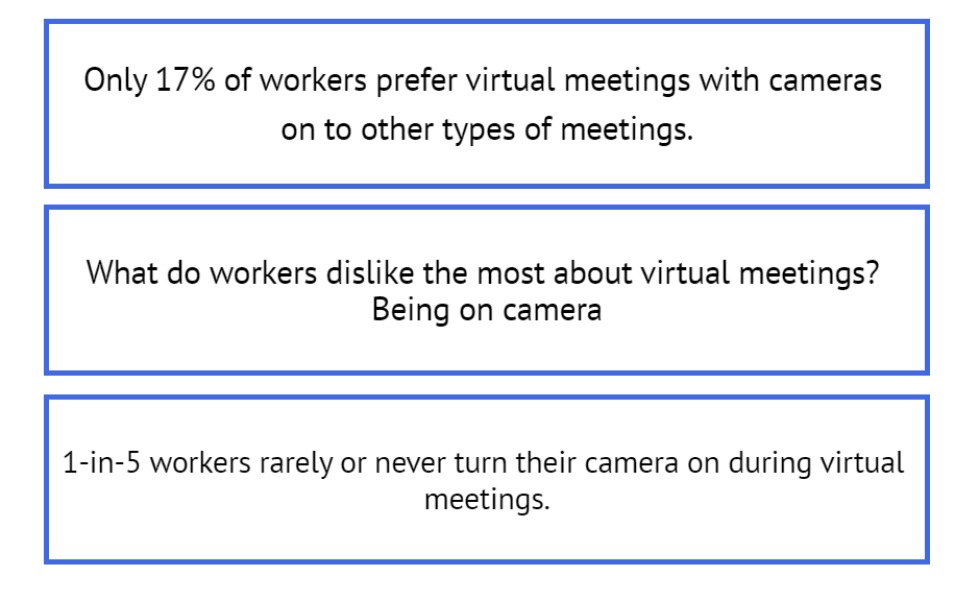
- Only 20% of workers consistently turn on their cameras during virtual meetings.
- This figure is surprisingly low given that employees are twice as likely to favor virtual meetings without cameras, indicating that this trend may stem more from workplace policies than personal preferences.
- Post-meeting, workers most commonly report being annoyed by disruptions from family, pets, or roommates, as well as technical issues.
- Over 20% of participants express frustration with disengaged coworkers and those experiencing technical difficulties.
- Many employees find it challenging to stay focused and avoid distractions during virtual meetings.
- A notable 92% of workers at least “somewhat” tidy or prepare their workspace for virtual meetings.
- An audacious 8% simply turn on their cameras without any preparation.
- While the majority of workers dress professionally for virtual meetings, 10% more are fully dressed when their cameras are on.
- A small (but notable) 1% of participants admitted to attending a virtual meeting shirtless.
- 73% of workers invest more time in grooming (hair, makeup, etc.) when preparing for a meeting with cameras on.
What Do Employees Dislike About Virtual Meetings?
While being on camera is a significant grievance for 48% of participants, it’s not the sole issue.
Many employees struggle to maintain focus during virtual meetings. The second most frequent annoyance stems from household disruptions. Although technical issues and social media distractions persist, they pale in comparison to the interruptions caused by children or pets.
It’s essential to recognize that many employees transitioned to remote work unexpectedly, often lacking the ideal environment or childcare to optimize their productivity. This reality likely colors their perceptions of virtual meetings.
Additionally, many workers voiced frustrations regarding unengaged colleagues and technical difficulties experienced by others.
Other Common Virtual Meeting Grievances
- Feels performative
- Tiring
- Lack of body language/eye contact
- Less effective communication
- Boring
Overall, while many have adapted to virtual meetings, there remains a strong desire for in-person interaction.
Do Workers Dress Differently in Virtual Meetings When the Camera Is On Versus When It’s Off?
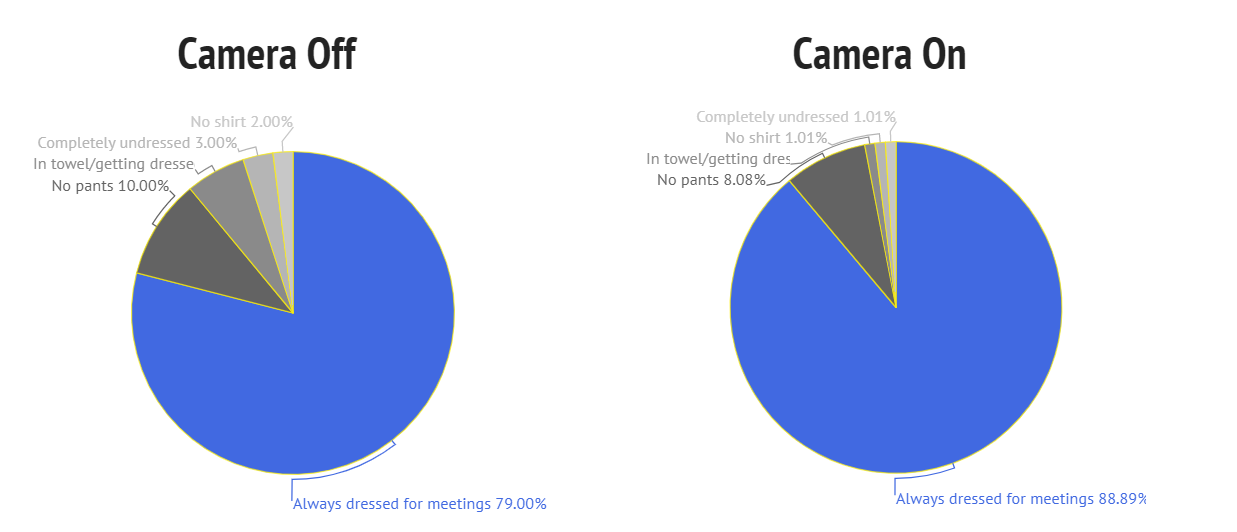
Unsurprisingly, employees are 10% more likely to dress fully when their cameras are active. Regardless of camera status, the majority of workers attend meetings dressed and ready for business.
While a small number of workers feel comfortable appearing shirtless in meetings, with only about 1% admitting to doing so on camera, it’s not a recommended practice for professional settings.
Most employees make an effort to present themselves well and professionally. Additionally, 73% spend more time grooming when preparing for camera-on meetings.
Methodology
Zippia.com, a career resource website, conducted a study involving 1,927 remote workers across the U.S. on virtual meetings.
All respondents were asked identical questions regarding their feelings about meetings and their behaviors during them, particularly concerning appearance.
Participants were recruited through Clickworker during March 2021.
Can We All Agree to Make Meetings Better?
Ultimately, most employees still prefer in-person meetings.
However, face-to-face interactions are not always feasible for remote or distributed teams. Fortunately, alternatives such as phone calls and virtual meetings without cameras can still be effective.
While cameras can enhance communication by allowing participants to observe body language, many workers report discomfort with being on camera, which is their primary complaint about virtual meetings.
Companies should reconsider their camera policies—are cameras necessary for every meeting? A large company-wide meeting might not require everyone’s camera to be on, while a one-on-one with your manager could genuinely benefit from face time.

Author

Kathy is the head of content at Zippia with a knack for engaging audiences. Prior to joining Zippia, Kathy worked at Gateway Blend growing audiences across diverse brands. She graduated from Troy University with a degree in Social Science Education.