- Facts and Figures
- Social Security Statistics
- Social Media Statistics
- Cell Phone Usage Statistics
- Cryptocurrency Statistics
- White Collar Crime Statistics
- Crowdfunding Statistics
- Branding Statistics
- How Many Emails Are Sent Per Day
- Money Laundering Statistics
- Childcare Availability Statistics
- Cold Calling Statistics
- Automation And Job Loss Statistics
- Student Loan Statistics
- Spam Statistics
- Password Statistics
- Ransomware Statistics
- Christmas Spending Statistics
- Average Grocery Cost By State
- Average Screen Time Statistics
- Average Monthly Expenses
- IoT Statistics
- Gen Z Statistics
20 Shocking White-Collar Crime Statistics [2026]: The State of White-Collar Crime in the U.S.
White-collar crime research summary. White-collar crime encompasses a variety of frauds committed by professionals in business and government sectors. The prevalence of white-collar crime may astonish you, especially considering the low rates of prosecution. Based on our comprehensive research:
-
White-collar crimes account for only 3% of federal prosecutions.
-
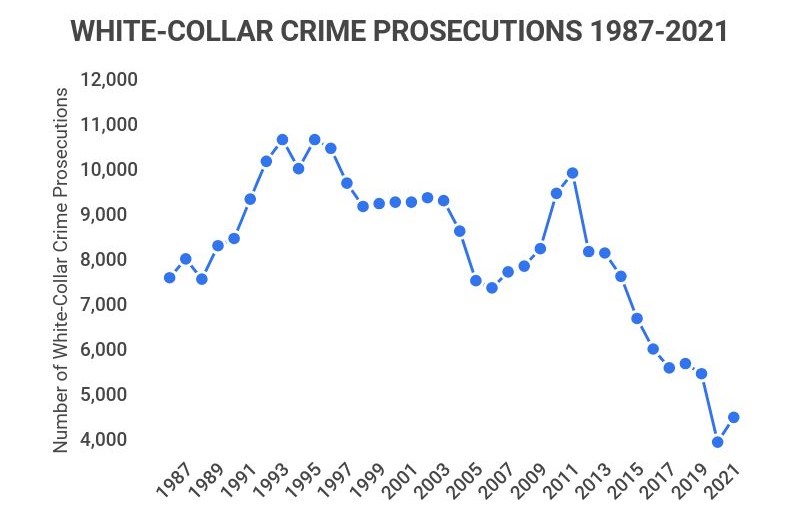
Prosecutions for white-collar crimes fell by 53.5% from 2011 to 2021.
-
Annual losses due to white-collar crimes were estimated in 2021 to range from $426 billion to $1.7 trillion. This broad range reflects significant underreporting and prosecution issues.
-
In 2022, there were 4,180 prosecutions for white-collar crimes.
-
It is estimated that up to 90% of white-collar crimes remain unreported.
For further insights, we’ve categorized the data into the following sections:
Prosecutions | White-Collar Criminals | Trends + Projections | Industry | Costs
General White-Collar Crime Statistics
Understanding that white-collar crimes constitute only 3% of federal prosecutions highlights the significant impact on individuals and organizations. Here are some alarming statistics that reveal the extent of the issue:
-
White-collar crime affects over 35% of U.S. businesses.
Among employees, an estimated 75% steal from their employer at least once, with half of those repeating the act. Notably, over 50% of embezzlers hold managerial positions.
-
Approximately 5,000 white-collar crime-related arrests occur for every 100,000 people in the U.S.
Despite this figure, the number of prosecutions continues to decline. For instance, prosecutions numbered 9,507 in 2001 and 10,162 in 2011, yet only 4,180 prosecutions took place in 2022, despite no significant decrease in crime rates.
-
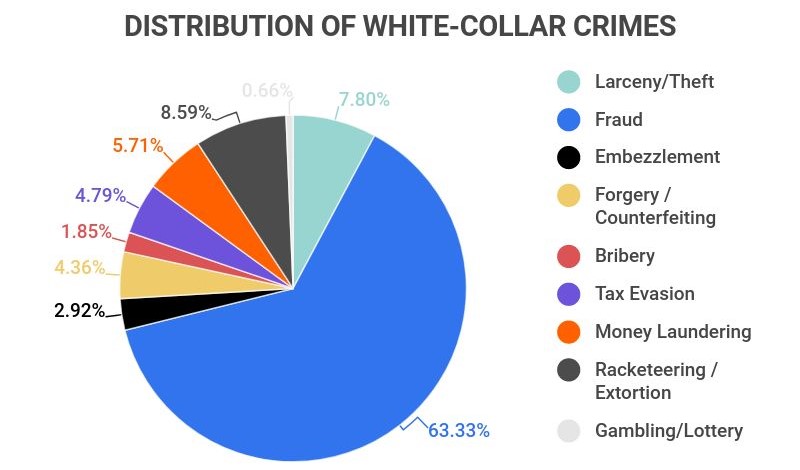
Fraud constitutes 63% of white-collar crimes, making it the most prevalent type.
Following fraud, embezzlement and larceny/theft are the next most common offenses. The high incidence of fraud is largely due to its encompassing nature.
-
Identity theft and fraud have impacted over 17 million Americans.
At least 24% of U.S. households have been victims of white-collar crime, with a staggering 88% of victims choosing not to report their experiences.
-
Since 9/11, there has been a 22% increase in Suspicious Activity Reports (SARs) filed by financial institutions.
This includes various fraudulent activities, indicating a troubling trend in criminal behavior alongside declining prosecution rates.
-
Identity theft complaints surged by 113% from 2019 to 2020.
This significant rise correlates with a growing trend of digital crimes, indicating a shift in criminal methodology.

White-Collar Crime Statistics by Prosecutions
Surprisingly, white-collar crime prosecutions remain low despite the increase in criminal activities. Additionally, sentences for these crimes tend to be less severe compared to other offenses. Here are the key insights:
-
In 2022, there were 4,180 prosecutions for white-collar crimes in the U.S.
This figure reflects a 53.5% decrease in prosecutions compared to a decade ago, and a 24.4% decrease from five years prior. This trend is alarming, especially as fraud and identity theft rates continue to rise.
-
The average prison sentence for white-collar crimes, such as fraud, is approximately 27 months.
While sentences can reach up to 30 years, this is infrequently seen; shorter terms and fines are more common outcomes.
-
Racketeering/Extortion is the white-collar offense with the highest average sentence at 79 months.
This translates to over six and a half years of incarceration, significantly more than the average for other white-collar offenses. In contrast, gambling/lottery crimes typically result in sentences of less than six months.
Average/Median Sentences for White-Collar Crimes
Primary Offense Average Months Median Months Larceny/Theft 11 2 Fraud 27 14 Embezzlement 10 1 Forgery/Counterfeiting 16 12 Bribery 27 18 Tax Evasion 13 10 Money Laundering 29 18 Racketeering/Extortion 79 51 Gambling/Lottery 5 4 -
White-collar criminals may face fines up to $1,000,000.
This substantial penalty is primarily for those involved in bank fraud. Other offenses, like tax evasion and mail/wire fraud, can lead to maximum fines of $100,000. Fines remain the most common form of punishment for white-collar criminals.
Federal White-Collar Crime Prosecutions 2011-2022
| Fiscal Year | Total Prosecutions |
|---|---|
| 2022 | 4,180 |
| 2021 | 4,727 |
| 2020 | 4,200 |
| 2019 | 5,702 |
| 2018 | 5,932 |
| 2017 | 5,825 |
| 2016 | 6,253 |
| 2015 | 6,935 |
| 2014 | 7,864 |
| 2013 | 8,373 |
| 2012 | 8,433 |
| 2011 | 10,162 |
White-Collar Statistics by Criminals
Similar to other crimes, certain demographics are more likely to engage in white-collar crime. The profile of white-collar criminals indicates that:
-
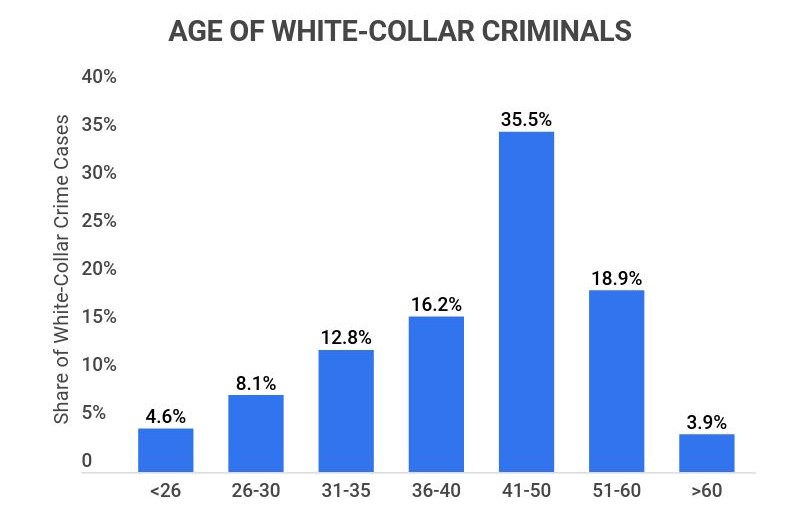
More than half of white-collar criminals are aged between 41 and 60.
Rarely do perpetrators of white-collar crimes fall under the age of 40, likely due to their positions of authority and understanding of financial systems.
-
In the U.S., less than 10% of white-collar criminals are female.
Additionally, just 8.6% of those committing income tax violations are women, aligning with perceptions that few believe women would engage in white-collar corruption.
-
75.2% of individuals committing property crimes, embezzlement, counterfeiting, bribery, or fraud are White.
This figure exceeds the 60.1% of the overall population identifying as White, with the percentage of bribery cases notably at 84.9%.
White-Collar Crime Trends and Projections
Our research provides insights into the trends affecting white-collar crime prosecutions over time:
-
Prosecutions for white-collar crime plummeted by 53.5% between 2011 and 2021.
In 2021, there were 4,727 prosecutions, marking a significant decline from the 10,162 prosecutions in 2011. Compared to two decades ago, the prosecutions have decreased by over 50%.
-
Identity theft remains the fastest-growing white-collar crime, affecting over 10 million Americans in 2020 alone.
This surge can be attributed to the increasing digitization of financial data, making it easier for criminals to access sensitive information.

White-Collar Crime Statistics by Industry
White-collar crime disproportionately impacts certain industries. Based on our research, the following industries are the most affected:
-
The Financial Services industry experiences the highest rate of white-collar crime, with 17% of embezzlement cases occurring here.
Other industries heavily impacted include non-profits/religious organizations, depository institutions, insurance companies, finance companies, money services businesses, and securities/futures.
-
Companies with fewer than 500 employees account for 69% of federal white-collar cases.
Small businesses are particularly vulnerable; those with 150 employees are ten times more likely to experience fraud, with 80% of thefts occurring in businesses with fewer than 150 employees.
-
Non-profits suffer at least one-sixth of all major embezzlement cases.
Overall, non-profit organizations are at a higher risk for white-collar crimes compared to private sectors, frequently facing theft, fraud, and unauthorized use of funds or assets.
White-Collar Crime Statistics by Costs
The financial ramifications of white-collar crime in the U.S. are significant. Here’s what you need to know about the costs associated with these crimes:
-
As of 2021, annual losses from white-collar crimes ranged from $426 billion to $1.7 trillion.
Estimating the total financial impact is challenging due to the high volume of crimes and low prosecution rates. Even at the conservative estimate of $426 billion, this figure surpasses the entirety of America’s marine economy.
-
The average company loses at least $9 per employee each day due to white-collar crime.
This loss accumulates to approximately 6% of a company’s total annual revenue lost to employee-committed white-collar crimes.
White-Collar Crime Statistics FAQ
-
What percentage of crime is white-collar?
The exact percentage of white-collar crime remains unclear due to underreporting, insufficient prosecution, and unapprehended criminals. An estimated 24% of American households have experienced white-collar crime, yet 88% of victims do not file formal complaints.
Moreover, only 3% of federal prosecutions pertain to white-collar crimes, a figure that has been steadily declining over the past decade.
-
Who commits the most white-collar crime?
The demographic most frequently associated with white-collar crime is white males aged 41-50. Males account for at least 75% of white-collar crimes, with bribery predominantly committed by white individuals (84.9%).
Conversely, women contribute to less than 10% of white-collar crime offenses.
-
Is white-collar crime increasing or decreasing?
While definitive numbers are lacking, trends suggest that white-collar crime is on the rise. This increase is linked to advancements in technology and globalization.
Our growing reliance on digital platforms for financial and personal information makes us increasingly susceptible to cybercrime.
-
What is the biggest white-collar crime in U.S. history?
The largest white-collar crime in U.S. history is Bernie Madoff’s Ponzi scheme. This scheme, which took place in 2008, involved an estimated $65 billion. Madoff pled guilty to 11 counts of securities fraud and money laundering, receiving a 150-year prison sentence along with a $170 billion restitution order to victims.
-
What are five examples of white-collar crimes?
Five common white-collar crimes include fraud, embezzlement, forgery, tax evasion, and money laundering. These crimes are primarily financial and involve the illegal appropriation of funds.
-
What is the most common white-collar crime?
Fraud is recognized as the most prevalent white-collar crime. This category encompasses various deceptive practices, including phone scams, phishing, and workplace fraud, such as unauthorized use of corporate credit cards.
-
What is the average sentence for white-collar crime?
The average sentence for a white-collar crime is approximately 23 months. Sentences vary based on the type of crime, its public profile, and other factors, but they are generally shorter than sentences for other offenses. For comparison, the average sentence for robbery is 163 months, despite the similarities in the nature of the crimes.
Conclusion
White-collar crimes impose a financial burden exceeding $400 billion annually on the U.S., impacting individuals and businesses nationwide. An estimated 24% of households have been victimized by these crimes, with businesses losing up to 6% of their total annual revenue due to employee misconduct.
Alarmingly, most victims do not report these offenses, with 88% opting against formal complaints. Furthermore, businesses often fail to monitor their employees, who collectively steal an average of $9 per person per day.
The lack of accountability leads to low prosecution rates, with white-collar crime prosecutions decreasing by 53% over the past decade. Currently, these crimes represent only 3% of federal prosecutions.
Clearly, addressing white-collar crime in the U.S. is imperative. Individuals, businesses, and government entities must collaborate more effectively to identify, report, and prosecute these criminals.
Sources
-
Denton Law Firm. “White Collar Crime Impact on Businesses and Employees: An Overview of Workplace Theft.” Accessed December 1, 2021.
-
TacReports. “White-Collar Crime Prosecutions for 2021 Continue Long Term Decline.” Accessed December 1, 2021.
-
Harvard Business School. “Why White-Collar Crime Spiked in America After 9/11.” Accessed December 1, 2021.
-
Sage Journals. “A Black Box Warning: The Marginalization of White-Collar Crime Victimization.” Accessed December 1, 2021.
-
New Deals Law Firm. “What punishments do white-collar defendants in Texas face if convicted of a non-violent offense like fraud or racketeering?” Accessed December 1, 2021.
-
FPP. “Federal Sentencing Guidelines and Penalties.” Accessed December 1, 2021.
-
ACFE. “Profiling a White Collar Criminal.” Accessed December 1, 2021.
-
Research Gate. “Gender and white-collar crime: only four percent female criminals.” Accessed December 1, 2021.
-
U.S. Department of Justice. “The Measurement of White-Collar Crime Using Uniform Crime Reporting (UCR) Data.” Accessed December 1, 2021.
-
Desjarlais. “Identity Theft.” Accessed December 2, 2021.
-
Property Casualty 360. “6 things to know about white collar crime.” Accessed December 2, 2021.
-
Mondaq. “United States: Preventing Fraud And Embezzlement In Your Nonprofit Organization.” Accessed December 2, 2021.
-
U.S. Department of Justice. “How Much Does White Collar Crime Cost?” Accessed December 2, 2021.
-
BrandonGaille. “35 Surprising White Collar Crimes Statistics.” Accessed December 2, 2021.
-
ACFE. “2008 Report to the Nation on Occupational Fraud & Abuse.” Accessed February 15, 2022.
-
Insurance Information Institute. “Identity Theft And Fraud Reports.” Accessed February 15, 2022.
-
Transactional Records Access Clearinghouse. “Corporate and White-Collar Prosecutions Hit New All-Time Lows in FY 2022.” Accessed February 22, 2023.
- Facts and Figures
- Social Security Statistics
- Social Media Statistics
- Cell Phone Usage Statistics
- Cryptocurrency Statistics
- White Collar Crime Statistics
- Crowdfunding Statistics
- Branding Statistics
- How Many Emails Are Sent Per Day
- Money Laundering Statistics
- Childcare Availability Statistics
- Cold Calling Statistics
- Automation And Job Loss Statistics
- Student Loan Statistics
- Spam Statistics
- Password Statistics
- Ransomware Statistics
- Christmas Spending Statistics
- Average Grocery Cost By State
- Average Screen Time Statistics
- Average Monthly Expenses
- IoT Statistics
- Gen Z Statistics

Author

Jack Flynn is a writer for Zippia. In his professional career he’s written over 100 research papers, articles and blog posts. Some of his most popular published works include his writing about economic terms and research into job classifications. Jack received his BS from Hampshire College.