Explore jobs
Find specific jobs
Explore careers
Explore professions
Best companies
Explore companies
Job outlook for adjunct associate professors in the United States
Adjunct associate professor job growth summary. After extensive research, interviews, and analysis, Zippia's data science team found that:
The projected adjunct associate professor job growth rate is 12% from 2018-2028.
About 159,400 new jobs for adjunct associate professors are projected over the next decade.
Adjunct associate professor salaries have increased 0% for adjunct associate professors in the last 5 years.
There are over 179,203 adjunct associate professors currently employed in the United States.
There are 18,385 active adjunct associate professor job openings in the US.
The average adjunct associate professor salary is $113,706.
Are adjunct associate professor jobs in demand?
Adjunct associate professor job and salary trends over time
Adjunct associate professor jobs over time
Adjunct associate professor job growth rate over time
| Year | # of jobs | % of population |
|---|---|---|
| 2021 | 179,203 | 0.05% |
| 2020 | 183,809 | 0.05% |
| 2019 | 186,356 | 0.06% |
| 2018 | 184,662 | 0.06% |
| 2017 | 181,404 | 0.06% |
Average adjunct associate professor salary over time
Adjunct associate professor salary by year
| Year | Avg. salary | Hourly rate | % Change |
|---|---|---|---|
| 2026 | $113,706 | $54.67 | +1.8% |
| 2025 | $111,675 | $53.69 | --0.1% |
| 2024 | $111,732 | $53.72 | --0.5% |
| 2023 | $112,306 | $53.99 | --1.5% |
| 2022 | $114,016 | $54.82 | +9.4% |
Adjunct associate professor jobs by state
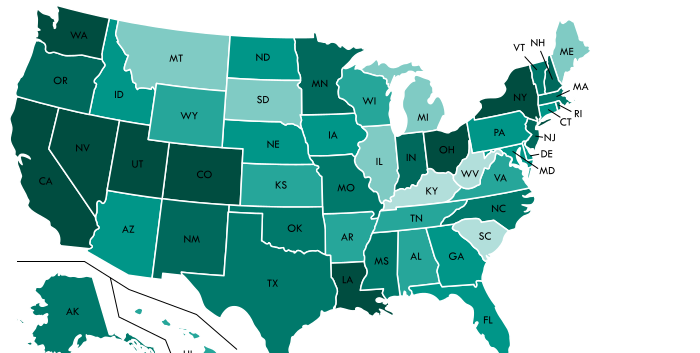
Most common states for adjunct associate professors
| Rank | State | Population | # of jobs | Employment/ 1000ppl |
|---|---|---|---|---|
| 1 | District of Columbia | 693,972 | 102 | 15% |
| 2 | Alaska | 739,795 | 101 | 14% |
| 3 | Vermont | 623,657 | 74 | 12% |
| 4 | Virginia | 8,470,020 | 841 | 10% |
| 5 | Oregon | 4,142,776 | 323 | 8% |
| 6 | New York | 19,849,399 | 1,299 | 7% |
| 7 | Colorado | 5,607,154 | 405 | 7% |
| 8 | South Carolina | 5,024,369 | 363 | 7% |
| 9 | South Dakota | 869,666 | 58 | 7% |
| 10 | Indiana | 6,666,818 | 429 | 6% |
| 11 | Nebraska | 1,920,076 | 114 | 6% |
| 12 | West Virginia | 1,815,857 | 109 | 6% |
| 13 | Pennsylvania | 12,805,537 | 653 | 5% |
| 14 | North Carolina | 10,273,419 | 475 | 5% |
| 15 | Massachusetts | 6,859,819 | 314 | 5% |
| 16 | Alabama | 4,874,747 | 237 | 5% |
| 17 | Iowa | 3,145,711 | 172 | 5% |
| 18 | Utah | 3,101,833 | 159 | 5% |
| 19 | Mississippi | 2,984,100 | 142 | 5% |
| 20 | Rhode Island | 1,059,639 | 57 | 5% |
Most common cities for adjunct associate professors
| Rank | City | # of jobs | Employment/ 1000ppl | Avg. salary |
|---|---|---|---|---|
| 1 | San Diego | 2 | 0% | $138,866 |
Adjunct Associate Professor job outlook: Expert opinions
Our panel of adjunct associate professor experts
The University of Tennessee - Chattanooga
Tiffin University
Kean University
North Carolina State University
Sam Houston State University
University of Maine
Saint Peter's University
Skidmore College
Worcester State University

Curry College

College of Charleston

Indiana University Kokomo
What general advice would you give to an Adjunct Associate Professor?
Rick Mulvihill M. Sc.: People skills! All positions in the Criminal Justice field work with people, usually at the worst moment in their life. Writing skills! All positions require you to document your actions. Those documents could be the basis of a Supreme Court case.
What will help Adjunct Associate Professors increase their earning potential?
Rick Mulvihill M. Sc.: Education! The higher your level of education, the more positions you may be eligible for and the higher the starting salary. An example from Federal law enforcement is that a candidate with a B.A. starts at GS 7 while with a M.A. they would start at GS 9.
What general advice would you give to an Adjunct Associate Professor?
Alex Holte PhD: My advice for someone new to the field of academia is to learn time management skills early and learn what type of service work you find interesting and would like to contribute to. From there, learn how to say “no” to opportunities that may not align with your goals as well. I feel a lot of new professors tend to find the need to be involved in everything, which can result in burning out later in their career.
What Adjunct Associate Professor skills would you recommend for someone trying to advance their career?
Alex Holte PhD: I would say being able to work with AI may be something that is more important in the next 3-5 years. Right now it’s a new technology and people are just now learning how to integrate it in the workplace, but I feel it is possible the future workforce of tomorrow will necessitate some form of being able to use AI technology.
What will help Adjunct Associate Professors increase their earning potential?
Alex Holte PhD: When you are starting out at any career, it is important to negotiate your salary. Many candidates feel that they have to accept their first offer, but in reality, at many jobs, there is some room for negotiation. Be mindful however, to not request a salary that is much higher than what is being offered as they may feel like a compromise would not be possible and move on to the next candidate.
Sherah Basham Ph.D.
Assistant Professor and Criminal Justice Online CoordinatorThe University of Tennessee - Chattanooga
Criminal Justice And Corrections
What Adjunct Associate Professor skills would you recommend for someone trying to advance their career?
Sherah Basham Ph.D.: 1. Specialized career paths - Criminal justice salaries will vary significantly by level (federal vs local), location, and specialty. Developing specific skills such as cybercrime investigations, forensic or crime scene investigations, data analysis, or speaking a foreign language can leverage higher salaries for specialized positions. 2. Education - Master's degrees, specialized certificates, and professional training can increase earning potential. Education can assist with increasing base salaries or bonuses. It can also help with the placement and selection of specific roles. 3. Explore non-traditional roles - Consider career opportunities outside of traditional law enforcement or corrections agencies. Private security firms, corporations, research institutions, and consulting firms can offer competitive salaries in criminal justice.
Dr. Stephanie Opfer
Associate Professor of English, Assistant Dean of the School of Creative and Media ArtsTiffin University
Visual And Performing Arts
What general advice would you give to an Adjunct Associate Professor?
Dr. Stephanie Opfer: Because of the state of higher education in our country today, teaching in higher education can be a difficult field to break into. However, most colleges and universities still hire adjunct instructors (part-time instructors). Students shouldn't be afraid to teach as an adjunct for a while to get some experience and decide if teaching is for them.
What Adjunct Associate Professor skills would you recommend for someone trying to advance their career?
Dr. Stephanie Opfer: Flexibility and adaptability will be the biggest skills instructors will need. The state of higher education is changing, and the 'ivory tower' is going away. Colleges and universities are starting to focus more on career-oriented programs, which include practical and application skill sets. In order to stay relevant, the focus of humanities classes like art and film should be on teaching students analysis, synthesis, and other critical-thinking skills. The content becomes less important and becomes only the vehicle for teaching these skills.
What will help Adjunct Associate Professors increase their earning potential?
Dr. Stephanie Opfer: Unfortunately, teaching as an adjunct does not pay well. Students should keep their full-time jobs and teach part-time until they find a full-time job at a college or university. That part-time teaching provides them valuable experience and connections that make them more competitive candidates for full-time positions because they'd also be competing with candidates who have PhDs. So adjunct work is more of a long-term investment rather than an immediate return. Also, even full-time teaching jobs don't pay particularly well, so they'll really need to love teaching if they want to do it full-time. If they don't like teaching as an adjunct, they won't like doing it full-time.
What general advice would you give to an Adjunct Associate Professor?
Mia Fiore Ph.D.: First, I would tell all students that it is VERY different from teaching k-12. Unlike K-12, you are not placed in a school with a teaching job upon graduation; teaching in higher education is one of the most competitive fields, period. The next difference is that you are expected to be an expert/ master of your field. If you're also willing to accept that you will likely have to work as an adjunct professor (for low pay) first, then go for it! Teaching in higher education is the most rewarding job, especially for people who love learning.
What Adjunct Associate Professor skills would you recommend for someone trying to advance their career?
Mia Fiore Ph.D.: Awareness and familiarity with technology has become more important, and it will continue to be more important in the next 3-5 years. With everything from peer-reviewed journals available online, to AI, technology is an important part of higher education.
What will help Adjunct Associate Professors increase their earning potential?
Mia Fiore Ph.D.: Maximize your salary potential by teaching at a state school- if you do you can join the PSLF program and after ten years, your student loans will be forgiven.
What general advice would you give to an Adjunct Associate Professor?
Justin Whitehill Ph.D.: Perseverance pays off. Its worth it to pursue the career you want and not settle and be unhappy.
What Adjunct Associate Professor skills would you recommend for someone trying to advance their career?
Justin Whitehill Ph.D.: In the area of genetics and genomics, the identification of areas of the genome that can be CRISPR’d and used to add an immediate benefit is going to be very important as every cropping system races to make genome editing a reality. AI will likely play a huge role in predicting genes/regions of the genome that will provide the biggest benefits.
What will help Adjunct Associate Professors increase their earning potential?
Justin Whitehill Ph.D.: I wouldn’t know, I’m a professor.
What Adjunct Associate Professor skills would you recommend for someone trying to advance their career?
Joshua Adams Ph.D., CFE: Keep in mind that salary is usually commensurate with your experience. That being said, do not expect to be wealthy in your first years in your career. You can maximize your salary potential when starting your career in your field by not being afraid to seek overtime opportunities and by having advanced training and/or education. Most local, city, and state municipalities are on fixed budgets, and most public service career opportunities at this level are very transparent of a salary range when they post job announcements. Typically, as you advance in rank, you advance into subsequent brackets of pay ranges. Some organizations provide extra incentives for bachelor’s-level or higher education, but some do not. This leaves the preferred option of maximizing salary, which is working overtime or working a part-time position somewhere else using your same skills (moonlighting) if your agency allows outside employment.
What will help Adjunct Associate Professors increase their earning potential?
Joshua Adams Ph.D., CFE: There are two main pieces of advice that I would give to a graduate beginning their career in the field of criminal justice. First, think of everything you would like to accomplish by the time your new career is ending and develop a plan to accomplish your goals during your tenure. Oftentimes, we underestimate how fast time goes, and due to the fast-paced nature of public service, you will have 10 or more years of service before you know it. Finally, develop your network of trusted friends and advisors early. You will need to rely on these friends and advisors when you have bad days because you will be involved in the best days of citizen’s lives and the worse days of citizen’s lives, so you will need to constantly perform self-reflection so that your positivity continues to permeate throughout the community.
Jane Kuandre
Associate ProfessorWhat general advice would you give to an Adjunct Associate Professor?
Jane Kuandre: My advice for someone looking to pursue a career in academia would be to focus on building a strong publication record, developing a network of collaborators, and continuously seeking opportunities for professional development.
What Adjunct Associate Professor skills would you recommend for someone trying to advance their career?
Jane Kuandre: Some essential skills for success in academia include critical thinking, effective communication, time management, and the ability to work both independently and collaboratively.
What will help Adjunct Associate Professors increase their earning potential?
Jane Kuandre: Networking is crucial for career advancement in academia as it allows individuals to establish collaborations, gain access to resources, and stay updated on the latest research trends.
What will help Adjunct Associate Professors increase their earning potential?
Heather Alaniz-Salas Ph.D: I trust this email finds you well. I have been informed by Dr. Boisvert about your recent inquiry regarding obtaining information on preparing for a career in criminal justice from a faculty member at SHSU. With my extensive experience teaching within the college for four years and my recent appointment as the Director of Internship and Career Services in the field of criminal justice at SHSU, I am more than willing to provide valuable insights and guidance on this matter.
Dr. Elizabeth Neiman
Director of Women's, Gender, and Sexuality Studies ProgramUniversity of Maine
Ethnic, Cultural Minority, Gender, And Group Studies
What general advice would you give to an Adjunct Associate Professor?
Dr. Elizabeth Neiman: Students interested in enhancing their program of study with a WGS minor just 3 additional courses to take in WGS so as to complete a minor. Nursing students who have taken advantage of this opportunity report to me that they are excited about the perspectives that WGS studies provides them and that they feel more prepared than ever to begin a career in Nursing.
What Adjunct Associate Professor skills would you recommend for someone trying to advance their career?
Dr. Elizabeth Neiman: I can reflect better on how I'd guide students to think about the work they do at UMaine in Women's Gender and Sexuality Studies so as to prepare for potential careers.
What will help Adjunct Associate Professors increase their earning potential?
Dr. Elizabeth Neiman: Rather than answer your questions, I'll give you some background information: Since becoming Director of the Women's, Gender and Sexuality Studies program at UMaine in fall 2022, I have been doing a great deal of outreach to faculty in other departments across the university.
What will help Adjunct Associate Professors increase their earning potential?
Beth Adubato: We are going to see some changes in the way prisons work and how they are physically designed. Again, this requires a matching of planning/design skills and knowledge of the criminal justice system. Another area of growth is cybercrime--as fast as we can solve some of the cyber crimes, criminals are finding ways to get around them. Policing is changing--focusing on more equity in the system, while maintaining order. We hear from students in police academies right now that the focus is on community prevention, so forward-thinking young people will have an advantage if they can innovate.
Aurelie Matheron
Assistant Professor of FrenchSkidmore College
Romance Languages, Literatures, And Linguistics
What general advice would you give to an Adjunct Associate Professor?
Aurelie Matheron: Present yourself as a professional in your cover letter and interviews. The people who interview you will look at you as a future colleague and not a student. Use the past “I” to show what the future “I” will do. Meaning: in your interviews, say “I have developed X courses/projects and I have acquired X skills useful for a collaborative project at your institution. For instance, one project I will develop is XYZ.” You show your experience/expertise and how you will be using your skills. Don’t dwell too much on the “past I” and, I’d say, don’t use the past “we” => “at my former institution, we would do X or Z.” => this shows that you still view yourself as part of that community and don’t project yourself at your new institution. Once you have the job: observe the dynamics of your new work place. Meet with colleagues who also recently got a job at your institution. They will help you navigate the first year.
What Adjunct Associate Professor skills would you recommend for someone trying to advance their career?
Aurelie Matheron: Leadership: you will be in positions of leading a program/department. Learn from current chairs by observing their own skills during meetings and moments of decision. Collaboration: develop interpersonal and interprofessional relationships that will allow you to build collaborative projects (interdepartmental courses, for instance).
What will help Adjunct Associate Professors increase their earning potential?
Aurelie Matheron: Do some research online about how much someone earns at your stage of the career. If there is a significant gap, point out (diplomatically) that, because of your extensive experience in XYZ, you would like to get a X% increase in your salary. Be reasonable: if you want a 3% increase, ask for 5% (not 10% or more). Justify your negotiation: why should they pay me more? What experience can I show them to justify my request? If you have a higher offer from another place, you can say that “I have received another generous offer and would like to know about the possibility for matching that offer.” Salary is not the only thing you can negotiate: office space, computer/laptop, sabbaticals, course release, etc. Again, be reasonable: if you think you are entitled to XYZ requests, you also have to show why.
What general advice would you give to an Adjunct Associate Professor?
Aimée Delaney Ph.D.: The best way to increase salary and promotion potential is through higher education. Any college degree makes for a more desirable candidate. The skills acquired, in addition to knowledge, are highly sought attributes from most employers (e.g., critical thinking skills, proficient writing abilities). Many employers require some level of post-secondary education for initial hire as well as many supervisory positions. If a post-secondary degree is not necessary for a specific job, a college degree will allow a competitive edge and increase the chances for a promotion into a higher rank (and therefore increasing salary potential long term).
What Adjunct Associate Professor skills would you recommend for someone trying to advance their career?
Aimée Delaney Ph.D.: The most important skill for a career in criminal justice is interpersonal relations. Most positions within criminal justice require face to face interaction with other people. Criminal justice professionals interact with the public on a daily basis, and potential candidates for jobs need to be comfortable talking with people. This includes interactions with strangers. Learn to become comfortable interacting with anyone, in any situation. Additionally, criminal justice professionals need to have proficient writing skills. The criminal justice field requires report writing, either formal or informal. Clarity, detail-orientation, and succinctness are necessary skills to develop before gaining employment within the criminal justice field. Overall communication skills, inclusive of verbal and non-verbal, is necessary when working with the public.
What will help Adjunct Associate Professors increase their earning potential?
Aimée Delaney Ph.D.: Early criminal justice professionals need to learn to be comfortable with the uncomfortable. Professionals in the criminal justice field face the unknown on a daily basis. It is important to learn to recognize our fears, anxieties, and discomfort so we can begin the process of leaning into these trepidations. The criminal justice field is not for the faint of heart. Fortunately, we often work with a team of other professionals. Find a mentor, particularly someone who has different characteristics. Diversify your support network, and expand your mindset.
What general advice would you give to an Adjunct Associate Professor?
Jennifer Balboni: In the justice realm—whether we are discussing policing, corrections, or other community or alternative services—the job market is strong for new graduates in many regions. Many justice-related agencies are short-staffed and currently trying to re-staff after considerable attrition (much of which is related to COVID retirements). My advice for graduating seniors is to do their homework about agencies where they want to pursue work; they should find out as much as they can about the history and values that the place holds. While those entering the workforce should absolutely be ready and willing to learn in their new roles, they also should find an agency that shares their approach to the administration of justice. These tendencies matter in finding a good match professionally. I would also suggest to all new graduates that they need to consider they may need to take “a” job before they get “the” job. Often, criminal justice students desire to be a detective or FBI agent—but these dream jobs require several years of professional experience. Taking a job in the justice field—even if it is not the ideal job—is almost always better than taking a barista job. Even if the pay or status at the justice agency isn’t exactly what they might have hoped, if there is room for advancement, it is usually better to take the job in the field. As a new professional, it is critical to develop professional connections, establish a strong work record, and put themselves in a place where they will learn about future opportunities.
What Adjunct Associate Professor skills would you recommend for someone trying to advance their career?
Jennifer Balboni: Adaptability! Our world is changing so rapidly through AI advancements that even the justice field (which is often resistant to change) will need to incorporate these shifts. Investigative skills utilizing AI or other software will become increasingly common, and those skills will be sought after by many different types of agencies. With that said, in the justice realm, there is absolutely no substitute for soft skills. Being able to communicate clearly with people generally, and build rapport is essential in this field. Similarly, being able to assess situations and use de-escalation techniques is equally critical. There is no AI that can interpret human emotions and make a personal connection that defuses a potentially volatile situation! All of these skills matter in improving personal and community safety. The justice realm is just beginning to implement trauma-informed approaches, and this is true progress for the field! Those skills are critical for any justice professional.
What experience really stands out on Adjunct Associate Professor resumes?
Dr. Phyllis G. Jestice: The experience that most stands out on resumés, to my mind, is definitely internships or anything where the applicant has had to show initiative and exercise independent thought.
What general advice would you give to an Adjunct Associate Professor?
Kelly Fisher: Technology will continue to be a prevalent theme in advancing skills moving forward. Understanding and leveraging technology can be challenging, but it is crucial in criminal investigations. I focus on teaching critical thinking and processes to students, so they can function in the absence of technology while embracing technology as an aid, but not a crutch.
What Adjunct Associate Professor skills would you recommend for someone trying to advance their career?
Kelly Fisher: Don't be afraid to make strategic moves. A foot in the door and network connections can take students closer to their end goals. Taking a lower paying position for future opportunities is often part of the investment in the long plan. It is easier to leverage skills to maximize worth if value has been established to an agency. Comparing full salary packages is crucial, as fringe benefits can often outweigh a small salary difference.
What will help Adjunct Associate Professors increase their earning potential?
Kelly Fisher: The first job after graduation is merely a tool to gain experience, perspective, and network connections to work towards the next career steps. I advise students to learn something from every step along the way and continue to work towards the big picture. The network connections they make now will become invaluable in the future.