Explore jobs
Find specific jobs
Explore careers
Explore professions
Best companies
Explore companies
Job outlook for adjunct nursing faculties in the United States
Adjunct nursing faculty job growth summary. After extensive research, interviews, and analysis, Zippia's data science team found that:
The projected adjunct nursing faculty job growth rate is 12% from 2018-2028.
About 159,400 new jobs for adjunct nursing faculties are projected over the next decade.
Adjunct nursing faculty salaries have increased 9% for adjunct nursing faculties in the last 5 years.
There are over 12,904 adjunct nursing faculties currently employed in the United States.
There are 66,092 active adjunct nursing faculty job openings in the US.
The average adjunct nursing faculty salary is $63,831.
Are adjunct nursing faculty jobs in demand?
Adjunct nursing faculty job and salary trends over time
Adjunct nursing faculty jobs over time
Adjunct nursing faculty job growth rate over time
| Year | # of jobs | % of population |
|---|---|---|
| 2021 | 12,904 | 0.00% |
| 2020 | 11,584 | 0.00% |
| 2019 | 11,315 | 0.00% |
| 2018 | 10,563 | 0.00% |
| 2017 | 10,538 | 0.00% |
Average adjunct nursing faculty salary over time
Adjunct nursing faculty salary by year
| Year | Avg. salary | Hourly rate | % Change |
|---|---|---|---|
| 2026 | $63,831 | $30.69 | +1.2% |
| 2025 | $63,095 | $30.33 | +1.5% |
| 2024 | $62,157 | $29.88 | +3.1% |
| 2023 | $60,271 | $28.98 | +3.1% |
| 2022 | $58,469 | $28.11 | +2.4% |
Adjunct nursing faculty jobs by state
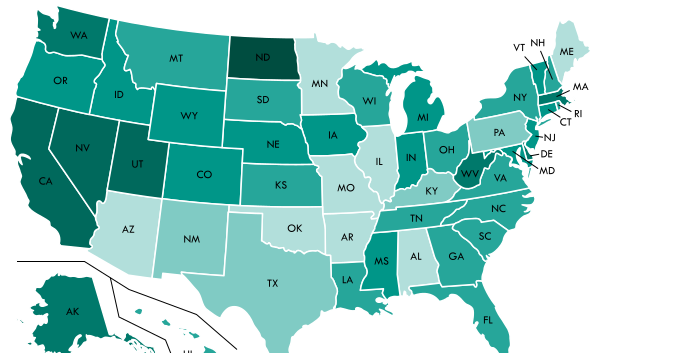
Most common states for adjunct nursing faculties
| Rank | State | Population | # of jobs | Employment/ 1000ppl |
|---|---|---|---|---|
| 1 | Kansas | 2,913,123 | 455 | 16% |
| 2 | Georgia | 10,429,379 | 1,488 | 14% |
| 3 | New York | 19,849,399 | 2,154 | 11% |
| 4 | California | 39,536,653 | 3,139 | 8% |
| 5 | Arizona | 7,016,270 | 584 | 8% |
| 6 | Mississippi | 2,984,100 | 225 | 8% |
| 7 | Texas | 28,304,596 | 1,852 | 7% |
| 8 | South Carolina | 5,024,369 | 345 | 7% |
| 9 | Washington | 7,405,743 | 158 | 2% |
| 10 | North Dakota | 755,393 | 0 | 0% |
| 11 | West Virginia | 1,815,857 | 0 | 0% |
| 12 | Nevada | 2,998,039 | 0 | 0% |
| 13 | Utah | 3,101,833 | 0 | 0% |
| 14 | District of Columbia | 693,972 | 0 | 0% |
| 15 | Delaware | 961,939 | 0 | 0% |
| 16 | Indiana | 6,666,818 | 0 | 0% |
| 17 | Alaska | 739,795 | 0 | 0% |
| 18 | Michigan | 9,962,311 | 0 | 0% |
| 19 | Massachusetts | 6,859,819 | 0 | 0% |
| 20 | Nebraska | 1,920,076 | 0 | 0% |
Most common cities for adjunct nursing faculties
| Rank | City | # of jobs | Employment/ 1000ppl | Avg. salary |
|---|---|---|---|---|
| 1 | Dalton | 1 | 3% | $58,740 |
| 2 | Fair Oaks | 1 | 3% | $80,718 |
| 3 | Kingman | 1 | 3% | $52,236 |
| 4 | Gainesville | 2 | 2% | $63,981 |
| 5 | Fairfield | 1 | 2% | $67,504 |
| 6 | Grand Junction | 1 | 2% | $70,054 |
| 7 | La Crosse | 1 | 2% | $61,349 |
| 8 | Ocala | 1 | 2% | $64,168 |
| 9 | Nampa | 1 | 1% | $65,831 |
| 10 | Phoenix | 3 | 0% | $51,289 |
| 11 | Dallas | 2 | 0% | $53,471 |
| 12 | Anchorage | 1 | 0% | $75,772 |
| 13 | Atlanta | 1 | 0% | $58,726 |
| 14 | Baltimore | 1 | 0% | $66,661 |
| 15 | New York | 1 | 0% | $63,970 |
Adjunct Nursing Faculty job outlook: Expert opinions
Our panel of adjunct nursing faculty experts
Tiffin University
College of the Marshall Islands

Grambling State University
Skidmore College
College of Charleston

Shaw University
University of Nebraska-Lincoln

Arkansas Tech University

The University of Tennessee Knoxville

Oakland University
Franklin and Marshall College
AGWA - American Grant Writers' Association, Inc.
Merrimack College
Florida International University
The University of North Carolina Greensboro
Misericordia University
Texas State University
Northwestern University
Seattle University
Elmira College
Dr. Stephanie Opfer
Associate Professor of English, Assistant Dean of the School of Creative and Media ArtsTiffin University
Visual And Performing Arts
What general advice would you give to an Adjunct Nursing Faculty?
Dr. Stephanie Opfer: Because of the state of higher education in our country today, teaching in higher education can be a difficult field to break into. However, most colleges and universities still hire adjunct instructors (part-time instructors). Students shouldn't be afraid to teach as an adjunct for a while to get some experience and decide if teaching is for them.
What will help Adjunct Nursing Faculties increase their earning potential?
Dr. Stephanie Opfer: Unfortunately, teaching as an adjunct does not pay well. Students should keep their full-time jobs and teach part-time until they find a full-time job at a college or university. That part-time teaching provides them valuable experience and connections that make them more competitive candidates for full-time positions because they'd also be competing with candidates who have PhDs. So adjunct work is more of a long-term investment rather than an immediate return. Also, even full-time teaching jobs don't pay particularly well, so they'll really need to love teaching if they want to do it full-time. If they don't like teaching as an adjunct, they won't like doing it full-time.
What will help Adjunct Nursing Faculties increase their earning potential?
Alexander Velasquez: I think everyone should look into their career fields and find out what it is that makes you more valuable in that field. Are there any certifications that you can get? What is it that you need to know or learn that companies will find valuable? Much can be learned online, so pick up as many of those skills as you can, and make sure they're on your resume or CV. I believe all those things could maximize salary potential, especially when starting out.
What are the biggest trends we'll see in the Adjunct Nursing Faculty job market given the pandemic?
Dr. Cheyrl Ensley: The demand for teachers is still prevalent. Virtual job fairs and interviews are the current trends. Additionally, employees are looking more at the candidate's knowledge and comfort level with online teaching and using technology to impact student learning.
What Adjunct Nursing Faculty skills would you recommend for someone trying to advance their career?
Dr. Cheyrl Ensley: Training to be essential is critical. Increasing skills in using technology are necessary. Keeping students engaged and actively learning through technology is a crucial tool that will be extremely important to a teacher, whether teaching in person or virtually. Additionally, the gap year should be used to identify an area of interest for work. Once the site is specified, the graduate should build professional relationships and learn the site's culture.
What general advice would you give to an Adjunct Nursing Faculty?
Dr. Cheyrl Ensley: Flexibility is important. The graduate must be prepared and flexible! The graduate must be prepared to teach effectively and efficiently, regardless of the delivery method and flexibility regarding reporting to the school or working from home. Be prepared and accepting of the fact that what is required of you may change unexpectedly. In this age of uncertainty, the graduate must be flexible enough to perform as needed and remain focused on student growth.
What experience really stands out on Adjunct Nursing Faculty resumes?
Tillman W. Nechtman Ph.D.: In my home department, we've tried to stress that students need to ask themselves how they plan to tell their own story - how they want to present themselves - when they leave the college and head out on the job market. That's a personal question, one only the student can answer, and the answer shapes the things that a particular student will want to put on a resume. For instance, if you wanted to go to graduate school, we'd all suggest that you take the Thesis in History and put in the full-year work on a single research project.
That way, in your cover letter (and never underestimate the value of the cover letter as a tool for guiding potential employers through your CV and your other materials), you can narrate the work you did there. If you think your goal is to work in a museum setting, you should consider taking our class in Public History. That is a course that does a lot of directed research too, and it can span a year as well. But, it's a course that partners students with local public history institutions so that students get first-hand experience mobilizing historical research within a museum or institution of that sort. The key is for students to think about the story; they will tell potential employers. What are the things you did - that unique combination of courses and experiences - that make you stand out against the broader pool of applicants? How will you write that story in a cover letter so strong that nobody reading it will miss that you are the one candidate for the position? Be bold here. Make it clear. You stand out from the pack. Yes, perhaps other have taken a more traditional path to a specific job, but if that employer or graduate program wants somebody who can think outside the box or who brings in a different set of skills that just might shake things up in a positive way, well, make sure they know you're their candidate.
Will there be an enduring impact of the coronavirus pandemic on Adjunct Nursing Faculties?
Dr. Phyllis G. Jestice: It's hard to imagine that there WON'T be an enduring impact of the pandemic. For History graduates, the worst of it is likely to be that two graduating classes will essentially be entering the job market at the same time---the 2020 graduates as well as the 2021 graduates---increasing competition. Many graduates, especially people coming out of a strong public history program like CofC's, have had many of their typical entry-level jobs essentially vanish for the better part of a year (coming back soon, I hope!)---museum work, park service work, historical societies, and so on. For non-history-specific jobs, where History majors are at an advantage (jobs that require good critical thinking and people skills), the market seems likely to bounce back more quickly.
What experience really stands out on Adjunct Nursing Faculty resumes?
Dr. Phyllis G. Jestice: The experience that most stands out on resumés, to my mind, is definitely internships or anything where the applicant has had to show initiative and exercise independent thought.
What type of skills will young Adjunct Nursing Faculties need?
TaVshea Smith: As a professor of education, I have noticed that there are a variety of skills that young graduates will need to enter the workforce. Young graduates should collaborate with others by building collaborative relationships that represent diverse cultures, lifestyles, races, genders, religions, and viewpoints. It is essential for young graduates, who enter the teaching profession, to be able to work in a team structure and know-how to manage conflict. The pandemic has shown us that technology is critical in education. As teachers, young graduates should know existing digital technologies and demonstrate significant adaptability to new technologies to integrate into their design of lessons and curriculum content. Young graduates must have a strong work ethic, demonstrate personal accountability, and establish effective work habits.
Are there any particularly good places in the United States for Adjunct Nursing Faculties to find work opportunities?
TaVshea Smith: As an educator, graduates should be able to find many work opportunities to teach. The pandemic has highlighted the need for educators to share their immense talent with students and key stakeholders.
How do you envision technology impacting Adjunct Nursing Faculties in the next 5 years?
TaVshea Smith: Technology will play a vital role in education in the next five years. The pandemic has changed the way educators think about teaching learners and interacting with families and colleagues. Educators will need to learn various instructional methods of engaging with learners, enhancing instructional practices, and using digital tools ethically and efficiently to create assignments, complete tasks, solve problems, and effectively teach students.
What experience really stands out on Adjunct Nursing Faculty resumes?
Suzanne Kemp Ph.D.: Any work or volunteer experiences that they have had with students with disabilities. All of the graduates will have the same school experiences, and if they don't have anything else, they don't stand out from their peers. Additionally, they have to know that principals and professional school talk, so they have to do a great job in their in-school experiences, so their names are remembered and shared.
What Adjunct Nursing Faculty skills would you recommend for someone trying to advance their career?
Suzanne Kemp Ph.D.: They need to stay engaged in some level of working with people with disabilities. If they do something that isn't relevant to the field, they won't be as marketable as a new graduate.
What technology do you think will become more important and prevalent for Adjunct Nursing Faculties in the next 3-5 years?
Suzanne Kemp Ph.D.: All of the apps that assist with online learning. These change all of the time, and they have to be adapted to finding new apps that engage the student who may be learning at a distance, and hopefully, they can be integrated into in-person learning. Students graduate knowing how to use computers and now Zoom, but learning all of the available apps doesn't occur to the level it is now needed.
What technology do you think will become more important and prevalent for Adjunct Nursing Faculties in the next 3-5 years?
Sam Strasner: It will be fascinating to see if the pandemic convention of Zoom-style interviews becoming permissible for broadcast television and internet news websites will carry over in a post-pandemic world. If it does, distance technology interviews will open up a cost-efficient way to access a much greater variety of sources, stories, and content. I hope that is the case.
Will there be an increase or decrease in demand for Adjunct Nursing Faculties in the next 5 years?
Sam Strasner: I think it depends upon how one defines the field. The data says we are in the middle of a 10-year period that will see a 10.1 percent decline in journalism jobs. I noticed that trend early in my career and pivoted to public relations. Our society needs journalists. It is essential that we have people who are willing to, and have the skills necessary to, do real reporting. I believe there will always be a need for that. The question is how prevalent that need will be. As a result, my recommendation to someone pursuing a journalism degree today would be to focus their electives in some combination of digital marketing, public relations, or another closely related field based on communication. That subtle diversification in skills could be the key to a new graduate getting that first job and beginning a career journey toward whatever their ultimate dream might be.
Dr. Misty Anderson Ph.D
Department Head, English, Affiliate Professor of Theatre and Religious Studies, President, Tennessee University Faculty SenatesThe University of Tennessee Knoxville
College of Arts and Sciences
Are there any particularly good places in the United States for Adjunct Nursing Faculties to find work opportunities?
Dr. Misty Anderson Ph.D: And as long as Tennessee continues to expand broadband access, those jobs can be anywhere. We're incredibly excited when we hear about young people returning home or moving into small towns where they can run businesses and work remotely.
Robert Anderson
Associate Professor & Department ChairOakland University
Department of English
Will there be an increase or decrease in demand for Adjunct Nursing Faculties in the next 5 years?
Robert Anderson: Contrary to what many media reports say, the demand for graduates in English is pretty high. Like most degrees in the liberal arts, a degree in English can take a graduate to almost any field. English is not a professional program designed to prepare students for a specific career. In contrast, English majors learn skills that will transfer to almost every field. English majors learn to write carefully and read critically. Several years ago, we had a student graduate who got a job with a firm that manufactures parts for companies that supply parts to automakers. He got the job because of an internship he had as an undergraduate. His career was to take in reports from their client companies, about the parts they made, read them, and produce digested reports for the company's engineers. It may be surprising to hear that engineering and manufacturing firms would value the skills an English major would have, but most companies need people who can write clearly. He was so effective at his job that the companies he worked with wanted him to come work for them.
I tell my students that studying poetry can help them be critical thinkers in other contexts. Learning to work with metaphors, for example, develops students' abilities to find similarities between things where most people see only differences-and differences, where others find only differences (this is an idea I got from the British Romantic poet William Wordsworth). This kind of critical thinking can be beneficial. What is more, English majors learn how to research. They have to find sources relevant to a particular project, read and digest their findings, and integrate them into their writing.
What general advice would you give to an Adjunct Nursing Faculty?
David McMahan Ph.D.: Keep open to possibilities beyond the narrow range of what your diploma lists as your major or minor. Whatever job you get trained for today, in 10-20 years, it may be very different. Or it may not exist. Focus on obtaining and maintaining flexibility, critical thinking, creativity, and passion for learning. Being an interesting person is as vital as any credential.
Will there be an enduring impact of the coronavirus pandemic on Adjunct Nursing Faculties?
John Porter Ph.D.: Grant writing is a very consistent business. It does not matter if the market is up or down or which party is in office. If the economy is down and money is tight, business tends to turn towards grant funding to supplement revenue. If the economy is strong, the company has a little extra cash and is willing to explore grant funding.
When unemployment rises and it isn't easy to find employment, more people will start their own business. If that business is a non-profit, it could receive grant funding for their programs and activities.
Grant writing is an excellent full-time, and part-time opportunity. Many, mostly non-profit organizations, seek Certified Grant Writers to help compensate for the lack of revenue, which has occurred from the recent economic shutdown. Independent Grant Consultants have a lot of control over the number and type of clients they work with, from a few each month to as many as there is time to do.
Certified Grant Writers are in high demand to compensate for issues like the recovery from the economic shutdown, rising taxes, and other financial strains,
What technology do you think will become more important and prevalent for Adjunct Nursing Faculties in the next 3-5 years?
John Porter Ph.D.: There is not a lot of technology required in grant writing. The most critical and prevalent skill in grant writing, which is lacking, is appropriately writing. Over the past decade, there has been an increase in abbreviation and slang. When put into a standard text, these expressions can become confusing.
The technology is that younger, individual writers may like to stay up on the most recent software and communication methods. Whereas funders, private, corporate, and government, tend not to keep up as fast and have older software versions. This means that the newest and glitziest software may not be compatible with the funder's software when submitting grant proposals and applications.
What type of skills will young Adjunct Nursing Faculties need?
Russell Olwell Ph.D.: I have found that flexible students can use technology and connect with students who are getting jobs, but it is taking longer and can be frustrating!
Are there any particularly good places in the United States for Adjunct Nursing Faculties to find work opportunities?
Russell Olwell Ph.D.: In the field I work the most in, education, the labor market has been volatile, with positions being held until the last minute due to budget pressures then proceeding quickly. Job seekers who kept their eyes open, had identified places they wanted to work, and had their materials ready to go were rewarded.
How do you envision technology impacting Adjunct Nursing Faculties in the next 5 years?
Russell Olwell Ph.D.: Technology has changed education quickly. Some of our students got jobs as more experienced teachers quit, as they did not want to be a part of remote instruction. Our students have been quick to pick up educational software and have been able to move into open positions as a result. With more jobs being remote, where you are may make less difference. I have probably seen fewer students looking at long moves for work or graduate school.
David Chang
Chairperson, Frost Professor of ArtFlorida International University
Department of Art and Art History
What type of skills will young Adjunct Nursing Faculties need?
David Chang: Young graduates should possess the knowledge, skills, and dispositions necessary to function professionally in today's society. Our students go through rigorous studio training along with cutting-edge theories that inform their practices.
April Dawkins Ph.D.
Assistant ProfessorThe University of North Carolina Greensboro
Library & Information Science Department
What experience really stands out on Adjunct Nursing Faculty resumes?
April Dawkins Ph.D.: Across the United States, most school librarians are required to have a graduate degree in either education or library and information science with licensure as a school librarian (school library media coordinator). The most likely experience to benefit them in their job search is a previous experience as a classroom teacher. Teaching is one of the significant roles that school librarians play in schools, through direct and indirect instruction with students, and professional development for classroom teachers.
What Adjunct Nursing Faculty skills would you recommend for someone trying to advance their career?
April Dawkins Ph.D.: Our graduates are likely to be already employed, both during their studies and immediately after graduation. Many school librarians transition from the classroom to the library setting, while they are completing their tasks. Suppose a graduate wanted to take an additional year before seeking employment as a school librarian. In that case, they might focus on improving teaching skills, their knowledge about children's and young adult literature, and picking up new technology skills. They could work on these skills by using a bookstore or public library, volunteering with after-school programs or community groups that do outreach with children, and exploring new technology trends.
What technology do you think will become more important and prevalent for Adjunct Nursing Faculties in the next 3-5 years?
April Dawkins Ph.D.: Technology in schools is rapidly changing. Many schools have been transitioning to a one-to-one device environment in the last decade (the pandemic has put a rush on this for some districts who have been late to adopt this model). School librarians have played a significant role in the early adoption of technology and providing classroom teachers training in its practical use. In the current pandemic, school librarians have helped parents and students access technology for learning, such as online classrooms, ebooks and audiobooks, and other digital learning tools. School librarians are also powerful advocates for equity of access for all students by ensuring students have access to devices, stable broadband and the internet, and digital resources for learning and reading. While school librarians can advocate for these things, it will require a significant commitment at local, state, and national levels to ensure that ALL students truly have equity of access.
For the future, I see a growing need for school librarians to be knowledgeable about technology tools that have excellent accessibility features and promote individualized learning. We live in a world where students need to create new content and explore new ideas. Therefore, school librarians need to be well-versed in audio and video creation tools, and know the potential for augmented and virtual reality as learning tools.
David Hage
Assistant Professor, Field DirectorMisericordia University
Department of Social Work
Will there be an increase or decrease in demand for Adjunct Nursing Faculties in the next 5 years?
David Hage: Even before the global COVID-19 pandemic, there was a 13% expectation for growth within the social work field between 2019 and 2029 (BLS.GOV, 2019). Given the increase in complexity and specific societal problems, the needs of individuals, families, groups, and communities will likely continue to require qualified, competent, and caring social service professionals to meet growing social service demands.
Newer social work and human service graduates will have probably faced many of these COVID-10 specific challenges in their internship work and be uniquely positioned to confidently enter to workforce, amid the global pandemic, to positively impact the wide range of social problems facing society today, and for some time to come.
What technology do you think will become more important and prevalent for Adjunct Nursing Faculties in the next 3-5 years?
David Hage: I have seen many social service agencies behind technological trends in the past begin to catch up as they figure out how to deliver quality services in a post-COIVD world. Examples of technologies that will likely grow might include telehealth and online meeting platforms, for example.
In-home based services, offered via technology, are not the end-all-be-all solution, but they will be an essential tool to continue to provide services while practicing appropriate social distancing protocols rapidly.The National Association of Social Workers (NASW), Association of Social Work Boards (ASWB), Council on Social Work Education (CSWE), and the Clinical Social Work Association (CSWA) have wisely developed a set of standards for technology in social work practice which can help when implementing technology in the field.
Online documentation systems and electronic medical (EMR) or health record systems (EHR) will also likely increase in use as agencies need to make employee documentation more accessible from various locations. Mobile app-based supports may increase in use among social workers, and social service web-based resources and social service directories will be likely to increase in use among social service consumers, in addition to new novel technology solutions as well.
Are there any particularly good places in the United States for Adjunct Nursing Faculties to find work opportunities?
Dr. Rodney Rohde Ph.D.: There are large vacancy rates all over the country. This is a good news/bad news issue. However, with a degree in medical laboratory science (also known as a clinical laboratory science) AND certification, one can find employment anywhere in the U.S. One of the great things about this career is that graduates honestly can decide where they "fit best" with regard to geography and employer (urban, rural, large, or small).
How do you envision technology impacting Adjunct Nursing Faculties in the next 5 years?
Dr. Rodney Rohde Ph.D.: Technology in laboratory automation and laboratory information systems (LIS) will continue to explode in the future. We've seen this over the past decade or two, and there is no reason to believe that technology, especially in the area of molecular diagnostics, will not continue to increase.
What Adjunct Nursing Faculty skills would you recommend for someone trying to advance their career?
Helen Callus: A gap year is a terrific way to build a resume. By looking at where there might be a lack of experience like competitions, teaching, administration, summer festival interns, assistantships - they can focus their time and build their resumes well. I also think being creative in these current times, showing that you have experience teaching remotely, making a studio, creating a website, writing an article, and doing research that could be helpful later on. You could also spend the time preparing repertoire to teach or take auditions and make your first recording and video YouTube performance.
Alexander Mouton
Chair, Associate ProfessorSeattle University
Department of Art, Art History & Design
Will there be an enduring impact of the coronavirus pandemic on Adjunct Nursing Faculties?
Alexander Mouton: It is hard to tell how the coronavirus pandemic will affect graduates. Some I know are joining the workforce or doing creative work, which is a good sign. How this will play out will be interesting to see, though it's a little hard for me to judge from the classroom!
What general advice would you give to an Adjunct Nursing Faculty?
Rebecca Sarver: Listen more than you talk. There is so much to be learned from clients, seasoned human service workers, and the community that you work within. By listening and observing versus always feeling compelled to speak, you will learn job skills, people skills, and your clients' needs.