Find a Job You Really Want In
The modern workforce is increasingly characterized by a focus on career advancement and personal fulfillment, often leading individuals to prioritize work over relationships.
In today’s society, the trend of remaining single longer has gained traction, with many recognizing the benefits of financial independence and building robust professional networks. These benefits are often more accessible to those who are not tied down by committed relationships.
However, it raises a question: what careers are most associated with being single at 40? Let’s explore the data.
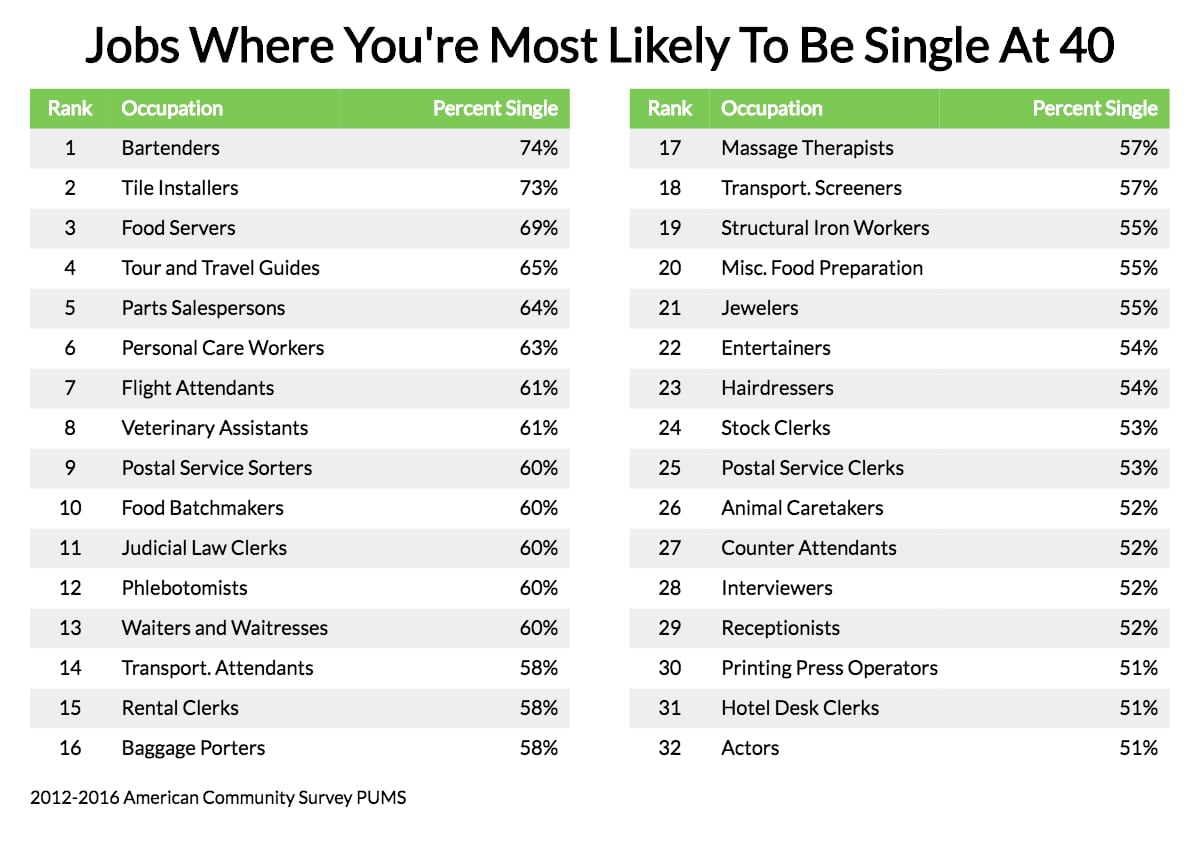
Top 10 Jobs Where You’re Most Likely To Be Single At 40
- Bartenders: 74%
- Tile installers: 73%
- Food servers, non-restaurant: 69%
- Tour and travel guides: 65%
- Parts salespersons: 64%
- Personal care workers: 63%
- Flight attendants: 61%
- Veterinary assistants: 61%
- Postal service mail workers: 60%
- Food batchmakers: 60%
To identify the professions most common among single individuals at age 40, we analyzed census data.
Summary of Findings
- Bartenders lead the list, with 74% being single.
- Tile installers follow closely at 73%.
- Sales engineers rank as the least common profession for single 40-year-olds, with fewer than 10% remaining single.
- Many of these roles are situated within high-turnover industries.
- Careers such as chief executives and dentists tend to have lower divorce rates, contributing to fewer single individuals in these fields.
Bartenders
A key factor contributing to the high number of single bartenders is their reliance on tips, which can be enhanced through social interactions with patrons. In urban areas, many bartenders can earn six-figure incomes, making their careers a priority.
High Turnover Industries
The professions most frequently associated with being single at 40 often reside in high-turnover sectors. Workers in these fields may dedicate themselves to their careers, leaving little time for serious relationships. Additionally, many of these jobs involve travel, which can further discourage settling down with a partner.
Often, these roles include commission structures, incentivizing longer work hours and reducing opportunities for personal connections.
How We Did It
Using data from the 2017-2021 American Community Survey PUMS dataset, we analyzed full-time workers aged 40 and ranked professions by the percentage of single individuals.
The analysis was conducted separately for men and women to identify gender-specific trends in singlehood at this age.
More Info
Takeaways
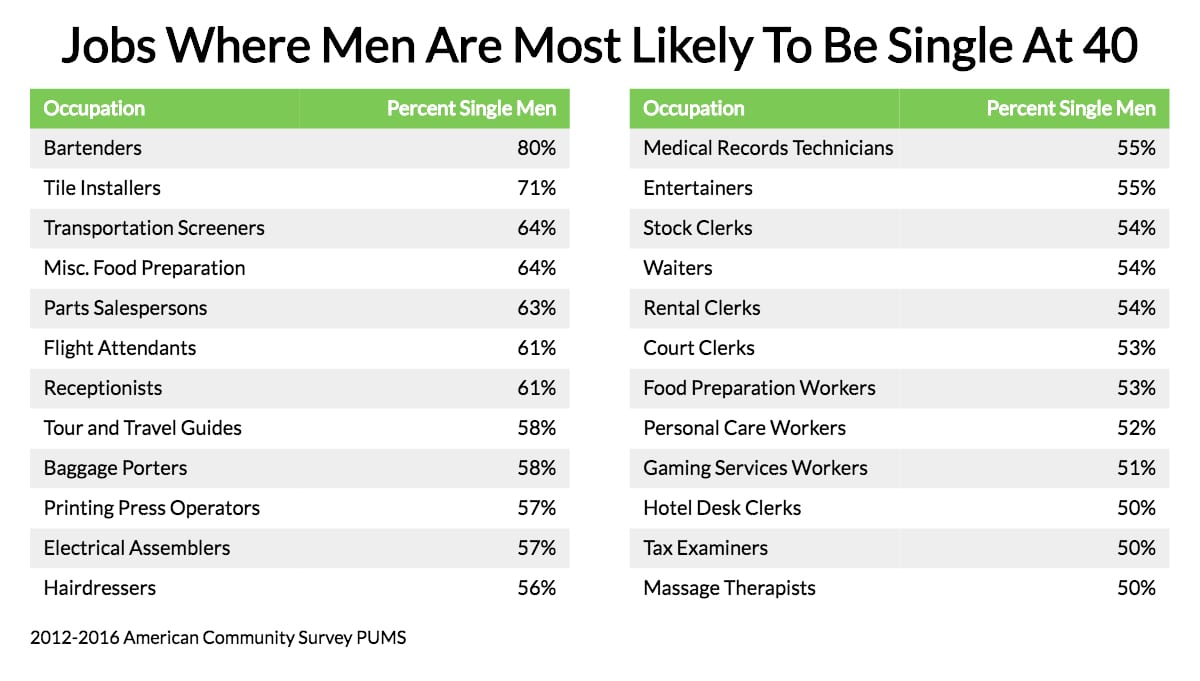
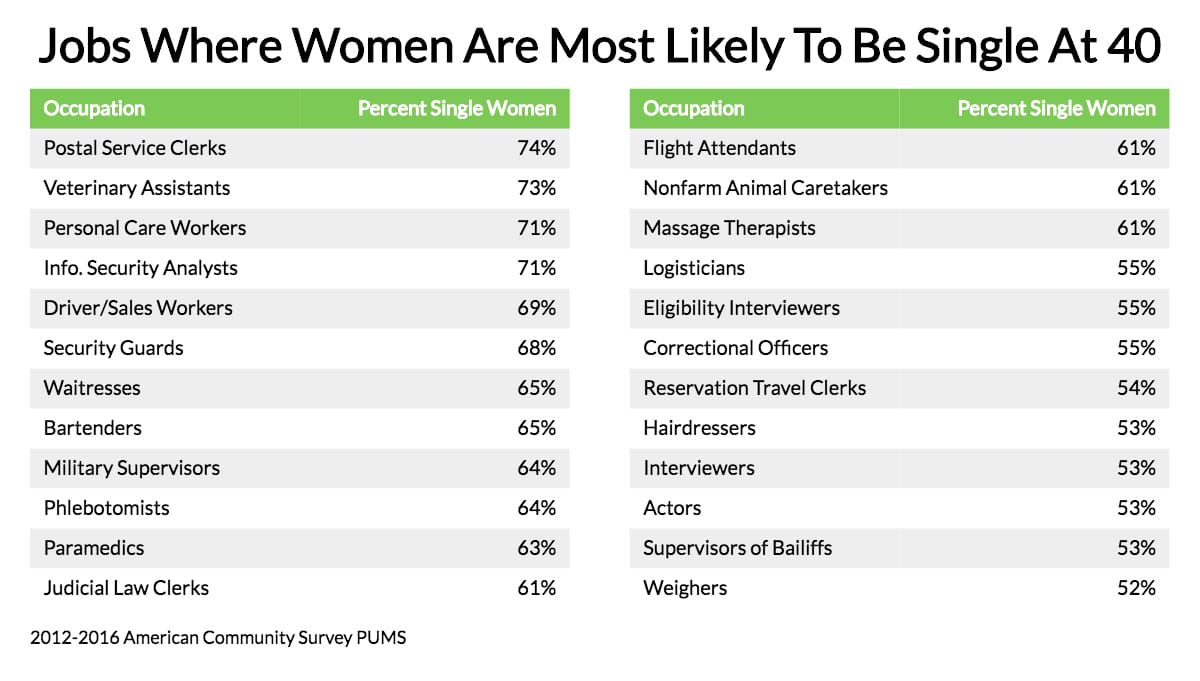
- Men and women share six professions on the list of most common jobs for single 40-year-olds.
- Single 40-year-old men predominantly hold the same top two positions as the general single population: bartenders and tile installers.
- Postal service clerks (74%) and veterinary assistants (73%) are the most common professions for single 40-year-old women.
- Taxi drivers rank as the least common job for single men, with fewer than 7% being single.
- For women, chiropractors are among the least likely to be single, with just over 14% remaining unattached.
Changing Times
As the millennial marriage rate continues to decline, the number of Americans who remain single throughout their lives is on the rise. This shift is reflected in the workplace, with an increasing percentage of single workers.
Research indicates that women often seek job stability in a partner, yet the decline in male workforce participation complicates this dynamic.
Jobs Where You’re Least Likely To Be Single At 40
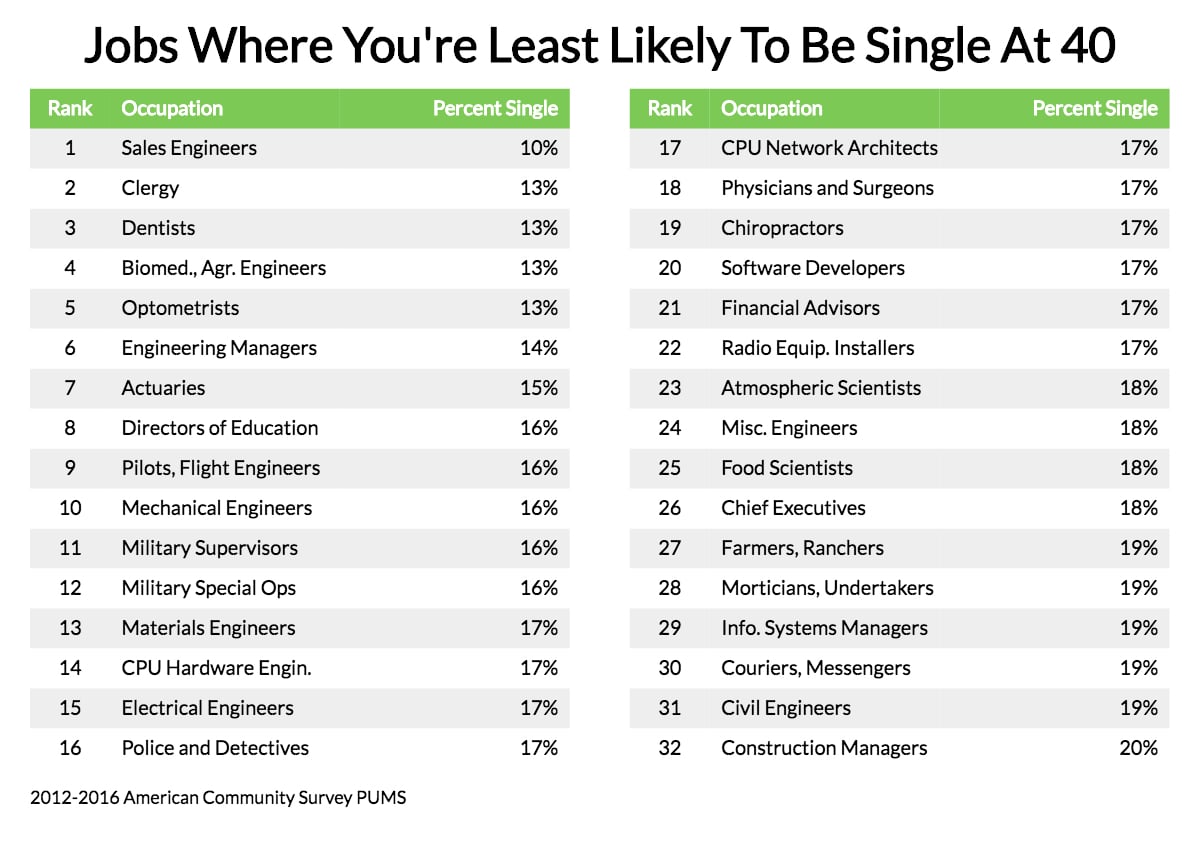
For comparison, let’s explore which professions are most likely to have individuals in committed relationships by the age of 40.
Takeaways
- Engineering professions dominate the list, accounting for 10 of the top 32 spots.
- Sales engineers are the most likely to be in a relationship at 40, with only 10% remaining single.
- Surprisingly, morticians rank low, with only 19% being single at age 40—one can only imagine the dinner conversations.
- Many positions in this category offer high salaries, but it’s clear that relationships are built on more than just financial gain.

Author

McLeod Brown is a former writer and researcher for the Zippia Career Advice blog. His work at Zippia focused on understanding the relationship between colleges, debt, and jobs. A graduate of the University of North Carolina at Wilmington with a BA in Business Administrator, he is now pursuing a masters of science in analytics from the Institute of Advanced Analytics.