- Formulas
- APR Formula
- Total Variable Cost Formula
- How to Calculate Probability
- How To Find A Percentile
- How To Calculate Weighted Average
- What Is The Sample Mean?
- Hot To Calculate Growth Rate
- Hot To Calculate Inflation Rate
- How To Calculate Marginal Utility
- How To Average Percentages
- Calculate Debt To Asset Ratio
- How To Calculate Percent Yield
- Fixed Cost Formula
- How To Calculate Interest
- How To Calculate Earnings Per Share
- How To Calculate Retained Earnings
- How To Calculate Adjusted Gross Income
- How To Calculate Consumer Price Index
- How To Calculate Cost Of Goods Sold
- How To Calculate Correlation
- How To Calculate Confidence Interval
- How To Calculate Consumer Surplus
- How To Calculate Debt To Income Ratio
- How To Calculate Depreciation
- How To Calculate Elasticity Of Demand
- How To Calculate Equity
- How To Calculate Full Time Equivalent
- How To Calculate Gross Profit Percentage
- How To Calculate Margin Of Error
- How To Calculate Opportunity Cost
- How To Calculate Operating Cash Flow
- How To Calculate Operating Income
- How To Calculate Odds
- How To Calculate Percent Change
- How To Calculate Z Score
- Cost Of Capital Formula
- How To Calculate Time And A Half
- Types Of Variables
Find a Job You Really Want In
In today’s rapidly evolving business landscape, effective expense management is crucial for any organization. Understanding how to calculate fixed costs plays a vital role in determining net profit, a key indicator of financial health. Expenses can be categorized into two primary types: fixed costs and variable costs.
Fixed costs are expenses that remain constant regardless of the level of production or sales. These costs are essential for business operations and are often referred to as overhead or indirect costs.
Variable costs, on the other hand, fluctuate based on production volume. As output increases, variable costs rise; conversely, they decrease when production slows. Understanding this distinction is crucial for effective budgeting and pricing strategies.
Key Takeaways:
- Fixed costs are calculated by summing up all fixed cost items or by deducting total variable costs from the total cost.
- Fixed costs are periodic expenses that do not change with output levels.
- Average fixed cost is determined by dividing total fixed costs by the number of units produced.
- The break-even point can be calculated by dividing total fixed costs by the difference between product price and variable costs per unit.
- Marginal cost is calculated as the change in total cost divided by the change in quantity produced.
How to Calculate a Fixed Cost Formula
Accurately calculating fixed costs is essential for effective financial planning. To do this, businesses can employ a fixed cost formula, which clarifies which costs remain fixed within total expenses. There are two main methods for calculating fixed costs:
-
Using Multiple Fixed Costs: This involves adding together all known fixed costs. The formula can be expressed as:
Total Fixed Cost = F1 + F2 + F3 + … -
Using Variable Costs: If only total costs and variable costs per unit are available, fixed costs can be calculated using the formula:
Fixed Cost = Total Cost – (Variable Cost Per Unit * Units Produced)
Each method has its advantages and challenges. Let’s explore both options with practical examples.
Fixed Cost Formula: Option 1, Using Multiple Fixed Costs
To calculate total fixed costs, itemize all known fixed expenses. The formula looks like this:
Total Fixed Cost = F1 + F2 + F3 + …
Where Fn represents an individual fixed cost.
For example:
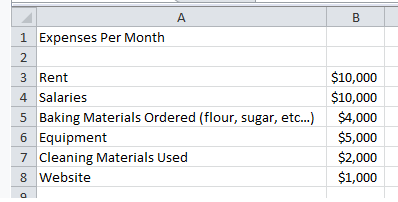
Imagine you operate a small bakery and have compiled a list of monthly expenses in an Excel spreadsheet.
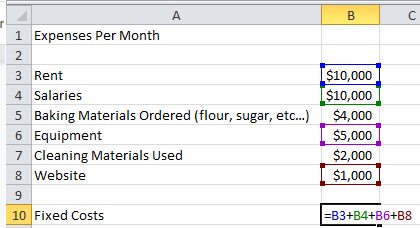
First, differentiate fixed costs from variable ones. In this case, fixed costs include rent (B3), salaries (B4), equipment (B5), and website hosting (B8).
Next, in Excel, you would use the formula:
“=B3+B4+B5+B8”.
Upon pressing enter, Excel will sum these costs to yield “$26,000”.
This method is effective if your business maintains a detailed expense list. However, it requires accurate identification of fixed costs and thoroughness in compiling all relevant items. If this proves challenging, consider the second method for calculating fixed costs.
Fixed Cost Formula: Option 2, Using Variable Costs
In scenarios where only total costs and variable costs are recorded, fixed costs can still be determined. The fixed cost formula relies on three factors: the variable cost per unit, the total production cost, and the number of units produced.
To compute fixed costs, first multiply the variable cost per unit by the quantity produced, then subtract this from the total production cost. The formula is as follows:
Fixed Cost = Total Cost – (Variable Cost Per Unit * Units Produced)
Using the bakery example:
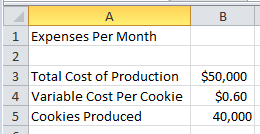
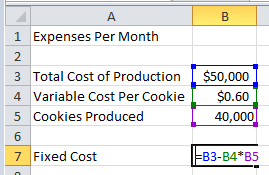
Suppose your total costs amount to $50,000, the variable cost per cookie is $0.60, and you produced 40,000 cookies this month. In your Excel spreadsheet, it would appear as follows:
Using the formula, subtract the product of the variable cost per cookie (B4) and the number of cookies made (B5) from the total production cost (B3). In Excel, the formula would be =B3-B4*B5. It should look like this:
Upon pressing enter, this yields a fixed cost of $26,000, consistent with the prior calculation.
It’s crucial to calculate total variable costs before determining fixed costs. Knowing the variable cost per unit is straightforward since it changes with output, and tracking total output makes calculating total variable costs a simple multiplication task.
How to Calculate Average Fixed Cost
Once you establish the total fixed costs, this information can serve multiple purposes, including budgeting and pricing strategies.
Calculating the average fixed cost allows you to ascertain the fixed cost per unit produced, irrespective of sales volume. This average fixed cost is instrumental in pricing products and services. Understanding fixed production costs prior to incorporating variable costs enables you to establish a consistent expense framework, aiding in the determination of an appropriate starting price.
To calculate the average fixed cost, divide your total fixed cost by the number of units produced. The formula is:
Average Fixed Cost = Total Fixed Cost / Units Produced
In the cookie bakery scenario:
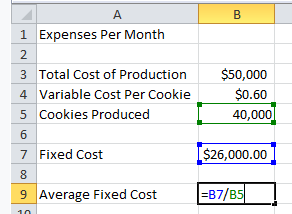
Create an Excel formula for the average fixed costs by dividing total fixed costs (B7) by the number of cookies produced (B5).
After hitting enter, your average fixed cost is calculated at $0.65 per cookie.
With this information, your variable cost per cookie is $0.60. Combining this with your average fixed cost of $0.65 results in a total cost of $1.25 per cookie. To ensure profitability, your retail price must exceed $1.25 per cookie.
Understanding average fixed costs also reveals how increased production can enhance profit margins. As production volume rises, fixed costs per unit decrease, allowing for potential price reductions while maintaining profitability. For instance, selling 100,000 cookies in a month would reduce your average fixed cost to $0.26 per cookie, fostering the possibility of lowering prices without sacrificing profits.
This illustrates why larger companies, such as Walmart, can offer competitive pricing while remaining profitable—their high production output significantly lowers average fixed costs.
What Is A Fixed Cost?
Fixed costs are recurring expenses typically tied to a schedule or contractual agreement. While not permanent, any alterations to fixed costs do not correlate directly with production output levels. These costs are generally calculated over short periods, such as monthly, quarterly, or annually.
Common examples of fixed costs include:
- Rent/Mortgage: Regardless of business activity, you must pay for your physical location, typically unchanged unless lease terms are renegotiated.
- Salaries: Salaries represent fixed labor costs, with changes generally unrelated to production levels.
- Insurance: Fixed costs also encompass insurance premiums, determined by contractual agreements.
- Depreciation: Tangible assets like machinery depreciate over time, and these costs can be calculated by the accounting department.
- Taxes: Taxes imposed by governments remain fixed regardless of business performance, with the exception of some variable taxes based on output.
- Interest: Loans incur periodic interest payments based on contractual terms.
- Fees/Permits: Certain businesses incur recurring fees or require permits to operate, which may be one-time or ongoing expenses.
What Is Break-Even Point?
The break-even point represents the minimum revenue required for a business to avoid losses. To determine this point, you must understand both total fixed and variable costs.
Before launching a new business, it’s advisable to project your break-even point. It can also serve as a valuable metric for optimizing existing operations or specific projects.
The formula for calculating the break-even point is:
Break-even Point = Fixed Costs / (Price – Variable Costs per Unit)
For example:
Assuming your total fixed monthly costs (rent, utilities, salaries, taxes) amount to $30,000, and you sell soft drink products at a variable cost of $0.60 each while selling them for $2.50, you can insert the values into the formula:
$30,000 / (2.50 – 0.60) = 15,789.5
This means you must sell 15,790 soft drinks per month to break even. Sales beyond this point will yield profit.
Businesses can also be categorized based on their financial performance:
- Operating at a Loss: Revenue is less than the sum of variable and fixed costs.
- At Break-Even Point: Revenue equals the sum of variable and fixed costs.
- Operating at a Profit: Revenue exceeds the sum of variable and fixed costs.
Fixed Cost FAQ
- How do you calculate fixed cost per unit? To find fixed cost per unit, start by determining total fixed costs using one of the methods outlined above. Then divide that figure by the total units produced. For instance, if total fixed costs are $50,000 and 5,000 units are sold, the fixed cost per unit would be $10.
- What is the total cost formula? The total cost formula is:
(Average Fixed Cost x Average Variable Cost) x Number of Units Produced = Total Cost
Total cost is a valuable metric for assessing product line viability; however, calculating total costs can be complex for businesses with extensive service offerings.
- How do you find marginal cost? Marginal cost represents the expense of producing an additional unit. For instance, if producing 25 cookies costs $5.00, the cost to produce the 26th cookie reflects your marginal cost. The formula for marginal cost is:
Marginal Cost = Change in Cost / Change in Quantity
- What is an example of total fixed cost? Typical fixed costs include rent/mortgage, salaries, utility bills, insurance, taxes, and interest. Essentially, any recurring expense necessary to maintain operations, excluding direct production costs, qualifies as a fixed cost.
- Formulas
- APR Formula
- Total Variable Cost Formula
- How to Calculate Probability
- How To Find A Percentile
- How To Calculate Weighted Average
- What Is The Sample Mean?
- Hot To Calculate Growth Rate
- Hot To Calculate Inflation Rate
- How To Calculate Marginal Utility
- How To Average Percentages
- Calculate Debt To Asset Ratio
- How To Calculate Percent Yield
- Fixed Cost Formula
- How To Calculate Interest
- How To Calculate Earnings Per Share
- How To Calculate Retained Earnings
- How To Calculate Adjusted Gross Income
- How To Calculate Consumer Price Index
- How To Calculate Cost Of Goods Sold
- How To Calculate Correlation
- How To Calculate Confidence Interval
- How To Calculate Consumer Surplus
- How To Calculate Debt To Income Ratio
- How To Calculate Depreciation
- How To Calculate Elasticity Of Demand
- How To Calculate Equity
- How To Calculate Full Time Equivalent
- How To Calculate Gross Profit Percentage
- How To Calculate Margin Of Error
- How To Calculate Opportunity Cost
- How To Calculate Operating Cash Flow
- How To Calculate Operating Income
- How To Calculate Odds
- How To Calculate Percent Change
- How To Calculate Z Score
- Cost Of Capital Formula
- How To Calculate Time And A Half
- Types Of Variables

Author

Conor McMahon is a writer for Zippia, with previous experience in the nonprofit, customer service and technical support industries. He has a degree in Music Industry from Northeastern University and in his free time he plays guitar with his friends. Conor enjoys creative writing between his work doing professional content creation and technical documentation.