Find a Job You Really Want In
Maternity leave in the United States remains a complex issue. As of 2026, the U.S. is still the only developed nation that does not guarantee paid maternity leave for new mothers. This absence of a national policy means that companies are left to establish their own maternity leave policies, leading to significant variability across industries and organizations.
In an evolving job market, maternity leave is often viewed as a benefit rather than a standard right. Consequently, certain professions are significantly more likely to offer paid maternity leave than others.
To help clarify which jobs are most (and least) likely to provide this essential benefit, we analyzed over 1.5 million job listings.
Best Jobs For Maternity Leave
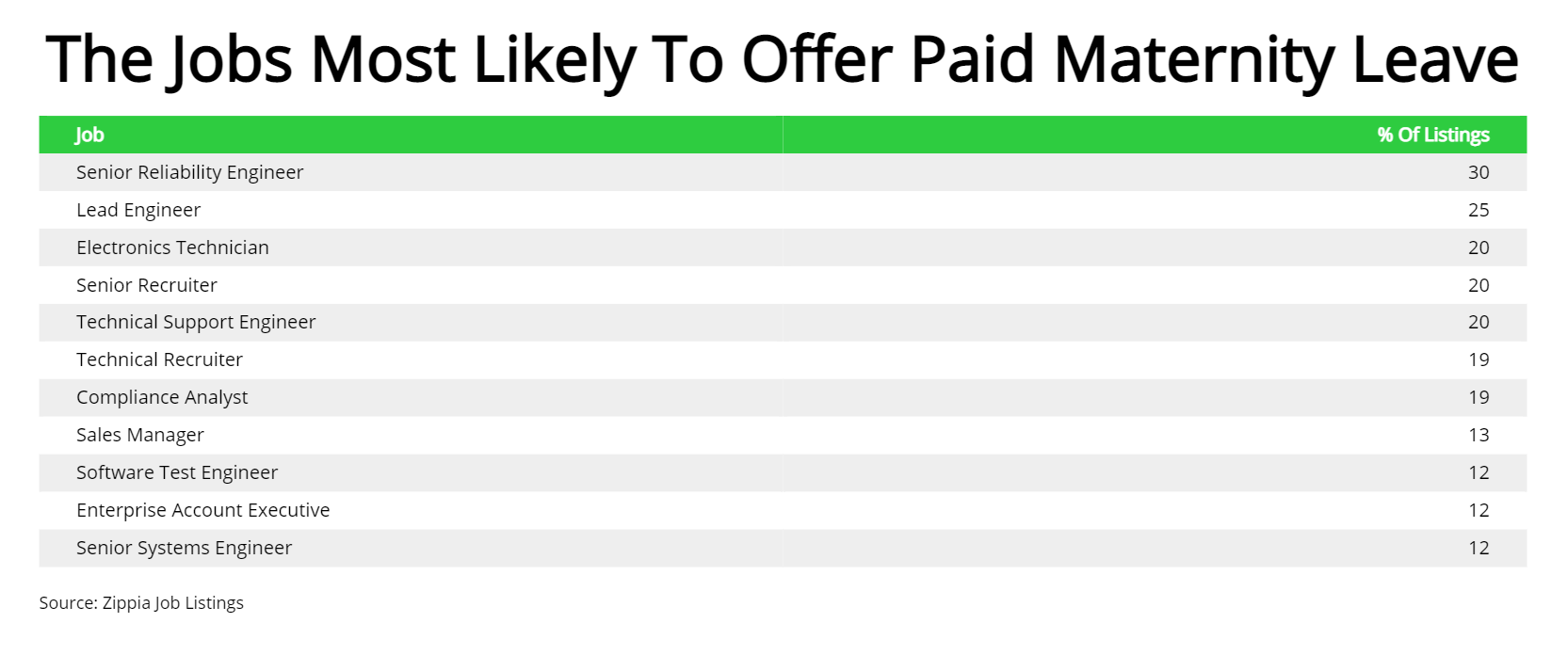
The chart above highlights job titles where over 10% of listings mention paid maternity leave. Unsurprisingly, many of these positions are in higher-paying sectors, often requiring advanced education or extensive work experience.
Notably, a significant number of these roles are within the technology sector, where companies are recognized for their comprehensive benefits packages, which frequently include generous maternity and parental leave.
Worst Jobs For Maternity Leave
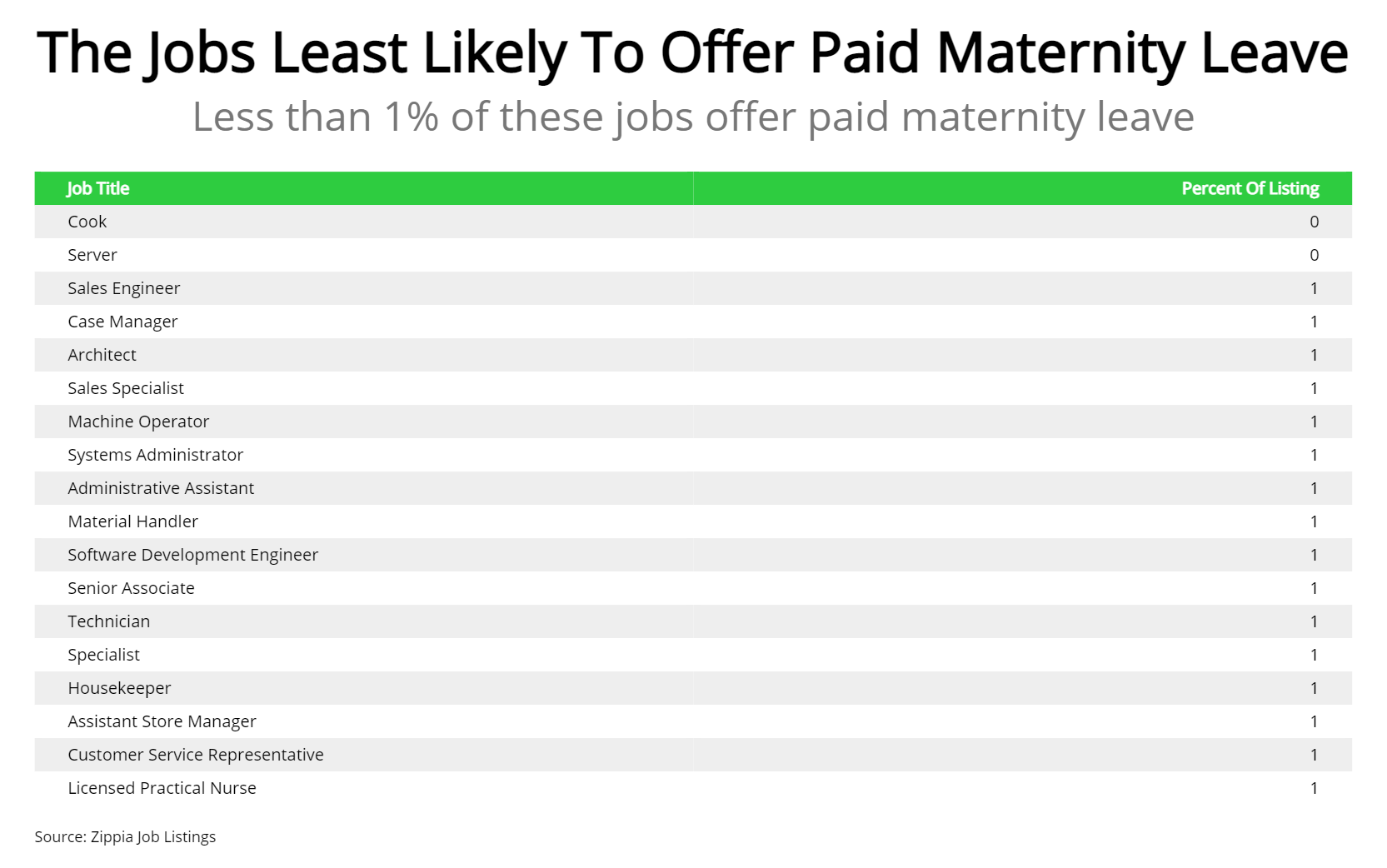
The chart above illustrates job titles where less than 1% of listings mention paid maternity leave.
Notably, the roles of cook and server report 0% listings for paid maternity leave, reflecting the challenges faced by those in common, lower-paying positions.
In addition to these roles, other low-wage jobs such as Material Handler, Machine Operator, and Housekeeper also feature prominently on this list, with average annual salaries below $30,000.
How We Determined This
To identify which jobs provide the most maternity leave benefits, we analyzed a database of job listings, examining over 1.5 million postings for relevant keywords.
The percentage of job listings that included maternity leave benefits serves as an indicator of how many positions in that field offer this crucial support. Although the absence of keywords does not definitively indicate a lack of paid maternity leave, companies that provide this benefit often advertise it as a competitive advantage in attracting talent.
Class And Income Impact Availability Of Leave
Typically, higher-paying jobs are more likely to offer paid maternity leave. In the current landscape of maternity leave in the U.S., many women find themselves searching for employment among a limited pool of companies that provide this benefit.
Employers offering paid maternity leave often utilize this advantage to attract skilled talent. However, women across all income brackets frequently encounter challenges, as the majority of new mothers in the U.S. still lack access to paid maternity leave. Even within the “best job” category, only 30% of listings provide this benefit.
The U.S. mandates that new mothers receive up to 12 weeks of unpaid leave under the Family and Medical Leave Act (FMLA), yet this only applies to employees of companies with 50 or more employees and who have been with the company for at least one year. Consequently, roughly half of all women are eligible for this unpaid leave, and many struggle to take it due to financial constraints.
In conclusion, understanding the landscape of maternity leave is crucial for job seekers and employers alike. As the job market continues to evolve in 2026, awareness of which professions offer paid maternity leave can empower women to make informed career choices.

Author

Kathy is the head of content at Zippia with a knack for engaging audiences. Prior to joining Zippia, Kathy worked at Gateway Blend growing audiences across diverse brands. She graduated from Troy University with a degree in Social Science Education.