Research Summary. Current statistics indicate that over 6 million blog posts are published globally each day, predominantly in English, followed by Spanish. High-quality blogs can generate substantial income for their creators, ranging from thousands to even millions of dollars annually, while serving as powerful marketing tools. Our data analysis team has synthesized the following findings:
-
Bloggers consistently publish more than 6 million blog posts daily worldwide.
-
The first blog post was introduced in 1994.
-
Blogs significantly influence consumer behavior, with over 60% of consumers making purchasing decisions based on articles or videos from brands.
-
While many bloggers start their journey aiming to earn money, less than 10% are successful in monetizing their blogs.
-
The average blog post length is approximately 1,416 words, although posts exceeding 2,000 words with multimedia elements often achieve better engagement.
-
Tumblr hosts around 518 million blogs, while WordPress remains the leading content management system with 60 million blogs.
-
Over half of all bloggers fall within the age range of 21 to 35.
-
Establishing a successful blog hinges on building credibility through consistent, high-quality content, appealing design, and an active social media presence.
-
The four most popular blog niches are food, lifestyle, travel, and arts and crafts.
For more in-depth analysis, you can explore the following categories:
Historical | Marketing | Earnings | Formatting | Platform | Age and Gender | Credibility | Niche

General Blogging Statistics
Every day, millions of blog posts are generated, primarily in English. While the average user reads approximately 10 posts daily, most tend to skim, spending less than 30 seconds on each article.
-
Currently, there are over 600 million blogs globally, contributing to more than 6 million posts per day, amounting to over 2.5 billion annually.
-
Users create about 77 million new blog comments each month.
-
As of 2020, there were 31.7 million bloggers in the United States.
-
Blogs constitute more than one-third of all websites.
-
California has a higher concentration of bloggers than the entire country of Canada.
-
English remains the most prevalent blogging language.
-
77% of internet users engage with blogs.
-
Individuals read around 10 blog posts per day.
-
43% of readers admit to skimming blog content.
-
The median time spent on an article is approximately 37 seconds.
-
Blogs and social networks occupy 23% of total internet time.
-
U.S. internet users dedicate three times more time to blogs than to email.
-
The peak traffic time for most blogs occurs on Monday at 11 AM, while the highest comment activity is noted on Saturdays at 9 AM.
-
Professional bloggers manage an average of four blogs.
Historical Blogging Statistics
Blogging officially began in 1994, with video blogging or vlogging emerging six years later.
-
Freelance journalist Justin Hall posted the inaugural blog in 1994.
-
Jorn Barger introduced the term ‘weblog’ on December 17, 1997.
-
The first blogging platform, Open Diary, was launched in 1998.
-
Peter Merholz coined the term ‘blog’ in 1999.
-
Adrian Miles created the first video blog in 2000, referring to it as a ‘vog.’
Blog Marketing Statistics
Blogging is widely regarded as a cornerstone of content marketing strategies, enhancing consumer awareness of companies and their offerings, boosting lead growth, and driving site traffic.
-
Search engines remain the primary traffic source for blogs across all sectors.
-
In 2019, 77% of marketers prioritized written content.
-
21% of bloggers focus on marketing rather than content creation.
-
68% of social media marketers incorporate blogs into their strategy, while 89% of content marketers utilize blog posts in their content creation efforts.
-
45% of marketers identify blogging as the most vital component of their content strategy.
-
76% of social media marketers are likely to engage in blogging, compared to only 6% of business-to-consumer marketers; however, 86% of B2B companies actively maintain a blog.
-
On average, small businesses with fewer than ten employees allocate 42% of their marketing budget to content marketing.
-
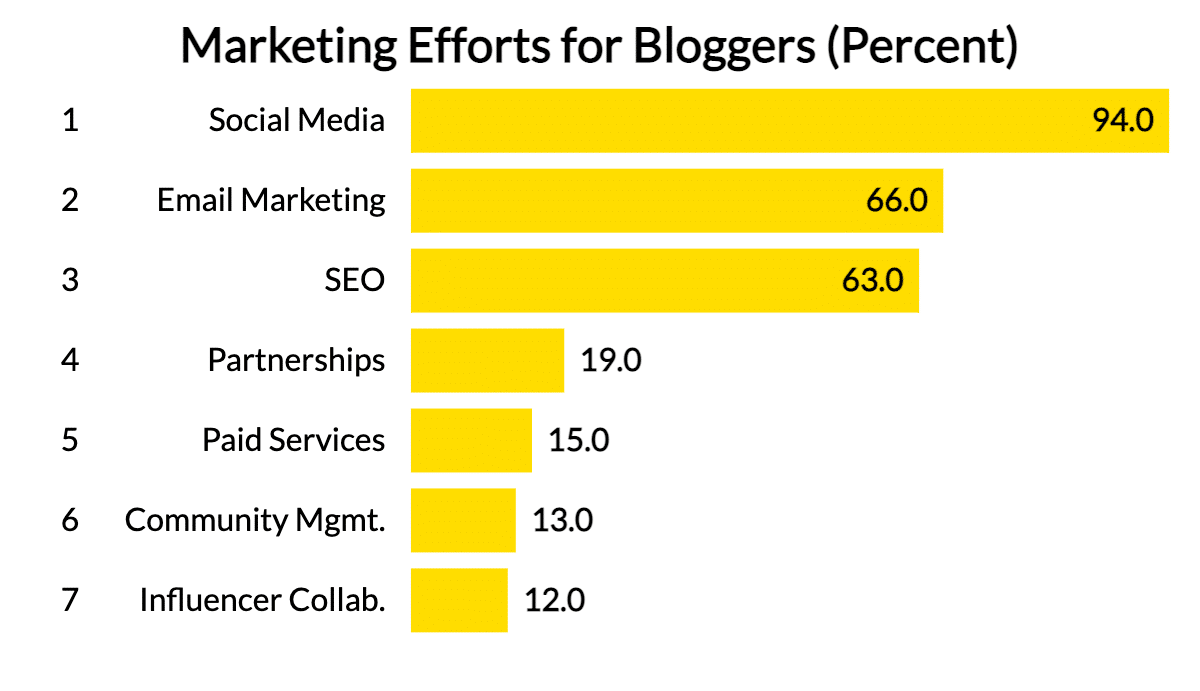
Marketing strategies for bloggers include:
-
Social media (94%);
-
SEO (63%);
-
Email marketing (66%);
-
Partnerships and collaborations (19%);
-
Community or forum management (13%);
-
Influencer collaboration (12%);
-
Paid services (15%).
-
-
70% of consumers discover a company through articles rather than advertisements.
-
Small businesses that maintain a blog experience 126% more lead growth than those that do not.
-
B2B marketers utilizing blogs generate 67% more leads compared to those who do not.
-
90% of bloggers direct traffic to their sites through social media, 68% through SEO, 62% via email marketing, 10% via influencer collaborations, and 13% through paid promotions.
-
32% of social media marketers republish blog content on Facebook, with 25% doing so on LinkedIn.
-
The primary challenges faced by bloggers include:
-
Finding time to create and promote content: 53%;
-
Driving traffic and attracting visitors: 49%;
-
Consistently creating quality content: 39%;
-
Maintaining content volume: 35%;
-
Generating relevant topic ideas: 20%.
-
-
61% of U.S. online consumers have made purchases based on blog recommendations.
-
60% of consumers feel more favorable toward a company after engaging with its custom content.
-
43% of buyers have viewed three to five pieces of content before interacting with a sales representative.
-
61% of individuals attribute their purchase decisions to vlogs on YouTube.
Blogging Statistics by Earnings
While most bloggers express a desire to earn money through their efforts, only a small fraction (less than 10%) achieve any income. Among those who do, about 10% earn over $10,000 annually.
-
The primary motivation for blogging is financial gain, with two-thirds of bloggers citing it as their main goal.
-
14% of bloggers receive a salary from their blogging activities.
-
33% of bloggers have monetized their blogs; approximately 10% earn over $10,000 per year, while the top 0.6% earn more than $1 million.
-
Despite the low income generation rate, less than 10% of all bloggers earn any revenue.
-
Bloggers primarily earn income through ads, affiliate marketing, sponsored reviews, their products, and online courses.
-
Google AdSense remains the most popular monetization strategy, closely followed by affiliate marketing.
-
High-income bloggers utilize paid promotion 10.3 times more than their lower-income counterparts.
-
Bloggers earning over $50,000 annually are over four times more likely to employ video content, eight times more likely to offer free resources, and five times more likely to host podcasts compared to lower-income bloggers.
-
For bloggers earning over $50K per year, the primary traffic sources include Google, email, Facebook, influencer outreach, and YouTube. Those earning less typically rely on Facebook, Google, Twitter, email, and Instagram for traffic.
-
Marketers focusing on blogging are 13 times more likely to see a positive return on investment (ROI).
-
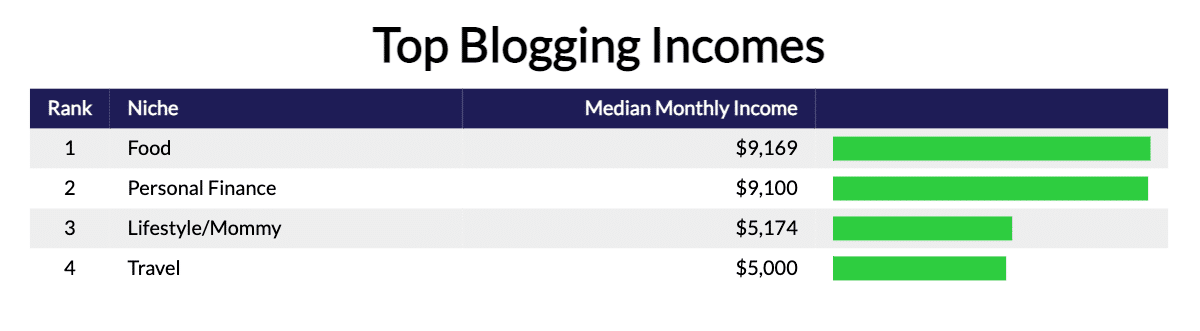
Food bloggers report a median monthly income of $9,169, while personal finance bloggers earn $9,100. Other high-earning niches include lifestyle/mommy blogs ($5,174) and travel ($5,000).
Blog Formatting Statistics
To optimize performance, most successful blog posts—whether instructional, list-based, or interviews—are typically over 2,000 words long and incorporate multimedia elements such as images and videos.
-
The average blog post length stands at 1,416 words.
-
47% of bloggers integrate two to three images within a typical post.
-
The optimal blog post headline should be 60 characters long.
-
Most bloggers (61%) draft two to three headlines before finalizing their posts.
-
Headlines of eight to 12 words tend to perform better on Twitter, while those with 12 to 14 words are more successful on Facebook.
-
Blog posts featuring images garner 94% more total views.
-
A general guideline suggests including one image for every 350 words.
-
Users spend 10% more time engaging with images than with written content.
-
90% of bloggers incorporate images in their posts, with only 25% including videos.
-
The suggested length for a blog introduction is 150 characters.
-
The ideal blog post length is approximately 2,100 words and takes about seven minutes to read.
-
Long-form content (2,000+ words) typically receives more shares, ranks higher in search results, and attracts more backlinks than shorter articles.
-
Articles exceeding 3,000 words achieve three times more traffic, four times more shares, and 3.5 times more backlinks than shorter pieces.
-
47% of blog readers expect a two-second load time.
-
76% of bloggers create how-to articles, 54% produce listicles, and 45% develop long-form guides and e-books. The most successful formats include roundups (30%), gated content (29%), and interviews (27%).
-
Listicles generate twice the shares compared to other blog formats.
-
41% of bloggers have initiated and published original research in the past year.
-
44% of bloggers edit their own content, while 17% collaborate with a formal editor.
-
23.3% of bloggers publish weekly, while 20% publish between two to six posts weekly.
-
Over the last five years, the average time spent writing a post has increased from 2 hours 24 minutes to 3 hours 28 minutes, while the average length of blog posts has risen from 808 to 1,151 words.
| How Long Does It Take to Write a Typical Blog Post? | |
|---|---|
| Year | Time |
| 2014 | 2 hrs 24 min |
| 2015 | 2 hrs 35 min |
| 2016 | 3 hrs 16 min |
| 2017 | 3 hrs 20 min |
| 2018 | 3 hrs 28 min |
| 2019 | 3 hrs 57 min |
| 2020 | 3 hrs 55 min |
| 2021 | 4 hrs 1 min |
Blogging Statistics by Platform
WordPress continues to be the preferred content management system (CMS) for bloggers, while Tumblr hosts the largest number of blogs overall.
-
Tumblr holds the majority of blogs with approximately 518 million.
-
WordPress, the leading CMS, ranks second with around 60 million blogs.
-
18% of marketers select WordPress as their CMS.
-
Wix supports a blogging platform for over 180 million users.
-
Squarespace hosts approximately 2.5 million blogs.
-
More than 50% of bloggers using Facebook as their primary platform report increased difficulty in driving traffic.
-
WordPress garners over 409 million monthly views across more than 20 billion pages.
-
WordPress users generate around 70 million new posts and 77 million new comments monthly.
-
WordPress captures 64.2% of the CMS market share and powers 39.9% of all web pages.
-
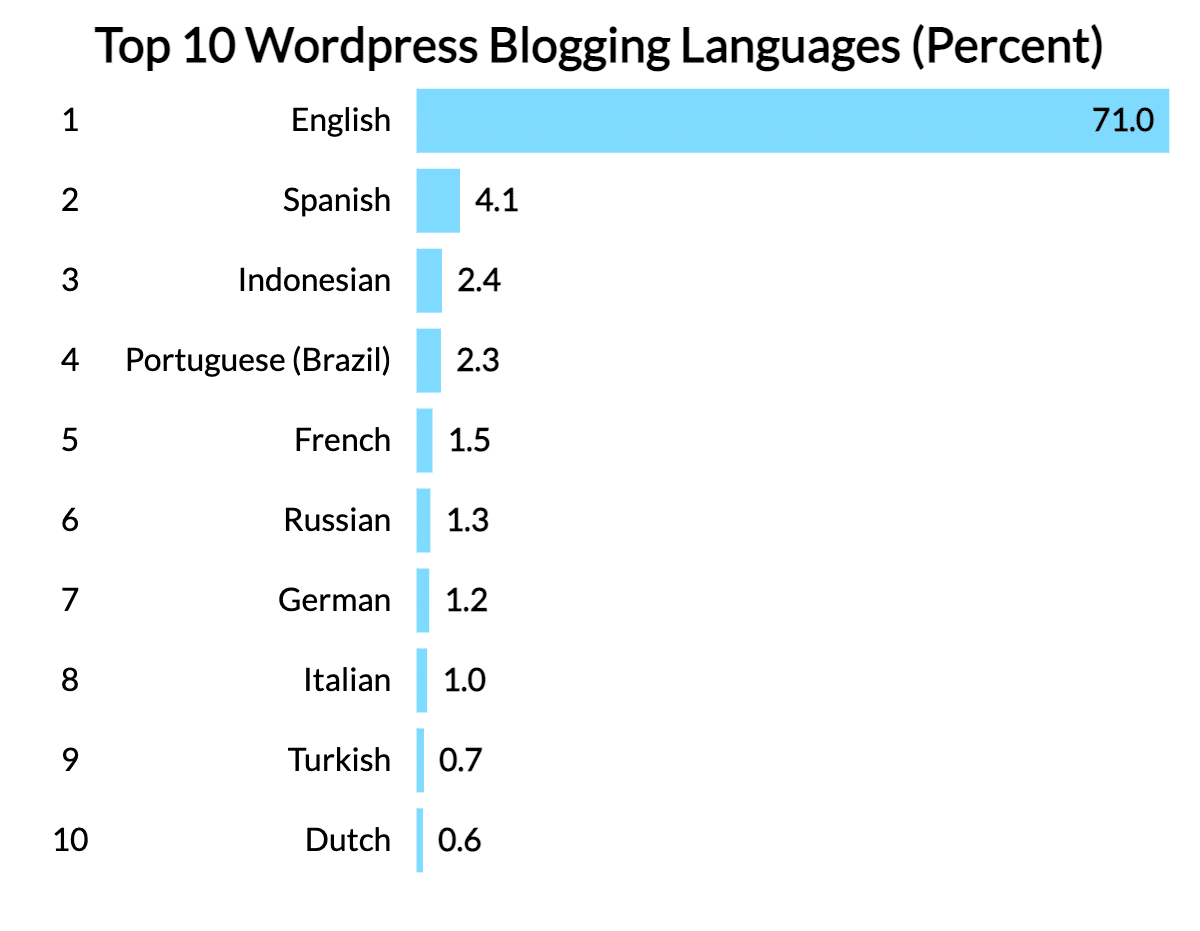
WordPress supports blogs in over 120 languages. Here’s the breakdown of the top 10:
-
English: 71%
-
Spanish: 4.7%
-
Indonesian: 2.4%
-
Portuguese (Brazil): 2.3%
-
French: 1.5%
-
Russian: 1.3%
-
German: 1.2%
-
Italian: 1%
-
Turkish: 0.7%
-
Dutch: 0.6%
-
Blog Statistics by Age and Gender
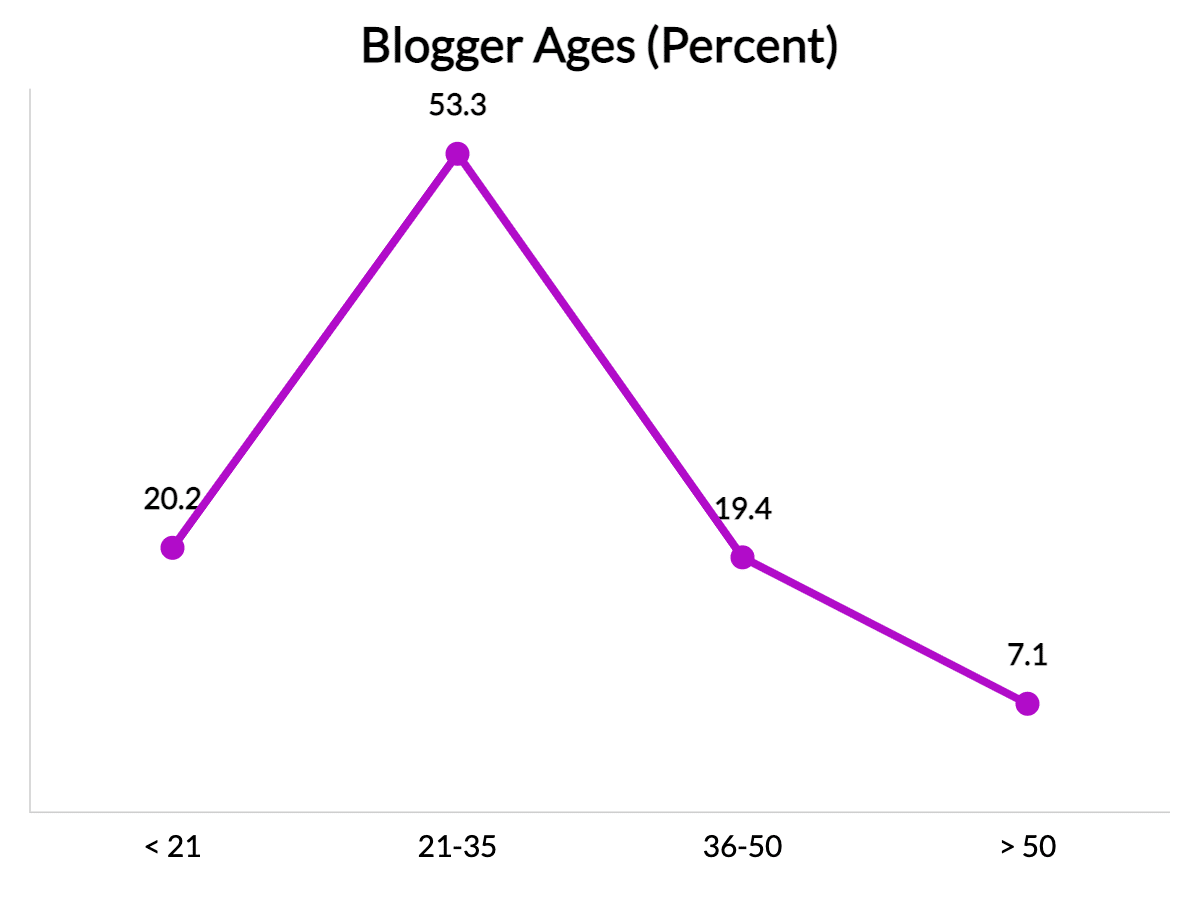
Bloggers are represented across all age groups, with a notable concentration of those aged 35 or younger.
-
53.3% of bloggers are aged between 21 and 35. Other demographics include:
-
Under 21 years: 20.2%;
-
36-50 years: 19.4%;
-
Over 50 years: 7.1%.
-
-
49.1% of bloggers identify as male, while 50.9% identify as female.
Blogging Statistics Related to Credibility
Building a credible blog necessitates time and consistent publication of high-quality, well-designed content.
-
68.52% of respondents believe that blogs enhance website credibility.
-
The primary factors contributing to a blog’s credibility include quality content (30%), appealing design (17%), regular publishing (15%), and a strong social media presence (13%).
-
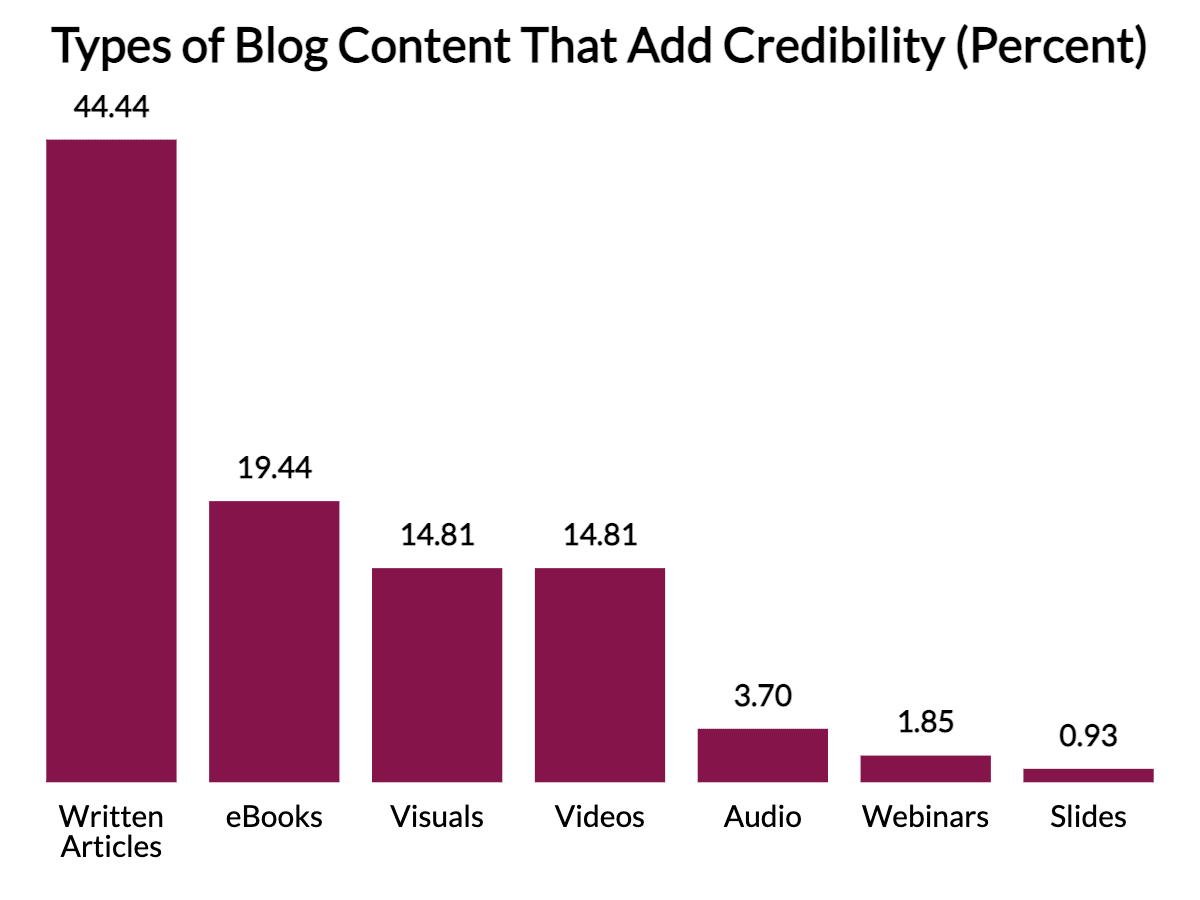
The types of blog content that enhance credibility include:
-
Written articles (44.44%);
-
eBooks (19.44%);
-
Visuals (14.81%);
-
Videos (14.81%);
-
Audio (3.7%);
-
Webinars (1.85%);
-
Slides (0.93%).
-
-
The top factors that undermine a blog’s credibility include:
-
Poor content (23.84%);
-
Subpar design (21.35%);
-
Fake social media followers (17.44%);
-
Negative content (13.17%);
-
Excessive advertisements (11.74%);
-
No shares (4.27%);
-
Few or no subscribers (4.27%);
-
No comments (3.91%).
-
Blog Statistics by Niche
-
The four leading blog niches (food, lifestyle, travel, arts/crafts) collectively represent 74% of all high-traffic blogs.
-
The top three niches for new bloggers are lifestyle (25%), travel (18%), and food (13%).
-
The most successful niches in terms of high-traffic blogs include food (42.8%), lifestyle/mommy (13.3%), and travel (10%).
Blog Post FAQ
-
How many blog posts are published per day?
Over 6 million blog posts are published daily across 1.9 billion global websites. This is double the 2 million posts published daily in 2012, indicating a significant rise in blogging popularity over the past decade.
-
What is the number one traffic source to blogs?
Search engines serve as the primary traffic source for blogs across all sectors. This underscores the critical importance of SEO optimization, enabling Google to present relevant keywords to searchers visiting your site.
Other vital traffic sources for blogs include social media, email marketing, and direct traffic.
-
How much time does it take to write a blog post?
The average time to compose a blog post is approximately 4 hours and 10 minutes. This figure reflects the average for a typical blog post, which is 1,376 words long. Posts under 1,000 words generally take less time to write, while those exceeding 2,000 words may require significantly more time.
-
How much money does a blogger make?
Most bloggers earn between $38,440 to $51,906 annually. Less than 10% of bloggers generate any income, with approximately 10% earning over $10,000 each year. Furthermore, only 0.6% make more than $1 million.
-
How often should you publish blog posts?
It is recommended to publish blog posts at least once a week. However, the optimal frequency varies based on individual circumstances and the nature of the blog. Smaller companies often find success with one post weekly, while larger organizations or more established bloggers may post daily or multiple times a day.
Typically, the most effective publishing rates range from one to six times per week, with 23.3% of bloggers posting weekly and 20% posting two to six times each week.
Regardless of your posting schedule, consistency is key to ensuring your audience knows when to expect new content.
-
How many views per day is good for a blog?
Achieving over 1,000 views per day is considered successful for a blog. This is especially true if your goal is to monetize the blog. New blogs or those intended as creative outlets may be satisfied with 100 views daily.
For monetization purposes, aiming for over 1,000 unique visitors each day is a commendable goal—anything below that can complicate monetization. It’s important to remain patient, particularly during the early stages of your blog, and focus on steadily increasing your daily views.
-
What are the average page views per day for a blog?
The average daily views for a blog range between 150 and 1,500. Concrete studies on blog view statistics are scarce, but general consensus suggests that numbers can vary widely based on the blog’s age, topic, audience, and promotional strategies.
Smaller blogs might be content with 100 daily views, while larger, more established blogs typically attract over 1,000 visitors each day. The crucial takeaway is to consistently increase your average daily page views, which signifies progress for your blog.
Sources
-
Hosting Tribunal. How Many Blogs Are There? We Counted Them All! Accessed on 10/7/21.
-
WordPress. A live look at activity across WordPress.com. Accessed on 10/7/21.
-
Orbit Media Studios. New Blogging Statistics: Survey of 1067 Bloggers Shows Which Content Strategies are Working in 2021. Accessed on 10/7/21.
-
Contently. The Lost Art of the Mid-Range Blog Post. Accessed on 10/7/21.
-
GrowthBadger. Data from Our Study of 1,117 Bloggers (Income, Tactics More). Accessed on 10/7/21.
-
KissMetrics. The Science of Social Timing: Part 3, Timing and Blogging. Accessed on 10/8/21.
-
Social Marketing Writing. How to Build a Credible Blog. Accessed on 10/8/21.
-
RankIQ. The Most Profitable Blog Niches Study. Accessed on 10/8/21.
-
Statista. Number of bloggers in the United States from 2014 to 2020. Accessed on 10/8/21.
-
Daily Infographic. The State of the Blogging Industry 2017. Accessed on 10/8/21.
-
Hubspot. The Ultimate List of Marketing Statistics for 2021. Accessed on 10/8/21.
-
SEMrush. 81 of the Most Up-to-Date Blogging Statistics in 2021. Accessed on 10/8/21.

Author

Chris Kolmar is a co-founder of Zippia and the editor-in-chief of the Zippia career advice blog. He has hired over 50 people in his career, been hired five times, and wants to help you land your next job. His research has been featured on the New York Times, Thrillist, VOX, The Atlantic, and a host of local news. More recently, he's been quoted on USA Today, BusinessInsider, and CNBC.