- Income Statistics
- Average PTO Days
- What Percentage of Americans Live Paycheck to Paycheck?
- Average American Income
- Millionaire Statistics
- Average Salary out of College
- Average Bonus Statistics
- Minimum Wage Statistics
- Union Benefits Statistics
- Savings Statistics
- Average Annual Raise
- Income Inequality Statistics
- How Many People Make Over 100k?
- Average 401(k) Sstatistics
- Average Net Worth Statistics
- $100k After-Tax Income By State
- Average Global Income
How Many People Make Over $100k Per Year?
Research Summary: The median income in the US stands at $44,225. Despite this, many Americans aspire to earn more, with the goal of surpassing $100,000 annually often seen as a key milestone toward financial independence and success.
So, how many Americans actually achieve this financial benchmark?
To gain insight into how many individuals earn over $100k per year, we’ve compiled essential facts and data. Our research reveals:
-
18% of individual Americans earn over $100k annually.
-
34.4% of US households report incomes exceeding $100k per year.
-
37% of White households make over $100k, compared to only 22% of Black households.
-
9% more men earn $100k annually than women in the US.
-
Between 2017 and 2022, the percentage of US households earning over $100k per year increased by 2.97%.
For a deeper dive, we’ve organized the data as follows:
General | Gender | Race | Age | Over Time
General $100k Income Statistics
To understand more about earning $100k or more in the US, consider the following general statistics:
-
Only 15.5% of Americans earn between $100,000 and $149,999 per year.
While this group represents the largest segment of high earners, only 8.3% earn between $150,000-$199,999, and 10.3% earn over $200k.
Annual Income Share of Americans Less than $100k 65.6% $100k-$149.9k 15.5% $150k-$199.9k 8.3% $200k+ 10.3% -
45% of Americans earning over $100k live paycheck-to-paycheck.
Contrary to the belief that higher income leads to more financial stability, nearly half of high earners are struggling to make ends meet. In fact, the percentage of over $100k earners living paycheck-to-paycheck rose sharply in recent years, reflecting ongoing economic pressures.
-
82% of Americans making over $100k annually believe they need at least $200k to feel wealthy.
This contrasts with 56% of Americans who think earning $100k would qualify as rich, highlighting differing perceptions of wealth across various income brackets.
$100k Incomes by Gender
Significant disparities persist between men and women in terms of income. Here are key insights from our research:
-
17% of all men earn over $100k annually, compared to just 8.4% of women.
Men are approximately twice as likely to earn $100k or more per year compared to women. This statistic is based on surveys from recent years.
-
53.5% more men working full-time earn $100k annually when compared to women.
Among full-time workers, 28.4% of men earn over $100k, while only 18.5% of women reach that threshold.
-
San Jose, California, has the highest percentage of women earning $100k or more, at 34%.
Other cities with notable percentages of high-earning women include: San Francisco, California (31%), Washington, D.C. (27%), Stamford, Connecticut (25%), and Boston (21%).
-
The average woman earns 83% of what her male counterparts earn.
On average, men earn 17 cents more per dollar than women, leading to substantial income disparities over the course of a career.
$100k Incomes By Race
Race significantly influences income levels in the US. Our findings highlight the following:
-
51% of Asian households earn $100k or more annually.
Asian households represent the highest earning demographic, with 17.7% earning between $100,000 and $149,999, 12.2% earning between $150,000 and $199,999, and 21.1% earning $200,000 and above.
Annual Income Share of Asian Households $100k-$149.9k 17.7% $150k-$199.9k 12.2% $200k+ 21.1% -
37% of White households earn $100k or more annually.
White households constitute a significant portion of the population, with 16.6% earning between $100,000 and $149,999, 8.6% earning between $150,000 and $199,999, and 12.1% earning $200,000 and above.
Annual Income Share of White Households $100k-$149.9k 16.6% $150k-$199.9k 8.6% $200k+ 12.1% -
27% of Hispanic households earn $100k or more annually.
Hispanic households face greater challenges in reaching the $100k mark compared to their White or Asian counterparts, with 14.3% earning between $100,000 and $149,999, 5.9% earning between $150,000 and $199,999, and 6.8% earning $200,000 and above.
Annual Income Share of Hispanic Households $100k-$149.9k 14.3% $150k-$199.9k 5.9% $200k+ 6.8% -
Only 22% of Black households earn $100k or more annually.
Black households consistently show lower percentages of high earners, with just 11.4% earning between $100,000 and $149,999, 4.6% between $150,000 and $199,999, and 5.7% earning $200,000 or more.
Annual Income Share of Black Households $100k-$149.9k 11.4% $150k-$199.9k 4.6% $200k+ 5.7% -
68.2% more White households earn over $100k compared to Black households.
With 37% of White households surpassing the $100k income threshold versus only 22% of Black households, a stark disparity persists.
-
18% of White working men earn over $100k annually, compared to 8% of Black working men.
This highlights a significant income gap between these demographic groups.
$100k Incomes By Age
Income levels also vary significantly across age groups. Here are some notable trends:
-
Americans under 25 who earn over $100k annually are in the top 1% of earners in their age group.
Among those aged 18-24, only 1% earn $100k or more, making this the lowest earning demographic.
-
Americans see the most significant income growth between ages 25 and 35.
Only 2% of 25-year-olds earn over $100k; by age 35, this jumps to 12%, marking a 500% increase in high earners.
-
21% of 66-year-olds earn $100k or more annually.
Generally, older Americans tend to earn more, with over 20% of those aged 66 and older making $100k or more.
| Age | Share of Americans who make $100k or more |
|---|---|
| 20 | 1% |
| 25 | 2% |
| 30 | 7% |
| 35 | 12% |
| 40 | 15% |
| 45 | 16% |
| 50 | 16% |
| 55 | 18% |
| 60 | 17% |
| 65 | 18% |
| 70 | 20% |
$100k Incomes Over Time
Overall, the number of Americans earning over $100k annually has been on the rise. Various factors, such as inflation and job growth, contribute to this trend. Key insights from our research include:
-
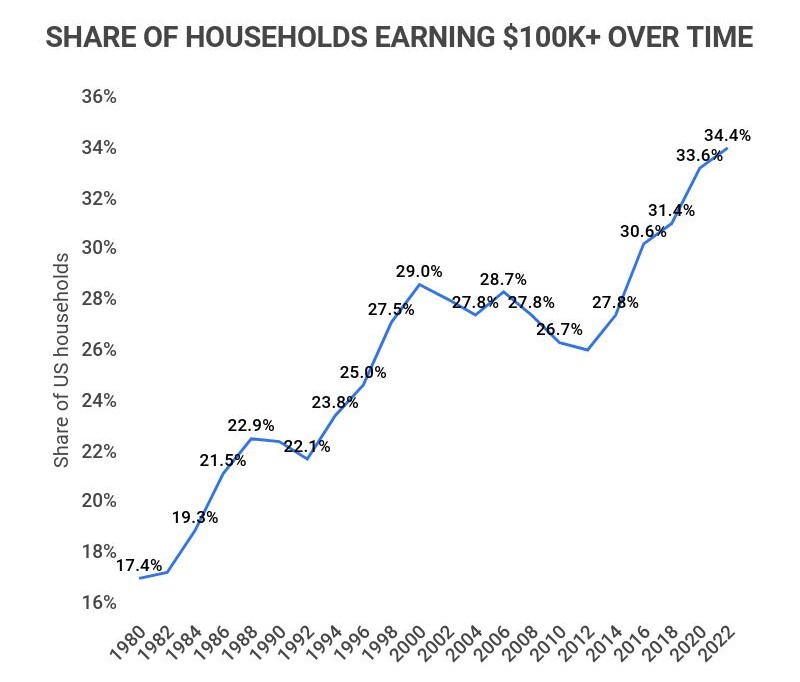
Between 2017 and 2022, the percentage of US households earning over $100k increased by 2.97%.
Although there was a dip from 34.6% to 33.6% in 2020 due to economic disruptions, the overall trend has been upward in recent years.
-
From 1980 to 2022, the share of Americans earning $100k or more nearly doubled.
Around 17.4% of Americans earned $100k in 1980, compared to 34.4% by 2022.
Year Share of Americans who make $100k or more 1980 17.4% 1985 20.0% 1990 22.8% 1995 24.2% 2000 29.0% 2005 27.8% 2010 26.7% 2015 29.6% 2020 33.6% -
96% of Americans earning over $100k are worried about inflation.
Moreover, 65% express that they are “very concerned” about inflation, leading 46% of these high earners to reduce their spending.
People Making Over $100k Per Year FAQ
-
What is the median salary in the US?
The median salary in the US is $44,225 as of 2022. The majority of Americans (54.98%) earn $50k or less, while only 18% of individuals earn $100k or more.
In this context, Americans are significantly more likely to earn below $50k than to exceed the $100k threshold.
-
What is considered a good salary?
A “good salary” varies based on numerous factors, including your location and the local cost of living. For instance, the average annual salary in Des Moines, Iowa is $67,519, with a median home price of $183K. In contrast, average salaries in NYC may reach $100,260, but the cost of living is substantially higher at $789K for homes.
On average, weekly earnings in the US exceed $1,000, suggesting that any salary above this figure might be viewed as a good income.
-
Is making $100k considered rich?
In the US, earning $100k per year is not typically classified as rich; it is often viewed as upper-middle class. In some high-cost areas, it may even be considered lower-middle class. However, 56% of Americans believe that a six-figure income qualifies as rich.
Conclusion
In the United States, 18% of individual Americans and 34.4% of households earn $100k or more annually. This figure has risen by 2.97% over the last five years and has nearly doubled since 1980.
However, it’s essential to recognize that the distribution of $100k+ earners is not uniform. For instance, men are 9% more likely to earn this income compared to women, and White households are 68.2% more likely to reach this income level than Black households.
As we move forward, it remains crucial to focus on providing equal opportunities for all workers, enabling everyone to achieve their potential and enhance their earning capacity.
References:
-
CNBC – How much money Americans say they need to make to feel rich
-
CNBC – The 10 U.S. cities where women are most likely to earn $100,000 or more
-
Visual Capitalist – Visualizing American Income Levels by Age Group
- Income Statistics
- Average PTO Days
- What Percentage of Americans Live Paycheck to Paycheck?
- Average American Income
- Millionaire Statistics
- Average Salary out of College
- Average Bonus Statistics
- Minimum Wage Statistics
- Union Benefits Statistics
- Savings Statistics
- Average Annual Raise
- Income Inequality Statistics
- How Many People Make Over 100k?
- Average 401(k) Sstatistics
- Average Net Worth Statistics
- $100k After-Tax Income By State
- Average Global Income

Author

Jack Flynn is a writer for Zippia. In his professional career he’s written over 100 research papers, articles and blog posts. Some of his most popular published works include his writing about economic terms and research into job classifications. Jack received his BS from Hampshire College.