Understanding Workplace Conflict: Key Statistics for 2026. Navigating workplace dynamics can be challenging, whether you’re facing a chatty coworker or a demanding boss. Conflicts in the workplace are inevitable and can significantly impact employee well-being, organizational productivity, and the broader economy. We’ve compiled the latest statistics on workplace conflict to shed light on this pressing issue:
-
85% of employees report experiencing conflict at work.
-
On average, US workers spend 2.8 hours each week dealing with conflict.
-
49% of workplace conflicts stem from personality clashes.
-
76% of employees tend to avoid conflict rather than confront it directly.
-
Workplace conflict costs US companies approximately $359 billion annually in lost productivity.
For a deeper dive into the topic, explore our detailed sections on: Causes of Workplace Conflict | How Workplace Conflict is Handled | Results of Workplace Conflict | Cost of Workplace Conflict | Effects of Conflict Management Training
Frequency of Workplace Conflict
Chances are that you have encountered workplace conflict in some form. The reality might be more alarming than you think. Here’s a look at how frequently these conflicts occur:
-
36% of employees often experience workplace conflict.
Since 2008, there has been a notable increase, with the figures rising from 29% to the current 36%.
-
The prevalence of workplace conflict has surged by approximately 25% since 2008.
Today, more than a third of workers are regularly facing conflicts.
-
Managers dedicate an average of 4.3 hours each week to managing conflict.
This time commitment has doubled since 2008, leading to a significant loss of productivity daily.
Causes of Workplace Conflict
As workplace conflicts rise, understanding their root causes becomes essential. Here are some key contributors to these conflicts:
-
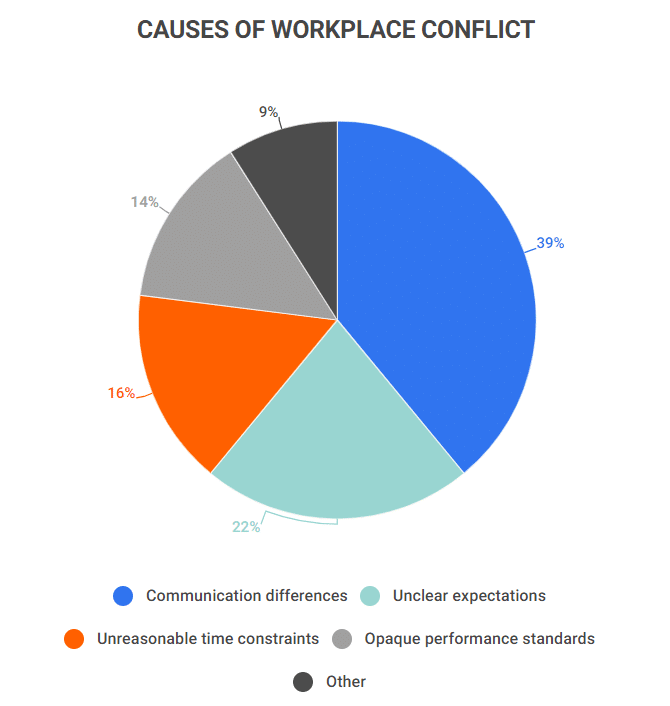
22% of conflicts arise from unclear expectations.
Many employees are unsure of their roles, leading to misunderstandings with managers and colleagues.
-
Communication differences account for 39% of conflicts.
A significant portion of workplace conflicts can be traced back to just a few primary causes:
Core Causes of Workplace Conflict
Causes Share of Conflicts Communication differences 39% Unclear expectations 22% Unreasonable time constraints 16% Opaque performance standards 14%
How Workplace Conflict is Managed
With the rise in workplace conflicts, identifying effective management strategies is crucial. Here’s how conflicts are typically addressed:
-
54% of employees escalate coworker conflicts to higher management.
Meanwhile, 60% of employees attempt to resolve coworker conflicts independently before they escalate.
-
67% of employees actively avoid coworkers they disagree with.
Many individuals choose to sidestep conflict, which can create additional issues in the long run.
-
The predominant conflict resolution style is accommodating, used by 34.3% of employees.
This approach focuses on addressing the needs of the other party first. Other common styles include:
Workplace Conflict Resolution Styles
Conflict Resolution Style Share of Managers Accommodating 34.3% Compromising 18.5% Avoiding 13.9% Collaborating 13.9% Competing 6.5% Combination of Styles 12.9%
Consequences of Workplace Conflict
The repercussions of workplace conflict can be severe for both employees and organizations. Here are some significant outcomes:
-
57% of employees have witnessed conflicts escalating to personal insults or injuries.
Over half of employees report that conflicts can lead to serious issues, with 27% witnessing personal attacks.
-
40% of employees leave jobs due to unresolved conflicts.
Many opt to resign over workplace conflicts, while those who remain often express that their job satisfaction would improve with better conflict resolution.
-
31% of managers believe they manage conflict effectively, whereas only 22% of non-managers agree.
This disparity indicates a disconnect between management perceptions and employee experiences, which can hinder progress.
-
43% of employees feel that managers need better conflict resolution skills, compared to 23% of managers who acknowledge this need.
This highlights a significant gap in the perceived effectiveness of conflict management strategies.
-
87.8% of professionals are open to compromise in conflicts.
The majority of employees prioritize finding resolutions, even if it means making concessions.
The Financial Impact of Workplace Conflict
The financial toll of workplace conflict can be extensive, particularly when considering the hours lost. Here are some key insights into the costs associated with workplace conflict:
-
Employees involved in workplace conflicts are 12% less productive.
Conflict can consume over 8% of an employee’s work time, resulting in decreased productivity and, consequently, reduced profits for businesses.
-
US employees collectively lose the equivalent of 385 million working days annually due to workplace conflict.
With an average loss of 2.8 hours each week, the cumulative effect is staggering.
-
Disengaged employees cost companies 18% of their annual salary in lost productivity.
For an employee earning $60,000 a year, this translates to a loss of approximately $10,800 in productivity.
Impact of Conflict Management Training
Equipping managers and employees with conflict management skills is essential for fostering a healthy workplace. Here are some findings on the effects of such training:
-
60% of employees have never received basic conflict management training.
Addressing this gap could significantly enhance conflict resolution capabilities within organizations.
-
76% of employees who received conflict resolution training report improvements in their ability to handle conflicts positively.
Specifically, 41% feel they have a better understanding of others, while 29% have discovered more effective solutions to workplace challenges post-training.
Frequently Asked Questions About Workplace Conflict
-
What are the primary causes of workplace conflict?
91% of workplace conflict is driven by communication differences, unclear expectations, unreasonable time constraints, and opaque performance standards. The leading cause is communication differences, accounting for 39%, followed by unclear expectations (22%), unreasonable time constraints (16%), and opaque standards (14%).
-
What percentage of full-time employees encounter conflict?
85% of full-time employees face workplace conflict. This equates to nearly 3 hours wasted weekly on conflict resolution, making it a costly affair for most.
-
Is workplace conflict increasing?
Yes, workplace conflict is on the rise, with the percentage of employees experiencing it increasing by nearly 25% since 2008. In 2008, only 29% of employees reported frequent conflicts; today, that figure has risen to 36%.
-
How many employees avoid conflict in the workplace?
76% of employees strive to avoid conflict in the workplace whenever possible. The majority prefer to sidestep conflict, with 67% taking extra measures to avoid coworkers they disagree with.
-
Is workplace conflict always detrimental?
No, workplace conflict can be both functional and dysfunctional. Here’s a brief overview of each:
-
Functional Conflict: Results from differing perspectives, fostering creativity, innovation, and problem-solving. When managed well, it can enhance team dynamics and promote open communication.
-
Dysfunctional Conflict: Arises from personal differences or misunderstandings, hampering productivity and leading to a negative environment. If unchecked, it can escalate stress and diminish morale.
-
Conclusion
Workplace conflict is a pervasive issue that cannot be ignored, with a notable increase in employees reporting frequent conflicts since 2008. Currently, 85% of employees acknowledge experiencing conflict at work.
Regrettably, many individuals lack the skills to navigate these situations effectively. From managers misjudging their conflict resolution abilities to employees actively avoiding confrontations, the challenges persist.
To mitigate the impacts of conflict—such as reduced profits, high turnover, and declining mental health—organizations must prioritize and invest in conflict management training.
References
-
New Research: Time Spent on Workplace Conflict Has Doubled Since 2008
-
SHRM – Reducing Employee Conflict
-
NIH – Conflict resolution styles and skills and variation among medical students
-
Newsweek – Americans Are Raising Grievances About Their Coworkers

Author

Jack Flynn is a writer for Zippia. In his professional career he’s written over 100 research papers, articles and blog posts. Some of his most popular published works include his writing about economic terms and research into job classifications. Jack received his BS from Hampshire College.