American Dream research summary. The American Dream has remained a cornerstone of American identity for generations. The notion that hard work can lead to homeownership and family stability continues to resonate, yet many individuals now perceive this dream as increasingly unattainable.
If you’re an American employee or job seeker curious about the contemporary state of the American Dream, you’re in the right place. We’ve compiled the latest insights, opinions, and statistics regarding this enduring concept. Here’s what our research reveals:
-
24% of Americans believe the American Dream is out of reach.
-
42% of Americans feel they are on track to achieving the American Dream.
-
33% of Americans assert they have already realized the American Dream.
For further analysis, explore our breakdown of the data in the following sections: What is the American Dream? | American Dream Over Time | Is the American Dream Real?
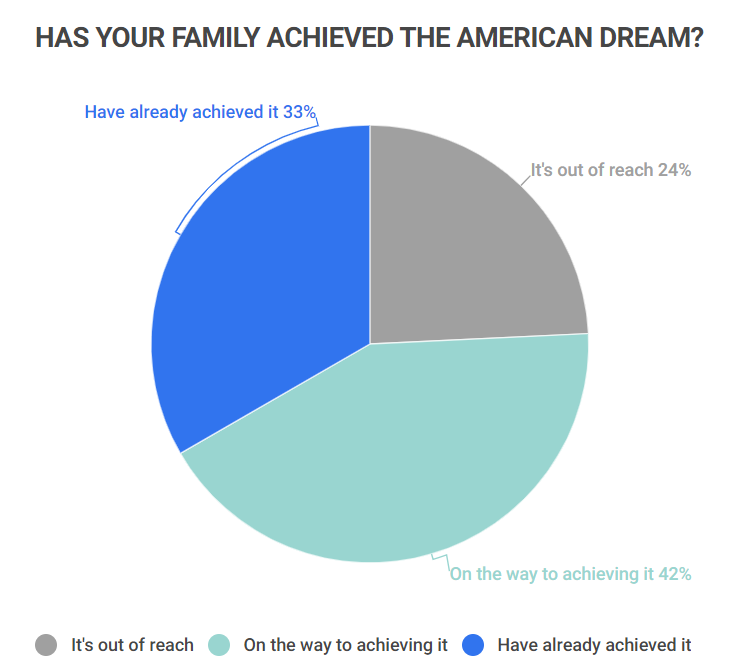
To what extent has your family achieved the American Dream?
| Extent of achievement | Share of Americans |
|---|---|
| It’s out of reach | 24% |
| On the way to achieving it | 42% |
| Have already achieved it | 33% |
American Dream by demographics
The perception of the American Dream varies significantly based on demographic factors. Young Americans and those facing economic hardships often feel particularly disenfranchised. Here are some key insights into how different demographics perceive the American Dream:
-
White Americans are 1.2x more likely to say they’ve achieved the American Dream than Black Americans.
40% of White Americans report achieving the American Dream, in contrast to 18% of Black Americans and 23% of Hispanic Americans. Notably, many from these groups are actively pursuing the dream, with 56% of Black Americans and 48% of Hispanic Americans indicating they are on their way to achieving it.
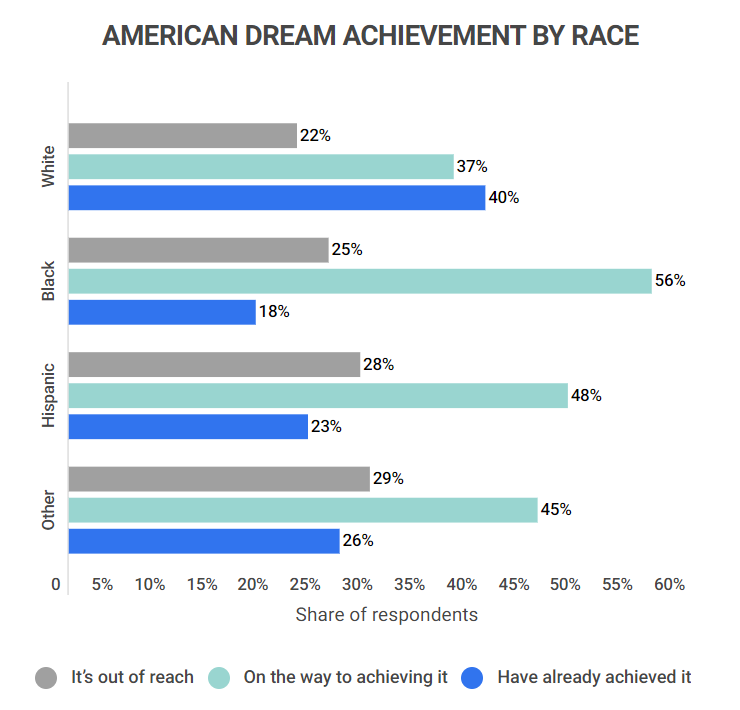
American Dream achievement by race
Race It’s out of reach On the way to achieving it Have already achieved it White 22% 37% 40% Black 25% 56% 18% Hispanic 28% 48% 23% Other 29% 45% 26% -
Men are nearly 10% more likely than women to say the American Dream is achievable.
Men aged 18-49 and those 50+ have similar views, with 73% and 74% asserting it’s achievable, respectively. In contrast, while 73% of women over 50 agree, only 58% of those aged 18-49 share this belief.
American Dream achievement by gender
Gender and age group It’s out of reach Will be able to achieve it Men 18-49 25% 73% Men 50+ 22% 74% Women 18-49 42% 58% Women 50+ 24% 73% -
Americans aged 60+ are over 80% more likely to say they’ve achieved the American Dream than those between 18-29.
47% of Americans who are 60 or older report having achieved the American Dream. Generally, as age decreases, so does the percentage of Americans claiming to have achieved it. Interestingly, those aged 30-44 are the least likely to report achievement, at just 22%.
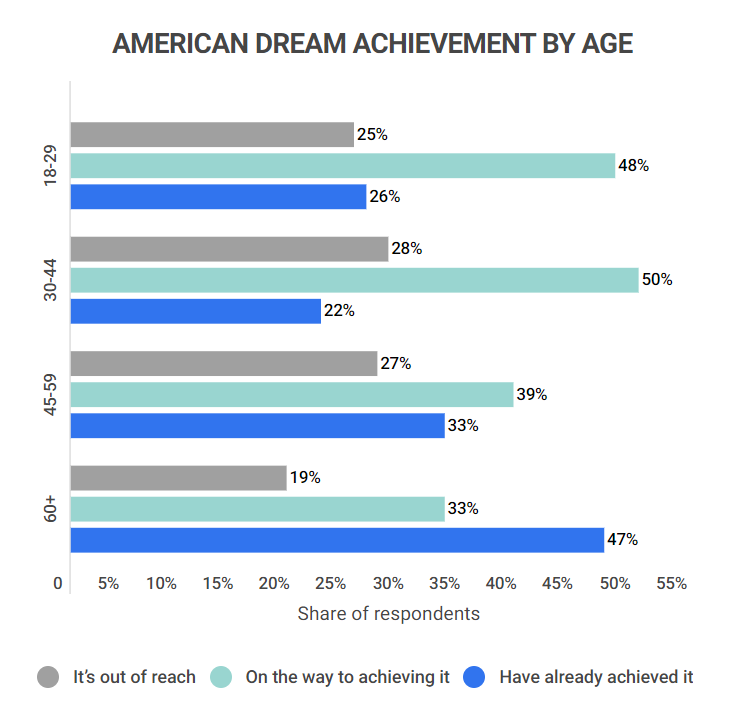
American Dream achievement by age
Age It’s out of reach On the way to achieving it Have already achieved it 18-29 25% 48% 26% 30-44 28% 50% 22% 45-59 27% 39% 33% 60+ 19% 33% 47% -
Individuals earning $100k+ annually are 1.4x more likely to say they have achieved the American Dream than those in the lowest income bracket.
48% of Americans earning $100,000+ annually claim to have achieved the American Dream, with only 11% stating it’s unachievable. In contrast, just 20% of those earning less than $30,000 a year believe they have achieved the American Dream, while 38% deem it unachievable.
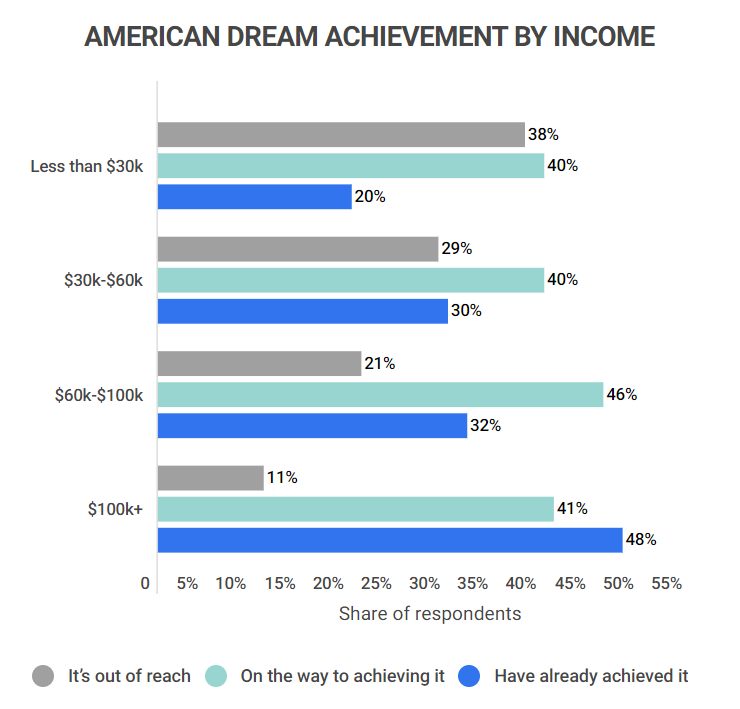
American Dream achievement by income
Annual income It’s out of reach On the way to achieving it Have already achieved it Less than $30k 38% 40% 20% $30k-$60k 29% 40% 30% $60k-$100k 21% 46% 32% $100k+ 11% 41% 48% -
Those with a Bachelor’s degree are 1.3x more likely to claim they’ve achieved the American Dream than those without a high school diploma.
42% of Americans with a Bachelor’s degree assert they’ve achieved the American Dream, compared to only 18% of individuals lacking a high school diploma. The likelihood of claiming to have achieved the American Dream increases with educational attainment.
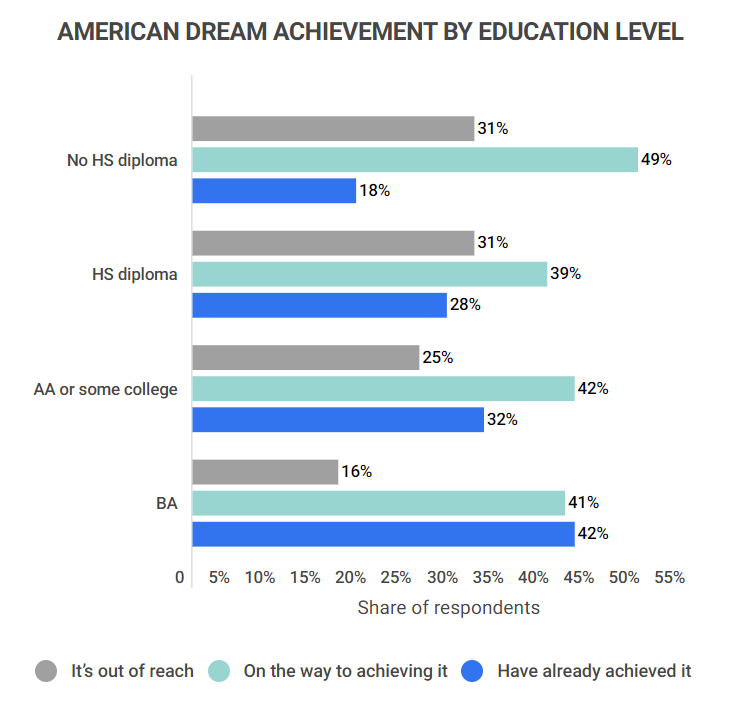
American Dream achievement by education level
Education level It’s out of reach On the way to achieving it Have already achieved it No HS diploma 31% 49% 18% HS diploma 31% 39% 28% AA or some college 25% 42% 32% BA 16% 41% 42%
What is the American Dream?
The American Dream may feel more or less attainable depending on individual circumstances, but what does it truly represent? Here are some key components through which Americans define the American Dream:
What is essential to the American Dream?
| Key aspect | Essential | Important but not essential | Not important |
|---|---|---|---|
| Freedom of choice in how to live | 82% | 14% | 2% |
| Having a good family life | 79% | 17% | 2% |
| Retiring comfortably | 68% | 26% | 3% |
| Owning a home | 50% | 40% | 7% |
| Having a successful career | 42% | 49% | 7% |
| Making valuable contributions to the community | 28% | 57% | 13% |
| Becoming wealthy | 14% | 51% | 31% |
-
82% of Americans view freedom of choice in how to live as the most crucial aspect of the American Dream.
This is closely followed by the importance of family life (79%) and the ability to retire comfortably (68%).
-
Only 14% of Americans deem becoming wealthy as essential to the American Dream.
Interestingly, 31% of Americans feel that wealth is not important at all, making it the least significant factor in their perception of the American Dream.
American Dream over time
Perceptions of the American Dream have evolved over the decades, with younger generations increasingly feeling that upward mobility is diminishing. Effects from recent economic fluctuations continue to influence how Americans perceive the American Dream. Here are notable shifts in perception over time:
-
24% of Americans believe the American Dream is out of reach in 2026.
In 2026, the percentage of Americans who feel the dream is unattainable has resurged, echoing sentiments observed in previous years.
How Americans view the American Dream over time
Year It’s out of reach On the way to achieving it Have already achieved it 2026 24% 42% 33% 2025 18% 50% 30% 2024 20% 45% 34% 2023 24% 45% 29% -
48% of Americans feel they have more opportunities than their parents in 2026.
This marks a decline from 52% in 2020, as the percentage of Americans claiming fewer opportunities has gradually increased.
How Americans view their opportunities compared to their parents
Year Fewer opportunities Same opportunities More opportunities 2026 19% 32% 48% 2025 12% 32% 55% 2024 16% 33% 50% 2023 15% 33% 52% -
Between 1940 and 1980, the likelihood of Americans outearning their parents in the 50th percentile decreased by over 50%.
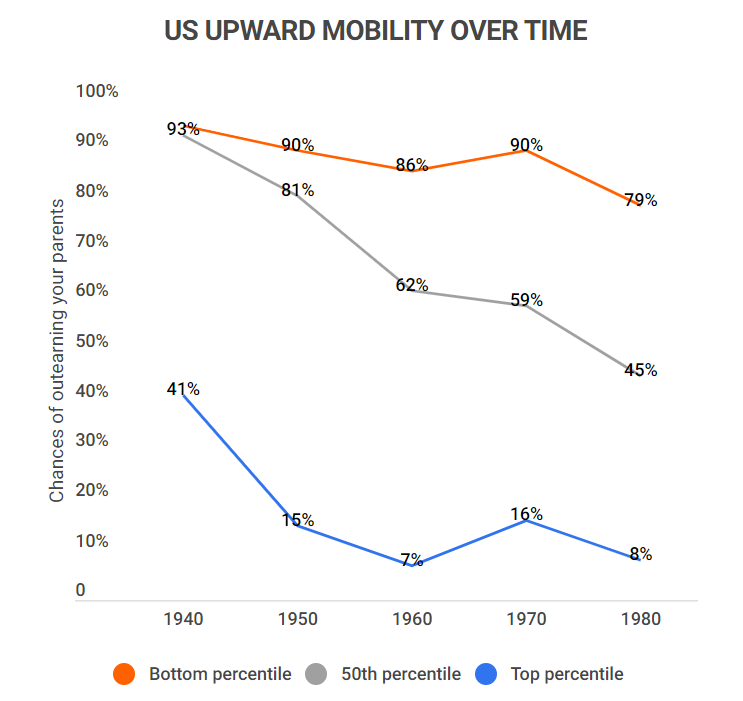
In 1940, 93% of individuals in the 50th percentile expected to earn more than their parents. By 1980, that figure plummeted to 45%. For those in the top income percentile, the probability of outearning parents dropped from 41% to merely 8%.
Chances of Americans outearning their parents over time
Year Chances for the bottom percentile Chances for the 50th percentile Chances for the top percentile 1980 79% 45% 8% 1970 90% 59% 16% 1960 86% 62% 7% 1950 90% 81% 15% 1940 95% 93% 41%
Is the American Dream real?
While the American Dream remains a reality for some, fewer Americans hold a positive view of its attainability. Here’s what the current sentiment looks like regarding the validity of the American Dream:
-
43% of Americans believe the American Dream is real.
Conversely, 35% of Americans doubt its existence, while 23% remain uncertain in 2026.
Is the American Dream real?
Is the American Dream real? Share of adult citizens Yes 43% Unsure 23% No 35% -
Individuals under 30 are 45% less likely to believe the American Dream is real compared to those aged 65 and older.
Only 29% of Americans under 30 believe in the reality of the American Dream, while 53% of those 65 and older do. Younger generations generally exhibit more skepticism toward the American Dream than their older counterparts.
Is the American Dream real by age
Age Yes, it’s real Unsure No, it’s not real Under 30 29% 31% 40% 30-44 44% 20% 37% 45-64 43% 22% 35% 65+ 53% 21% 26% -
Republicans are 77% more likely to believe the American Dream is real.
62% of Republicans affirm the American Dream’s reality, in contrast to 35% of Democrats, with Independents generally aligning with the Democratic viewpoint.
Is the American Dream real by political affiliation
Political affiliation Yes, it’s real Unsure No, it’s not real Democrats 35% 26% 39% Independents 36% 25% 40% Republicans 62% 17% 21% -
Compared to those earning less than $50k, individuals earning $100k+ per year are 40% more likely to believe the American Dream is real.
52% of Americans with an income of $100k+ affirm the American Dream’s reality, compared to 37% of those earning under $50k.
Is the American Dream real by income bracket
Income bracket Yes, it’s real Unsure No, it’s not real $50k or less 37% 25% 38% $50k-$100k 46% 18% 36% $100k+ 52% 19% 29%
Project Management FAQ
-
What is the American Dream?
The American Dream embodies the belief that success is achievable for everyone, regardless of their background. Success varies among individuals, yet the core idea is that all classes and origins should have equal opportunities. The majority of Americans emphasize freedom of choice (82%) and family life (79%) as the most vital components of the American Dream. In contrast, only 50% consider homeownership essential, while merely 14% prioritize wealth.
-
How has the American Dream evolved?
Shifts in societal values have transformed the American Dream, with a greater emphasis on passion and gender equality. While homeownership and family life remain important, contemporary values reflect rising costs and a focus on gender equality. Today, pursuing personal passions and career fulfillment holds significant importance for women and girls, marking a shift toward individualized interpretations of the American Dream.
Yet, declining upward mobility and homeownership rates have led to fewer Americans viewing homeownership as a core aspect of the American Dream.
-
Is the American Dream in decline?
In several respects, the American Dream appears to be waning. For instance, while 90% of children in 1940 outearned their parents, today only about 50% do so, indicating a notable decline in upward mobility. However, it’s essential to recognize that the American Dream is not a static notion; it evolves to reflect the changing desires and circumstances of the population.
Conclusion
As of 2026, the American Dream remains nearly a century old, yet perceptions have significantly shifted, with 24% of Americans feeling it is out of reach.
While 42% of individuals claim they’ve achieved the American Dream, these figures reveal disparities across demographics. White, affluent, older, and highly educated Americans tend to report achievement more frequently.
Regrettably, only 43% of Americans currently believe in the reality of the American Dream. Factors such as inflation, housing unaffordability, and growing inequality contribute to this skepticism.
References
-
WEF – Is the American Dream over? Here’s what the data says
-
YouGov – In 2026, do Americans believe in the ‘American Dream’?

Author

Jack Flynn is a writer for Zippia. In his professional career he’s written over 100 research papers, articles and blog posts. Some of his most popular published works include his writing about economic terms and research into job classifications. Jack received his BS from Hampshire College.