- Industry Statistics
- Wedding Industry Statistics
- Yoga Industry Statistics
- Music Industry Statistics
- Landscaping Industry Statistics
- Bicycle Industry Statistics
- Coffee Industry Statistics
- Car Rental Industry Statistics
- Home Improvement Industry Statistics
- Insurance Industry Statistics
- Supplements Industry Statistics
- Golf Industry Statistics
- Fitness Industry Statistics
- US Media And Entertainment Industry Statistics
- Firearm Industry Statistics
- Financial Services Industry Statistics
- Health And Wellness Industry Statistics
- Trucking Industry Statistics
- Wine Industry Statistics
- Pet Industry Statistics
- Mobile App Industry Statistics
- Digital Marketing Industry Statistics
- Hotel Industry Statistics
- Retail Statistics
- Robotics Industry Statistics
- Jewelry Industry Statistics
- Appointment Scheduling statistics
- Restaurant Industry Statistics
- Food Delivery Statistics
- Food Truck Industry
- Fashion Industry
- Real Estate Industry
- US Film Industry
- US Beverage Industry
- USu202fFast Food Restaurants
- US Construction Industry
- US Book Industry
- Cosmetics Industry
- US Food Retail Industry
- US Pharmaceutical Industry
- US Healthcare Industry
- Airline Industry
- Automobile Industry
- Transportation Industry Statistics
- Event Industry Statistics
- Project Management Statistics
- Oil And Gas Industry Statistics
- Nursing Home Statistics
- Nursing Shortage Statistics
- Nursing Statistics
36 Automotive Industry Statistics [2026]: Average Employment, Sales, And More
Research Summary. The automotive industry remains a cornerstone of the U.S. economy, demonstrating resilience and adaptability in response to evolving market dynamics. As we move into 2026, the industry continues to rebound from previous disruptions, embracing innovation and sustainability:
-
The total value of the U.S. car and automobile manufacturing market stands at $104.1 billion in 2026.
-
9.2 million U.S. vehicles were produced in 2021, with ongoing production reflecting increasing demand.
-
The U.S. automobile industry produced 9.2 million vehicles in 2021, marking a 4.5% increase from 2020.
-
923,000 Americans are employed in motor vehicles and parts manufacturing, with 1,251,600 working in automobile dealerships.
-
The revenue generated by U.S. motor vehicle and parts dealers reached $1.53 trillion as of 2021.
-
The automotive sector contributes 3% to America’s GDP.
-
In 2022, approximately 13.75 million cars and light trucks were sold in the U.S., reflecting ongoing recovery trends.
For deeper insights, we have categorized the data as follows:
US Economy | Jobs | Trends and Predictions | Environmental Impacts

General Automotive Industry Statistics
-
In 2022, over 10.9 million new light trucks and 2.9 million passenger cars were sold in the United States.
-
Approximately 36.2 million used light vehicles were sold in the United States in 2022.
-
In total, Americans purchased around 13.75 million cars in 2022.
-
As of 2022, 91.5% of households reported having access to at least one vehicle.
-
There were 290.8 million registered vehicles in the United States in 2022.
-
Globally, there are about 1.446 billion registered vehicles.
-
In 2020, over 77.6 million vehicles were produced globally, with the U.S. ranking second only to China in total production.
Americans collectively spend $698 billion annually on automobile loans and insurance.
Vehicles Sold by Country 2020
| Country | Cars | Commercial Vehicles | Total | % Y-o-Y Change |
|---|---|---|---|---|
| Global | 55,834,456 | 21,787,126 | 77,621,582 | -16% |
| China | 19,994,081 | 5,231,161 | 25,225,242 | -2% |
| USA | 1,926,795 | 6,895,604 | 8,822,399 | -19% |
| Japan | 6,960,025 | 1,107,532 | 8,067,557 | -17% |
| Germany | 3,515,372 | 227,082 | 3,742,454 | -24% |
| South Korea | 3,211,706 | 295,068 | 3,506,774 | -11% |
The Automotive Industry and The US Economy
-
U.S. vehicle sales fell by 8.6% in 2022.
Despite a sustainable recovery in 2021, vehicle sales dropped again in 2022, reflecting ongoing challenges in supply chains and consumer preferences.
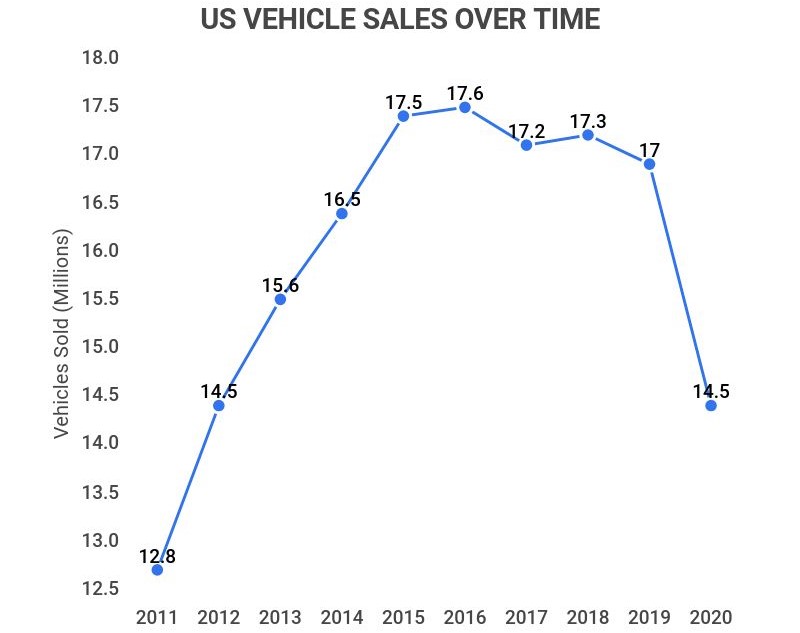
US Vehicle Sales 2011-2022
Year Vehicles Sold (millions) 2011 12.8 2012 14.5 2013 15.6 2014 16.5 2015 17.5 2016 17.6 2017 17.2 2018 17.3 2019 17 2020 14.5 2021 16.3 2022 14.9 -
In 2021, around 1.6 million passenger cars and light vehicles were exported from the United States.
Exports increased by 14.3%, with Canada being the largest importer of U.S. passenger vehicles.
-
The United States auto industry represents 3% of the total American GDP.
Furthermore, the auto sector is the largest exporter in the U.S. and generates more jobs than any other industry. It is a significant investor in research and development.
-
$114.6 billion in direct foreign investments were injected into the U.S. auto industry in 2018.
At that time, 1.8 million new light vehicles and 131,200 medium/heavy trucks were exported, valued at approximately $60 billion.
-
The United States ranked second in the global automotive market with 9.2 million vehicles produced in 2021.
China led with over 25 million vehicles produced.
-
An estimated $82 billion was allocated by the United States Department of Treasury to bail out the auto industry.
This was the second-highest allocation during government bailouts, surpassed only by the banking sector, which received $250 billion.
-
The top three automobile manufacturers in the United States are General Motors Company (GM), Stellantis, and Ford Motor Company.
While these companies dominate the market, they face increasing competition from international manufacturers from Europe, Japan, and South Korea, including Toyota, Hyundai, and Honda.
-
U.S. vehicle production has seen a decline of 27.7% since 2016.
From over 12 million vehicles produced in 2016, the production dropped to approximately 8.8 million vehicles annually by 2020.
US Vehicle Production 2016-2020
| Year | Vehicles Produced |
|---|---|
| 2016 | 12.2M |
| 2017 | 11.2M |
| 2018 | 11.3M |
| 2019 | 10.9M |
| 2020 | 8.8M |
| 2021 | 9.2M |
Automotive Industry Jobs Statistics
-
The automobile industry employs over 1.7 million people in total.
Career opportunities in the auto industry span engineering, manufacturing, sales, and design.
-
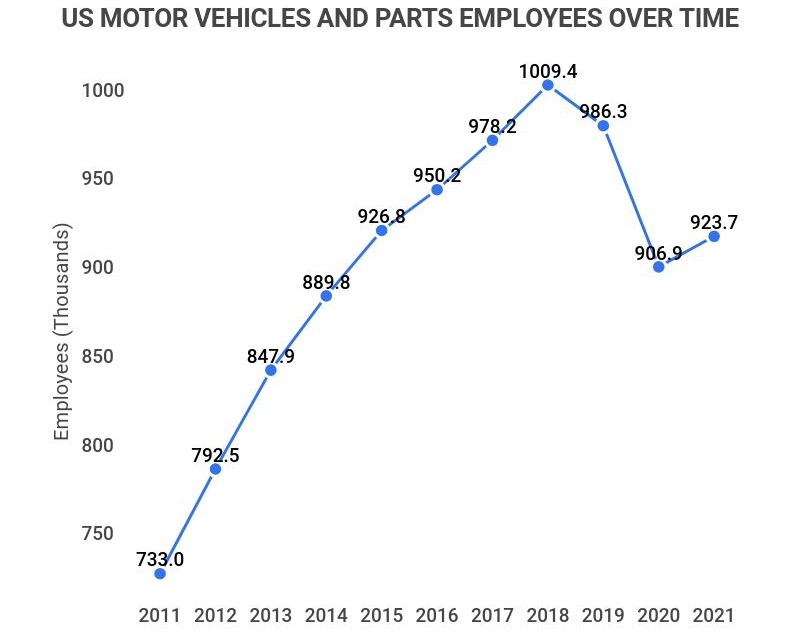
As of November 2021, 923,700 individuals were employed in motor vehicles and parts manufacturing in the U.S.
This figure rose from 906,900 the previous year, indicating a rebound in employment.
-
About 2 million people work in auto sales jobs in the United States.
Auto sales positions represent roughly 1.25% of all employed Americans, a significant figure considering the diversity of career paths in the U.S.
-
As of November 2021, 1,251,600 individuals were employed at automobile dealerships.
This number has increased by 21,900 from 1,229,700 in the previous year.
-
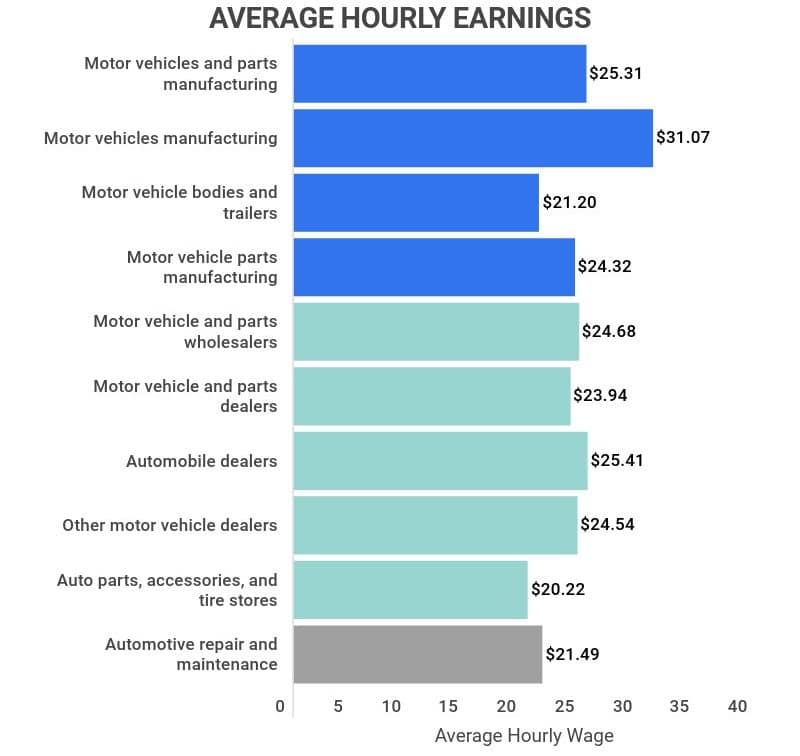
The average hourly wage for an automobile dealership employee is $25.76 as of March 2023.
This represents a $0.35 per hour increase (1.4%) since 2021, when the average was $25.41.
Automotive Industry Trends and Predictions
-
The U.S. automotive industry has historically fluctuated between 10 million and 17 million cars sold annually since 1976.
The economic recession of 2008 led to some of the lowest sales rates in decades, but a gradual increase of 60% in sales occurred between 2009 and 2018.
-
Approximately $18 billion is spent annually by the U.S. auto industry on research and development (R&D).
Despite being a significant contributor to greenhouse gas emissions, the automotive sector accounts for a smaller percentage of global R&D spending compared to other industries. Major contributors to R&D include Volkswagen, Toyota, General Motors, Honda, and Daimler.
-
The North American automotive market is projected to grow at a compound annual growth rate (CAGR) of around 7.22%.
This growth is anticipated to be driven by the increasing demand for electric vehicles, as manufacturers strive to meet emission standards and consumer preferences.
Automotive Industry Statistics in the Pandemic
-
Between 2019 and 2020, vehicle sales dropped by approximately 13.3%.
Sales of light vehicles fell from around 16,961,000 in 2019 to 14,471,800 in 2020.
-
The average price for a new car reached $38,723 as of September 2020.
This marked a 2.5% increase from the previous year, continuing a trend of rising costs over the past two decades.
-
The price of used cars surged by 17% from 2020 to 2021.
After an average price of $23,371 in 2020, the cost jumped to $27,297 in April 2021.
-
During the pandemic, U.S. emissions decreased by 13% in 2020.
However, emissions quickly rebounded as economic activity resumed and restrictions were lifted.
-
The National Highway Traffic Safety Administration reported an estimated 38,680 motor vehicle fatalities in 2020.
Despite reduced traffic, there was a 7.2% increase in deaths compared to 2019.
Environmental Impacts of the Automotive Industry
-
29% of greenhouse gas emissions in the United States originated from transportation in 2019.
-
58% of these emissions from the transportation sector were attributed to light-duty vehicles or passenger vehicles.
-
While global energy emissions fell by a record 7% in 2020, emissions from SUVs increased by 0.5%, with oil consumption from SUVs reaching 5.5 million barrels per day.
-
Oil usage in all cars except SUVs decreased by 10% or 1.8 million barrels per day in 2020, likely due to the pandemic’s impact.
-
From 2014 to 2019, Kia models achieved the largest reduction in CO2 emissions, averaging 31 gallons per mile.
Automotive Industry FAQ
-
How much is the automobile industry worth?
The U.S. automobile industry is valued at $104.1 billion in 2026. This marks a 26% increase from 2021, when the industry was valued at $82.6 billion.
-
What percentage of the economy is the auto industry?
America’s auto industry constitutes 3% of the U.S. GDP. Despite fluctuations, the U.S. automotive sector remains the largest manufacturing industry and significantly contributes to the national economy.
-
Is the automotive industry the biggest industry?
No, the automotive industry is not the largest in the U.S. The biggest industry is real estate, renting, and leasing. However, auto manufacturing is a vital part of America’s durable manufacturing sector, ranking as the fifth-largest industry.
-
Is the automobile industry growing?
Yes, the U.S. automobile industry is expanding at a compound annual growth rate of 7.22%. After challenges in 2020, the industry has shown signs of recovery and growth.
-
How many jobs are available in auto manufacturing?
The U.S. automotive industry supports over 7.25 million jobs. These positions range from research labs and supplier factories to assembly lines and dealership showrooms.
Conclusion
The automotive industry plays a crucial role in the lives of Americans, with 290.8 million registered vehicles facilitating daily transportation. Despite experiencing fluctuations in sales over the past 50 years, U.S. vehicle manufacturers remain among the largest sectors in the economy.
As of 2022, the industry is navigating a path toward recovery, following the impacts of recent market uncertainties. The sale of approximately 13.75 million cars and light trucks in 2022 indicates a cautious rebound. However, ongoing challenges persist, especially concerning supply chain disruptions and changing consumer preferences.
While the automotive sector is undeniably profitable, it is also a major contributor to greenhouse gas emissions. According to the U.S. Environmental Protection Agency, transportation accounted for 29% of total greenhouse gas emissions in 2019, with the majority stemming from light-duty vehicles.
As the industry evolves, the emphasis on sustainability and innovation will be critical in addressing these environmental challenges and meeting the future demands of consumers.
References
-
Statista. “Vehicle sales in the United States 1976-2020.” Accessed on August 18, 2021
-
Doxo. “Cost of Car Ownership in the US: Auto Insurance and Auto Loans Reports 2021.” Accessed on August 18, 2021
-
Ibisworld. “Car Automobile Manufacturing in the US – Market Size 2005–2027.” Accessed on August 18, 2021
-
CarProUSA. “NADA First Quarter 2021 Auto Industry Analysis.”
-
Statistica. “US motor vehicle and parts retail trade revenue 2000-2020.” Accessed on August 18, 2021
-
Statistica. “US new and used car sales 2010-2020.” Accessed on August 18, 2021
-
Value Penguin. “Car Ownership Statistics (2021 Report).” Accessed on August 18, 2021
-
Hedges Company. “US VEHICLE REGISTRATION STATISTICS.” Accessed on August 18, 2021
-
Hedges Company. “How Many Cars Are There in the World in 2021?” Accessed on August 18, 2021
-
Experian. “What Is the Average Price for a New Car?” Accessed on August 18, 2021
-
Silive. “Used car prices on the rise, but how steep is the increase in NYC?” Accessed on August 18, 2021
-
Nature. “COVID curbed carbon emissions in 2020 — but not by much.” Accessed on August 18, 2021
-
U.S. News World Report. “Traffic Deaths Increased in 2020 Despite Fewer People on Roads During Pandemic.” Accessed on August 18, 2021
-
Statistica. “Vehicle sales in the United States 1976-2020.” Accessed on August 18, 2021
-
CarGroup. “Just How High-Tech is the Automotive Industry?” Accessed on August 18, 2021
-
Business Wire. “North American Automotive Market Report 2020-2025 – ResearchAndMarkets.com” Accessed on August 18, 2021
-
Forbes. “U.S. Vehicle Exports, Imports Sink to 18-Year Low, New Data Shows.” Accessed on August 18, 2021
-
Statistica. “U.S. light vehicle export volume 2014-2020.” Accessed on August 18, 2021
-
American Auto Makers. “US Economic Contributions.” Accessed on August 18, 2021
-
SelectUSA. “AUTOMOTIVE SPOTLIGHT: The Automotive Industry in the United States.” Accessed on August 18, 2021
-
The Global Economy. “Passenger car sales – Country rankings.” Accessed on August 18, 2021
-
Wikipedia. “List of countries by motor vehicle production.” Accessed on August 18, 2021
-
U.S. Department of the Treasury. “Troubled Assets Relief Program (TARP).” Accessed on August 18, 2021
-
Investopedia. “Big Three Automakers.” Accessed on August 18, 2021
-
CarGroup. “Contribution of the Automotive Industry to the Economies of all Fifty States and the United States.” Accessed on August 18, 2021
-
U.S. Bureau of Labor Statistics. “Automotive Industry: Employment, Earnings, and Hours.” Accessed on August 18, 2021
-
IEA. “Carbon emissions fell across all sectors in 2020 except for one – SUVs.” Accessed on August 18, 2021
-
EPA. “Highlights of the Automotive Trends Report.” Accessed on August 18, 2021
-
EPA. “Fast Facts on Transportation Greenhouse Gas Emissions.” Accessed on August 18, 2021
-
Statista. Automotive Industry in the United States. Accessed on December 8, 2021
-
OICA. 2020 Production Statistics. Accessed on December 8, 2021
- Industry Statistics
- Wedding Industry Statistics
- Yoga Industry Statistics
- Music Industry Statistics
- Landscaping Industry Statistics
- Bicycle Industry Statistics
- Coffee Industry Statistics
- Car Rental Industry Statistics
- Home Improvement Industry Statistics
- Insurance Industry Statistics
- Supplements Industry Statistics
- Golf Industry Statistics
- Fitness Industry Statistics
- US Media And Entertainment Industry Statistics
- Firearm Industry Statistics
- Financial Services Industry Statistics
- Health And Wellness Industry Statistics
- Trucking Industry Statistics
- Wine Industry Statistics
- Pet Industry Statistics
- Mobile App Industry Statistics
- Digital Marketing Industry Statistics
- Hotel Industry Statistics
- Retail Statistics
- Robotics Industry Statistics
- Jewelry Industry Statistics
- Appointment Scheduling statistics
- Restaurant Industry Statistics
- Food Delivery Statistics
- Food Truck Industry
- Fashion Industry
- Real Estate Industry
- US Film Industry
- US Beverage Industry
- USu202fFast Food Restaurants
- US Construction Industry
- US Book Industry
- Cosmetics Industry
- US Food Retail Industry
- US Pharmaceutical Industry
- US Healthcare Industry
- Airline Industry
- Automobile Industry
- Transportation Industry Statistics
- Event Industry Statistics
- Project Management Statistics
- Oil And Gas Industry Statistics
- Nursing Home Statistics
- Nursing Shortage Statistics
- Nursing Statistics

Author

Sky Ariella is a professional freelance writer, originally from New York. She has been featured on websites and online magazines covering topics in career, travel, and lifestyle. She received her BA in psychology from Hunter College.