Here’s How Many Hours Workers Are Actually Productive (And What They’re Doing Instead)
The standard American workday is typically 8 hours long, but how many of those hours are spent on actual productive work? Recent insights reveal that the reality is quite different.
It’s a common observation that small talk, coffee breaks, and digital distractions significantly reduce effective work time. But just how much time do employees genuinely dedicate to their tasks? To find out, we surveyed 1,000 employees across various industries.
The findings? During an 8-hour workday, the average employee is productive for only 4 hours and 12 minutes. Continue reading to discover what employees are doing instead and explore other key insights:
-
47% of workers admit to browsing the internet during work hours, making it the most prevalent off-task activity.
-
78% of respondents indicated they do not require a full 8 hours to finish their daily tasks.
-
Employees spend an average of 1 hour and 5 minutes reading news websites throughout the workday.
-
71% of time spent in meetings is viewed as unproductive by employees.
-
The optimal focus time for intensive tasks is between 25 to 90 minutes.
What Do Workers Do Instead of Work?
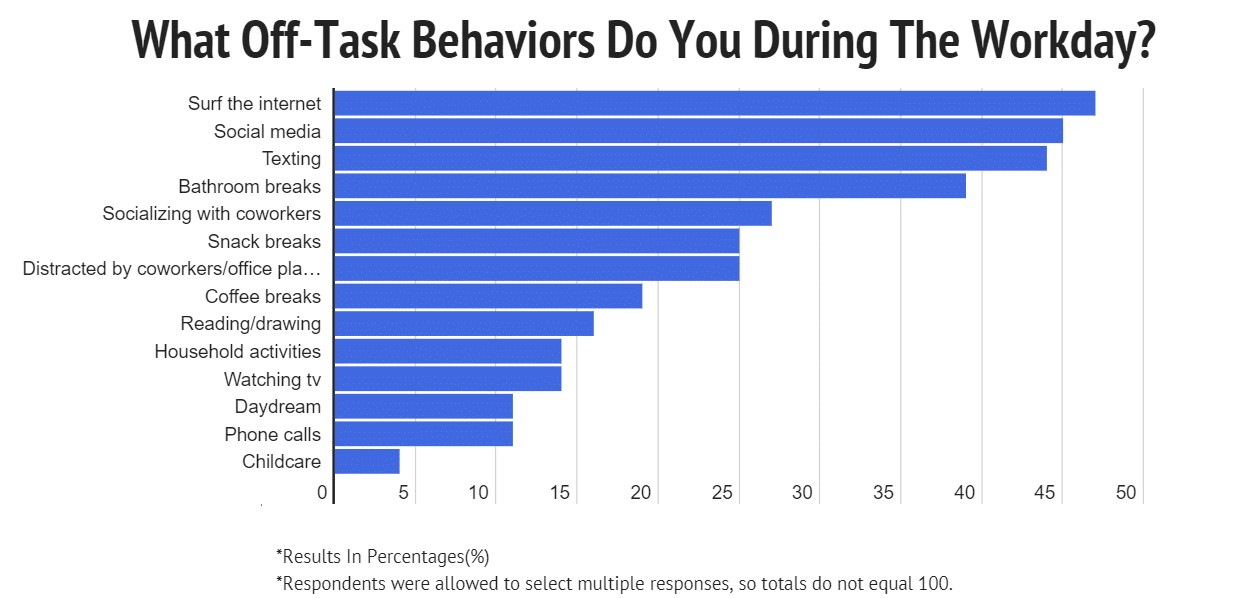
Distractions abound for today’s workers, with 47% of respondents regularly surfing the web, while 45% check social media during work hours. Given that many jobs are now digitally oriented, it’s no surprise that workers find it hard to resist the urge to browse the news or scroll through social media.
Texting has also become a common diversion, with 44% of respondents admitting to using their phones to pass time at work. Beyond digital distractions, 39% of workers report taking additional bathroom breaks as a way to escape their tasks.
Office dynamics can also be a significant distraction; 27% of employees waste time socializing with colleagues, and another 25% cite coworker noise as a disruption to their focus. For remote workers, distractions may include household chores (14%) or watching TV (14%).
Common Reasons for Not Being Busier at Work:
-
Breaks in tasks
-
Waiting for colleagues to complete their work
-
All tasks completed
-
Lack of engagement or motivation
-
Personal distractions
-
Suboptimal work environment
The majority of respondents express satisfaction with their work performance, stating they do not need the full 8 hours to complete their tasks. Many attribute their reduced productivity to a lack of work or other barriers.
Methodology
Zippia.com, a leading career resource platform, conducted a comprehensive study involving 1,000 full-time employees to gain insights into workplace productivity.
Each participant answered a series of questions regarding their daily activities and productivity levels.
How Many Hours Are Workers Productive FAQ
-
How many productive hours are in a workday?
Typically, there are only 3-6 productive hours in a workday. The average worker dedicates about 4 hours and 12 minutes to active work during an 8-hour shift, highlighting potential inefficiencies in longer shifts. The most productive workers cap out at around 6 hours, indicating that even the most engaged employees waste approximately 2 hours each day.
-
What is the average workday length?
The average full-time worker in the U.S. works approximately 8.5 hours per weekday and 5.9 hours on weekends. For part-time employees, these figures drop to about 5.6 hours on weekdays and 4.8 hours on weekends. Regardless of employment status, one could argue that working over 8 hours daily may be counterproductive, leading to wasted time and reduced efficiency compared to a more focused 4-hour work session.
-
What is a good productivity percentage?
A strong productivity percentage falls between 70-75%. This ratio suggests that employees should aim to spend 70% or more of their time actively working, with 25% or less allocated to breaks. This balance fosters profitability without risking burnout or diminishing work-life equilibrium. However, it’s important to note that most American workers only achieve a maximum of 60% productivity, with office workers averaging around 31%, while freelancers boast an impressive 87% productivity rate.
Do We Even Need An 8-Hour Workday?
The 8-hour workday has its roots in the Industrial Revolution, a relic from a time when workplace reforms were crucial. Over a century later, many office workers are still adhering to 8-hour shifts, similar to their factory worker predecessors, despite vastly different job responsibilities.
In numerous professional roles, natural breaks in workflow occur, and there is often no continuous stream of tasks to keep employees engaged.
Research indicates that frequent breaks can enhance overall productivity. Workers are not machines; they require intervals of rest to function at their best.
This raises important questions: are we evaluating productivity based on work accomplished or simply time spent at a desk? More critically, why is there still an expectation for employees to be present in the office for an entire 8-hour period?

Author

Kathy is the head of content at Zippia with a knack for engaging audiences. Prior to joining Zippia, Kathy worked at Gateway Blend growing audiences across diverse brands. She graduated from Troy University with a degree in Social Science Education.