- Industry Statistics
- Wedding Industry Statistics
- Yoga Industry Statistics
- Music Industry Statistics
- Landscaping Industry Statistics
- Bicycle Industry Statistics
- Coffee Industry Statistics
- Car Rental Industry Statistics
- Home Improvement Industry Statistics
- Insurance Industry Statistics
- Supplements Industry Statistics
- Golf Industry Statistics
- Fitness Industry Statistics
- US Media And Entertainment Industry Statistics
- Firearm Industry Statistics
- Financial Services Industry Statistics
- Health And Wellness Industry Statistics
- Trucking Industry Statistics
- Wine Industry Statistics
- Pet Industry Statistics
- Mobile App Industry Statistics
- Digital Marketing Industry Statistics
- Hotel Industry Statistics
- Retail Statistics
- Robotics Industry Statistics
- Jewelry Industry Statistics
- Appointment Scheduling statistics
- Restaurant Industry Statistics
- Food Delivery Statistics
- Food Truck Industry
- Fashion Industry
- Real Estate Industry
- US Film Industry
- US Beverage Industry
- USu202fFast Food Restaurants
- US Construction Industry
- US Book Industry
- Cosmetics Industry
- US Food Retail Industry
- US Pharmaceutical Industry
- US Healthcare Industry
- Airline Industry
- Automobile Industry
- Transportation Industry Statistics
- Event Industry Statistics
- Project Management Statistics
- Oil And Gas Industry Statistics
- Nursing Home Statistics
- Nursing Shortage Statistics
- Nursing Statistics
Insights into the Cosmetics Industry in 2026. The cosmetics industry remains one of the most lucrative markets worldwide, with the United States playing a significant role in its expansion. As consumer trends evolve, so does the demand for personal care and beauty products, leading to rapid growth in the sector. Our thorough analysis reveals the following:
-
Approximately $52.5 billion is generated by cosmetics sales in the United States each year.
-
On average, Americans spend between $260 and $330 on cosmetics every month.
-
The global cosmetics industry is valued at $605 billion.
-
The cosmetics industry is growing at a rate of 5.3% each year.
-
Personal care products comprise 45% of the market, with a volume of $272 billion, representing the largest segment of the industry.
-
Despite challenges, the beauty and cosmetics market has rebounded post-pandemic, showing resilience and innovation.
For a deeper dive, explore our detailed sections that analyze the data:
Consumers | Segments | Trends and Projections
General Statistics of the Cosmetics Industry
The cosmetics industry has evolved significantly since its ancient origins. Today, it stands as a global titan, serving consumers in virtually every corner of the globe. Here are some compelling facts uncovered through our research:
-
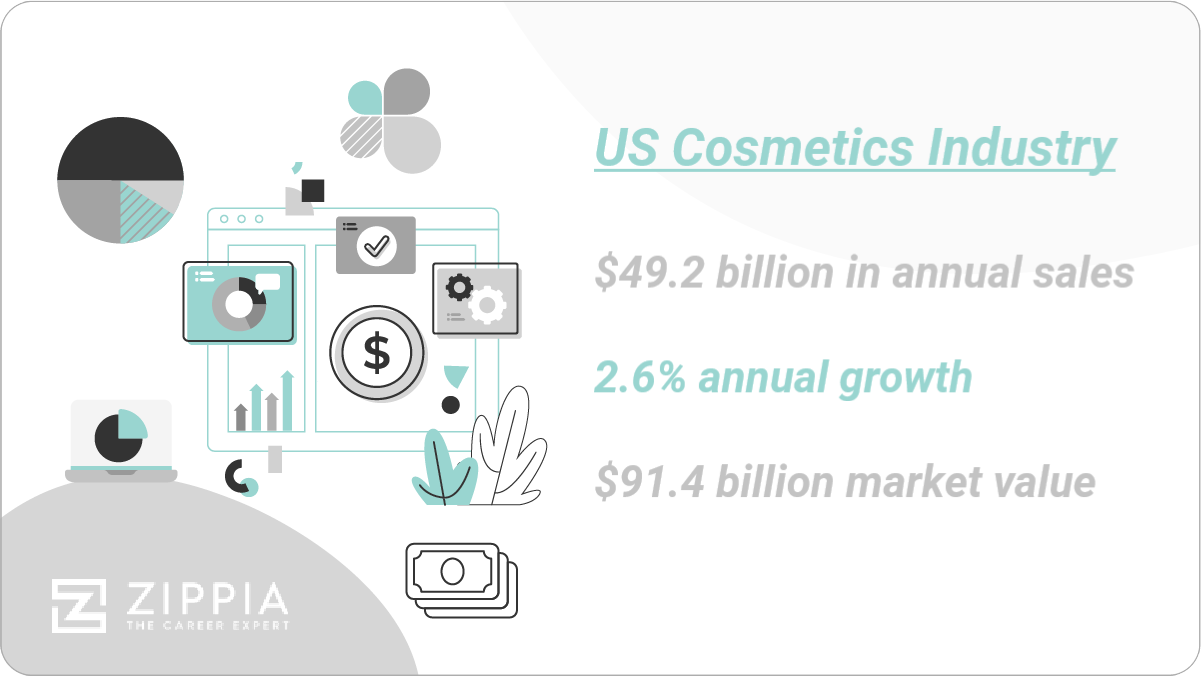
The American cosmetics and beauty market is valued at $91.4 billion.
The U.S. beauty and personal care market accounts for approximately 22% of the global cosmetics industry’s total value.
-
Around 70% of beauty buyers engage with cosmetics brands on social media.
Social media has become a pivotal platform for brand discovery and consumer interaction, allowing companies to build trust and market effectively.
It’s estimated that 40% of shoppers find new cosmetics brands or products through social media ads, while 32% rely on recommendations from social media influencers and peers.
Furthermore, 68% of customers learn about brands through posts on social media, endorsements from bloggers, and influencer partnerships.
-
L’Oréal remains the most valuable cosmetics company in the U.S.
As of 2023, L’Oréal reported annual revenues of $42 billion, capturing 20% of the Western European cosmetics market share.
Other dominant players alongside L’Oréal include Unilever, Procter & Gamble Co., Estée Lauder Companies, and Shiseido.
-
In the U.S., Huda Beauty and Kylie Cosmetics lead in social media engagement.
Recent data reveals Huda Beauty boasts over 300 million social media interactions, with Kylie Cosmetics following closely with 250 million interactions.
-
Facial and eye cosmetics generate significant revenue within the beauty sector.
In 2022, sales of eye cosmetics brought in approximately $2.1 billion, while facial cosmetics accounted for about $2 billion in revenue. Mascara remains a top-selling product, with eyeliners and eyeshadows also performing well.
Notably, Neutrogena’s makeup remover is a leading product in the facial cosmetics category.
Hair care continues to be a substantial segment, accounting for 24% of the beauty industry, with lip cosmetics generating around $700 million.
-
While e-commerce thrives, retail shopping remains essential.
Ulta Beauty continues to be a dominant health and beauty retailer, generating about $8 billion in sales in 2022.
Sephora remains competitive, with retail sales nearing $6.5 billion.
Cosmetics Brands by Revenue (2023)
| Brand | Revenue (2023) |
|---|---|
| L’Oreal | $42B |
| Unilever | $25.2B |
| Estée Lauder | $19B |
| P&G | $15.3B |
| Shiseido | $9.1B |
| Bath & Body | $8.5B |
| Johnson & Johnson | $8.1B |
| LVMH | $8B |
| Natura & Co | $7.5B |
| Beiersdorf | $7.3B |
Cosmetics Industry Consumer Insights
Consumer behavior significantly influences the cosmetics industry, guiding product development and popularity. Here are some key statistics illustrating consumer trends:
-
Americans account for approximately one-fourth of the global cosmetics purchases.
North America captures 24% of the global cosmetics market, with the Asia Pacific region now leading in overall cosmetics consumption.
-
The men’s personal care and beauty industry is projected to reach $200 billion by 2026.
Men’s engagement with cosmetics continues to rise, with nearly 45% of men expressing interest in gender-neutral beauty products. In the past year, sales of men’s skincare surged by 10%.
-
Women spend, on average, $70 more than men monthly on cosmetics.
Recent studies indicate that American women spend an average of $330 a month on cosmetics, totaling approximately $3,960 annually, while men spend about $260 monthly, or $3,120 per year — 21% less than women.
-
African American consumers dominate the ethnic beauty market.
Recent reports show that African Americans spend $1.5 trillion annually on beauty and cosmetics, with significant growth expected in the coming years.
-
Over 30% of young women feel incomplete without makeup.
Surveys reveal that a significant number of young women, about 60%, wear makeup regularly, often starting as early as age 8.
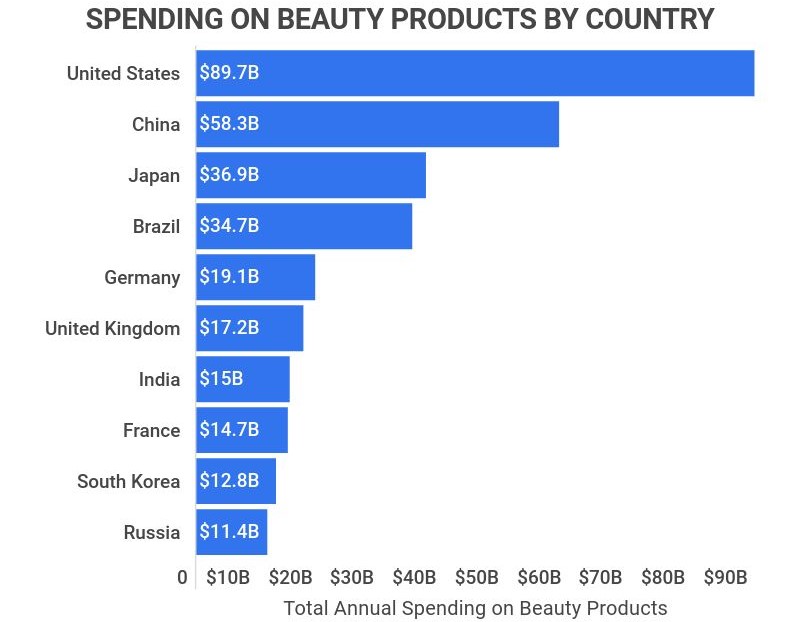
Cosmetic Industry Revenue by Country
| Country | Beauty Products Spending (2023) |
|---|---|
| United States | $93B |
| China | $66B |
| Japan | $40B |
| Brazil | $37B |
| Germany | $21B |
| United Kingdom | $19B |
| India | $18B |
| France | $16B |
| South Korea | $14B |
| Russia | $12B |
Cosmetics Industry Segment Insights
The cosmetics industry is diverse, encompassing various segments. Here’s a closer look at the most prominent areas:
-
Skincare constitutes approximately 45% of the global market.
Skincare product sales dominate the global cosmetics arena, followed closely by hair care products, which account for about 24% of the market.
-
Makeup represents nearly 20% of the global cosmetic market.
Makeup products account for about 18.5% of the total global cosmetics market value.
-
The global makeup market is estimated at around $92 billion.
Makeup sales are projected to grow as more individuals incorporate products like lipsticks, concealers, and foundations into their daily routines.
-
Skincare and hair care combined represent nearly 60% of the global cosmetics market.
According to market insights, skincare and hair care products have shown significant sales growth in recent years.
-
The global anti-aging cosmetics market value is projected to reach $42 billion.
Anti-aging products are expected to grow at a CAGR of 6.5% in the coming years, reaching a projected value of $70 billion by 2027.
Trends and Predictions in the Cosmetics Industry
The cosmetics industry is continually evolving, with innovative practices and trends shaping its future. Here are some insights into where the industry is heading:
-
The global cosmetics industry is expected to reach $700 billion by 2030.
Over the next several years, the cosmetics industry is projected to grow by $95 billion, reflecting ongoing consumer interest and market expansion.
-
From 2022 to 2030, the global cosmetics market is projected to grow at a CAGR of 5.5%.
This growth is influenced by shifting consumer lifestyles, increased product usage, and the rising popularity of cosmetics among men.
-
CBD-infused cosmetics are anticipated to grow significantly.
The CBD cosmetics market is expected to expand by over $3 billion through 2026, driven by consumer interest in wellness products.
-
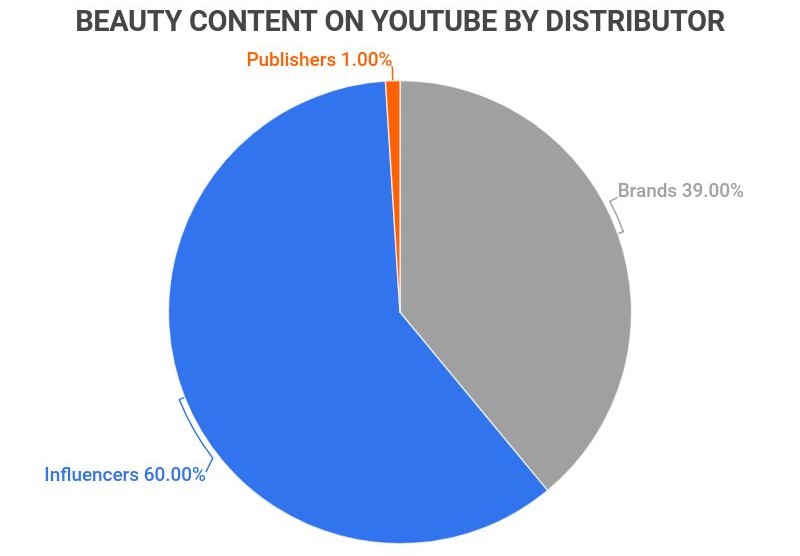
Influencers are set to dominate over 60% of beauty content on social media platforms.
As consumers increasingly turn to influencers for authentic product recommendations, brands are adapting their marketing strategies to leverage this trend.
FAQs About the Cosmetics Industry
-
How is the cosmetics industry segmented?
The cosmetics industry is divided into seven main categories. These include skincare products, hair care products, makeup, perfumes, toiletries, deodorants, and oral care products. Skincare products remain the most profitable segment, followed closely by hair care.
-
What is the cosmetics industry worth in 2026?
The cosmetics industry is valued at approximately $605 billion. North America holds about 16% of the global cosmetics market, with the U.S. market valued around $92 billion.
-
Is the cosmetics industry growing?
Yes, the cosmetics industry is on an upward trajectory. Current projections estimate a 5.5% compound annual growth rate, positioning the market to reach approximately $700 billion by 2030.
-
What is the largest cosmetics company globally?
L’Oréal holds the title as the largest cosmetics company worldwide. The French giant reported annual revenues of $42 billion in 2023, outpacing other major companies in the cosmetics sector.
-
Which country spends the most on cosmetics?
The United States leads in global cosmetics spending. In 2023, U.S. consumers spent approximately $93 billion on cosmetics, significantly surpassing other markets.
-
Is the cosmetics industry saturated?
Yes, many experts believe the cosmetics market is highly saturated. With an overwhelming array of products available, new brands struggle to gain traction without backing from major companies.
Conclusion
Globally, the beauty and cosmetics industry continues to thrive. The current valuation of the cosmetics industry stands at approximately $605 billion, with the United States contributing around $52.5 billion in annual sales.
As more individuals, regardless of gender, invest in skincare, makeup, hair care, perfumes, and personal care products, the industry shows no signs of slowing down.
With a consistent annual growth rate of roughly 5.3%, and with average spending between $260 and $330 per month on cosmetics by Americans, the outlook for the cosmetics industry remains exceedingly positive.
References
-
Statista. “Cosmetics Industry In The U.S. — Statistics & Facts.” Accessed on October 10, 2026.
-
Allied Market Research. “Cosmetics Market By Category, Gender And Distribution Channel: Global Opportunity Analysis And Industry Forecast, 2022-2030.” Accessed on October 10, 2026.
-
New York Post. “Vanity Costs American Women Nearly A Quarter Of A Million Dollars.” Accessed on October 10, 2026.
-
Statista. “Cosmetics Consumer Behavior In The U.S. — Statistics & Facts.” Accessed on October 10, 2026.
-
We Are Social. “How Social Media Is Reshaping The Beauty Industry.” Accessed on October 10, 2026.
-
Statista. “Cosmetic Sales In The United States In 2022, By Segment.” Accessed on October 10, 2026.
-
Statista. “Global Makeup Market Size 2022-2030.” Accessed on October 10, 2026.
-
CNBC. “Men Are A MultiBillion Dollar Growth Opportunity For The Beauty Industry.” Accessed on October 10, 2026.
-
Fortune Business Insights. “Anti-Aging Cosmetics Market Size, Share & Industry Analysis, By Product Type, Product Form, End-User, Distribution Channel, And Regional Forecast, 2022-2030.” Accessed on October 10, 2026.
-
PR Newswire. “From Barbies To Blush — New Survey Reveals Young Girls Are Wearing Makeup Earlier Than Ever To Hide Their Insecurities.” Accessed on October 10, 2026.
-
Essence. “Feature: The Industry That Black Women Built.” Accessed on October 10, 2026.
-
PR Newswire. “Global CBD Infused Cosmetics Market: $3 Billion Growth Expected During 2022-2026.” Accessed on October 10, 2026.
-
Statista. Distribution of beauty content views on YouTube as of 2022. Accessed on October 10, 2026.
-
Statista. Consumption value of beauty products worldwide in 2022, by leading country. Accessed on October 10, 2026.
-
Beautypackaging.com “Top Global Beauty Companies 2023 Report.” Accessed on October 10, 2026.
-
Statista. Beauty & Personal Care – Worldwide. Accessed on October 10, 2026.
- Industry Statistics
- Wedding Industry Statistics
- Yoga Industry Statistics
- Music Industry Statistics
- Landscaping Industry Statistics
- Bicycle Industry Statistics
- Coffee Industry Statistics
- Car Rental Industry Statistics
- Home Improvement Industry Statistics
- Insurance Industry Statistics
- Supplements Industry Statistics
- Golf Industry Statistics
- Fitness Industry Statistics
- US Media And Entertainment Industry Statistics
- Firearm Industry Statistics
- Financial Services Industry Statistics
- Health And Wellness Industry Statistics
- Trucking Industry Statistics
- Wine Industry Statistics
- Pet Industry Statistics
- Mobile App Industry Statistics
- Digital Marketing Industry Statistics
- Hotel Industry Statistics
- Retail Statistics
- Robotics Industry Statistics
- Jewelry Industry Statistics
- Appointment Scheduling statistics
- Restaurant Industry Statistics
- Food Delivery Statistics
- Food Truck Industry
- Fashion Industry
- Real Estate Industry
- US Film Industry
- US Beverage Industry
- USu202fFast Food Restaurants
- US Construction Industry
- US Book Industry
- Cosmetics Industry
- US Food Retail Industry
- US Pharmaceutical Industry
- US Healthcare Industry
- Airline Industry
- Automobile Industry
- Transportation Industry Statistics
- Event Industry Statistics
- Project Management Statistics
- Oil And Gas Industry Statistics
- Nursing Home Statistics
- Nursing Shortage Statistics
- Nursing Statistics

Author

Chris Kolmar is a co-founder of Zippia and the editor-in-chief of the Zippia career advice blog. He has hired over 50 people in his career, been hired five times, and wants to help you land your next job. His research has been featured on the New York Times, Thrillist, VOX, The Atlantic, and a host of local news. More recently, he's been quoted on USA Today, BusinessInsider, and CNBC.