- Small Business Statistics
33 Captivating Coworking Statistics [2026]: Essential Facts and Trends
Research Summary. The evolution of technology and the enduring shift toward remote work have led to a significant rise in coworking spaces across the U.S. This flexibility offers numerous benefits, including enhanced collaboration and networking opportunities, while also presenting unique challenges for professionals outside traditional office environments.
Coworking spaces bridge the gap by providing collaborative environments that foster productivity and connections. Here’s what our latest research on coworking has revealed:
-
As of 2026, there are over 19,400 coworking spaces across the globe, with more than 6,200 located in the U.S.
-
Approximately 1.7 million people in the U.S. utilize coworking spaces.
-
In North America, the average coworking space spans about 9,799 square feet and accommodates roughly 105 individuals, translating to approximately 93 square feet per person.
-
The number of coworking spaces in the U.S. has surged by nearly 55% since 2017.
-
In 2026, the average monthly hot desk price in the United States is around $300.
For a deeper dive, explore our analysis categorized by:
Trends | Demographics | Reasons for Coworking | Benefits | Company

General Coworking Statistics
-
Globally, there are approximately 19,400 coworking spaces, with over 6,200 in the U.S.
-
As of 2026, about 1.7 million people in the U.S. use coworking spaces.
-
In 2025, around 2.5 million people worldwide were utilizing coworking spaces.
-
The average coworking space globally measures 7,308 square feet, while the average U.S. space remains at 9,799 square feet.
-
The U.S. holds 18.3% of the world’s coworking spaces.
-
Each U.S. coworking space accommodates about 105 members, compared to a global average of 83 members.
-
Asia leads in coworking space capacity with an average of 114 members per space, while South America has the lowest at 54 members.
-
Before the pandemic, approximately 3.4% of the U.S. workforce was remote.

Coworking Statistics Over Time
-
In 2007, the U.S. had just 14 coworking spaces; this grew to over 4,000 by 2017.
-
By 2026, the U.S. is estimated to have more than 6,200 coworking spaces.
-
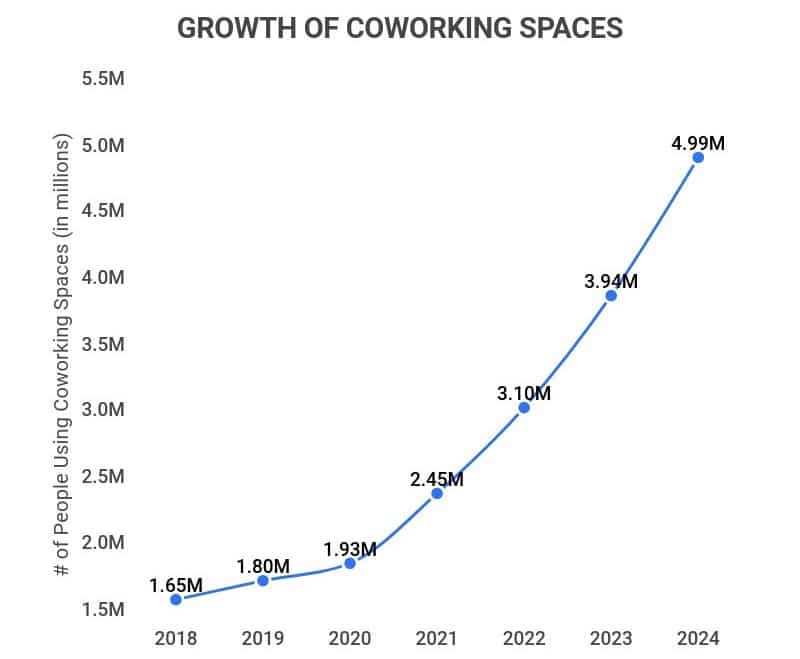
In 2015, around 331,000 people used coworking spaces in the U.S., increasing to approximately 1.7 million by 2026.
Coworking Statistics by Demographics
-
The average age of coworking space members globally is 36 years.
This reflects a diverse membership across age groups, with younger members often in creative fields and older members typically in consulting roles.
-
Women comprised over 50% of coworking space members globally for the first time in recent years.
While this is significant, many spaces still exhibit a gender imbalance, with estimates suggesting women represent only 40% of active memberships.
-
In the U.S., nearly 90% of coworking members identify as “white or Caucasian.”
Minority representation remains low, particularly for Hispanic, Latino, and Black individuals, highlighting ongoing diversity challenges in the industry.
-
20% of coworking space members are in IT.
This is followed by members in PR, marketing, consulting, and design.
-
42% of coworking space members worldwide are freelancers.
The remaining 58% are employees of various organizations, with a growing trend toward companies utilizing flexible workspaces for their remote staff.
-
80% of coworking space members hold a college degree.
This trend has decreased over time, with younger professionals driving membership numbers.
-
After the U.S., India has the largest share of the world’s coworking spaces.
The U.S. accounts for nearly 20% of global coworking spaces, while India represents about 10%.
Top 10 Countries with the Greatest Share of the World’s Coworking Spaces (2020)
| Country | Number Of Spaces | World Share |
|---|---|---|
| United States | 3,762 | 18.30% |
| India | 2,197 | 10.69% |
| United Kingdom | 1,044 | 5.08% |
| Spain | 939 | 4.57% |
| Germany | 791 | 3.85% |
| Canada | 617 | 3.00% |
| Australia | 590 | 2.87% |
| Mexico | 508 | 2.47% |
| Japan | 411 | 2.00% |
| Brazil | 393 | 1.91% |
Top Reasons for Coworking
-
“An enjoyable work atmosphere” is cited by 70% of U.S. coworking spaces as a key selling point.
This sentiment is notably prevalent in the U.S. market, with other appealing factors including:
-
“Well-situated location”
-
“Attractive design and fit-out”
-
“Thriving community”
-
“High-quality service”
-
“Affordable pricing”
-
“Diverse events”
-
“Available parking”
-
“Multi-location access”
-
“Fast internet”
-
“Focus on wellness.”
-
-
Recent sentiments regarding coworking spaces highlight:
-
“Membership in my coworking space enhances my well-being.”
-
“I trust my coworkers.”
-
“Our coworking community supports one another.”
-
“This community has the potential to influence others.”
-
-
Post-pandemic trends indicate an increase in demand for private offices and long-term contracts.
This shift is a response to the changing needs of remote workers seeking dedicated spaces away from home, creating a blend of coworking and office environments.
Benefits of Coworking
-
69% of office workers report increased productivity when working in varied environments.
Coworking spaces provide a refreshing change of scenery for remote professionals.
-
Globally, 47% of remote workers cite isolation and loneliness as significant challenges.
Despite the popularity of remote work, many professionals recognize the value of social interaction, with 79% of coworking space members reporting expanded social networks.
-
83% of coworking space members feel less lonely since joining.
Interaction within coworking spaces not only fosters community but also opens up opportunities for collaboration, with 64% gaining freelance work through their connections.
-
69% of members have learned new skills in coworking environments.
Many spaces offer professional development opportunities, with 67% of members attending events or workshops regularly.
-
Research indicates coworking members score higher on measures of employee satisfaction compared to traditional office workers.
Factors contributing to this include the sense of community and the ability to choose their work environment.
Coworking Statistics by Company
-
The leading companies in the U.S. coworking space industry include WeWork, Impact Hub, and Spaces.
WeWork operates over 800 locations worldwide, with a membership exceeding 600,000.
Impact Hub focuses on community and sustainability, boasting over 100 locations worldwide and 16,000 members.
Spaces offers a customizable experience across 400 locations globally.
Other notable names in the industry include:
-
Your Alley
-
Knotel
-
District Cowork
-
Make Office
-
Industrious Office
-
Techspace
-
Venture X
-
Serendipity Labs
-
Green Desk
-
SomeCentral.
-
-
The global coworking space market is projected to reach $11.52 billion, recovering from previous downturns.
The pandemic temporarily impacted usage, but demand for flexible workspaces continues to rise as remote work becomes more entrenched.
-
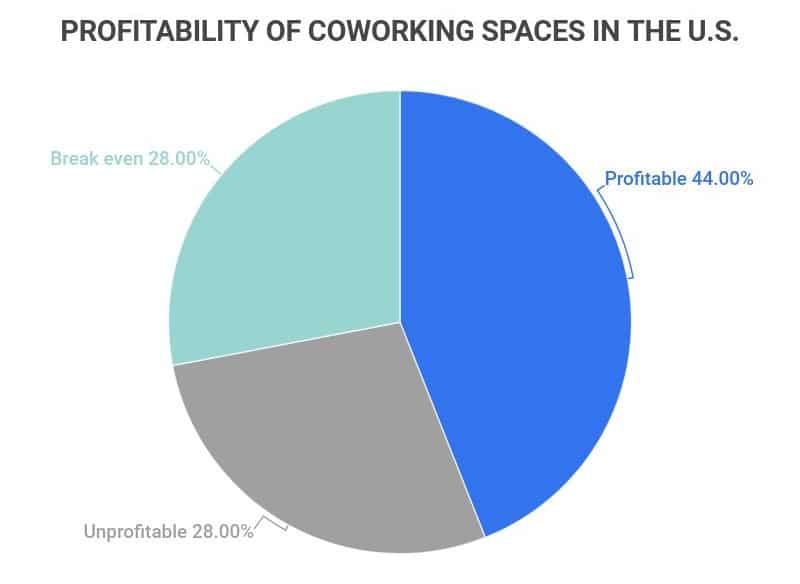
44% of coworking spaces in the U.S. reported profitability in recent years.
Major hubs for coworking spaces are metropolitan areas, with the majority located in cities with populations over one million.
Coworking Definitions
-
Hot Desk: An unassigned workspace in a coworking environment available for use on a first-come, first-served basis.
-
Dedicated Desk: A workspace permanently reserved for an individual or organization.
-
Flexible Workspace: A broad term encompassing any workspace that lacks a defined tenant or permanent purpose, including coworking spaces.
Coworking Statistics FAQ
-
How many people use coworking spaces?
Approximately 1.7 million people in the U.S. utilize coworking spaces, part of a global total nearing 2 million. This number has been steadily rising, especially as remote work continues to gain traction.
-
How profitable are coworking spaces?
About 44% of coworking spaces in the U.S. are currently profitable. Profitability often increases after two years of operation, with revenues primarily generated from desk rentals.
-
Is coworking really the future?
Coworking is increasingly recognized as a key component of the future of work. With a growing number of Americans working remotely, the demand for coworking spaces is expected to rise significantly.
-
Who uses coworking spaces the most?
Freelancers and IT professionals dominate coworking spaces. Approximately 42% of members are freelancers, and 20% work in IT.
-
How many members does the average coworking space have?
On average, coworking spaces host about 190 members. This fosters a diverse community and networking opportunities among professionals.
Conclusion
Coworking spaces have become essential for modern professionals, providing environments that encourage collaboration and creativity. They cater to a range of needs, from casual remote work to dedicated project spaces, and are integral in bridging the gap between home and office.
With rapid growth over the past two decades, coworking is not just a trend but a significant aspect of the evolving work landscape. As remote work continues to expand, these spaces are poised to foster global connections, resource sharing, and a new way of working.
References
-
www.coworkingresources.org. “Global Coworking Growth Study 2020.” Accessed on June 30, 2021.
-
www.statista.com. “Number of People Working in Coworking Spaces in U.S. 2015-2022.” Accessed on June 30, 2021.
-
www.allwork.space. “Number of Coworking Spaces Worldwide To Double Within the Next 4 Years.” Accessed on June 30, 2021.
-
www.businesswire.com. “Impact of COVID-19 on the Global Coworking Spaces Market, 2020-2030 – ResearchAndMarkets.com” Accessed on June 30, 2021.
-
www.statista.com. “Number of Coworking Spaces in the U.S. from 2007 to 2022.” Accessed on June 30, 2021.
-
www.mordorintelligence.com. “Coworking Spaces in North America – Growth, Trends, COVID-19 Impact, and Forecasts (2021-2026).” Accessed on June 30, 2021.
-
www.deskmag.com. “Coworking Space Members: It’s a girl!” Accessed on June 30, 2021.
-
www.slideshare.net. “2019 USA Coworking Statistics: Selected Results of the 2019 Global Coworking Survey.” Accessed on June 30, 2021.
-
www.yourhana.com. “The Benefits of Coworking Spaces.” Accessed on June 30, 2021.
-
www.coworkinginsights.com. “2020 Future of Work Report: What the Future Holds for Coworking Remote Work.” Accessed June 30, 2021.
-
www.smallbizlabs.com. “Coworking Spaces are Human Spaces.” Accessed on June 30, 2021.
-
www.hbr.org. “Why People Thrive in Coworking Spaces.” Accessed on June 30, 2021.
-
www.coworkingresources.org. “Largest Coworking Companies in the U.S.: 2021.” Accessed on June 30, 2021.
-
www.coworkinginsights.com. “2022 Hot Desk Price Index” Accessed on February 3, 2023.
-
www.statista.com “Number of coworking spaces worldwide from 2018 to 2020 with a forecast to 2024” Accessed on February 3, 2023.
- Small Business Statistics

Author

Abby is a writer who is passionate about the power of story. Whether it’s communicating complicated topics in a clear way or helping readers connect with another person or place from the comfort of their couch. Abby attended Oral Roberts University in Tulsa, Oklahoma, where she earned a degree in writing with concentrations in journalism and business.