20+ Trending Digital Nomad Statistics [2026]: Digital Nomadism Across the Globe
Digital nomad research summary. The rise of remote work has empowered millions to embrace the digital nomad lifestyle, allowing individuals to work from stunning locations worldwide. Our updated analysis presents the latest digital nomad statistics, revealing:
-
There are 35 million digital nomads globally.
-
The average age of a digital nomad is 32 years old.
-
80% of digital nomads report high job satisfaction, compared to 59% of those who work on-site.
-
The number of digital nomads in the US has surged by nearly 140% (10 million new nomads!) since 2019.
For a deeper understanding, explore our sections on: Popularity of Digital Nomads | Where Do Digital Nomads Work? | Digital Nomads’ Income | Digital Nomads’ Demographics
American digital nomad statistics
The US remains a vibrant hub for digital nomads, with a significant proportion of this workforce originating from the country. Here are some compelling US-based digital nomad statistics:
-
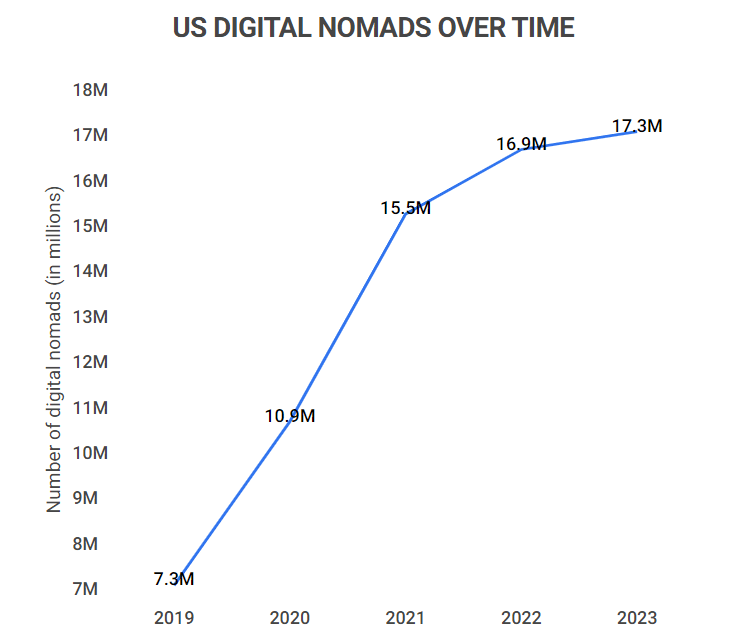
There are currently 17.3 million digital nomads in the US.
This figure represents nearly half of all digital nomads worldwide, making the US a key player in this lifestyle trend.
Number of digital nomads in the US over time
Year Number of digital nomads 2019 7.3M 2020 10.9M 2021 15.5M 2022 16.9M 2023 17.3M -
10 million more workers have become US digital nomads since 2019.
As of 2023, the digital nomad population in the US has more than doubled, with significant growth occurring between 2020 and 2021 during the pandemic.
-
17% of American digital nomads are VanLifers.
Approximately 1.9 million Americans live and work from their vehicles as of 2023, contributing to the growing VanLife community.
-
19 million Americans aspire to be digital nomads.
This reflects an 18% increase in interest compared to 2019, with an additional 45 million Americans considering the digital nomad lifestyle in the future.
-
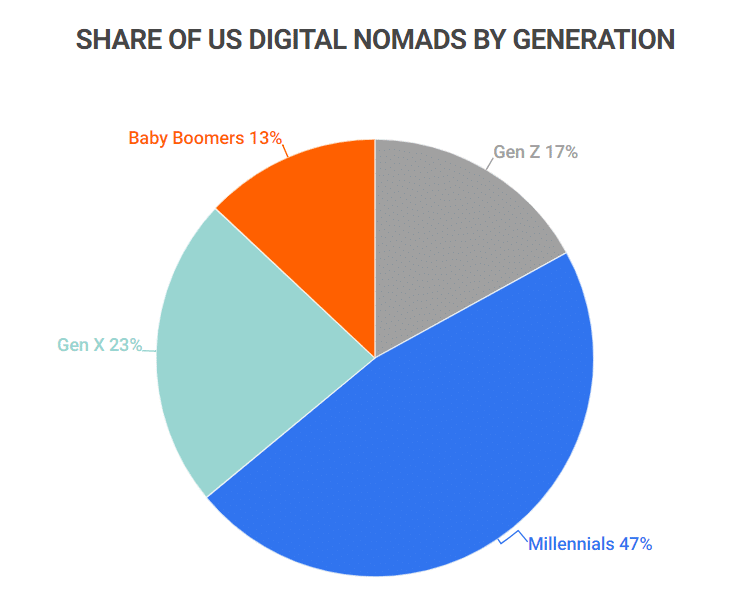
47% of American digital nomads are millennials.
Millennials make up nearly half of this group, followed by Gen X at 23%.
US digital nomads by generation
Generation Share of digital nomads Gen Z 17% Millennials 47% Gen X 23% Baby Boomers 13%
Popularity of digital nomads
The surge of digital nomads in recent years underscores the growing appeal of this lifestyle. Here are some fascinating insights:
-
58 countries offer digital nomad visas.
Countries like Mexico and Indonesia are highly regarded for digital nomads. Here’s a list of the top ten countries:
-
Mexico
-
Indonesia
-
Taiwan
-
Portugal
-
Spain
-
UAE
-
Vietnam
-
Thailand
-
Australia
-
Singapore
-
-
Digital nomads contribute $787 billion to the global economy annually.
This figure is just $100 billion shy of the total annual contribution of the dairy industry worldwide, highlighting the economic significance of digital nomads.
-
Global digital nomads increased by 131% between 2019-2023.
This growth mirrors the trends observed in the US, indicating a substantial rise in digital nomadism post-pandemic.
Where do digital nomads work?
With the ability to work from virtually anywhere, digital nomads tend to favor specific countries and cities. Here’s what we’ve found regarding their preferred locations:
-
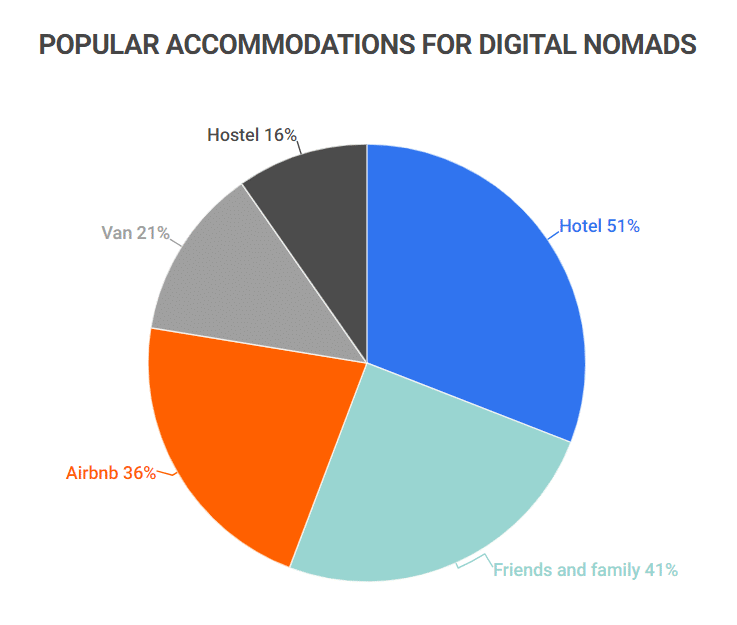
51% of digital nomads stay in hotels.
Hotels are often the go-to choice for short stays, but many also opt for accommodations like friends’ homes (41%), Airbnb (36%), vans (21%), and hostels (16%).
Most popular accommodations among digital nomads
Accommodation Share of digital nomads Hotel 51% Friends and family Airbnb 36% Van 21% Hostel 16% -
London is the most popular city among digital nomads.
Approximately 2.39% of digital nomads (over 836,000 people) have visited London, with other favored destinations including:
Most popular cities among digital nomads
City Share of digital nomads London, UK 2.39% Bangkok, Thailand 1.93% New York City, US 1.62% Berlin, Germany 1.58% Paris, France 1.54% Lisbon, Portugal 1.51% Barcelona, Spain 1.46% Amsterdam, Netherlands 1.34% San Francisco, US 1.27% Chiang Mai, Thailand 1.10% -
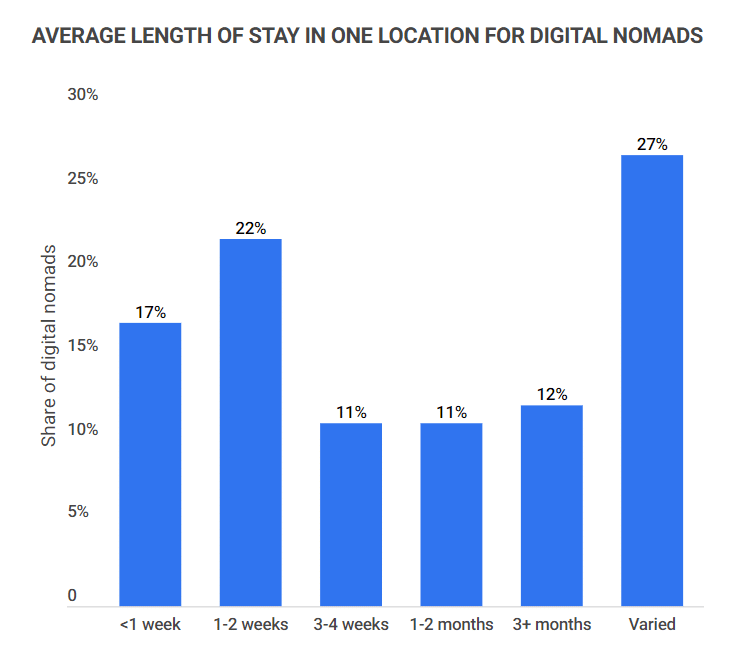
39% of digital nomads stay in one location for less than 2 weeks.
Digital nomads typically spend limited time in fixed locations, with only 12% remaining for three months or more.
Average length of stay in one location for digital nomads
Length of stay in one location Share of digital nomads Less than 1 week 17% 1-2 weeks 22% 3-4 weeks 11% 1-2 months 11% 3+ months 12% Varied 27%
Digital nomad income statistics
Curious about the income earned by digital nomads? While the lifestyle can come with expenses, the flexibility often balances it out. Here are some insights:
-
43% of digital nomads are freelancers.
Freelancing provides the flexibility that attracts many digital nomads, while only 5% engage in traditional part-time jobs.
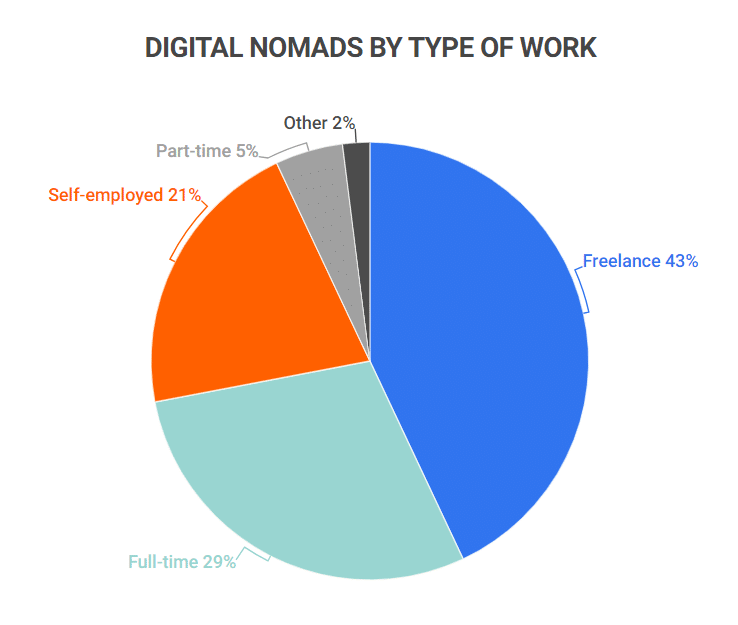
Digital nomads by type of work
Type of work Share of digital nomads Freelance 43% Full-time 29% Self-employed 21% Part-time 5% Other 2% -
58% of digital nomads earn less than $100,000 per year.
Despite the freedom of the digital nomad lifestyle, just over half earn modest incomes, with only 9% exceeding $250,000 annually.
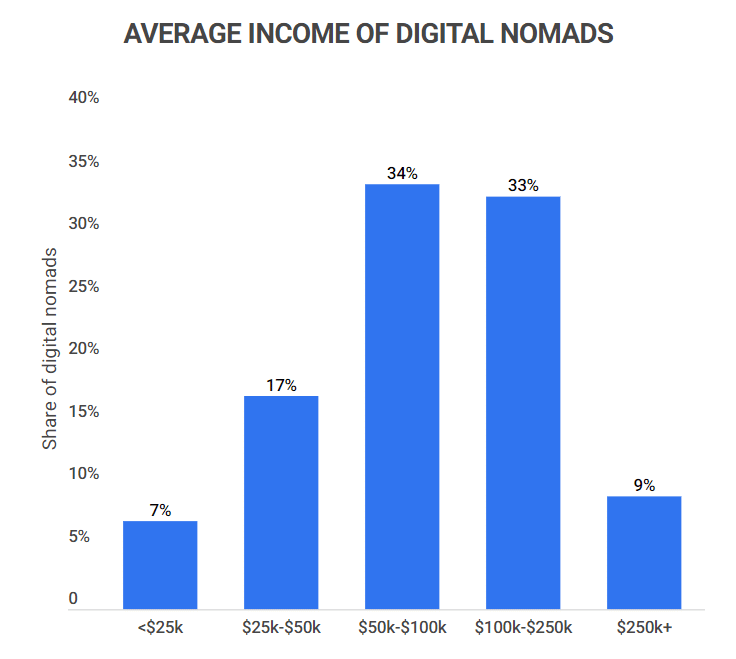
Average income of digital nomads
Income range Share of digital nomads Less than $25k 7% $25k-$50k 17% $50k-$100k 34% $100k-$250k 33% $250k+ 9% -
Digital nomads earn an average of 10-15% more than their office-based counterparts.
This suggests that while many digital nomads have moderate incomes, they tend to earn more than those working in traditional office settings.
Digital nomad demographics
Digital nomads come from diverse backgrounds, but certain trends are noticeable. Here are the key demographic insights:
-
46.5% of digital nomads are in their 30s.
This age group represents the largest segment of digital nomads, while only 4% are aged 60 or older.
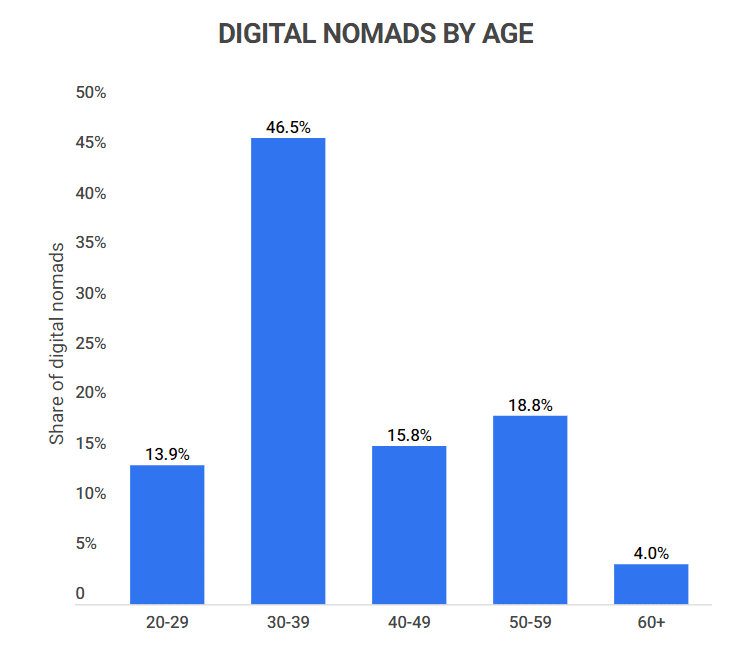
Digital nomads by age
Age range Share of digital nomads 20-29 13.9% 30-39 46.5% 40-49 15.8% 50-59 18.8% 60+ 4.0% -
51% of digital nomads are men.
Men slightly outnumber women in the digital nomad community, with 51% identifying as male and 49% as female.
-
60% of digital nomads identify as White.
Despite representing only 11.5% of the global population, approximately 60% of digital nomads are White. The remaining 40% comprise a variety of ethnicities, including:
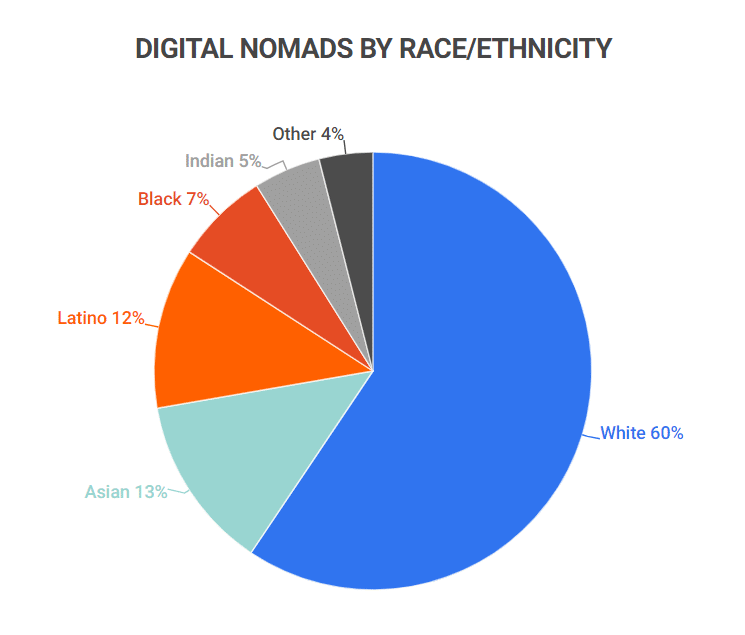
Digital nomads by race/ethnicity
Race/ethnicity Share of digital nomads White 60% Asian 13% Latino 12% Black 7% Indian 5% Middle Eastern 3% Pacific Islander 1%
Digital Nomad FAQ
-
What are digital nomads?
Digital nomads are workers who leverage the flexibility of online jobs to travel. They may work in different locations for varying durations, from a few days to several months.
The digital nomad lifestyle has gained popularity through social media influencers and content creators showcasing their journeys.
-
How common are digital nomads?
Digital nomads are increasingly prevalent, with 35 million worldwide and 17.3 million in the US. This means they represent about 11% of the US workforce, suggesting that 1 in 10 workers you meet may be a digital nomad.
-
Is 30 too old to be a digital nomad?
No, 30 is not too old to adopt a digital nomad lifestyle. In fact, 46.5% of digital nomads are in their 30s, and an impressive 38.6% are over 40, demonstrating that this lifestyle is accessible at any age.
-
Are digital nomads rich?
No, most digital nomads have average incomes. About 58% earn less than $100,000 annually, with only 9% making over $250,000, indicating that many earn between $50,000 and $100,000 (34%).
-
Do digital nomads pay US taxes?
Yes, digital nomads who work for US-based companies or hold US citizenship are required to pay US taxes, regardless of their location. Taxable income includes:
-
Wages
-
Interest
-
Dividends
-
Rental Income
-
-
What are the downsides of being a digital nomad?
The freedom of being a digital nomad can also lead to challenges, particularly the absence of a permanent home. While this flexibility allows for travel, it can also result in feelings of homesickness, loneliness, and stress.
Other potential downsides include:
-
Poor work-life balance. The excitement of new locations can lead to distraction from work responsibilities, risking burnout.
-
Wi-Fi dependency. Digital nomads require reliable internet access to work, which can limit travel to areas with adequate connectivity.
-
Lack of stability. Constant movement can be exhilarating, but it may also create stress due to the absence of routine.
-
Loneliness. Traveling alone in unfamiliar places can lead to isolation, especially in regions where language barriers exist.
-
Conclusion
Digital nomadism has gained remarkable traction in recent years, with 10 million more individuals in the US adopting this lifestyle since 2019. Currently, there are 17.3 million digital nomads in the US and 35 million worldwide, significantly impacting the global economy.
With 58 countries offering digital nomad visas, it has never been easier for individuals to pursue this lifestyle. Moreover, as most digital nomads earn less than $100,000 per year, this lifestyle is increasingly attainable for the average worker.
References
-
Forbes – Digital Nomadism Continues To Grow, Despite The “Back To The Office” Trend
-
Statista – Number of digital nomads in the United States from 2019 to 2023
-
BBC – Companies are helping people realise the work-from-anywhere dream. Business is booming.

Author

Jack Flynn is a writer for Zippia. In his professional career he’s written over 100 research papers, articles and blog posts. Some of his most popular published works include his writing about economic terms and research into job classifications. Jack received his BS from Hampshire College.