- Business Statistics
- Startup Statistics
- Cloud Adoption Statistics
- Customer Loyalty Statistics
- Nonprofit Statistics
- Affiliate Marketing Statistics
- Cart Abandonment Rate Statistics
- Ridesharing Statistics
- Call Center Statistics
- eLearning statistics
- Customer Service Statistics
- Customer Experience statistics
- Entrepreneur Statistics
- Outsourcing Statistics
- Gross Revenue for Marketing and Advertising
- Sales Statistics
- MBA Statistics
- Average Small Business Revenue + Profit Margin
- How Much Do Employee Benefits Cost?
Research Summary. Over the last decade, both companies and educational institutions have increasingly embraced eLearning, a trend that shows no signs of waning in 2026. Below are some key statistics highlighting the current landscape of eLearning:
-
The eLearning market is projected to reach $370 billion by 2026.
-
77% of U.S. companies currently utilize eLearning for employee training and development.
-
eLearning can enhance retention rates by 25-60%, making it a compelling training option.
-
Employee training through eLearning typically requires 40-60% less time compared to traditional training methods.
-
The eLearning market was valued at $281 billion in 2022, demonstrating significant growth.
-
42% of organizations report increased revenue following the implementation of eLearning programs.
For further analysis, we have categorized the data as follows:
Academic | Industry | Trends and Projections

Corporate eLearning Statistics
-
The global corporate eLearning sector is estimated to be worth $17.2 billion.
It is projected to grow to $37 billion by 2026, reflecting an 11% annual growth rate.
-
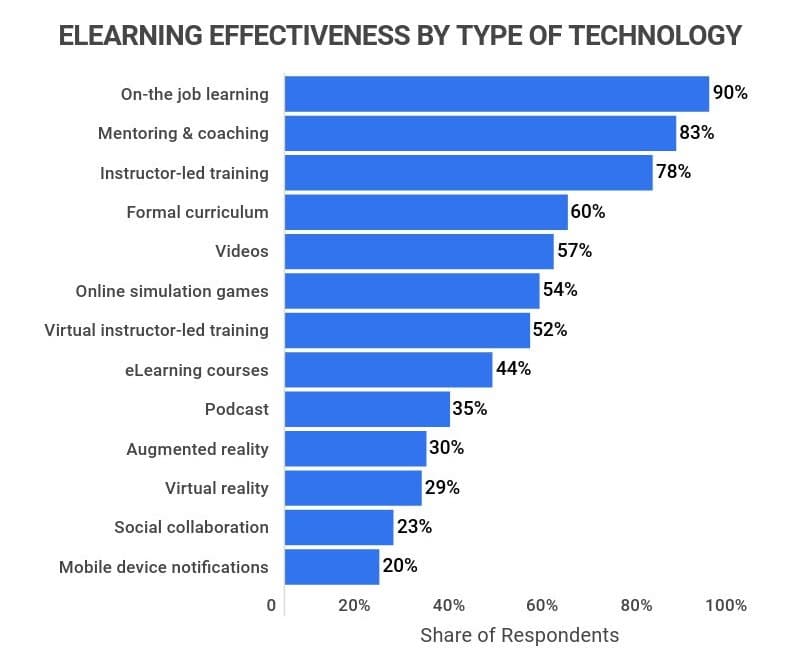
44% of employees worldwide consider eLearning courses effective.
However, many believe that traditional methods such as:
-
On-the-job or experiential learning (90%)
-
Mentoring or coaching (83%)
-
Classroom training (78%)
-
Formal courses at colleges or professional certification programs (60%)
-
Videos (57%)
-
Online simulation games (54%)
-
Virtual instructor-led training (52%)
are perceived as more beneficial. Yet, eLearning is still viewed as more helpful than:
-
Podcasts (35%)
-
Augmented reality (30%)
-
Virtual reality (29%)
-
Learning apps for employees (23%)
-
Mobile notifications (20%)
-
-
41.7% of Fortune 500 companies employ eLearning tools for training.
Organizations that leverage this technology have reported improvements in focus, time management, and employee engagement.
-
67% of companies provide eLearning options on mobile devices.
This shift reflects a growing trend toward mobile accessibility for training programs, as the mobile learning market has been projected to expand significantly.
Academic eLearning Statistics
-
By 2022, 68% of students in grades four and eight participated in fully remote or hybrid learning environments.
-
83% of fourth- and eighth-graders attended schools that offered remote learning options.
-
Only 24% of teachers reported that all their students had the necessary technology for effective eLearning.
-
Over six million undergraduate students were enrolled in at least one distance education course prior to the pandemic.
-
43% of college students in the U.S. find eLearning technology “extremely helpful.”
| Level of Enrollment | At Least One Distance Education Courses | Exclusively Distance Education Courses | Total |
|---|---|---|---|
| Undergraduate | 3.56M | 2.45M | 6M |
| Postbaccalaureate | 300K | 1M | 1.3M |
| Level of Enrollment | At Least One Distance Education Courses | Exclusively Distance Education Courses | Total |
|---|---|---|---|
| Undergraduate | 21.50% | 14.80% | 36.30% |
| Postbaccalaureate | 9.80% | 32.60% | 42.30% |
eLearning Industry Statistics
-
The global eLearning market was valued at $281 billion in 2022.
Online eLearning remains the largest segment at $100 billion, with expectations to exceed $370 billion by 2026.
-
North America accounted for 35% of global eLearning revenues in 2020.
The U.S. leads this sector, with growing contributions from Asia-Pacific nations projected to represent 26% of revenues by 2027.
-
Online learning can reduce emissions and energy consumption by up to 90%.
This reduction is attributed to fewer physical commutes and a decrease in paper usage, as more assignments are completed digitally.
| Type of Institution | Total of Any Distance Education Courses | Percentage of Total Courses |
|---|---|---|
| Public | 5.25M | 36.20% |
| Private Nonprofit | 1.34M | 32.30% |
| Private For-Profit | 726K | 73.30% |
eLearning Trends and Projections
-
The eLearning industry is expected to see a CAGR of over 21% from 2020 to 2027.
This growth is anticipated to be fueled by advancements in technologies such as virtual reality, cloud-based learning management systems, and artificial intelligence.
-
By 2025, the global eLearning market is anticipated to reach $325 billion.
This marks a significant increase from its valuation of $107 billion in 2015, effectively tripling in just a decade.
-
The self-paced eLearning market is experiencing a decline of about 6% annually.
This trend is due to lower engagement levels compared to training models that emphasize accountability.
-
The eLearning industry has expanded by over 900% since 2000.
This remarkable growth reflects the widespread adoption of eLearning tools and solutions.
eLearning Statistics FAQ
-
Yes, eLearning is effective. Approximately 43% of college students report finding eLearning “extremely helpful,” and 44% of employees in companies using eLearning believe it is effective.
Many appreciate the flexibility of completing courses at their own pace, rewatching lectures, and testing their understanding as they progress. However, some employees and students still prefer on-the-job training or in-person experiences.
There have also been concerns regarding the high number of failing grades among K-12 students in eLearning environments.
-
What are the positive effects of online learning?
Benefits of online learning include the ability to learn at your own pace, assess your understanding continuously, and experience a pressure-free learning environment.
eLearners appreciate fitting training into their schedules and the flexibility of pausing or rewatching content. Companies also benefit from standardized training across their workforce.
-
What percentage of students are doing online learning?
68% of fourth- and eighth-grade students are enrolled in remote or hybrid educational programs. This statistic reflects current trends in education as of 2022.
-
How big is the eLearning market?
The eLearning market is worth $281 billion. As of 2022, this market continues to grow, with projections indicating it could exceed $370 billion in the near future.
-
What percentage of companies use eLearning?
77% of companies utilize eLearning. This percentage reflects a steady increase since previous years, with 41.7% of Fortune 500 companies adopting eLearning for employee training.
Conclusion
In 2026, eLearning has solidified its role within educational institutions and businesses alike, facilitating everything from online coursework to virtual onboarding programs. The industry has grown more than 900% since 2000 due to technological advancements and accessibility improvements, with projections indicating a market value of $370 billion by 2026.
The rise of online learning was significantly accelerated by the COVID-19 pandemic, which catalyzed many educational institutions to adopt remote solutions. In this evolving landscape, while a majority of employees and college students find eLearning effective, challenges remain, particularly in K-12 education where access to resources is critical to success.
References
-
Statista. “Market Size of the Global Corporate e-Learning Industry in 2019 with a Forecast for 2026.” Accessed February 9, 2022.
-
Statista. “Share of Employees Worldwide Who Believe Learning Technologies Are Effective in 2018, by Type of Technology.” Accessed on February 9, 2022.
-
Skill Dynamics. “How Are Top Fortune 500 Companies Using eLearning To Boost Productivity.” Accessed on February 9, 2022.
-
eLearning Industry. “Top 20 eLearning Statistics for 2019 You Need To Know [Infographic].” Accessed on February 9, 2022.
-
NCES. “Fast Facts: Back-to-School Statistics.” Accessed on February 9, 2022.
-
The Hechinger Report. “Hundreds of Thousands of Students Still Can’t Access Online Learning.” Accessed on February 9, 2022.
-
NCES. “Fast Facts: Distance Learning.” Accessed on February 9, 2022.
-
Statista. “Size of the Global e-Learning Market in 2019 and 2026, by Segment.” Accessed on February 9, 2022.
-
Campus Technology. “E-Learning Market To Reach $1 Trillion Within 6 Years.” Accessed on February 9, 2022.
-
Triple Pundit. “4 Unsung Environmental Benefits of Online Education.” Accessed on February 9, 2022.
-
Global Market Insights. “E-Learning Market Industry Trends.” Accessed on February 9, 2022.
-
Forbes. “E Learning Climbing to $325 Billion by 2025 UF Canvas Absorb Schoology Moodle.” Accessed on February 9, 2022.
- Business Statistics
- Startup Statistics
- Cloud Adoption Statistics
- Customer Loyalty Statistics
- Nonprofit Statistics
- Affiliate Marketing Statistics
- Cart Abandonment Rate Statistics
- Ridesharing Statistics
- Call Center Statistics
- eLearning statistics
- Customer Service Statistics
- Customer Experience statistics
- Entrepreneur Statistics
- Outsourcing Statistics
- Gross Revenue for Marketing and Advertising
- Sales Statistics
- MBA Statistics
- Average Small Business Revenue + Profit Margin
- How Much Do Employee Benefits Cost?

Author

Abby is a writer who is passionate about the power of story. Whether it’s communicating complicated topics in a clear way or helping readers connect with another person or place from the comfort of their couch. Abby attended Oral Roberts University in Tulsa, Oklahoma, where she earned a degree in writing with concentrations in journalism and business.