- Cover Letter Format
Find a Job You Really Want In
Crafting the body of your cover letter can be challenging, but the conclusion often leads to writer’s block, even for the most articulate individuals.
In this article, we’ll guide you on how to effectively conclude your cover letter, providing example closing paragraphs and sign-offs. Additionally, we’ll highlight which closings to avoid, how to incorporate a P.S., and the fundamental structure of a cover letter.
Key Takeaways
-
Your cover letter’s final paragraph should feature a call to action, express your enthusiasm for the role, and include a thank you to the reader.
-
Ending with “Sincerely,” is a timeless choice for signing off your cover letter.
-
Using a P.S. can effectively make your cover letter memorable.
How to End a Cover Letter
As you write your cover letter, aim to conclude your body paragraphs effectively rather than trailing off. A succinct concluding paragraph is key.
This closing doesn’t need to be lengthy—one or two lines will suffice—but must include these components:
-
A call to action
-
Your enthusiasm for the position
-
A thank you
Your call to action typically invites further discussion about the position or offers to answer any questions the reader may have. This approach reminds the reader of your intent and encourages them to respond.
Express genuine excitement about the potential to work with the company; hiring managers appreciate candidates who show they care about the role.
Finally, thank the reader for their time and consideration. This simple gesture can significantly enhance your rapport with the hiring manager.
Examples of How to End Your Cover Letter
While closing statements in cover letters are crucial, strive to sound confident rather than insecure or anxious.
Here’s a list of effective ways to conclude your cover letter:
-
I look forward to the opportunity to discuss this position further and share how I would be a great fit for your organization.
A strong closing like this conveys your confidence and enthusiasm for the opportunity, indicating that you align with the company’s culture and work ethic.
-
I am eager to leverage my strengths, skills, and industry expertise to contribute to your organization.
Employers want to understand what you can offer and how you can help their business thrive. This statement demonstrates your commitment to being an integral part of their success.
-
If offered a position with your company, I am prepared to start immediately and exceed your expectations for success.
This type of closing demonstrates your eagerness to contribute and shows employers that you are passionate about your work.
-
I am excited about the opportunity to meet with you and discuss how my qualifications align with your company’s goals.
Employers want to see how your experience and qualifications will directly benefit their organization. It’s vital to communicate that your primary goal is to help the company grow.
How to Sign Off on a Cover Letter
Just as a strong closing statement is important, signing off your cover letter professionally is equally crucial. This forms a key part of your cover letter format.
Here’s a list of professional sign-offs suitable for cover letters and other business correspondence:
-
Sincerely / Sincerely yours / Most sincerely
-
Regards / Best / Best regards / With best regards
-
Respectfully / Respectfully yours
-
Yours truly
-
Thank you for your consideration
After your chosen closing, include a comma, then on a new line, write your name. If sending via email, add your contact information below your name. For example:
Best Regards,
Your Name
Your LinkedIn Profile URL
Your Email Address
Your Phone Number
Best Regards,
John Lynch
www.linkedin.com/in/john-lynch/
john.lynch@gmail.com
999-888-7777
Ensure your email address is professional. While a fun email like “catsRcuteNfun@aol.com” may be amusing, it’s unlikely to help you land the job.
The Best Closing for a Cover Letter
“Thank you in advance”
This phrase may seem unusual for a job seeker, but studies indicate it can yield high response rates. However, the “in advance” part may come off as presumptuous, so simply expressing gratitude is often more effective.
Everyone appreciates being acknowledged.
Mistakes to Avoid: How Not to Close a Cover Letter
There are certainly pitfalls to avoid when writing cover letters. If you sign off too casually, your cover letter may end up discarded.
To help you present yourself professionally, here’s a list of sign-offs to avoid at all costs:
-
Affectionately
-
Best wishes
-
Cheers!
-
Have a great day
-
Take it easy
-
Warm regards
-
Fondly
-
Love you
-
Smiles :~)
-
XOXO
-
Yours / Yours faithfully
-
Thx bro / Pls respond
-
Eagerly waiting for a response
-
Bye
-
Sent from my iPhone
This is a professional document—your cover letter should convey the firmness of a handshake, not the casualness of a fist bump.
Avoid ghosting and leaving your cover letter without a proper conclusion. Even if writing it is stressful, it’s crucial to conclude thoughtfully.
Ending a Cover Letter with P.S.
Another effective strategy for concluding your cover letter is using a postscript (P.S.). Hiring managers and recruiters often skim through cover letters, and a unique P.S. can catch their attention.
If your P.S. piques their interest, they’re likely to read the rest of your cover letter.
Utilize your P.S. to highlight something unique about yourself that may not fit neatly into the main body of your cover letter. It could also be something that underscores your initiative, problem-solving skills, or values—bonus points if these align with the company’s mission.
-
P.S. — I’d be excited to discuss how my sustainability initiative reduced CO2 emissions in my office by 17% and learn more about your commitment to environmental stewardship.
-
P.S. — In my 6+ years of teaching, I’ve educated students from diverse backgrounds, much like those your institution serves.
-
P.S. — I would love the opportunity to apply my proven marketing strategies at XYZ Inc. and achieve even greater results than the 213% increase in website traffic I delivered for previous clients.
While a P.S. may not suit everyone, if you can think of a compelling one that captures the hiring manager’s attention, it can be very effective.
What Is a Cover Letter For?
Cover letters serve as a platform for candidates to connect their resumes with the job they aspire to secure.
They allow you to demonstrate your key skills, qualifications, and achievements in a more narrative format than your resume allows. They also show that your application isn’t just a mass submission, as they can be tailored to reflect your interest in the specific role.
If you’re applying for a position in a writing-intensive field such as marketing, content creation, or public relations, your cover letter and its conclusion are vital in showcasing your communication skills, aligning your qualifications with the job requirements, and providing your contact information for further discussion.
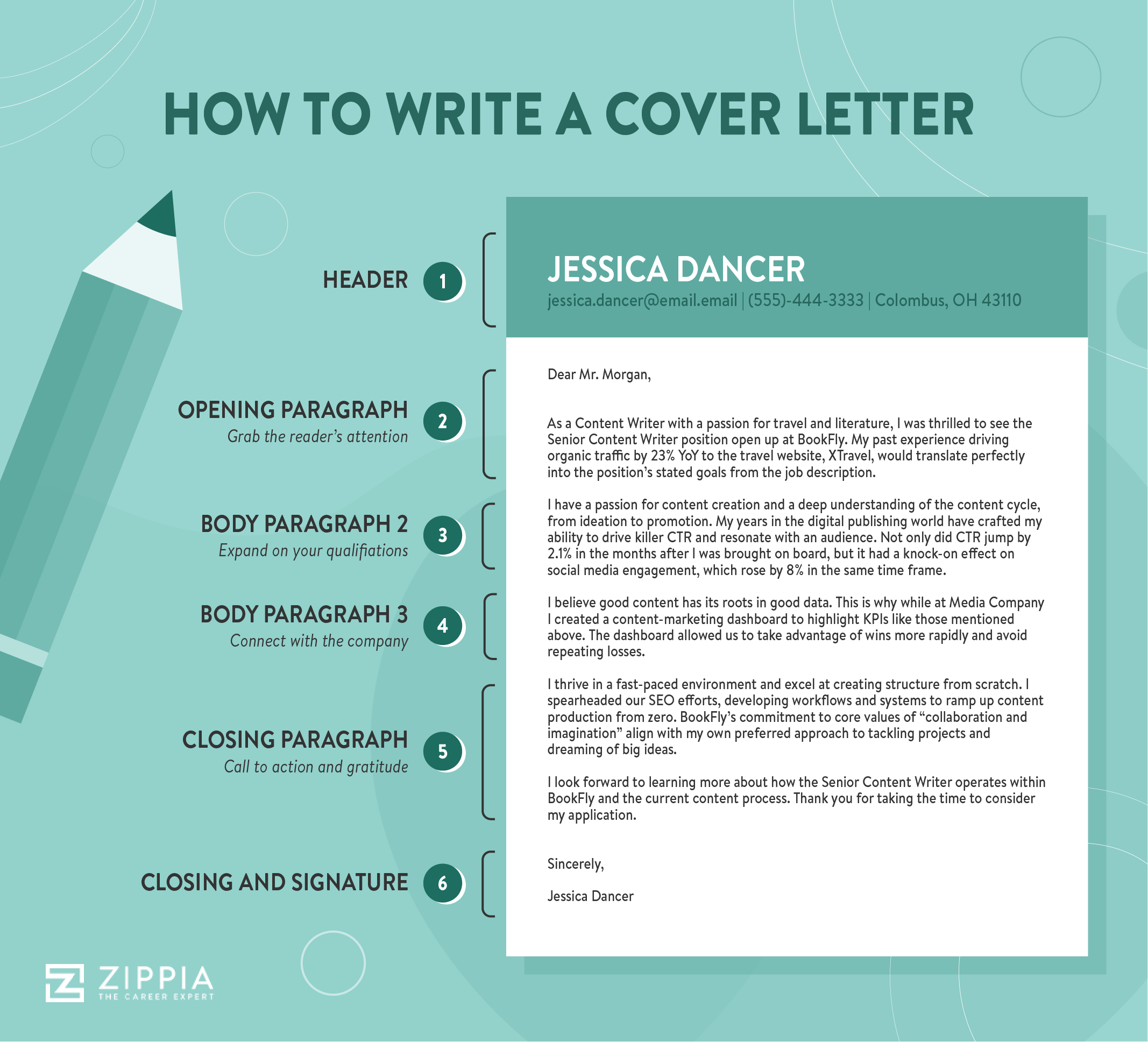
Cover Letter Format
-
Greeting: Use “Dear [Hiring Manager’s Name]” if you can find the recipient’s name (which we highly recommend). If you can’t locate it, here are alternative options to consider besides “Dear Hiring Manager.”
-
Opening paragraph: Begin with an introduction, a brief overview of your professional background, your enthusiasm for the opportunity, and how you learned about the job opening (especially if you were referred by a current employee). Aim for around three sentences.
-
Second paragraph: Align your professional experiences with the job description. Highlight your most impressive accomplishments that correspond with the responsibilities of the new position. Use quantifiable results whenever possible, as hiring managers appreciate seeing concrete outcomes. This paragraph should be your longest, but keep it under six sentences.
-
Third paragraph: Discuss why you’re an ideal fit for the company (and vice versa). Mention shared values, unique challenges they face that you’re equipped to handle, or commend the company’s achievements.
-
Concluding paragraph: This is the focal point of this article. A call-to-action and a thank-you are essential components here.
-
The sign-off: “Sincerely” is a reliable choice, but we have several alternatives listed below.
-
The P.S.: The postscript is a secret weapon you can use if you have an additional detail to highlight that didn’t fit within the rest of your cover letter.
Your cover letter should ideally be between 200-300 words, with a maximum of 400. Don’t fret if it appears short at 200 words—embrace white space, as many hiring managers prefer concise cover letters.
Final Thoughts
Cover letters are your first impression on a potential employer – and it’s vital to make it count. The conclusion of your cover letter plays a significant role in securing your next interview. By crafting an enthusiastic and confident closing paragraph, you’ll help your reader recognize that you’re the ideal candidate for the job.
Writing cover letters can be daunting—ensure you put forth your best effort from start to finish to reap the benefits of this essential document.
- Cover Letter Format

Author

Maddie Lloyd was a writer for the Zippia Advice blog focused on researching tips for interview, resume, and cover letter preparation. She's currently a graduate student at North Carolina State University's department of English concentrating in Film and Media Studies.
Expert
Matt Warzel a President of a resume writing firm (MJW Careers, LLC) with 15+ years of recruitment, outplacement, career coaching and resume writing experience. Matt is also a Certified Professional Resume Writer (CPRW) and Certified Internet Recruiter (CIR) with a Bachelor of Science in Business Administration (Marketing Focus) from John Carroll University.