- Industry Statistics
- Wedding Industry Statistics
- Yoga Industry Statistics
- Music Industry Statistics
- Landscaping Industry Statistics
- Bicycle Industry Statistics
- Coffee Industry Statistics
- Car Rental Industry Statistics
- Home Improvement Industry Statistics
- Insurance Industry Statistics
- Supplements Industry Statistics
- Golf Industry Statistics
- Fitness Industry Statistics
- US Media And Entertainment Industry Statistics
- Firearm Industry Statistics
- Financial Services Industry Statistics
- Health And Wellness Industry Statistics
- Trucking Industry Statistics
- Wine Industry Statistics
- Pet Industry Statistics
- Mobile App Industry Statistics
- Digital Marketing Industry Statistics
- Hotel Industry Statistics
- Retail Statistics
- Robotics Industry Statistics
- Jewelry Industry Statistics
- Appointment Scheduling statistics
- Restaurant Industry Statistics
- Food Delivery Statistics
- Food Truck Industry
- Fashion Industry
- Real Estate Industry
- US Film Industry
- US Beverage Industry
- USu202fFast Food Restaurants
- US Construction Industry
- US Book Industry
- Cosmetics Industry
- US Food Retail Industry
- US Pharmaceutical Industry
- US Healthcare Industry
- Airline Industry
- Automobile Industry
- Transportation Industry Statistics
- Event Industry Statistics
- Project Management Statistics
- Oil And Gas Industry Statistics
- Nursing Home Statistics
- Nursing Shortage Statistics
- Nursing Statistics
28 Dazzling Fashion Industry Statistics [2026]: How Much Is The Fashion Industry Worth
Fashion industry research summary: The vast array of apparel items found in closets worldwide highlights the fashion industry as a highly profitable and unique sector. While it has generated immense wealth, the apparel market has also historically faced scrutiny for its environmental impact.
To gain insights into the global fashion industry and its trends in the US, we’ve compiled key statistics and observations. Based on our findings:
-
The global fashion industry is valued at $1.9 trillion in 2026.
-
The fashion market saw an impressive growth rate of 5.8% from 2023 to 2026.
-
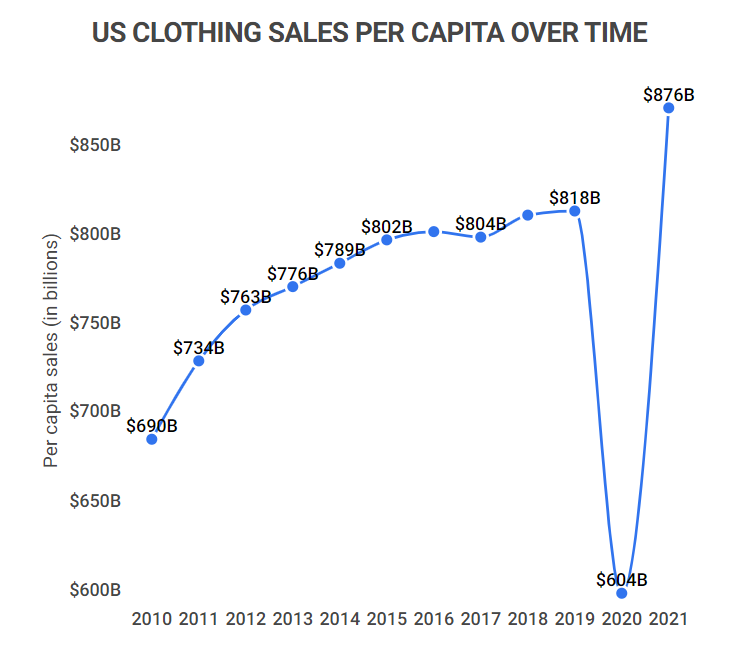
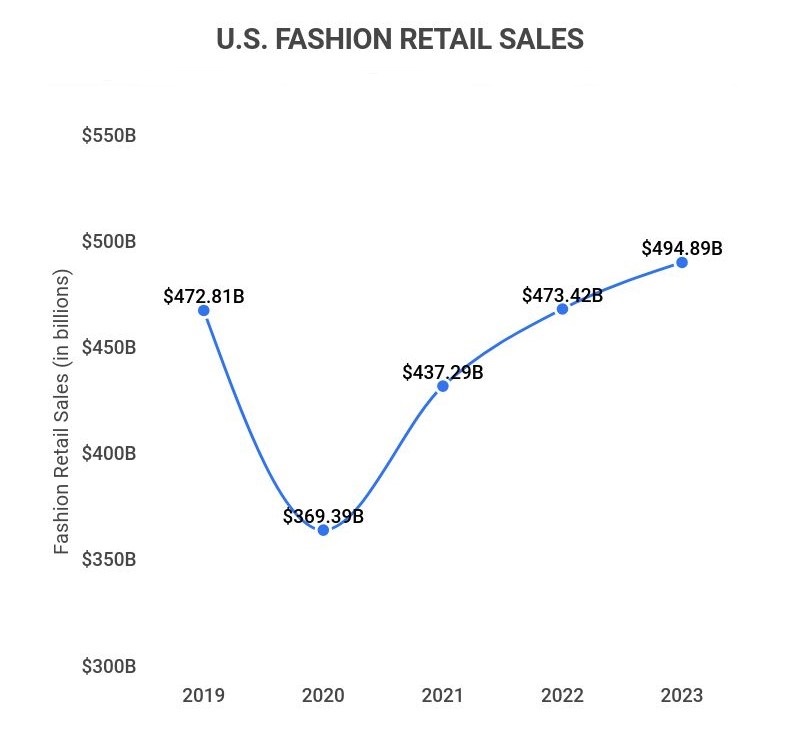
The United States fashion industry is valued at approximately $369.39 billion.
-
Forecasts suggest the fashion market in the United States will grow annually by 2.82% through 2027.
-
The fashion industry contributes 2% of the global Gross Domestic Product (GDP).
For a deeper analysis, we’ve categorized the data in the following sections:
Industry | Sectors | Trends and Predictions | Environmental Impact
Global fashion industry statistics
The fashion industry has a significant global impact, from luxurious high fashion to accessible fast fashion. Here are notable statistics illustrating its worldwide influence:
-
Global retail sales of apparel and footwear reached $2.0 trillion in 2023.
The fashion retail sector is projected to hit $3 trillion by 2030, indicating an estimated annual growth rate of 5.8%.
-
Out of the global workforce of 3.5 billion people, approximately 450 million work in fashion, clothing, and textile production.
This equates to about 12.9% of the global workforce, with a majority based in Asia.
-
The leading fashion company globally by revenue is LVMH Moët Hennessy Louis Vuitton, reporting €52.5 billion ($62.5 billion) in revenue for the first half of 2023.
The Christian Dior Group follows closely with €49.1 billion ($58.5 billion) in the same period.
-
In terms of per capita spending, the United States leads, where the average household member spends $850 on clothing and shoes annually.
In 2023, the United States purchased around 18 billion apparel units, while China remains a major consumer with approximately 45 billion units purchased in 2022.
US fashion industry statistics
The US fashion industry is vast, contributing significantly to the economy. Here are some essential statistics:
-
The US fashion industry is valued at approximately $369.39 billion.
-
In 2023, US clothing store sales totaled $205 billion.
-
Retail sales in the US fashion industry are projected to reach $494.89 billion by the end of 2026.
-
As of 2023, around 85,000 employees work in the apparel manufacturing sector in the United States.
-
There are over 4,600 fashion designers currently employed in the US.
-
The apparel market in the United States is expected to grow by 2.82% annually.
-
The largest segment of the US fashion market as of 2023 is women’s clothing.
Fashion industry sectors statistics
The fashion industry encompasses various sectors appealing to diverse demographics. Here are some compelling statistics about these sectors:
-
The women’s apparel segment is estimated to generate $850 billion in 2026.
This sector is expected to grow by 4.81% annually, largely driven by the rise of e-commerce platforms.
-
The men’s apparel segment is valued at $520 billion as of 2023.
This segment’s value is anticipated to reach $740 billion by 2026.
-
The children’s wear market is projected to total $240 billion by 2026.
-
The bridal gown market is currently valued at approximately $35 billion.
This sector is expected to grow to $45 billion by 2025.
Top 10 biggest fashion companies by market cap
| Company | Country | Mcap (in Billions USD) |
|---|---|---|
| Inditex | Spain | $120.00 |
| Nike | United States | $95.00 |
| LVMH | France | $90.00 |
| TJX | United States | $50.00 |
| Hennes & Mauritz | Sweden | $45.00 |
| Hermes | France | $43.00 |
| Rolex SA | Switzerland | $39.00 |
| Fast Retailing | Japan | $38.00 |
| Adidas | Germany | $35.00 |
| Chanel | France | $33.00 |
Fashion industry trends and predictions
The fashion industry remains vital as long as people require clothing. Here are some trends indicating its potential growth and evolution:
-
The mass production of clothing began in the mid-19th century, revolutionizing the way garments were created.
-
The first recognized fashion designer, Charles Fredrick Worth, operated from 1826 to 1895.
-
The global fashion market is expected to experience a Compound Annual Growth Rate (CAGR) of 5.5% from 2023 to 2028.
-
In comparison, the automotive manufacturing industry is projected to see a CAGR of 4.5% between 2023 and 2030, while the big data technology sector is anticipated to grow at a rate of 14% until 2027.
Fashion industry’s environmental impact statistics
The environmental impact of the fashion industry is significant, mirroring that of other large sectors. Here are some critical insights:
-
The fashion industry is responsible for approximately 10% of global carbon emissions.
This sector produces more carbon emissions than international flights and maritime shipping combined, and it is the second-largest consumer of the world’s freshwater resources.
-
85% of textiles produced end up in landfills each year.
An alarming 57% of discarded clothing is sent to landfills, equating to one garbage truck of clothes either incinerated or dumped every second.
-
Synthetic materials are responsible for 35% of all plastic microfibers in the oceans.
Although these materials reduce production costs, they contribute significantly to pollution and take a long time to decompose.
-
Producing a single pair of jeans requires approximately 3,781 liters of water.
This process emits around 33.4 kilograms of carbon equivalent, leading to an annual consumption of approximately 93 billion cubic meters of water by the industry.

Fashion industry statistics FAQ
-
Is the fashion industry growing?
Yes, the fashion industry is experiencing substantial growth, with a rate of 5.8% from 2023 to 2026. Projections indicate continued growth beyond this period.
-
How much is the fashion industry worth?
The global fashion market was valued at approximately $1.9 trillion in 2026. In the United States, the apparel industry is estimated to account for $369.39 billion and is expected to reach $494.89 billion by 2026.
-
Is the fashion industry dying?
The fashion industry is not dying but evolving.
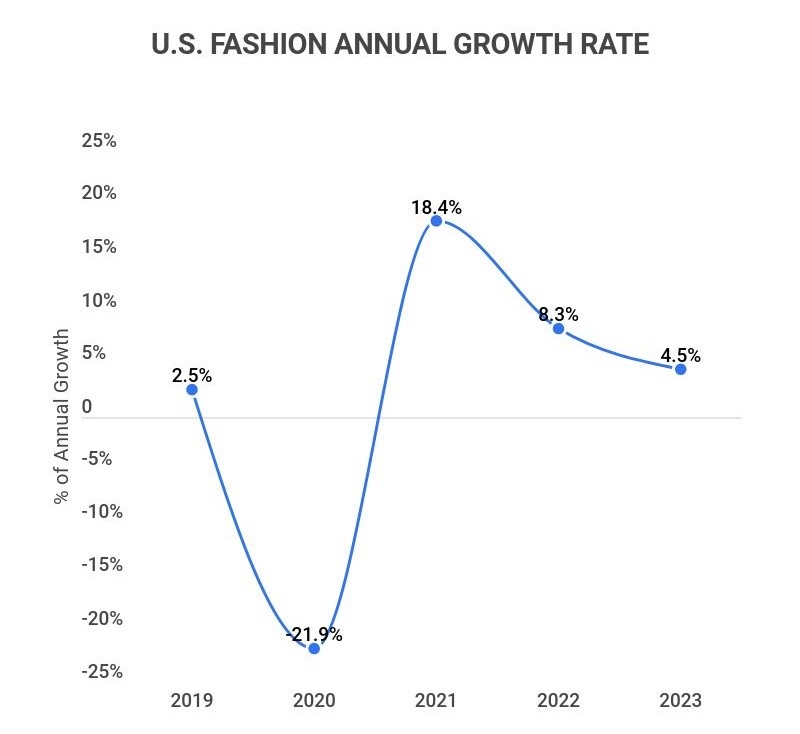
The impacts of the pandemic were significant but have led to an increased focus on e-commerce and sustainability. The public demand for environmentally-conscious practices is driving transformation within the sector.
-
What companies hold the largest share of the fashion industry?
Nike retains the largest market share in the fashion industry at 2.8%. Other major players include LVMH Moët Hennessy Louis Vuitton and the Christian Dior Group.
-
Which country spends the most on fashion?
Austalians lead in apparel spending, averaging $1,050 annually. The US follows with average spending of $850 per household member each year.
-
What are the four levels of the fashion industry?
The four levels of the fashion industry are Raw Materials Producers, Apparel Manufacturers, Retail, and Media/Consultants.
Detailed levels:-
Raw Materials Producers: This level involves the processing of fibers, yarn production, fabric manufacturing, and finishing. These materials are essential for all subsequent levels.
-
Apparel Manufacturers: This level encompasses the transformation of raw materials into fashion products through various stages, including design, production, and distribution.
-
Retail: After production, fashion items are distributed to retail outlets nationwide.
-
Media/Consultants: The final level includes those who market and provide services related to fashion, such as advertising and consulting.
-
Conclusion
The fashion industry has profoundly influenced society by producing clothing for nearly two centuries. Valued well over a trillion dollars and contributing 2% to the global GDP, its significance is evident.
With around 450 million individuals engaged in apparel-related careers globally and 85,000 in the US alone, the industry supports a vast workforce.
The largest sector, womenswear, generates approximately $850 billion, while menswear comes in significantly less at around $520 billion.
Despite its profitability, the fashion industry faces challenges regarding sustainability. It ranks among the highest producers of carbon emissions and is a major consumer of global water resources. Alarmingly, around 57% of clothing produced ends up in landfills.
While the fashion industry remains influential and lucrative, addressing its environmental impact is crucial for its future sustainability.
References
-
Statista. “Market growth of the apparel industry worldwide.” Accessed on November 6, 2023.
-
Fashion United. “Global fashion industry statistics – International apparel.” Accessed on November 6, 2023.
-
Oberlo. “US Fashion Industry Growth Rate.” Accessed on November 6, 2023.
-
Common Objective. “Faces and Figures: Who Makes Our Clothes?” Accessed on November 6, 2023.
-
Statista. “Consumer Markets-Apparel in the United States.” Accessed on November 6, 2023.
-
World Economic Forum. “These facts show how unsustainable the fashion industry is.” Accessed on November 6, 2023.
-
Global News Wire. “Big Data Technology Market to Rise at 14% CAGR till 2027.” Accessed on November 6, 2023.
-
Princeton. “The Impact of Fast Fashion on the Environment.” Accessed on November 6, 2023.
- Industry Statistics
- Wedding Industry Statistics
- Yoga Industry Statistics
- Music Industry Statistics
- Landscaping Industry Statistics
- Bicycle Industry Statistics
- Coffee Industry Statistics
- Car Rental Industry Statistics
- Home Improvement Industry Statistics
- Insurance Industry Statistics
- Supplements Industry Statistics
- Golf Industry Statistics
- Fitness Industry Statistics
- US Media And Entertainment Industry Statistics
- Firearm Industry Statistics
- Financial Services Industry Statistics
- Health And Wellness Industry Statistics
- Trucking Industry Statistics
- Wine Industry Statistics
- Pet Industry Statistics
- Mobile App Industry Statistics
- Digital Marketing Industry Statistics
- Hotel Industry Statistics
- Retail Statistics
- Robotics Industry Statistics
- Jewelry Industry Statistics
- Appointment Scheduling statistics
- Restaurant Industry Statistics
- Food Delivery Statistics
- Food Truck Industry
- Fashion Industry
- Real Estate Industry
- US Film Industry
- US Beverage Industry
- USu202fFast Food Restaurants
- US Construction Industry
- US Book Industry
- Cosmetics Industry
- US Food Retail Industry
- US Pharmaceutical Industry
- US Healthcare Industry
- Airline Industry
- Automobile Industry
- Transportation Industry Statistics
- Event Industry Statistics
- Project Management Statistics
- Oil And Gas Industry Statistics
- Nursing Home Statistics
- Nursing Shortage Statistics
- Nursing Statistics

Author

Sky Ariella is a professional freelance writer, originally from New York. She has been featured on websites and online magazines covering topics in career, travel, and lifestyle. She received her BA in psychology from Hunter College.