Find a Job You Really Want In
Every two years, the Bureau of Labor Statistics (BLS) publishes its Employment Projections program, providing critical insights into the American labor market based on ten-year forecasts. As we navigate through 2026, understanding these projections is essential for both job seekers and employers alike.
This study highlights anticipated shifts in the labor force, industry employment, macroeconomic trends, and occupational employment over the next decade. It also identifies which occupations are expected to experience the most significant declines, an important consideration for anyone planning a career path.
We analyzed this extensive dataset to uncover which jobs are projected to lose the most positions and which industries are facing significant workforce reductions.
In the agricultural sector, for instance, employment is declining at an alarming rate, but that’s just one part of a larger trend across various fields.
Summary of Findings for the 2026-2036 Decade:
- Approximately 164,000 secretary positions are expected to disappear over the next decade.
- A staggering 78 percent of train conductor jobs are projected to vanish, the highest rate of decline in any field.
- Most of the fastest declining occupations do not require a college degree.
- Roles such as entertainment attendants and bartenders continue to see the highest turnover rates.
A Note on Methodology
For this analysis, we utilized the BLS’s most recent Employment Projections report, focusing on data for 2026-2036. It’s important to note that these projections are not predictions but rather estimations based on current trends and assumptions about labor supply and demand in a fully employed economy.
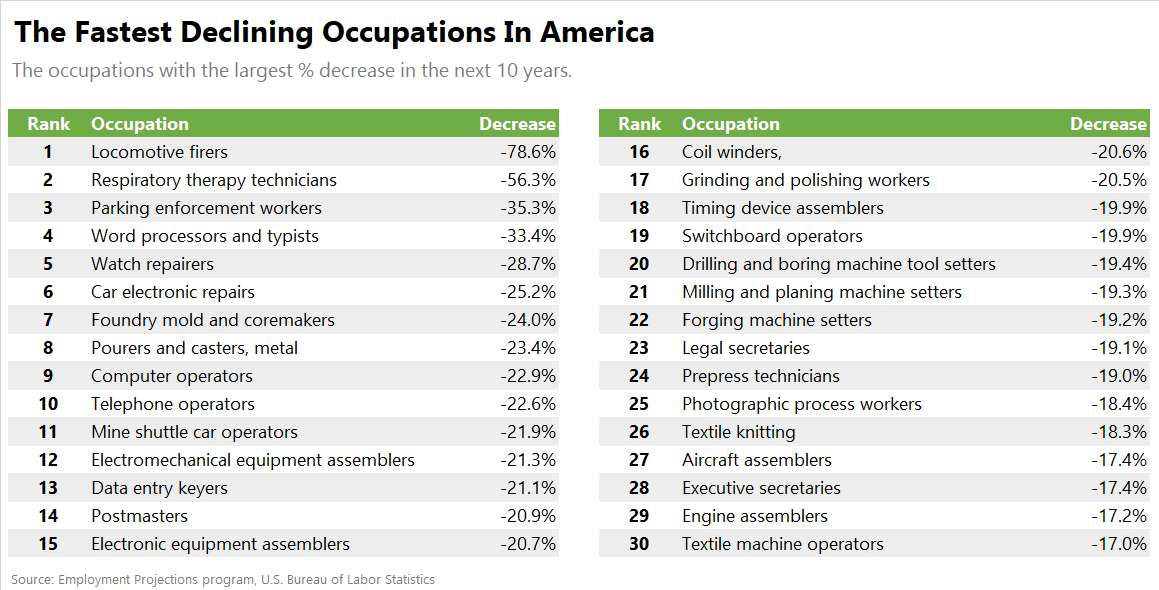
The BLS indicates that 163 out of 817 detailed occupations are anticipated to decline over the next decade. The top ten occupations on this list are particularly noteworthy due to their significant projected job losses.
The following table outlines the jobs experiencing the greatest percentage declines. For example, while watch repairers rank fifth, the size of their occupational space makes this percentage loss particularly impactful.
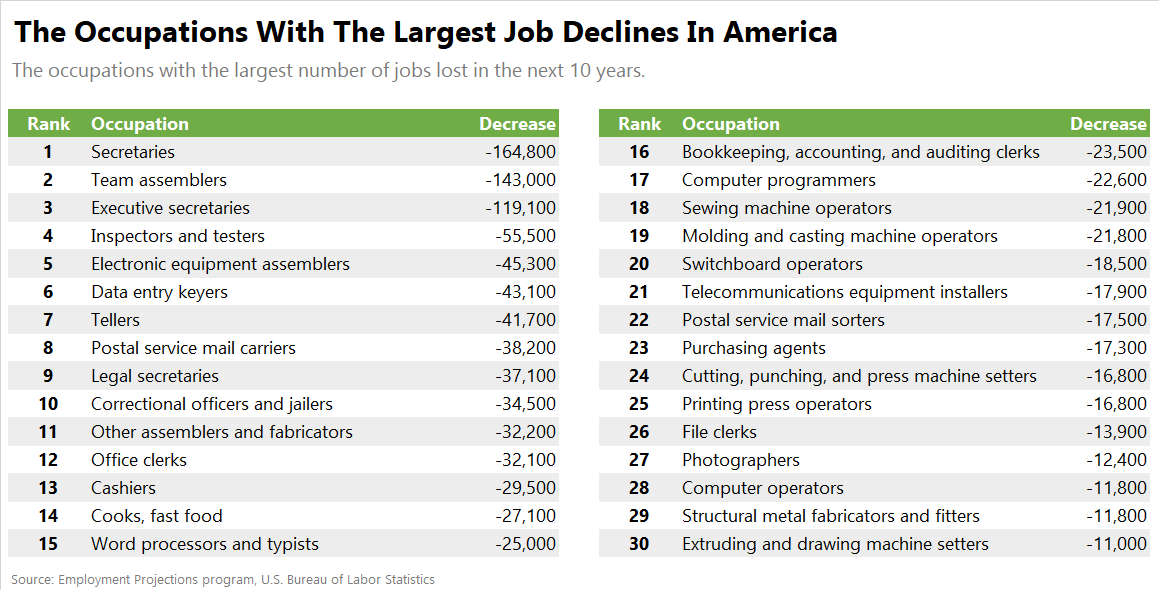
In contrast, data entry keyers appear on both lists, facing a decline of 21.1 percent, equating to approximately 43,100 jobs lost. Automation plays a critical role in the job losses across many of these occupations, particularly in the manufacturing sector.
The BLS notes that all occupational groups are expected to add jobs over the projection decade, except for the production occupations group, which is projected to decline by 4.1 percent.

This section highlights jobs with the highest turnover rates, indicating a trend of workers moving on to other sectors. Many of these positions are temporary or transitional, often serving as stopgaps until individuals find more stable employment.
It’s Not All Doom and Gloom — There’s a Service Industry Boom
While the outlook for certain occupations appears bleak, the overall employment landscape is more promising. According to the BLS report, total employment is projected to grow by 11.5 million jobs over the next decade, reaching 167.6 million by 2036—an increase surpassing the growth rate observed from 2006 to 2016.
The report also anticipates an increase in labor productivity, which is expected to drive GDP growth at a quicker pace than in the previous decade. Notably, while the goods-producing sector is projected to add around 219,000 jobs, the service-providing sector is expected to contribute 10.5 million new positions.
Key Takeaway: Education Matters
It’s worth noting that most of the fastest declining occupations do not require postsecondary education. In contrast, among the 30 fastest growing occupations, 19 typically necessitate some level of higher education for entry.

Author

David Luther was the Content Marketing Editor for the Zippia Advice blog. He developed partnerships with external reporting agencies in addition to generating original research and reporting for the Zippia Career Advice blog. David obtained his BA from UNC Chapel Hill.