- Job Seeker Statistics
- Career Change statistics
- Internship Statistics
- Job Search Statistics
- Average Number Of Jobs Applied
- Average Salary Increase When Changing Jobs
- Part Time Job Statistics
- Age Discrimination Statistics
- Networking Statistics
- Interview Statistics
- Average Number of Jobs In A Lifetime
- Resume Statistics
- Side Hustle Statistics
- Teacher Statistics
Research Summary. Securing a job in today’s competitive landscape can be challenging, with increasing competition and evolving recruitment processes. Let’s examine the statistics regarding how many applications are typically needed to land a job:
-
On average, it takes 21 to 80 job applications to secure one job offer.
-
A typical corporate job opening receives approximately 250 applications.
-
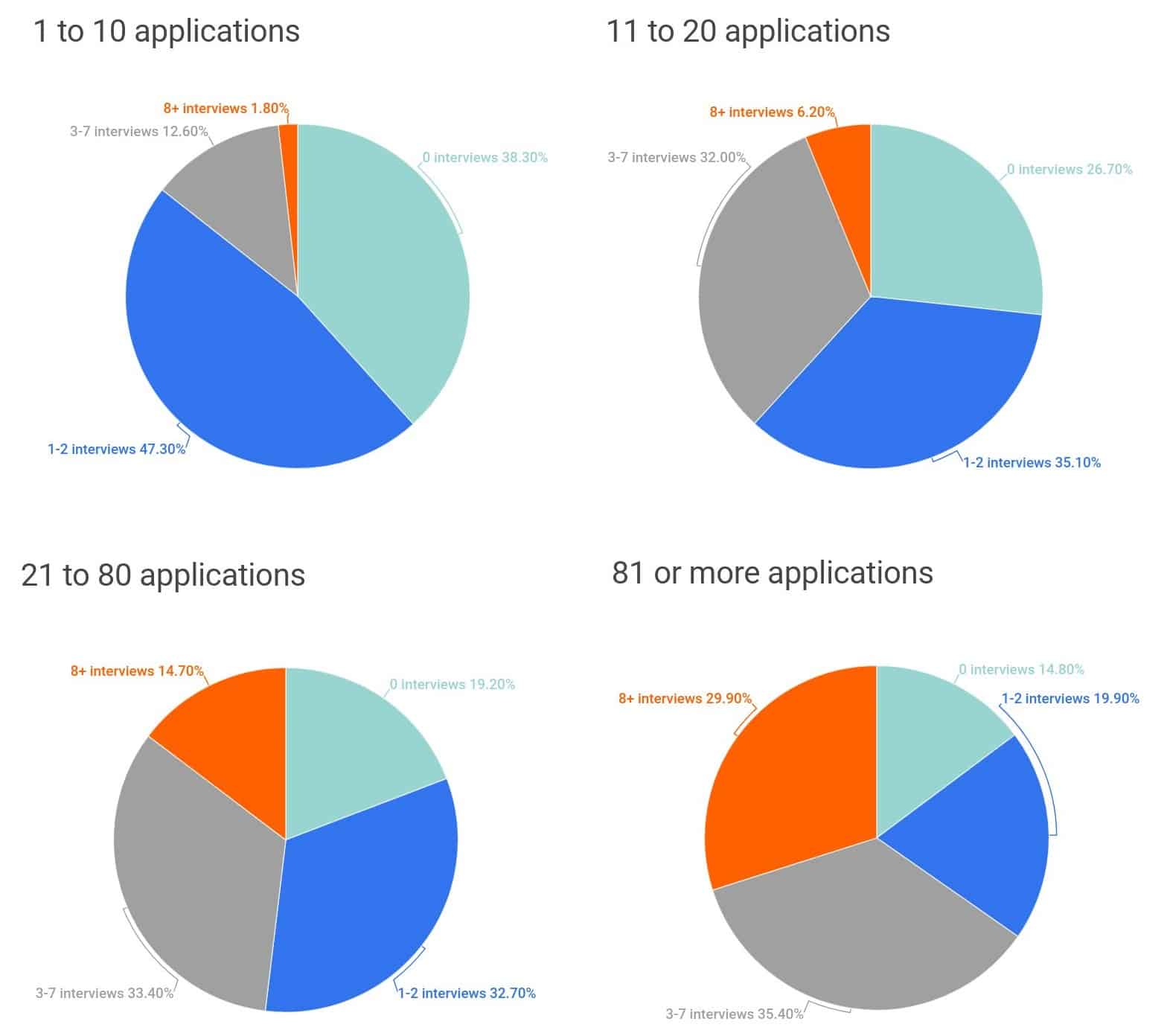
61.7% of job seekers receive at least one interview after submitting between 1-10 job applications.
-
51% of job seekers receive job offers after attending three job interviews.
For further insights, we have categorized the data as follows:
Interview | Demographics | Job Offers | ATS
Job Seeker Statistics
-
The average job seeker utilizes up to 16 sources during their job search.
Most job seekers rely on websites and mobile apps for job hunting. Mobile-friendly application portals are crucial, especially for millennials, as 1 in 10 millennials would reconsider a company if they could not apply via their mobile devices.
-
80% of jobs are filled through networking.
Recent studies indicate that the majority of jobs in the U.S. are filled through networking or personal connections. In fact, about 70% of job openings are never advertised on public job boards, as noted by CNBC.
-
Job seekers dedicate over 10 hours each week to their job search.
On average, job seekers spend about 11 hours weekly searching for jobs. A significant portion of this time is spent crafting resumes and supplemental cover letters and portfolios, since 53% of U.S. employers believe that a resume does not convey enough information about a candidate’s professional capabilities.
-
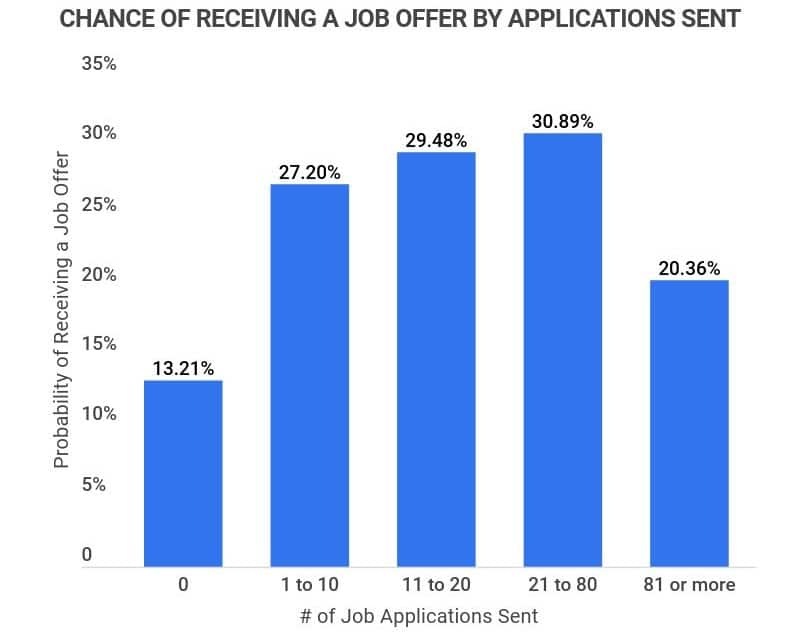
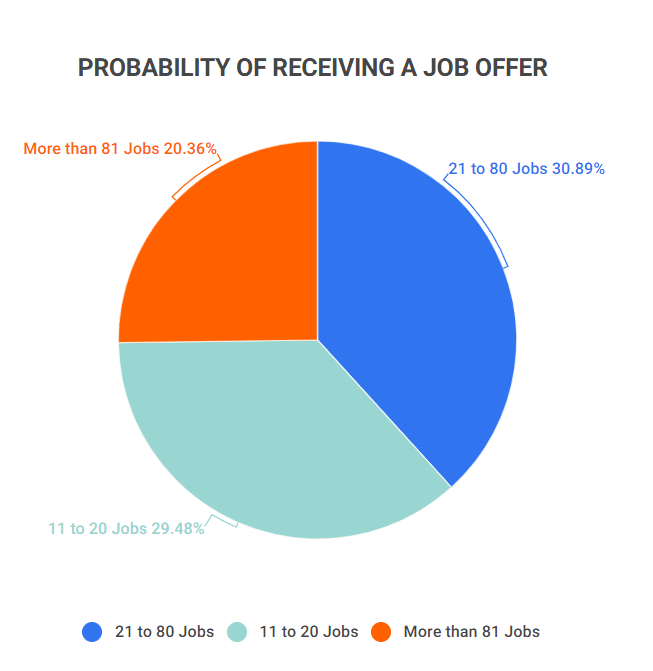
Job seekers applying for 21 to 80 jobs have the highest chances of receiving a job offer.
Data from the Bureau of Labor Statistics shows that candidates who apply for 21 to 80 jobs enjoy a 30.89% probability of receiving a job offer. Meanwhile, those applying for 11 to 20 jobs have a 29.48% chance, and individuals who submit over 81 applications see a decline to a 20.36% offer rate.
Interview Statistics
-
Approximately 22% of applicants for a job receive an interview.
On average, around 118 individuals apply for each job opening. Of those, only 22% will be invited for an interview, meaning roughly 24 applicants make it to that stage of the hiring process.
-
Job seekers who interview have a 36.89% chance of receiving a job offer.
Those who have interviewed after applying stand a 36.89% chance of securing an offer, compared to a mere 9.94% for applicants who did not get an interview.
-
Applicants with employee referrals have a 50% interview rate.
Employee referrals significantly enhance one’s chances of landing an interview and ultimately securing the job. About 20% of referrals lead to successful hires.
Interviews Received by Applications Sent
Applications Per Job by Demographics
-
Women apply for 20% fewer jobs than men.
Predominantly, women apply only for roles where they meet 100% of the requirements, while men are inclined to apply when they meet at least 60% of the criteria. This results in women being, on average, 16% less likely than men to apply for any given position.
-
Women are 16% more likely to get hired after applying than men, and 18% more likely for senior-level positions.
Despite submitting fewer applications, women have higher hiring rates once they do apply.
-
Since 1990, White applicants have received about 36% more callbacks than Black applicants with identical qualifications.
Furthermore, White candidates receive approximately 24% more callbacks than Latino applicants under similar circumstances, highlighting ongoing hiring discrimination against people of color in the U.S.
-
Job applicants aged 29 to 31 receive roughly 35% more callbacks than those aged 64 to 66.
Younger candidates are favored over older applicants, emphasizing the prevalence of age discrimination in hiring practices.
Job Offer Statistics
-
56% of U.S. employers reported that applicants rejected their job offers in the past.
A significant portion of job offers made by U.S. companies are declined by candidates, complicating the hiring process across various industries.
-
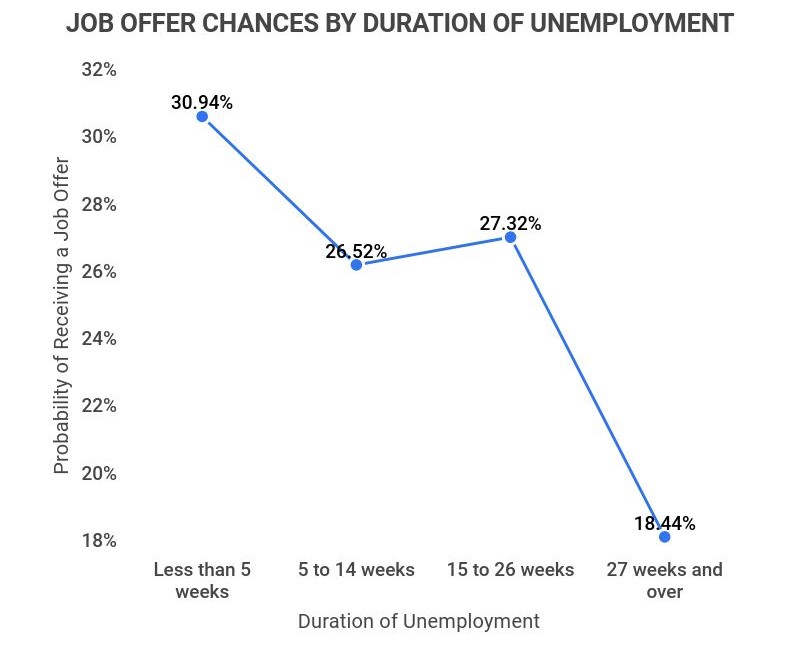
Being unemployed for 27+ weeks decreases your chances of receiving a job offer by 12.5%.
Applicants unemployed for less than 5 weeks have a 30.94% chance of receiving an offer, while those out of work for 27 weeks or more see their chances drop to 18.44%.
-
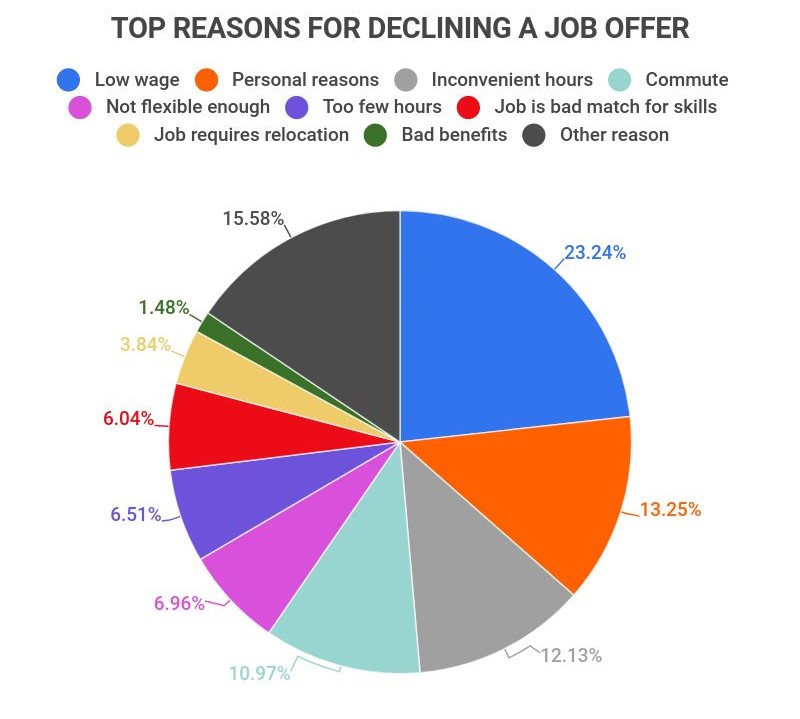
23.24% of individuals who reject job offers cite low wages as the primary reason.
The main reason for declining job offers is inadequate salary. Additionally, 13.25% reject offers due to personal circumstances, and 12.13% find the working hours unsuitable for their schedules.
-
It generally takes job seekers at least two months to land a position.
Job seekers typically invest two months or longer in their job search before receiving and accepting a job offer. The duration can vary significantly depending on location and industry.
Top Reasons Why Applicants Decline a Job Offer
| Reason | Percent |
|---|---|
| Low wage | 23% |
| Personal reasons | 13% |
| Inconvenient hours | 12% |
| Commute | 10% |
| Not flexible enough | 6% |
| Too few hours | 6% |
| Job is a bad match for skills | 6% |
| Job requires relocation | 3% |
| Bad benefits | 1% |
| Poor promotion potential | 0% |
| Other reason | 15% |
Applicant Tracking System (ATS) Statistics
-
95% of Fortune 500 companies utilize applicant tracking systems.
Almost all major corporations in the U.S. employ ATS technology. While this trend is most prevalent among large firms, mid-sized and smaller businesses are increasingly adopting these systems.
-
Applicant tracking systems filter out about 75% of job applications.
ATS are widely used to scan resumes and eliminate applications. Approximately 75% of job applications do not reach human reviewers.
-
Talent management software also screens out about half of job applications.
In addition to ATS, a majority of U.S. companies use talent management software to filter out up to 50% of applications immediately upon submission, analyzing resumes for keywords and relevant experience before a recruiter sees them.
Job Applications Per Job Offer FAQ
-
How many jobs should I apply for?
You should aim to apply for at least 10-15 jobs each week. This translates to 2-3 applications per day, enhancing your chances of securing a position.
While it’s possible to be hired with fewer applications, doing so may prolong your job search. If you’re in a challenging financial position or want to avoid prolonged unemployment, submitting as many applications as feasible is essential.
-
What are applicant tracking systems?
Applicant tracking systems (ATS) are software applications that scan resumes, cover letters, and job applications. These systems assess whether a candidate is suitable for a specific role based on their skills, experience, and qualifications.
Today, ATS are employed by almost all major companies in the U.S. They streamline the hiring process and typically discard around 75% of job applications.
-
How many job applications should I submit each day?
Submitting 2 or 3 job applications daily is advisable. Ultimately, the quality of your applications and how well they align with the job requirements is more important than the sheer number of applications.
As noted above, those who apply to over 81 jobs have a 20% chance of receiving a job offer, compared to a 27-31% chance for those applying for 1-80 jobs. The key takeaway is to focus on fewer, high-quality applications that are tailored to specific roles.
-
How many applications does it take to secure an interview?
It typically takes between 1-100 applications to receive an interview. Job seekers who apply between 1-10 jobs have a 61.7% chance of securing at least one interview, while those applying for 81 or more positions have an 85.2% chance.
The most favorable range appears to be 21-80 applications, yielding an 81.8% chance of obtaining at least one interview and maximizing the likelihood of converting that interview into a job offer.
-
How many interviews is typical?
Two to three interviews is standard. Companies usually invite 6-10 candidates per job opening to interview, narrowing it down to the top 2-3 candidates over 2-3 interview rounds.
Larger organizations often conduct more interview rounds, while smaller firms typically reach a decision in two rounds or fewer.
Conclusion
Searching for a job can be a daunting task, but understanding recruitment, hiring, and job application statistics can significantly expedite your journey towards your ideal position.
Today, it typically requires anywhere from 100 to 200 applications for the average job seeker to receive a single job offer. Compounding this challenge is the fact that, on average, every corporate job opening in the U.S. garners approximately 250 applications.
Regardless of where you stand in the job application process, remember that 51% of job seekers receive job offers after participating in three interviews. While competition remains stiff when applying for jobs, with persistence and effort, you are likely to find employment sooner than you think.
References
-
Forbes. “7 Things You Probably Didn’t Know About Your Job Search.” Accessed on September 1, 2021.
-
U.S. Bureau Of Labor Statistics. “How Do Jobseekers Search For Jobs? New Data On Applications, Interviews, And Job Offers.” Accessed on September 1, 2021.
-
Career Builder. “New Career Builder Study Unveils Surprising Must Knows For Job Seekers And Companies Looking To Hire.” Accessed on September 1, 2021.
-
CNBC. “How To Get A Job Often Comes Down To One Elite Personal Asset, And Many People Still Don’t Realize It.” Accessed on September 1, 2021.
-
LinkedIn. “New Report: Women Apply To Fewer Jobs Than Men, But Are More Likely To Get Hired.” Accessed on September 1, 2021.
-
Harvard Business Review. “Hiring Discrimination Against Black Americans Hasn’t Declined In 25 Years.” Accessed on September 1, 2021.
-
SHRM. “Hiring In The Age Of Ageism.” Accessed on September 1, 2021.
-
CNBC. “75% Of Resumes Are Never Read By A Human — Here’s How To Make Sure Your Resume Beats The Bots.” Accessed on September 1, 2021.
-
Career Pivot. “Employee Referrals — Your Ticket to Your Next Job.” Accessed on December 10, 2021.
- Job Seeker Statistics
- Career Change statistics
- Internship Statistics
- Job Search Statistics
- Average Number Of Jobs Applied
- Average Salary Increase When Changing Jobs
- Part Time Job Statistics
- Age Discrimination Statistics
- Networking Statistics
- Interview Statistics
- Average Number of Jobs In A Lifetime
- Resume Statistics
- Side Hustle Statistics
- Teacher Statistics

Author

Chris Kolmar is a co-founder of Zippia and the editor-in-chief of the Zippia career advice blog. He has hired over 50 people in his career, been hired five times, and wants to help you land your next job. His research has been featured on the New York Times, Thrillist, VOX, The Atlantic, and a host of local news. More recently, he's been quoted on USA Today, BusinessInsider, and CNBC.