Find a Job You Really Want In

The concept of the “American Melting Pot,” often introduced in school, suggests that various immigrant cultures would merge into a single American identity. However, the reality reflects a more segmented landscape, akin to a salad with distinct cultural groups coexisting yet remaining identifiable. This article examines the current state of diversity within America’s workforce, highlighting the disparities that persist across different occupations.
Utilizing census data from the latest American Community Survey, we analyzed the racial composition of 425 occupations to determine which are the most and least diverse. The findings reveal significant segregation within the workforce.
Continuing with our salad metaphor, certain professions resemble a Cobb salad with clearly defined racial clusters.
Key Findings on Job Diversity:
- The least diverse occupation in America is veterinarian, with 93% of the 41,100 veterinarians identifying as white.
- The most diverse occupation is textile and garment presser, employing 28,750 individuals with a Herfindahl-Hirschman Index (HHI) of 0.29.
- Occupations exhibiting the least overall diversity are typically dominated by white individuals.
- Interestingly, the eighth most diverse classification is “unemployed for more than five years or never worked,” with an HHI of 0.32.
Methodological Note
This analysis references the US Census American Community Survey, which provides insights into the diversity of 425 occupations categorized into nine distinct racial groups.
We employed the Herfindahl–Hirschman Index (HHI), a recognized measure of inequality, to evaluate the diversity of each occupation. The HHI quantifies the concentration of racial groups within the workforce. A score of zero indicates perfect equality, while a score of one represents complete inequality. However, in practice, HHI scores in this study range from 0.298 to 0.875.

Aside from veterinarians, the least diverse professions are predominantly found among allied health professions, almost all of which necessitate some form of post-secondary education. Notable exceptions include writers, cartographers, and certain niche roles.
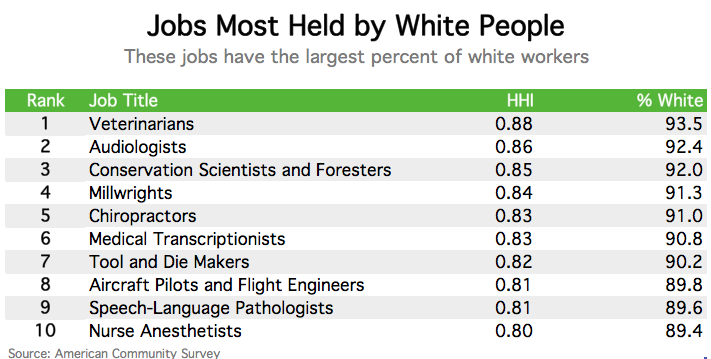
The least racially diverse jobs are overwhelmingly occupied by white individuals, often exceeding 90%. It’s important to note that while this chart displays the top ten by percentages, the HHI does not solely reflect these percentages. Due to the larger population of white individuals in America, professions with a high percentage of white workers consequently skew the HHI.
In this analogy, white individuals represent the lettuce in the salad.
Identifying the Most Diverse Jobs
Let’s examine the occupations with the highest levels of diversity.

Overall, these positions exhibit considerable diversity, which aligns with the large workforce numbers in these roles. However, only five of the most common jobs meet the criteria for being classified as highly diverse, with an HHI below 0.40.
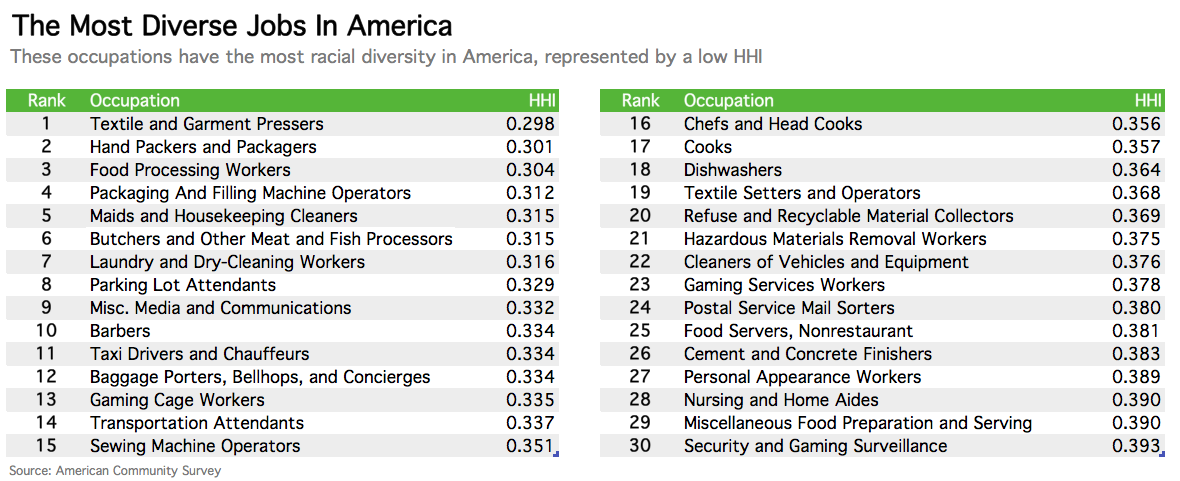
The most diverse occupations primarily include production, service, and entry-level positions that typically do not require advanced education. Examples include 1.52 million cooks and 966,000 maids and cleaners. Notably, gaming cage workers (6,161 employees) stand out as they operate within the casino environment, handling credit lines and chips.

For African Americans, there is a significant concentration in transportation-related roles. The role of a barber is well-defined, alongside transportation attendants, who are responsible for passenger safety and comfort across various modes of transportation.
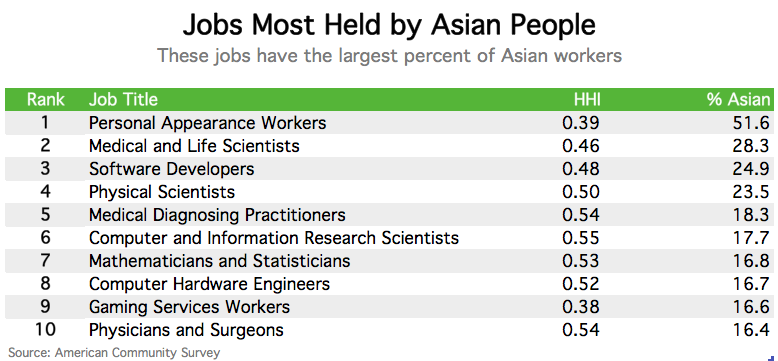
Most of these positions require advanced degrees—eight will typically require such credentials unless individuals have followed non-traditional paths through certifications and hands-on experience. Exceptions include personal appearance workers, such as manicurists, skincare specialists, and makeup artists, as well as gaming services workers who manage slot machines and oversee other gaming activities.

The majority of jobs listed in this section represent skilled labor and construction roles. Notably, miscellaneous media communications workers, which also encompass translators and interpreters, feature a considerable Hispanic workforce, representing 32% of the field.
America’s Eighth Most Diverse Occupation: None
Curiously, the fifteenth most common “occupation” is among the most diverse: those who have been unemployed for over five years or have never worked.

In conclusion, while the landscape of America’s workforce continues to evolve, significant disparities in job diversity remain evident. Understanding these dynamics is essential for fostering a more inclusive labor market that reflects the rich tapestry of American society.

Author

David Luther was the Content Marketing Editor for the Zippia Advice blog. He developed partnerships with external reporting agencies in addition to generating original research and reporting for the Zippia Career Advice blog. David obtained his BA from UNC Chapel Hill.