- Tech Industry Statistics
- MFA Statistics
- Streaming Services Statistics
- Mobile Vs. Desktop Usage Statistics
- AI Statistics
- Live Streaming Statistics
- Zoom Meeting Statistics
- Cord Cutting Statistics
- Digital Transformation Statistics
- Virtual Reality Statistics
- How Fast Is Technology Advancing
- Mobile Commerce Statistics
- SaaS Statistics
- Machine Learning Statistics
- Diversity In High Tech
- Cyber Security Statistics
- Ecommerce Statistics
- Tech Industry
- Gaming Industry
- Renewable Energy Job Creation
- Smartphone Industry
- Cybercrime Statistics
- Amazon Statistics
- Personalization Statistics
Research Summary. Cybersecurity remains a top priority for internet users, especially as data breaches continue to rise. With recent studies indicating that one in three American accounts has experienced hacking incidents, the need for robust security measures is more pressing than ever.
To address these threats, both organizations and individuals now leverage a variety of security tools, with Multi-factor Authentication (MFA) emerging as one of the most effective solutions. MFA enhances login security by requiring multiple forms of verification, making it a simple yet powerful way to safeguard sensitive information.
To better understand MFA and its significance in today’s digital landscape, we’ve compiled essential statistics on its adoption and effectiveness:
-
Only 13% of employees at small to medium businesses (SMBs) are mandated to utilize MFA, in stark contrast to 87% of employees at organizations with over 10,000 employees.
-
77% of accounts rely on SMS (text messages) for their two-factor authentication (2FA).
-
MFA successfully blocks an impressive 99.9% of modern automated cyberattacks.
-
81% of breaches related to hacking stem from weak or stolen passwords.
General MFA Statistics
Despite its advantages, MFA adoption has not kept pace across all sectors. Here are some key statistics reflecting the current state of MFA:
-
38% of large organizations still do not implement MFA.
For SMBs, the situation is even more concerning, with a majority (62%) lacking MFA protection.
-
From 2017 to 2021, MFA adoption surged by over 178%.
In 2017, only 28% of accounts utilized MFA; by 2021, this figure had soared to 78%.
Year MFA Adoption 2021 78% 2019 53% 2017 28% -
Stealing sensitive data remains the primary goal of cyberattacks.
Notably, 91% of cyberattacks initiate via email, where hackers attempt to manipulate individuals into sharing sensitive information.
-
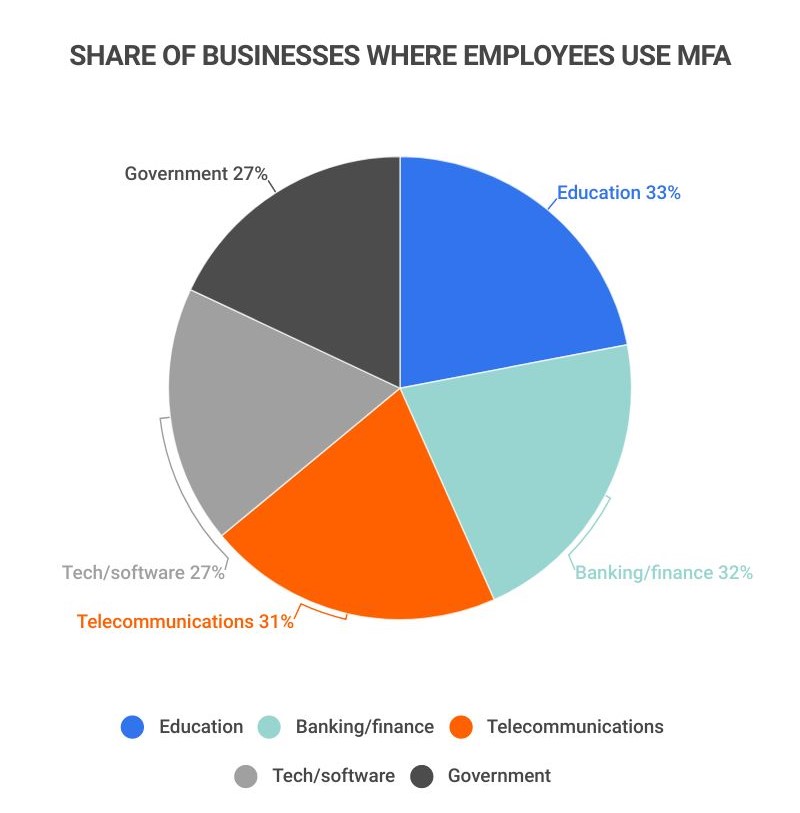
27% of businesses utilizing MFA are within the government sector.
Education leads with 33% of employees using MFA, followed closely by banking/finance (32%), telecommunications (31%), and tech/software (27%).
Industry Share of Businesses Using MFA Education 33% Banking/Finance 32% Telecommunications 31% Tech/Software 27% Government 27%
MFA Methods
There are various methods for implementing MFA, with some being more popular than others. Here are the latest insights on preferred authentication methods:
-
73% of individuals consider smartphones the most convenient MFA method.
Smartphones are the clear favorite for MFA, with only 17% opting for built-in authenticators, 5% for smart cards, and another 5% for U2F security keys.
MFA Method Percent Who Find It Most Convenient Smartphone 73% Built-in Authenticator 17% Smart Card 5% U2F 5% -
65% of Americans reuse passwords across multiple accounts.
This includes 52% of Americans who reuse passwords on some accounts and 13% who use the same password across all their accounts.
Password Reuse Share of Americans Reuse Passwords on All Accounts 13% Reuse Passwords on Multiple Accounts 52% Don’t Reuse Passwords 35% -
Less than 10% of Google accounts utilize two-factor authentication.
Despite some users finding 2FA inconvenient, it can reduce Google account hacks by 50%.
MFA Success Rate
MFA’s popularity is driven by its effectiveness in enhancing account security. Here are some key insights regarding its success rates:
-
MFA blocks an astounding 99.9% of modern automated cyberattacks.
As personal information is increasingly vulnerable to online theft, the ability of MFA to thwart 99.9% of automated attacks is remarkable.
-
MFA halts 96% of bulk phishing attempts.
Phishing attacks account for a quarter of all data breaches, underscoring MFA’s crucial role in security.
-
MFA prevents 76% of targeted attacks.
Targeted attacks pose a significant threat, but MFA can effectively thwart over three-quarters of these attempts.
Data Security Issues
As of 2026, our online presence has expanded significantly, leading to an increase in data security challenges. Consider the following statistics:
-
Over 50% of individuals who receive phishing emails fall victim to them.
A staggering 70% of recipients open phishing emails, in stark contrast to the mere 3% who engage with traditional spam emails.
-
30% of data breaches occur within the healthcare sector.
The healthcare industry remains particularly susceptible, with nearly 50 million Americans experiencing breaches of their protected health information in 2021 alone.
-
69% of individuals aged 18-24 utilize MFA to secure their data.
MFA adoption tends to decrease with age; for instance, only 33% of those aged 65+ employ MFA.
Age Share of MFA Users 18-24 69% 25-34 68% 35-44 58% 45-54 49% 55-64 36% 65+ 33%
Multi-factor Authentication Statistics FAQ
-
How effective is multi-factor authentication?
MFA is highly effective, blocking 99.9% of modern automated cyberattacks. Additionally, it prevents 96% of bulk phishing attempts and 76% of targeted attacks.
This high level of protection ensures that even if a hacker obtains login credentials, they cannot access accounts without further verification.
-
How common is multi-factor authentication?
MFA is increasingly common and continues to grow in adoption. For example, MFA usage rose from 28% in 2017 to 78% in 2021 (an increase of 178%).
Currently, around 62% of large organizations implement MFA.
-
Can hackers bypass multi-factor authentication?
Yes, hackers can circumvent MFA, but it’s considerably more challenging than breaching accounts without it. Here are some methods hackers may employ to bypass MFA:
-
Social Engineering: Hackers may manipulate individuals into revealing login information, for instance, by impersonating IT personnel requiring an SMS verification code.
-
Brute Force: Some hackers may attempt to guess passwords and codes, especially if simple MFA methods like a 4-digit PIN are in use.
-
Exploiting Generated Tokens: Hackers may exploit vulnerabilities in authentication apps, such as Microsoft Authenticator and Google Authenticator, to access temporary tokens and compromise the associated accounts.
-
Session Hijacking: Hackers can leverage session cookies to access personal information even after a user logs out.
-
SIM Hacking: This technique involves intercepting important codes by gaining unauthorized access to an individual’s SIM card, particularly an issue for those using SMS as their primary MFA method.
While hacking remains a persistent threat online, utilizing MFA significantly enhances your cybersecurity.
-
-
What are the disadvantages of multi-factor authentication?
The primary disadvantage of MFA is the additional time and resources required for implementation. However, the cost of potential breaches often far exceeds the investment in MFA.
Other cited drawbacks include user frustration with multiple authentication steps, though these inconveniences do not outweigh the cybersecurity benefits.
-
What is the strongest form of authentication?
Passwordless MFA is regarded as the most secure authentication method. This includes one-time passwords (OTPs), registered smartphones, and biometrics (fingerprint and retina scans), all of which are challenging to duplicate or compromise.
Hard Token 2FA also offers high security but demands significant ongoing maintenance and is vulnerable to token exploitation.
Conclusion
With 81% of data breaches resulting from weak passwords, the importance of robust security measures has never been more critical. Multi-factor Authentication (MFA) provides a powerful solution, boasting a 178% increase in adoption from 2017 to 2021.
Its effectiveness is underscored by its ability to thwart 99.9% of automated cyberattacks, 96% of bulk phishing attempts, and 76% of targeted attacks.
These compelling statistics highlight MFA’s significant role in safeguarding accounts, ensuring its continued rise in popularity among organizations and individuals alike.
References
-
Cyber Readiness Institute – Global Small and Medium-Sized Businesses Slow to Move to More Secure Multi-Factor Authentication Account Access Method, New Cyber Readiness Institute Survey Finds
-
TechRepublic – More companies use multi-factor authentication, but security still weak from poor password habits
-
Health IT Security – Multi-Factor Authentication Blocks 99.9% of Automated Cyberattacks
-
eSecurity Planet – Most Small to Mid-Sized Organizations Don’t Use Multi-Factor Authentication
-
DIW – Enterprises Lag Behind MFA Usage Rates Despite Widespread Consumer Adoption
-
Statista – Most convenient Multi-Factor Authentication (MFA) methods worldwide in 2021
-
ExtremeTech – Google Says Using Two-Factor Authentication Reduces Account Hacks 50 Percent
-
FireEye – Shaping the Future of Cybersecurity
-
SANS – NewsBites Drilldown for the Week Ending 13 November 2020
- Tech Industry Statistics
- MFA Statistics
- Streaming Services Statistics
- Mobile Vs. Desktop Usage Statistics
- AI Statistics
- Live Streaming Statistics
- Zoom Meeting Statistics
- Cord Cutting Statistics
- Digital Transformation Statistics
- Virtual Reality Statistics
- How Fast Is Technology Advancing
- Mobile Commerce Statistics
- SaaS Statistics
- Machine Learning Statistics
- Diversity In High Tech
- Cyber Security Statistics
- Ecommerce Statistics
- Tech Industry
- Gaming Industry
- Renewable Energy Job Creation
- Smartphone Industry
- Cybercrime Statistics
- Amazon Statistics
- Personalization Statistics

Author

Jack Flynn is a writer for Zippia. In his professional career he’s written over 100 research papers, articles and blog posts. Some of his most popular published works include his writing about economic terms and research into job classifications. Jack received his BS from Hampshire College.