25+ Must-Know Project Management Statistics [2026]
Project management research summary. The landscape of project management continues to evolve, driven by advancements in technology and shifting workplace dynamics. As a project manager, staying informed about current trends is essential for achieving organizational goals.
If you’re a project manager seeking insights into the industry’s current state and future direction, you’re in the right place. We’ve compiled the most relevant trends and statistics about project management, and based on our comprehensive research:
-
77% of high-performing projects utilize project management software.
-
11.4% of resources are squandered due to ineffective project management practices.
-
70% of global project management initiatives do not succeed.
-
23% of organizations employ project management software.
For further analysis, we categorized the data as follows:
Project Managers | Benefits of Project Management | Projects | Project Failure
Companies’ Relationships with Project Management
Project management should be a top priority for organizations, yet this is not always the case. Here are some updated insights regarding the average company’s approach to PM:
-
46% of organizations prioritize project management as part of their culture.
Despite the recognized benefits, many organizations still fall short. The less-than-half that do prioritize PM find it easier to meet objectives, stay on budget, and complete projects on time.
-
86% of organizations lack real-time KPI tracking.
Only 14% have the capability to track KPIs in real-time, with fewer than 9% of executives opting to monitor these metrics.
-
89% of organizations maintain at least one project management office (PMO).
Most companies have at least one PMO, which can be categorized into three types:
-
Supportive PMO. Provides minimal supervision for project management initiatives.
-
Controlling PMO. Offers supportive services along with additional governance.
-
Directive PMO. Establishes a centralized authority for consistency across multiple projects.
-
-
2.5% of companies report a 100% project success rate.
With 70% of projects failing, the likelihood of a company achieving a 100% success rate is exceedingly low; they are 27 times more likely to experience project failure.
-
42% of companies undervalue project management.
This lack of recognition contributes to the significant failure rate, with over two-fifths of companies not appreciating PM’s importance.
-
61% of organizations provide project management training.
Additionally, 47% have established a clear career development path for PM professionals, giving them a competitive edge.
-
52% of organizations implement at least one Agile methodology for most projects.
This trend is supported by the fact that 64% of Agile projects succeed compared to 49% of Waterfall projects.
Project Manager Statistics
The success of project management software hinges on the efforts of project managers. Here are some key statistics about their work:
-
59% of project managers manage 2-5 projects concurrently.
This is the most common workload, with only 15% handling a single project at a time and another 15% managing over 10 projects simultaneously.
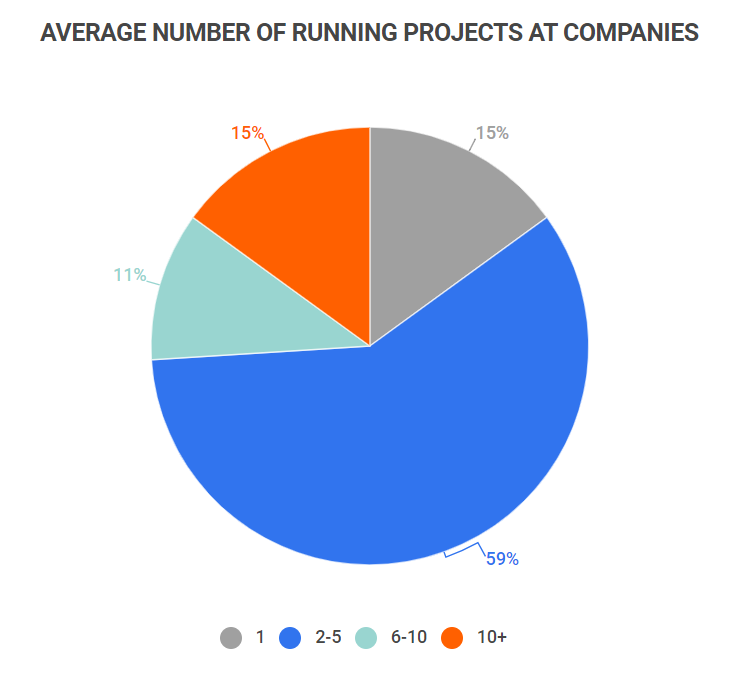
Average Number of Running Projects at Companies
Number of Running Projects Share of Project Managers 1 15% 2-5 59% 6-10 11% 10+ 15% -
80% of project managers rely on project portfolio management.
Analyzing and managing multiple projects collectively is crucial for project managers handling several current and potential projects.
-
PMP certification enhances PM salaries by 16% on average.
Some project managers even see salary increases of up to 20% upon obtaining certification.
-
81% of project managers use spreadsheets.
This reliance poses risks, as 94% of project management spreadsheets contain errors.
-
Only 35% of project managers express satisfaction with their current systems.
The lack of prioritization in project management culture has led to overall dissatisfaction among half of all project managers.
-
61% of project managers utilize defined project management methodologies for each project.
Disorganization can lead to significant challenges, yet many project managers do not consistently apply structured methods.
-
Over 426,000 project managers are employed in the US.
Of this workforce, 31.1% are women and 68.9% are men, indicating a significant gender disparity in the field.
Benefits of Project Management
Effective project management yields numerous benefits, including cost efficiency and enhanced profitability. Here are some key advantages:
-
54% of workers spend up to 5 hours on tasks that could be automated.
Additionally, 16% waste over 10 hours on automatable tasks.
-
73% of organizations employing a formal project management approach achieve their goals.
Organizations utilizing structured PM methods are more likely to complete projects on time and within budget.
Project Statistics
Each project is unique, with varying degrees of success. Here are vital project statistics:
-
63% of formally managed projects are completed within budget.
In comparison, only 48% of projects without formal management finish on budget, with 59% delivered on time.
-
45% of projects have active sponsors.
Active sponsorship is crucial, as 62% of successful projects had supportive sponsors.
-
Only 40% of projects realize their full benefits.
Despite efforts, many projects fail to deliver the anticipated outcomes, with only 35% considered successful upon completion.
Project Failure Statistics
Project failure is common, but organizations can learn from their mistakes. Here are key insights into failure and its causes in project management:
-
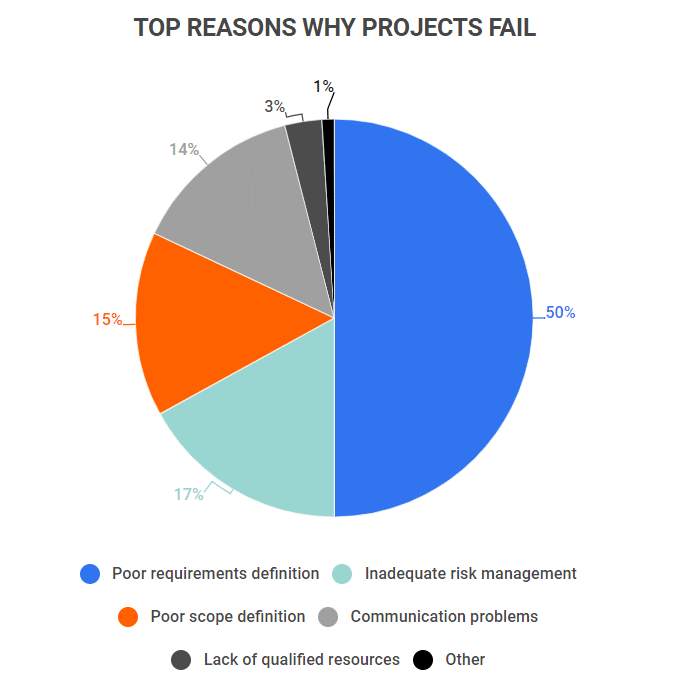
50% of projects fail due to poor requirements definition.
This is the leading cause, followed by inadequate risk management (17%) and poor scope definition (15%).
Top Reasons Why Projects Fail
Reason for Failure Share of Projects Poor Requirements Definition 50% Inadequate Risk Management 17% Poor Scope Definition 15% Communication Problems 14% Lack of Qualified Resources 3% Other 1% -
37% of projects fail due to a lack of clear goals.
Unclear objectives hinder effective project management, increasing the likelihood of failure.
-
55% of projects cite budget overruns as a reason for failure.
With only 48% to 59% of projects remaining within budget, budget overruns are a significant issue for project managers.
-
39% of projects fail due to poor planning.
Effective projects require thorough planning; inadequate planning often leads to a series of issues that result in failure.
Project Management FAQ
-
What is the success rate of projects?
The success rate of projects is 56%. Various factors contribute to this rate, including the maturity of project teams, which often meet 77% of their goals. Formally managed projects are more likely to finish on budget and on time.
Despite this, only 2.5% of companies achieve 100% success across all projects.
Conversely, numerous factors contribute to project failure; 70% of global project management initiatives fail due to unclear goals, delayed execution, and poor communication.
-
Will project managers be replaced by AI?
No, human project managers will not be replaced by AI. While AI will not eliminate project management roles, it will transform them.
AI is expected to automate more data-driven tasks, allowing project managers to focus on leadership, team motivation, and strategic planning.
-
What is the value of a project manager?
Project managers are essential for ensuring projects progress smoothly and effectively communicate project statuses to stakeholders. They assist teams in fulfilling their responsibilities and addressing challenges that arise.
Moreover, project managers play a crucial role in planning, aligning goals with client or organizational needs, and ensuring timely delivery of the final product.
-
Is project management a high-value skill?
Yes, project management is a highly sought-after skill. Proficiency in project management demonstrates strong communication, organization, critical thinking, and resourcefulness.
In fact, project management routinely ranks among the top 10 skills linked to high income potential.
-
Why do 70% of projects fail?
Many factors contribute to project failure. For instance, 44% of projects fail due to unclear goals, and 30% fail because of poor communication. Additional factors include:
-
Scope Creep. When a project expands beyond its original intent, it can lead to delays and inefficiencies.
-
Overallocated Resources. Poor resource allocation can result in specific projects receiving excessive resources, while others may lack the necessary support.
-
Poor Stakeholder Management. Ineffective communication with stakeholders can lead to project delays, underfunding, and misalignment with original goals.
-
Unreliable Estimates. Inaccurate estimates can derail projects, resulting in flawed schedules and unachievable objectives.
-
Lack of Risk Management. Neglecting risk management can overwhelm projects with unforeseen challenges.
-
Inadequate Team Planning Sessions. Insufficient team meetings can lead to poor communication and project execution.
-
Conclusion
The project management industry is dynamic and ever-evolving, but there are strategies that both companies and project managers can adopt to enhance success. Recognizing that 37% of projects fail due to unclear goals and 55% due to budget overruns is crucial for mitigating these issues.
Beyond fundamental practices such as improving communication, time management, and fostering a supportive culture, there are essential insights that project management professionals can leverage. Organizations with established PM practices waste significantly less money, and those with formal management structures are more likely to adhere to budgets and timelines.
Ultimately, despite the inherent risks of project management, understanding the statistics and analyzing current trends is vital for today’s project managers.
References
-
Vitality – 77% of High-Performing Teams Use Project Management Software
-
Geckoboard – US SMBs Who Set and Track Key Metrics Are 2x More Likely to Hit Targets
-
Project Managers – Implementing a Project Management Office: 4 Steps to Success
-
PMI – Earning Power: Project Management Salary Survey—Twelfth Edition
-
Lumeer – Risks of Using a Spreadsheet for Project Management

Author

Jack Flynn is a writer for Zippia. In his professional career he’s written over 100 research papers, articles and blog posts. Some of his most popular published works include his writing about economic terms and research into job classifications. Jack received his BS from Hampshire College.