Resume Lies and Fake References [2026]: Alarming Trends and Insights
In today’s competitive job market, where standards are exceptionally high, many job seekers resort to fabricating information on their resumes. While any form of deception is inexcusable, the prevalence of this behavior may surprise you.
Our latest research reveals key insights into the troubling trends surrounding resume falsifications and fake references:
-
55% of Americans have confessed to lying on their resumes.
-
21% admit to using fake references.
-
41% of applicants exaggerate their educational qualifications.
-
46% of resumes contain discrepancies that surface during background checks.
-
29% of employers report having found fake references.
For a deeper analysis, we categorized the data as follows:
Resume Lies | Who Lies | Consequences

Statistics on Resume Lies
Applicants commonly misrepresent various aspects of their resumes, particularly work experience and education. Here are some alarming statistics regarding the prevalence of resume lies:
-
41% of applicants misrepresent their college degrees.
With 75% of new job openings requiring a degree, but only 40% of applicants possessing one, many choose to misrepresent their educational qualifications to enhance their chances of being hired.
-
While 65% of Americans claim they’ve never lied on their resumes, one-third admit to embellishing the truth.
Factoring in those who “stretch the truth,” the percentage of Americans claiming to have never lied on their resumes drops to 44%.
-
The most common falsehood is about prior work experience, with 55.4% of applicants admitting to lying.
Next is lying about skills, with approximately 43.1% of applicants doing so. There are eight categories where more than 20% of applicants admit to lying:
What Applicants Lie About On Resumes
Resume Lies Share of Applicants Work Experience 55.4% Skills 43.1% College Degree 41.0% Personal Details 39.5% High School Details 39.2% Salary Information 33.6% Job-Specific Software/Equipment Skills 33.5% Employer References 21.0% -
The primary reason for lying on resumes is to cover gaps in employment history, cited by 24% of dishonest applicants.
Some individuals feel compelled to lie when they believe their actual work experience may not meet the job requirements, accounting for about 22% of applicants.

Reasons Why Applicants Lie On Resumes
Reason for Lying Share of Applicants Gaps in Employment History 24% Lack of Experience 22% Lack of Strong References 15% Fired in the Past 9% Laid Off in the Past 9% Education Level Doesn’t Match Requirements 7% Other 15% -
In 2008, 8% of people reported lying on their resumes.
This indicates a staggering 587% increase in the number of applicants lying on resumes over the past 15 years.
Who Lies on Their Resume?
Although it may seem that only unqualified candidates lie on their resumes, many hardworking individuals feel pressured to do so. Here are some noteworthy trends on who lies and why:
-
72% of high earners (making $150,000 or more) admit to lying on their resumes.
Those earning $150,000 or more are 31% more likely to lie compared to lower-income individuals.
-
27% of high school graduates confess to lying on their resumes.
High school graduates are more prone to exaggerate compared to 18% of those with college degrees and only 11% of individuals with advanced degrees.
Resume Lying by Education Level
Education Level Share of Respondents Who’ve Lied High School 27% College Degree (Associate’s, Bachelor’s, etc.) 18% Advanced College Degree (Master’s, Doctorate, etc.) 11% -
Men are over 18% more likely to lie than women.
59.9% of men reported lying on their resumes, compared to 50.6% of women. While men appear to lie more frequently, it’s essential to note that these figures are self-reported.
-
Those in the manufacturing sector are most likely to misrepresent their resumes, with 72% admitting to lying.
Other industries with high instances of resume deception include Healthcare and Arts/Creative sectors, with 64% and 63% respectively.
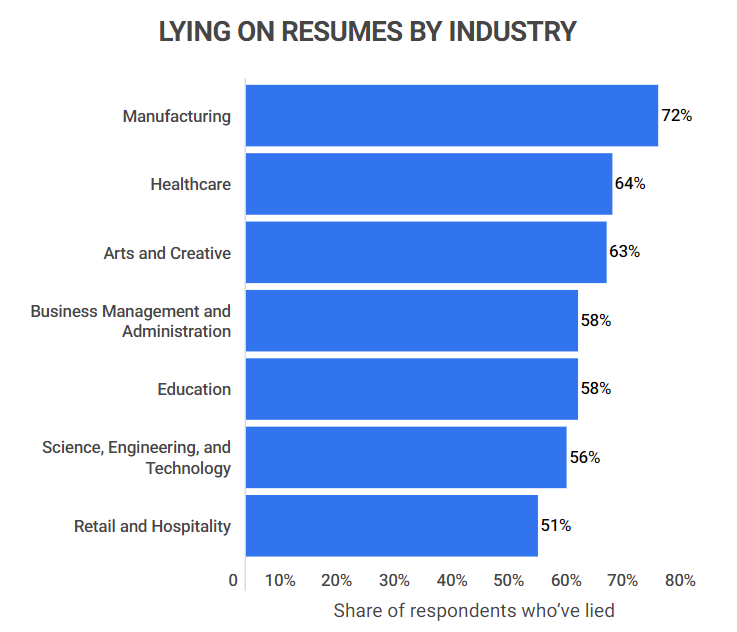
Lying On Resumes By Industry
Industry Share of Respondents Who’ve Lied Manufacturing 72% Healthcare 64% Arts and Creative 63% Business Management and Administration 58% Education 58% Science, Engineering, and Technology 56% Retail and Hospitality 51% Other 32%
Consequences of Lying on an Application
Despite the high frequency of dishonesty on job applications, many who lie remain undetected. Here are some key statistics regarding the outcomes of resume deception:
-
80% of dishonest job seekers secure employment.
Four out of five individuals who lie on their resumes are never caught. Even among those who are caught, fewer than half face repercussions, which may encourage dishonest behavior.
-
Of those who were caught, only 7.18% faced consequences for their actions.
The majority of individuals who lie on their resumes go undetected, and even when caught, they are unlikely to suffer penalties.
Share of Resume Liars Who Are Caught or Punished
Was the Resume Lie Uncovered? Share of Respondents No 79.28% Yes, but nothing happened 13.54% Yes, and there were consequences 7.18%
Statistics on Fake References
While it may seem challenging to fabricate references, many go unnoticed, shocking as it seems. Here are some revealing statistics:
-
21% of applicants have used fake references.
This deception often proves effective, with only 29% of employers detecting fake references.
-
Approximately 80% of employers do contact references.
This fact makes it surprising that fewer than one-third of those employers identify fake references.
-
69% of employers alter their opinions about a candidate after contacting a reference.
Unfortunately, 47% of employers view the candidate less favorably after the call, while only 23% view them more favorably.
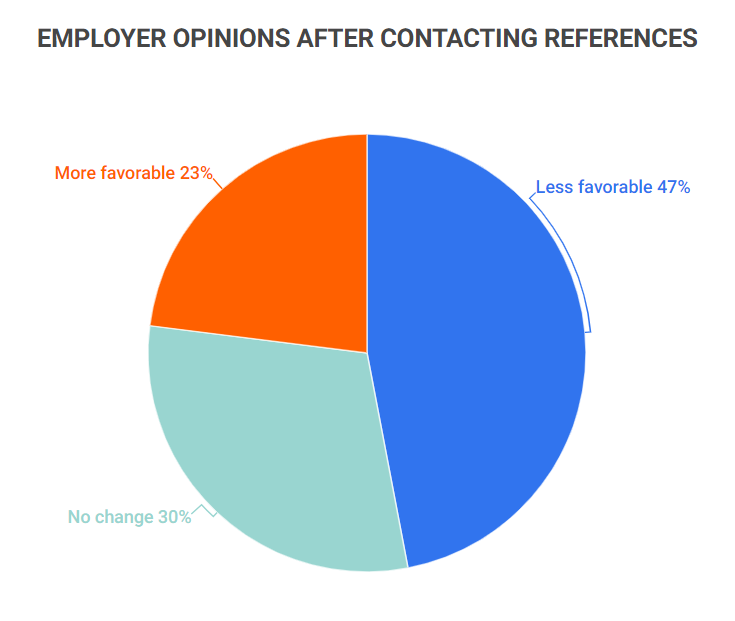
Results of Employers Contacting References
Change of Opinion Share of Employers More Favorable 23% No Change 30% Less Favorable 47%
FAQ on Application Lies
-
Is lying on a resume a crime?
Lying on a resume is generally not a crime. Resumes, cover letters, and job applications are not considered legal documents, thus prosecution is rare. However, certain lies, such as claiming a degree that one does not possess, could lead to legal consequences in some jurisdictions.
For instance, Texas Penal Code §32.52 states that “a person commits an offense if the person uses or claims to hold a postsecondary degree that the person knows is fictitious or has otherwise not been granted to the person…”.
Even if not legally punishable, companies may still enforce penalties for dishonesty, making it unwise to lie.
-
In which industry is lying on a resume most prevalent?
Resume deception is most common in the manufacturing sector. While the reasons remain unclear, it is evident that misrepresentation of skills and job experience is prevalent in this field. Applicants may exaggerate their expertise with machinery and other relevant skills.
Other sectors with high levels of resume dishonesty include:
-
Healthcare (64%)
-
Arts and Creative (63%)
-
Business Management and Administration (58%)
-
Education (58%)
-
-
Can employers uncover lies on resumes?
Yes, employers can discover resume lies. However, most employers are not adept at identifying these falsehoods, as up to 80% of dishonest job seekers are hired.
Of those caught, 13.54% typically face no penalties, and only 7.18% suffer consequences for their dishonesty.
-
Do employers verify references?
Yes, employers check the authenticity of references. Notably, around 80% of employers contact applicants’ references, and 29% find out when those references are fraudulent.
-
What is the risk of listing a fake reference?
Listing a fake reference can lead to application rejection. Although not all fake references are detected, those that are often result in immediate disqualification from consideration.
Even though this may not bode well for securing your dream job, there are generally no legal penalties for fabricating references.
Conclusion
Misrepresentation on resumes and the use of fake references are disturbingly common practices in the United States. As of 2026, 55% of Americans confess to lying on their resumes, and a striking 72% of higher earners admit to doing so as well.
The increasing pressure from heightened expectations and stiff competition for jobs drives this trend. Since 2008, the prevalence of resume dishonesty has surged by an astonishing 587%. Unfortunately, a lack of proactive measures by employers to detect these deceptions further exacerbates the issue.
Ultimately, many individuals feel compelled to fabricate elements of their resumes to remain competitive, illustrating a significant disconnect between employer expectations and the realities of the current labor market.
References
-
Workforce – Survey: 29% of Employers Find Fake Job References
-
ResumeLab – Lying on a Resume (2022 Study)
-
American Recruiters – These are the most common things people lie about on their resumes
-
AARC – References: More Important than You Think

Author

Jack Flynn is a writer for Zippia. In his professional career he’s written over 100 research papers, articles and blog posts. Some of his most popular published works include his writing about economic terms and research into job classifications. Jack received his BS from Hampshire College.