- Business Statistics
- Startup Statistics
- Cloud Adoption Statistics
- Customer Loyalty Statistics
- Nonprofit Statistics
- Affiliate Marketing Statistics
- Cart Abandonment Rate Statistics
- Ridesharing Statistics
- Call Center Statistics
- eLearning statistics
- Customer Service Statistics
- Customer Experience statistics
- Entrepreneur Statistics
- Outsourcing Statistics
- Gross Revenue for Marketing and Advertising
- Sales Statistics
- MBA Statistics
- Average Small Business Revenue + Profit Margin
- How Much Do Employee Benefits Cost?
100+ Essential Sales Statistics [2026]: Figures, Salaries, and Insights
Research Summary. Sales roles continue to be a vital part of the workforce, with many professionals falling into these positions unexpectedly. Despite the prevalence of sales roles, trust between buyers and salespeople remains low. Our data analysis team has gathered the following insights:
-
According to 40% of sales professionals, prospecting remains the most challenging aspect of their role.
-
67% of lost sales result from sales representatives inadequately qualifying potential customers before initiating the sales process.
-
Persistence is crucial, as 80% of sales require five or more follow-ups.
-
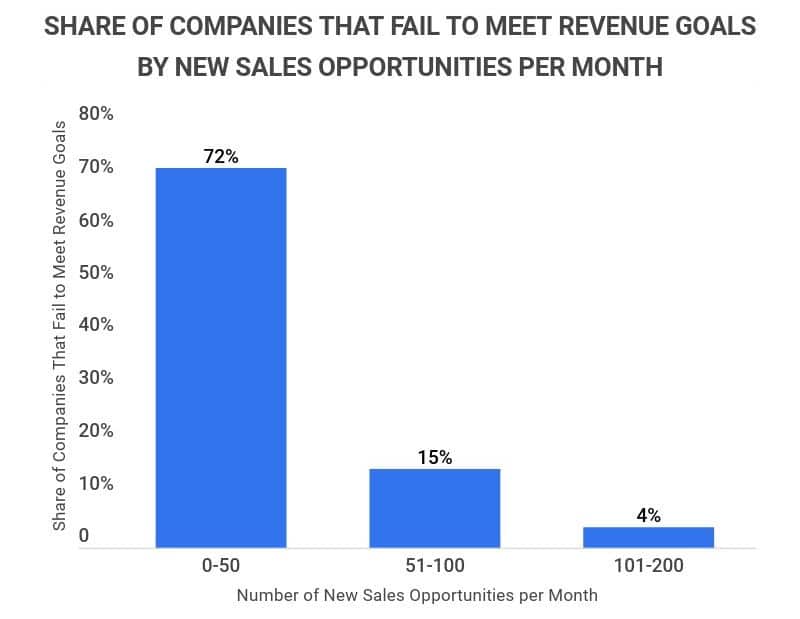
Opportunity is essential — 72% of companies with fewer than 50 new leads each month fail to meet their revenue targets, compared to 15% for those with 51-100 leads, and only 4% for organizations generating 101-200 leads monthly.
-
21% of a salesperson’s day is spent writing emails.
-
42% of sales reps state they lack sufficient information before making sales calls.
-
There are 13,715,050 sales positions across the United States.
-
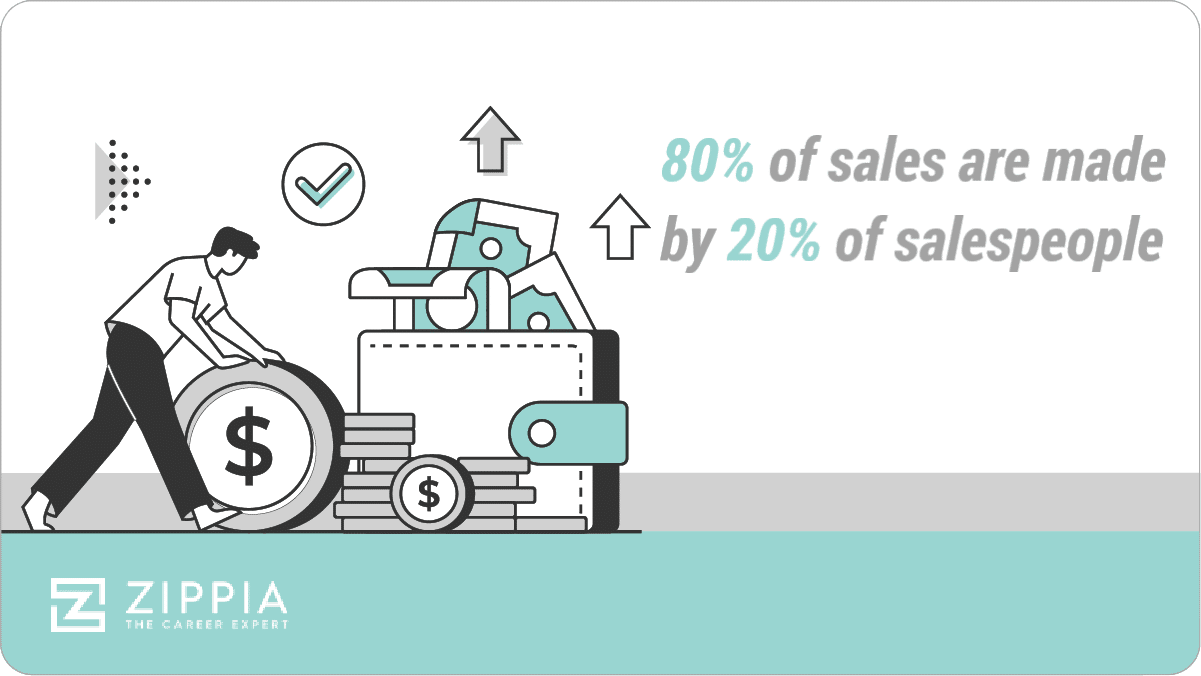
80% of sales are generated by 20% of salespeople.
For further analysis, we categorized the data in the following sections:
Successful Sales Techniques | Gender | Referrals | Email | Sales Training | Social Sales | Inside Sales | Outside Sales | Prospecting | Sales Calls | Sales Leads | Online Sales | Technology

General Sales Statistics
-
Nearly 13% of all jobs in the U.S. (1 in 8) are full-time sales positions.
-
Only 39% of salespeople initially planned to pursue a career in sales, creating approximately 4.14 million accidental sales professionals in the U.S.
-
Over $1 trillion is allocated annually for sales forces.
-
Only 13% of customers feel that a salesperson can grasp their needs.
-
Only 3% of buyers trust sales representatives. This places sales among the least credible professions, alongside car sales, politics, and lobbying.
-
The median salary for U.S. sales representatives exceeds $55,000.
-
Today’s sales professionals spend just 34% of their time actively selling.
Sales Statistics by Successful Techniques
Most buyers prefer to engage with a salesperson after conducting their research. When they do, they appreciate collaboration and confidence, and desire to discuss their goals and pain points, which fosters trust and optimism.
-
60% of customers say no four times before they agree to a sale, while 48% of salespeople never follow up after the initial contact.
-
35-50% of sales go to the vendor that responds first.
-
57% of customers are more likely to purchase from a salesperson who doesn’t apply pressure during follow-ups.
-
Nearly 60% of salespeople stick with what works for them, avoiding changes.
-
19% of buyers want to connect with a salesperson during the awareness stage, while 60% prefer to engage during the consideration stage.
-
20% of buyers want to talk during the decision stage when they’ve chosen a product.
-
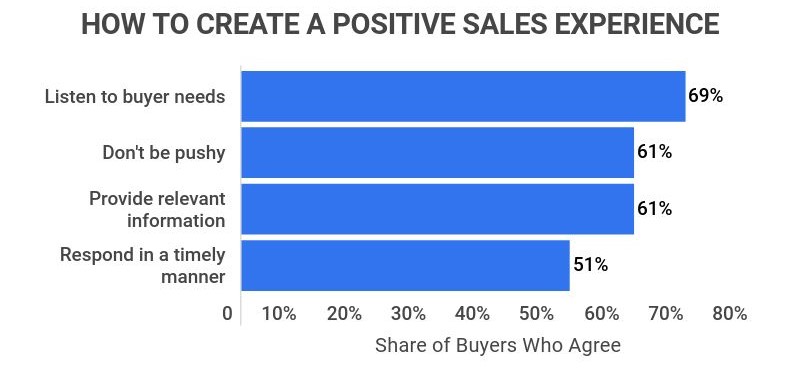
Here are the top ways to ensure a positive sales experience according to buyers:
-
Listen to their needs (69%)
-
Don’t be pushy (61%)
-
Provide relevant information (61%)
-
Respond in a timely manner (51%)
-
-
Successful salespeople are 10x more likely to use inclusive language like “us,” “we,” and “our,” avoiding “I” and “me.”
-
The most effective sales professionals use confidence-boosting phrases such as “definitely,” “certainly,” and “absolutely” 5x more than their lower-performing counterparts.
-
Prospects who are asked to take small steps are twice as likely to spend. Their spending matches those asked for larger commitments.
-
Curiosity, intelligence, and agility are key indicators of sales success.
-
Optimistic sales professionals outperform their pessimistic peers by 57%. This is true even when skills are comparable.
-
Nearly half of buyers consider “trustworthiness” a vital quality in a salesperson.
-
Asking questions about the buyer’s goals and challenges leads to better sales outcomes.
Sales Statistics by Gender
Despite outperforming men and achieving higher quotas, women typically receive lower overall compensation in sales roles.
-
Male-led sales teams consist of 76% men and 24% women, contrasting with the general population’s 50/50 split.
-
Female-led sales teams align more closely with the general population at 48% women and 52% men.
-
Women achieve 8% higher quota attainment than men.
-
78% of men regularly meet their sales quotas, while 86% of women achieve theirs.
-
Women outperform men by 3% yet earn 7% less overall.
-
While women earn a slightly higher commission rate, they have lower base salaries.
-
Women earn 77% of the total compensation of their male peers.
Sales Statistics Related to Referrals
Referrals are crucial for effective sales organizations. Most customers trust referrals, which lead to higher conversion and retention rates.
-
About 47% of top performers consistently ask for referrals, compared to only 26% of non-top performers.
-
92% of consumers trust recommendations from people they know.
-
Consumers referred by friends are 4X more likely to buy.
-
Referred customers have a 37% higher retention rate.
-
B2B companies with referral programs see a 70% higher conversion rate.
-
Referred customers’ lifetime value (LTV) is 16% higher than non-referred customers.
-
Referral leads convert at a 30% higher rate than leads from other channels.
-
Referrals account for 65% of new deals for companies.
-
Salespeople who actively seek referrals earn 4-5x more than those who do not.
-
91% of customers are willing to give referrals, but only 11% of salespeople
-
84% of buyers initiate their buying journey with a referral.
-
Companies with structured referral programs see 86% more revenue growth than those without.
-
70% of businesses report that social referrals convert faster than other types of leads.
-
84% of B2B buyers begin their purchasing process through referrals.
-
92% of buyers trust product/service recommendations from acquaintances.
-
83% of customers are happy to give referrals after a positive experience.
Email Sales Statistics
While many emails go unopened by prospective customers, email remains a powerful lead generation tool, often surpassing social media in effectiveness. Personalizing emails and subject lines can enhance success rates.
-
Email is nearly 40x more effective at acquiring new customers than Facebook and Twitter combined.
-
70% of salespeople stop after sending one email, yet sending multiple emails can yield a 25% response rate.
-
89% of marketers consider email their primary channel for lead generation.
-
80% of prospects prefer communicating with sales reps via email, which aligns with the 78% of reps who utilize it.
-
Email marketing offers a 2x higher return compared to cold calling.
-
44% of email recipients made at least one purchase last year due to a promotional email.
-
Only 24% of sales emails are opened by recipients.
-
40% of emails are initially opened on mobile devices.
-
Personalized subject lines have a 22.2% higher open rate.
-
Incorporating words like “Sale,” “New,” or “Video” in subject lines can improve open rates.
-
35% of recipients base their decision to open an email solely on the subject line.
-
Personalized emails lead to a 14% increase in click-through rates and a 10% rise in conversion rates.
-
Email marketing can achieve an ROI of up to 4,400%.
-
Email marketing conversion rates averaged 15.11% in 2020.
-
Typically, people delete 48% of their emails within five minutes.
Sales Training Statistics
Training is vital for sales success, helping salespeople not just meet quotas but also significantly boost ROI. Despite this, many companies invest minimally in training per employee, which can hinder overall performance.
-
55% of sales professionals lack the necessary skills to excel.
-
Ongoing training results in 50% higher net sales per employee.
-
Organizations typically spend $10,000-$15,000 hiring a new employee but only $2,000 annually on sales training.
-
New sales representatives require at least 10 weeks of training to be successful.
-
The average new hire becomes fully productive in 5.3 months. While 24% are ready in 1-3 months, 16% take longer than seven months.
-
81% of companies believe productivity could increase with improved processes, skills, or competency training.
-
U.S. sales teams spend over $70 billion annually on training.
-
Approximately 84% of sales training is lost after 90 days. This is largely due to poor retention of information among sales staff.
-
Investing $1 in sales training yields an average return of $29 in incremental revenue.
-
The best sales training can enhance an individual’s performance by 20% on average.
-
65% of employees report that the quality of training and learning opportunities positively impacts their engagement.
-
High-performing sales organizations are 2x as likely to provide ongoing training compared to lower-performing ones.
-
Investment in sales training yields a 353% ROI.
-
80% of high-performing sales teams rate their training process as exceptional or very good.
-
25% of sales representatives feel they have not received adequate sales training.
-
Companies that excel in providing training, coaching, and professional development achieve 17% higher success rates in meeting sales objectives.
-
Only 42% of businesses effectively provide professional development for sales teams.
-
61% of executives admit their sales managers lack training in pipeline management techniques.
-
Organizations that train managers in pipeline management experience 9% faster revenue growth.
-
64% of companies plan to spend less than $10,000 on training their sales staff this year.
-
¾ of all companies primarily use classroom training for sales staff.
-
High-achieving companies are 2x as likely to offer ongoing training to their sales teams.
Social Sales Statistics
Social media has become an essential tool for sales professionals, leading to faster conversions, better client relationships, and increased deal sizes. In fact, social selling contributes significantly to revenue in various industries.
-
90% of top sales performers incorporate social media into their sales strategies.
-
71% of salespeople utilize social selling tools.
-
65% of salespeople who engage in social selling maintain a full pipeline, compared to 47% of those who do not.
-
50% of sales professionals dedicate 3-10 hours per week to social selling activities.
-
4 in 10 sales reps have recently closed 2-5 deals directly through social media.
-
Social selling influences half of the revenue in 14 major industries, including:
-
Computer and network security
-
Computer software
-
Marketing and advertising
-
Management consulting
-
Internet
-
Information technology and services
-
Information services
-
Hospital and healthcare
-
eLearning
-
Professional training and coaching
-
Logistics and supply chain
-
Financial services
-
Human resources
-
Telecommunications
-
-
Using social selling tools can boost win rates and deal sizes by 5% and 35%, respectively.
-
70% of B2B sales professionals contend that social referrals convert faster than any other lead type.
-
78% of salespeople utilizing social media outperform their counterparts.
-
75% of B2B buyers and 84% of C-level executives use social media to guide purchasing decisions.
-
84% of CEOs and VPs also rely on social media when making purchasing decisions.
-
31% of B2B professionals feel that social selling has helped them forge deeper relationships with clients.
-
More than half of all B2B buyers use LinkedIn to support their purchasing decisions.
-
Sales representatives engaging in social selling are 50% more likely to meet or exceed their sales quotas.
-
63.4% of sales reps involved in social selling report an increase in their company’s revenue compared to 41.2% of those not using social selling.
-
Employing social selling tools can enhance the average deal size by 35%.
-
9 out of 10 B2B buyers say online content significantly influences their purchasing decisions.
-
Customers tend to spend 20% to 40% more on brands they engage with on social media.
-
Over 70% of marketers prioritize new customer acquisition in their social media strategies.
-
84% of buyers utilizing social media have larger budgets than non-social buyers.
-
72% of salespeople leveraging social media in their processes outperform their peers.
-
Social sellers achieve their quotas 66% more often than those who do not engage with social media.
-
54% of salespeople can trace closed deals back to social media interactions.
-
74.9% of companies employing social selling grow their sales teams within the next 12 months.
Inside Sales Statistics
Inside sales roles have expanded rapidly compared to outside sales, particularly within tech companies, primarily due to lower costs associated with calls and customer acquisition.
-
An outside sales call costs approximately $308, while an inside sales call costs around $50.
-
Inside sales teams incur costs that are 40%-90% less for new customer acquisition.
-
Only 33% of inside sales reps’ time is dedicated to active selling.
-
Sales representatives may spend up to 40% of their time searching for potential contacts to reach out to.
-
Hiring for inside sales roles is increasing at a 15% annual rate.
-
On average, inside sales roles have grown by 7%, while sales development roles have increased by 6% since 2015.
-
Inside sales representatives typically make 33 cold calls daily.
-
Average inside sales reps have 6.6 conversations each day.
-
Inside sales professionals succeed with 18% of their pitches.
-
The average annual quota for an inside sales professional is $985,000.
-
For every outside sales representative hired, 10 inside sales reps are brought on board.
-
46% of fast-growing tech companies employ inside sales, while 21% utilize outside sales.
Outside Sales Statistics
While inside sales roles are growing more rapidly, outside sales teams still constitute the majority of the sales workforce, achieving higher quotas at greater rates and earning more than their inside sales counterparts.
-
Face-to-face or field sales teams represent 71.2% of the sales workforce.
-
65% of outside account executives achieve their quotas, which is 10% higher than inside sales reps.
-
Outside sales representatives now spend 89% more time selling remotely than they did in 2013.
-
Outside sales professionals enjoy an average 40% closing rate.
-
The average annual quota for an outside sales representative is $2.7 million.
-
Outside sales professionals earn 14% more on average than inside sales professionals.
Prospecting Sales Statistics
Prospecting remains a difficult aspect of the sales process, as nearly half of prospects are often not suitable for the products being sold, even though most sales professionals do not spend the majority of their time on it.
-
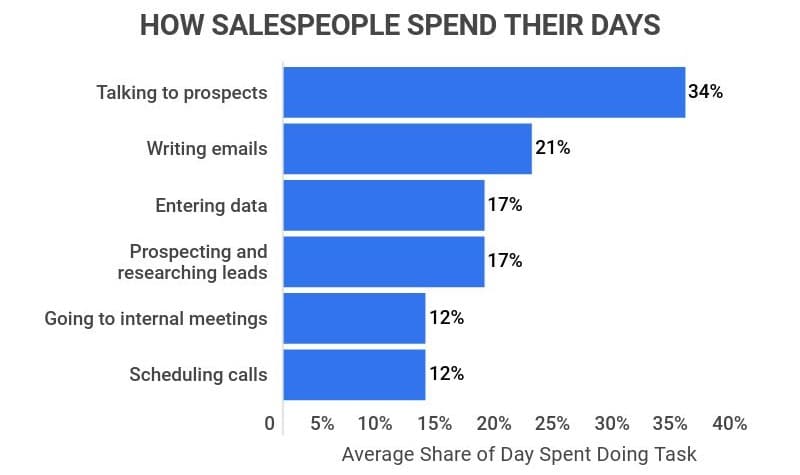
Salespeople devote just one-third of their day to speaking with prospects. They spend 21% writing emails, 17% entering data, another 17% prospecting and researching leads, 12% in internal meetings, and 12% scheduling calls.
-
More than 40% of salespeople consider prospecting the most challenging aspect of the sales cycle, followed by closing (36%) and qualifying (22%).
-
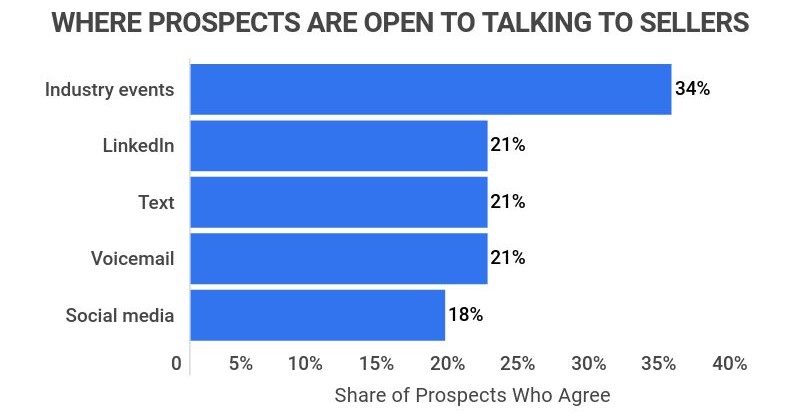
Prospects are open to communication from sellers during industry events (34%), via LinkedIn (21%), text (21%), voicemail (21%), and social media (18%).
-
50% of buyers prefer phone conversations, compared to 70% of sales reps. This preference increases for higher-level executives (VP or C-suite).
-
More than 50% of prospects desire to see a product demonstration during the initial call.
-
17% of salespeople believe they are pushy, contrasted with 50% of prospects.
-
9 in 10 companies utilize multiple lead enrichment tools to gather information about prospects.
-
At least 50% of prospects may not be a good fit for what you are selling.
-
The biggest challenges faced by today’s salespeople include:
-
Establishing urgency (42%)
-
Reaching out to prospects (37%)
-
Overcoming price objections (35%)
-
-
On average, it takes 8 cold call attempts to connect with a prospect.
-
Over 80% of prospects convert to buyers when contacted between 5 and 12 times.
-
Thursday is the most effective day for prospecting, followed by Wednesday.
-
More than 40% of prospectors fail to target the right audience.
-
Nearly 90% of sales reps stress the importance of proactively anticipating customers’ needs.
-
Motivation remains a significant challenge for two-thirds of sellers.
-
60% of potential customers will say no at least five times before agreeing to purchase.
-
83% of prospects who request additional information do not make a purchase for 3-12 months.
-
58% of prospects want to know pricing during the first call, while 54% desire a product demo.
-
Only 15% of prospects wish to discuss purchase authority during the initial call. Less than 25% want to talk about budget or timeline at that time.
-
70% of prospects view videos to aid in their decision-making, including product features, tutorials, and reviews.
Sales Call Statistics
Calls are among the most effective tools for sales; however, many professionals fail to follow up adequately, and a significant number feel they lack information prior to making calls.
-
A survey by sales strategist Marc Wayshak found that 41.2% of respondents deemed the phone the most effective sales tool.
-
In 2007, it took 3.68 cold call attempts to reach a prospect; today, it requires 8 attempts.
-
On average, 18 calls are necessary to truly connect with a buyer.
-
80% of sales necessitate five follow-up calls, making it concerning that 44% of salespeople
-
42% of individuals would be more inclined to purchase if the sales representative called back at a prearranged time.
-
Gong.io analyzed over 100,000 connected outreach calls and determined that successful salespeople speak for 54% of the call, while unsuccessful ones talk only 42% of the time.
-
75% of online buyers prefer receiving between 2-4 phone calls before a company gives up; 12% want the company to continue trying until they are reached.
-
The optimal time to connect with a lead is between 4 PM and 6 PM on a Thursday.
-
74% of companies do not leave voicemails.
-
On average, sales managers make no more than 2 attempts to contact a lead through cold calls.
-
42% of sales reps feel they lack adequate information prior to making a sales call.
-
85% of prospects and customers are dissatisfied with their experience during phone interactions.
-
Sales reps spend approximately 15% of their time
-
The ideal voicemail length for prospects is between 8 and 14 seconds.
-
Nearly 48% of sales calls conclude without an attempt to close the sale, with the national sales closing rate at 27%.
-
Close rates decline if the terms “discount” or “contract” are mentioned during sales calls.
-
More than 80% of buyers
-
Utilizing collaborative language positively impacts calls; using “we” instead of “I” increases success rates by 35%.
-
Asking “Did I catch you at a bad time?” reduces the likelihood of booking a meeting by 40%, while inquiring “How are you?” boosts the chances of securing a meeting 3.4 times.
-
The phrase “Show you how” reduces closing rates by 13% if used more than 4 times in a single sales call.
-
Repeatedly mentioning your company name 4+ times in one sales call can hurt close rates by 14%.
Sales Leads Statistics
While nearly three-quarters of companies prioritize converting leads into customers, the majority of B2B marketers have yet to implement lead nurturing or effectively qualify leads, despite the significant benefits of nurturing leads for sales opportunities.
-
74% of companies prioritize converting leads into customers.
-
Nurtured leads typically produce a 20% increase in sales opportunities compared to non-nurtured leads.
-
79% of marketing leads fail to convert into sales, primarily due to inadequate lead nurturing.
-
65% of B2B marketers have not established lead nurturing processes.
-
Companies excelling at lead nurturing generate 50% more sales-ready leads at 33% lower costs.
-
51% of email marketers believe email list segmentation is the most effective strategy for personalizing lead nurturing.
-
46% of B2B sales reps cite lead quantity and quality as their primary challenges.
-
67% of lost sales occur because sales reps fail to adequately qualify leads before engaging in the sales process.
-
61% of B2B marketers send all leads directly to sales, but only 27% of those leads will be qualified.
-
Only 44% of companies utilize lead scoring systems.
-
Merely 25% of marketing-generated leads meet the quality threshold to promptly transition to sales.
-
There is a 10x drop in lead qualification when responses exceed 5 minutes, and a 400% decrease when responses take longer than 10 minutes compared to 5 minutes.
-
Only 5% of salespeople consider marketing-generated leads to be of high quality.
-
The average duration from lead to close is 102 days.
-
92% of interested buyers respond to sales reps within a 14-day window of opportunity.
-
Sales teams are 2x as likely (33%) to prioritize leads using data analysis of “propensity to buy” as compared to instinct-based prioritization (16%).
-
High-performing sales teams are 2.8x more likely than underperformers to report a significant focus on personalizing customer interactions over the last 12-18 months.
-
78% of customers expect a consistent experience across departments and digital channels.
-
86% of buyers are willing to pay more for a product if the company delivers an exceptional customer experience.
-
The average sales conversion rate across all sectors is between 2.46% and 3.26%.
Online Sales Statistics
Online content significantly influences customers’ purchasing decisions, as most buyers engage with three to eight pieces of content before contacting a sales representative or making a purchase.
-
67% of a buyer’s journey is conducted digitally.
-
90% of B2B buyers indicate that online content has a moderate to significant impact on their purchasing decisions.
-
62% of B2B buyers cite web searches as one of their initial resources for discovering solutions.
-
80% of business decision-makers prefer receiving company information through articles rather than advertisements.
-
93% of B2B purchasing processes start with an online search.
-
94% of B2B buyers conduct online research prior to finalizing a purchase.
-
47% of buyers view 3-5 pieces of a company’s content before engaging with a sales representative.
-
Nearly 82% of buyers review 5-8 pieces of content from a vendor before making a purchase decision.
-
63% of sales leaders believe e-commerce enables their teams to focus on more critical aspects of their roles.
-
More than half of consumers believe their online research is more effective than interactions with sales representatives.
-
74% of B2B buyers conduct over half of their research online before making a purchase.
Technology Sales Statistics
Artificial intelligence, data-driven insights, connected processes, and analytics are becoming increasingly essential for sales professionals. Teams utilizing these technologies experience greater qualified leads, improved performance, and higher gross margins.
-
Video conferencing has emerged as the most valuable sales tool since 2019.
-
61% of high-performing sales professionals report using CRM systems to automate parts of their sales processes.
-
Most B2B brands anticipate digital sales will account for over 50% of their business within two years.
-
Enhancements in voice and visual search could elevate digital commerce revenue by 30%.
-
50% of teams utilize data to create timely, accurate forecasts.
-
Businesses employing marketing automation for nurturing prospects see a 451% increase in qualified leads.
-
High-performing sales teams are 1.5x more likely to base their forecasts on data-driven insights.
-
Only 46% of sales representatives possess data insights regarding customers’ buying propensity.
-
75% of business buyers consider connected processes crucial for winning their business.
-
81% of sales reps recognize the importance of having a cohesive view of data throughout the customer journey.
-
79% of sales teams currently utilize or plan to use sales analytics technology to enhance efficiency.
-
76% of sales professionals report that utilizing sales analytics has improved their ability to provide a consistent customer experience across all channels.
-
AI represents the top growth area for sales teams, with its adoption forecasted to grow by 139% over the next three years.
-
Triple-digit growth is anticipated in predictive intelligence (118%) and lead-to-cash process automation (115%) in the next three years.
-
Nearly one-third of sales organizations maintain a company-wide data storage solution that houses all internal and external data.
-
Companies embracing digital technology innovation achieve nearly 20% higher gross margins compared to their less adaptive counterparts.
-
79% of sales teams are currently using or plan to implement sales analytics technology.
-
Only 21% of small businesses express satisfaction with their CRM systems for sales analytics.
-
Two-thirds of organizations using dedicated sales analytics tools report significant (20%) or slight (47%) improvements in their sales outcomes and processes.
-
75%-85% of top salespeople regard CRMs, productivity apps, email marketing, and social selling as vital to their success.
-
High-performing sales professionals are over 2x as likely to utilize AI to guide their sales strategies.
-
For every dollar invested in CRM, the average company sees an $8.71 return.
-
CRMs can enhance sales by 29% and productivity by 34%.
Sales Statistics FAQ
-
What is the average sales success rate?
The average sales success rate is around 3%. This varies across industries, with rates ranging from below 1% to over 20% depending on the product, market, and sector.
-
What percentage of salespeople fail?
74% of salespeople fail. In contrast, 20% perform well but have room for improvement, while 6% are classified as “elites.” These figures come from assessments of over 650,000 salespeople across various industries by the Objective Management Group.
The study also indicates that the majority of this 74% subset can be trained to be competent in sales, while the bottom 25% are considered untrainable.
-
How many touches are required to make a sale?
On average, eight touches are necessary to qualify a sales lead and set up a meeting or another conversion with a potential prospect. Experts recommend spacing these eight touches over a month, with shorter intervals between subsequent touches.
-
How many Americans work in sales?
Over 2.3 million Americans hold sales jobs, representing approximately 1.75% of the total workforce. Of this number, about 76% are men and 24% are women.
While the sales industry is smaller than retail, it remains one of the largest sectors in the U.S.
Conclusion
The sales landscape is in a constant state of change, and sales professionals must stay informed about the latest trends to remain competitive and successful. Whether you’re aiming to enhance your sales performance or assess your existing sales team’s effectiveness, these statistics provide valuable insights into the current state of sales.
References
HubSpot Blog. 60 Key Sales Statistics That’ll Help You Sell Smarter in 2021. Accessed 6/14/21.
Brevet. 21 Mind-Blowing Sales Stats. Accessed 6/14/21.
Spotio. 130 Eye-Opening Sales Statistics For 2021. Accessed 6/14/21.
99 Firms. Sales Statistics. Accessed 6/14/21.
Salesforce. 26 Sales Statistics That Prove Selling Is Changing. Accessed 6/14/21.
Sales Hacker. 15 Sales Statistics That Will Change How You Think About Revenue In 2021. Accessed 6/14/21.
Xactly. Your Comprehensive List of Sales Planning, Process, Forecasting Statistics. Accessed 6/14/21.
Zety.com. 200+ Sales Statistics. Accessed 6/14/21.
- Business Statistics
- Startup Statistics
- Cloud Adoption Statistics
- Customer Loyalty Statistics
- Nonprofit Statistics
- Affiliate Marketing Statistics
- Cart Abandonment Rate Statistics
- Ridesharing Statistics
- Call Center Statistics
- eLearning statistics
- Customer Service Statistics
- Customer Experience statistics
- Entrepreneur Statistics
- Outsourcing Statistics
- Gross Revenue for Marketing and Advertising
- Sales Statistics
- MBA Statistics
- Average Small Business Revenue + Profit Margin
- How Much Do Employee Benefits Cost?

Author

Chris Kolmar is a co-founder of Zippia and the editor-in-chief of the Zippia career advice blog. He has hired over 50 people in his career, been hired five times, and wants to help you land your next job. His research has been featured on the New York Times, Thrillist, VOX, The Atlantic, and a host of local news. More recently, he's been quoted on USA Today, BusinessInsider, and CNBC.