Tinder continues to reign as the leading platform for online dating and casual encounters. Its influence on dating culture is undeniable, and it shows no signs of diminishing popularity as we move into 2026.
To gain deeper insights into Tinder’s user base and its financial performance, we have compiled key statistics that highlight the current state of the app:
-
Tinder boasts over 75 million monthly active users (MAUs) as of 2026.
-
75.8% of Tinder users identify as men, while 24.2% identify as women.
-
95% of matches on Tinder lead to in-person meetings within 2 to 7 days.
-
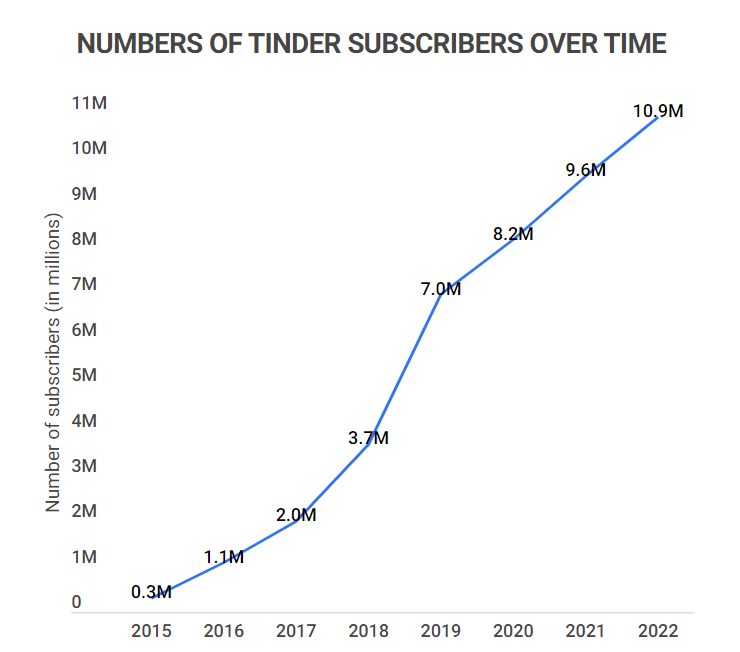
Currently, Tinder has approximately 10.9 million subscribers, which constitutes just over 14% of its total MAUs.
For a more detailed analysis, please see the following sections:
User | Business | Match
Tinder Users
Tinder attracts a diverse user base, appealing to a variety of demographics. From older couples exploring polyamory to young adults seeking casual connections, here are some noteworthy facts about Tinder’s user demographics:
-
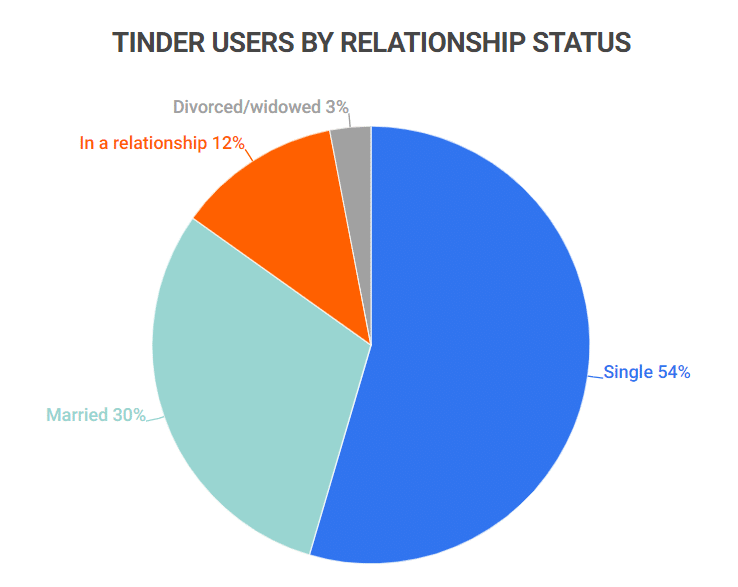
Only 54% of Tinder users are actually single.
Surprisingly, nearly half of Tinder users are not single. Specifically, about 30% are married, 12% are in a relationship, and 3% are divorced or widowed.
Tinder Users By Relationship Status
Relationship Status Share of Tinder Users Single 54% Married 30% In a Relationship 12% Divorced/Widowed 3% -
38% of Tinder users are between 16-24 years old.
The largest demographic of Tinder users actually falls within the 25-34 age bracket (45%), with 17% being older than that.
Tinder Users By Age
Age Range Share of Tinder Users 16-24 38% 25-34 45% 35-44 13% 45-54 3% 55-64 1% -
76% of Tinder users live in urban areas.
The app’s popularity is significantly higher in urban centers compared to rural areas, where only 7% of users reside.
Urban vs Rural Tinder Users
Location Share of Tinder Users Urban 76% Suburban 17% Rural 7% -
The Tinder app has seen over 64 million downloads annually.
In 2022, Tinder recorded 64 million downloads, slightly down from 67 million in 2021, yet it remains the most downloaded dating app globally.
Tinder Business Statistics
As a business, Tinder has proven to be exceptionally profitable. Here are some compelling trends and data points regarding Tinder’s financial standing:
-
Tinder has 35 times more subscribers in 2022 than it did in 2015.
From approximately 300,000 subscribers in 2015, Tinder’s numbers surged to 10.9 million subscribers by 2022.
Number of Tinder Subscribers Over Time
Year Number of Tinder Subscribers 2015 0.3M 2016 1.1M 2017 2.0M 2018 3.7M 2019 7.0M 2020 8.2M 2021 9.6M 2022 10.9M -
Tinder’s profitability has increased 37 times since 2015.
Annual revenue jumped from $47 million in 2015 to an impressive $1.794 billion by 2022.
Tinder Annual Revenue Over Time
Year Annual Revenue 2015 $47M 2016 $169M 2017 $403M 2018 $805M 2019 $1.15B 2020 $1.41B 2021 $1.65B 2022 $1.79B -
Tinder holds a 27.6% market share among dating apps.
Tinder leads the dating app market, with Bumble at 18% and Badoo at 15% following behind.
Dating Apps By Market Share
Dating App Market Share Tinder 27.6% Bumble 18.0% Badoo 15.0% Plenty of Fish 11.1% Hinge 10.7% LOVOO 5.1% Others 12.5%
Tinder Match Statistics
Matching is the primary objective for Tinder users, but user engagement varies significantly. Here are some intriguing statistics about matching trends on the platform:
-
Over 30 million matches are made on Tinder daily.
This figure remains robust, despite an average match rate of just 1.63%, indicating that a minority of users receive the majority of matches.
-
Men are 3 times more likely to swipe right compared to women.
On average, men swipe right 46% of the time, while women do so only 14%, further amplified by the gender imbalance on the app.
-
Only 7% of men send messages after matching on Tinder.
This contrasts with 21% of women who initiate conversations, highlighting another disparity in user interaction.
Tinder FAQ
-
What is the male-to-female ratio on Tinder?
The male-to-female ratio on Tinder is approximately three to one in the United States. Over 75% of users are male, contrasting with only 24.2% female users, resulting in an imbalanced dating environment.
However, this disparity varies by region. For example, in India, the ratio is 62% male to 38% female, while European countries tend to have a more balanced distribution.
-
Is Tinder losing popularity?
While Tinder has faced challenges since 2020, it remains a dominant force in dating. After a 5% decline in downloads in 2021 and a further 4.5% dip in 2022, the app’s growth trajectory has leveled off.
Despite these fluctuations, Tinder’s user base and engagement remain substantial compared to other dating platforms.
-
How does Tinder generate revenue?
Tinder primarily earns revenue through subscriptions, Super Likes, and Boosts. Here’s a breakdown of these revenue sources:
-
Subscriptions. Tinder offers tier-based subscription plans that can be billed monthly or annually. Options include Tinder Plus, Tinder Gold, and Tinder Platinum, each providing varying features such as unlimited likes, prioritized visibility, and enhanced messaging capabilities.
-
Super Likes. Super Likes significantly increase the likelihood of a match, boosting chances by threefold and leading to conversations that last 70% longer. Users receive one Super Like per month for free but often purchase additional ones to improve their matching success.
-
Boosts. Boosts elevate a user’s profile visibility significantly, placing it at the forefront of nearby users’ feeds. Depending on the boost type, profiles can gain visibility from 10 to 100 times more. Many users opt to pay for these boosts to enhance their chances of matching.
-
Conclusion
Since its launch in 2012, Tinder has solidified its position as the world’s largest dating app. As of 2026, it holds a market share of 27.6%, with an impressive increase in subscribers and revenue since 2015.
Despite its success, Tinder faces challenges related to user demographics and engagement. Downloads have decreased in recent years, marking a shift in the app’s growth pattern.
Nonetheless, Tinder remains a dominant player in the dating app landscape, with over 75 million monthly active users and a revenue of $1.79 billion as of 2022. The platform’s future will be shaped by how it adapts to evolving user needs and market dynamics.
References
-
The Guardian – 42% of people using dating app Tinder already have a partner, claims report
-
Statista – Leading dating apps worldwide in 2022, by downloads

Author

Jack Flynn is a writer for Zippia. In his professional career he’s written over 100 research papers, articles and blog posts. Some of his most popular published works include his writing about economic terms and research into job classifications. Jack received his BS from Hampshire College.