- Facts and Figures
- Social Security Statistics
- Social Media Statistics
- Cell Phone Usage Statistics
- Cryptocurrency Statistics
- White Collar Crime Statistics
- Crowdfunding Statistics
- Branding Statistics
- How Many Emails Are Sent Per Day
- Money Laundering Statistics
- Childcare Availability Statistics
- Cold Calling Statistics
- Automation And Job Loss Statistics
- Student Loan Statistics
- Spam Statistics
- Password Statistics
- Ransomware Statistics
- Christmas Spending Statistics
- Average Grocery Cost By State
- Average Screen Time Statistics
- Average Monthly Expenses
- IoT Statistics
- Gen Z Statistics
30+ Essential U.S. Child Care Statistics [2026]: Availability, Costs, And Trends
Research Summary. In 2026, the child care landscape in the United States continues to significantly impact both the economy and the workforce. Despite the recovery from pandemic-related disruptions, many families still face challenges in accessing quality child care. Our comprehensive analysis reveals:
-
57% of working families spent more than $10,000 on child care in 2023.
-
51% of Americans reside in communities identified as child care deserts.
-
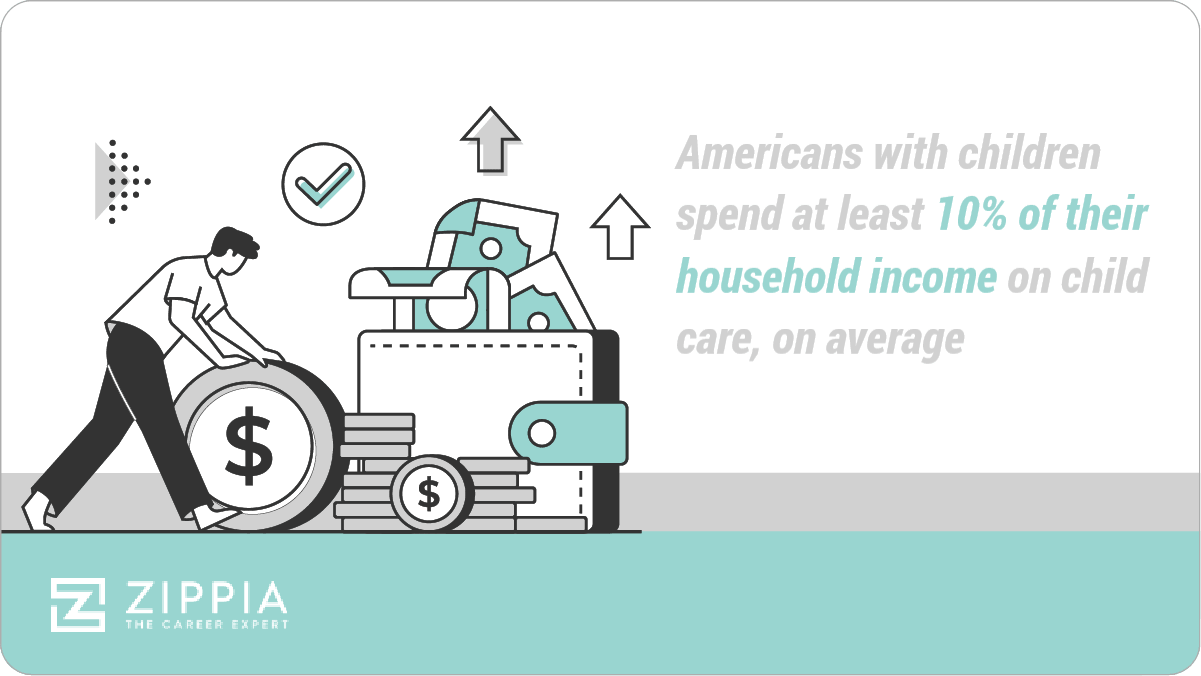
On average, two-income American households with children allocate at least 10% of their household income to child care.
-
58% of working parents depend on child care centers, equating to approximately 6.38 million parents nationwide.
-
The U.S. child care industry is valued at $60.4 billion.
-
Annual economic repercussions from child care issues culminate in $21 billion in lost tax revenue, $23 billion in lost business income, and $78 billion in diminished individual earnings.
For more detailed analysis, we categorized the data as follows:
Women in the Workplace | The Industry | Costs | Availability by Demographics | Availability by Region
General Child Care Statistics
-
27% of families struggle to find available child care slots.
A significant number of families report difficulties in accessing child care, with 27% indicating a lack of available slots. Consequently, two-thirds of parents have limited options, often facing only a single choice.
-
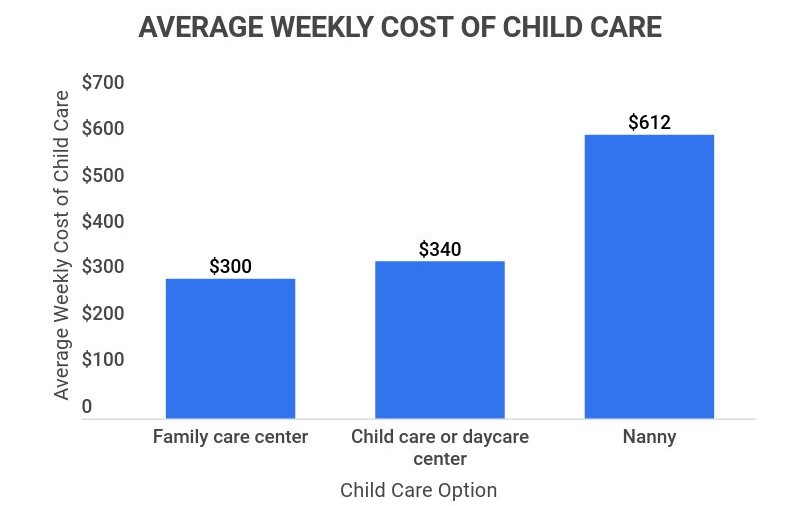
The average weekly cost for child care is $340.
Currently, the weekly expense for family care centers is around $300, while child care centers charge approximately $340. For nannies, the average weekly cost is $612, as highlighted by the Center for American Progress.
Sending two children to a child care center results in a weekly cost of about $640, whereas employing a nanny reaches about $654.
-
31.7% of U.S. children under five lack access to child care.
A 2020 study analyzed child care access for children under five, revealing that 8.4 million children needed care, but only 5.9 million slots were available, leaving about 2.7 million children without options.
Child Care Statistics and Women in the Workplace
-
Child care issues disproportionately affect mothers’ careers.
According to recent surveys, mothers are 40% more likely than fathers to claim that child care challenges have adversely affected their careers.
-
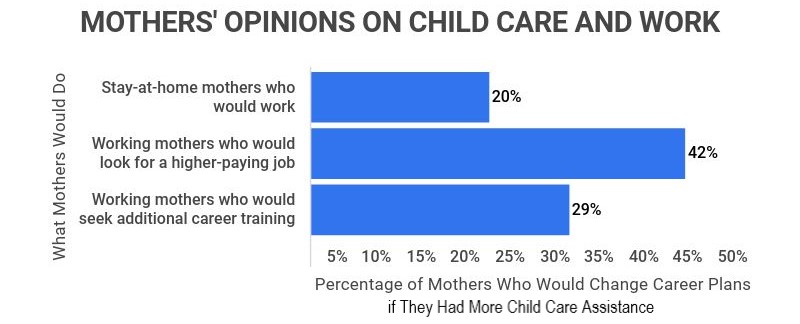
20% of stay-at-home mothers would join the workforce with better child care support.
Approximately 20% of mothers who are not currently employed would seek work if quality child care were more accessible.
An additional 42% of working mothers would pursue higher-paying jobs, and 29% would consider further education or training for career advancement.
-
Rising child care costs have contributed to a 13% decline in mothers’ employment.
Over two decades, the participation of women in the labor force has been declining, with high child care costs cited as a major factor. The lack of federal policies for child care and paid family leave has contributed to this trend.
-
69% of young mothers are part of the workforce.
Nearly 70% of young mothers are employed, with participation in the workforce closely linked to the availability of child care options.
-
42% of mothers are the primary breadwinners.
Overall, 70% of American mothers work, and about 42% are the sole or primary earners in their households, a figure notably higher among Black mothers, where it reaches 71%.
Child Care Statistics: The Industry
-
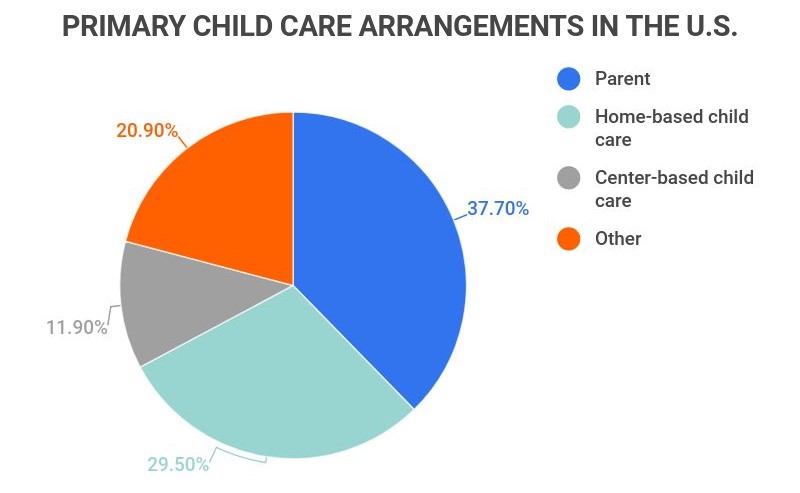
Around 30% of infants and toddlers are in home-based care.
Currently, 29.5% of infants and toddlers receive care in home-based settings, while 37.7% are exclusively cared for by parents or guardians.
-
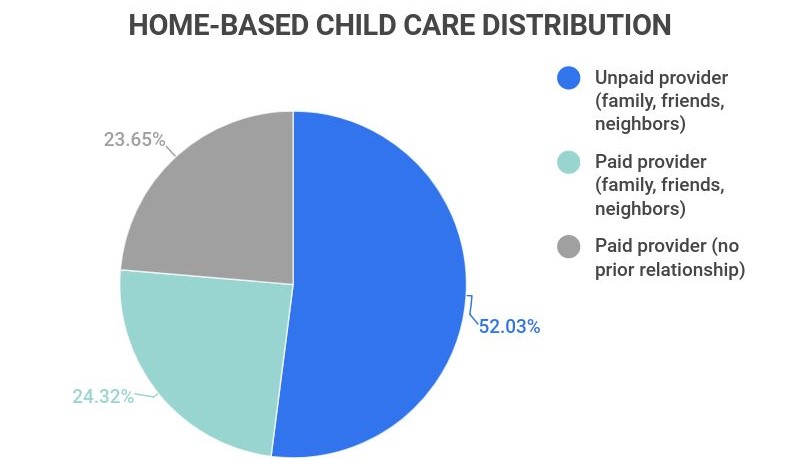
52% of home-based child care is unpaid.
The majority of non-parental home-based child care is provided by friends, family, or neighbors without compensation. This type of care accounts for the primary experience for 15.4% of infants and toddlers. Paid care comprises 48%, whether from acquaintances or professional caregivers.
7.2% of infants and toddlers are cared for by paid family members, friends, or neighbors, while 7% are under the care of paid professionals.
-
58% of working parents utilize child care centers.
58% of working parents with children aged five and younger, approximately 6.38 million parents, rely on center-based care, according to the National Household Education Survey.
The survey also reveals that of the 11 million working parents in the U.S., 31% do not use any outside child care, 25% depend on non-relatives, and 47% rely on relatives for care.
-
U.S. businesses incur an average loss of $12.7 billion annually due to child care issues.
Employees with children aged three and younger cost businesses about $1,150 per year due to insufficient child care. With 11 million working parents in the U.S., this results in an overall economic loss of $12.7 billion.
-
There are over 600,000 licensed daycare facilities in the U.S.
As of 2022, there were approximately 634,528 licensed daycare facilities in the U.S., employing around 1.5 million people.
Child Care Statistics by Costs
-
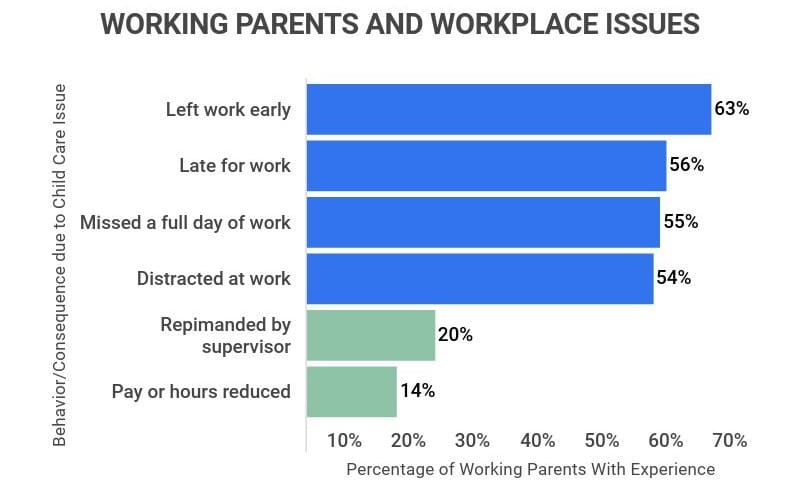
Many working parents have adjusted their work hours due to child care challenges.
Due to child care difficulties, 63% of working parents have left work early, 56% have been late, 55% have taken a full day off, and 54% have been distracted at work, according to Ready Nation.
Of those surveyed, one in five received reprimands from supervisors due to these challenges, and one in seven experienced pay or hour reductions.
-
More than half of U.S. families spent over $10,000 on child care in 2023.
57% of families spent more than $10,000 on child care last year, as reported by Care.com. This trend indicates that families are budgeting significant amounts for child care, often exceeding the average annual in-state college tuition of $9,580.
-
The current child care system imposes a $98 billion economic burden.
Parents lose an estimated $8,940 each year due to lost earnings and reduced workforce participation, leading to an overall economic cost of $98 billion nationwide for the current child care system.
-
The average weekly rate for in-home child care is $300.
This is the average weekly cost for family care centers, while employing a nanny averages about $612 weekly.
Child Care Statistics and the Ongoing Challenges
-
The U.S. is projected to lose 4.5 million child care slots permanently.
Despite recovery efforts, over 4 million child care slots are at risk of being permanently lost, predominantly impacting low-income families and communities of color.
-
Prior to the pandemic, two-thirds of U.S. families relied on child care.
Most parents of young children were employed and relied on child care to maintain their work commitments. About 22% of parents stated they could not work without child care.
-
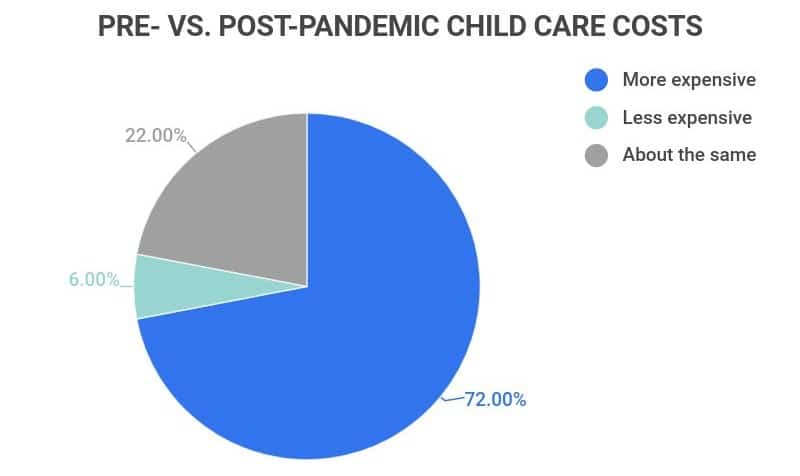
Current child care costs have risen since the pandemic.
72% of families report that child care has become more expensive post-pandemic, attributed to enhanced safety measures at facilities.
-
Quality child care remains difficult to secure compared to pre-pandemic times.
Nearly 46% of families find it harder to secure child care now than before the pandemic, resulting in a shift towards hiring nannies rather than relying on daycare centers.
Currently, hiring a nanny costs only $14 more weekly than placing two children in a child care center, a significant reduction from 2019.
-
Approximately 16,000 child care providers permanently shut down during the pandemic.
These closures occurred between December 2019 and March 2021 and have significantly impacted child care availability.
-
According to Care.com, 51% of American families who previously used child care centers report that their center is not fully operational, with 14% stating their provider is open but not fully functional.
-
Concerns over child care costs have increased among families.
62% of families now express greater concern over child care costs compared to pre-pandemic, with significant numbers citing increased expenses due to safety protocols and changes in care arrangements.
Child Care Statistics: Availability by Demographics
-
Nearly half of American families face challenges finding child care, with disparities based on race and income.
Approximately 44% of Black families, 50% of White families, and 57% of Hispanic families live in child care deserts. In high-income neighborhoods, 43% struggle with child care access, compared to 54% in low-income areas.
-
Over 70% of mothers in the U.S. are employed.
As of 2023, 71.2% of mothers with children under 18 participate in the labor force, a slight decline from previous years. In comparison, 92.3% of fathers with children under 18 are employed.
-
Black mothers have the highest labor force participation rates among U.S. mothers.
About 80% of Black mothers with children aged six to 17 are employed, marking the highest participation rate across racial and ethnic groups.
Child Care Statistics: Availability by Region
-
Child care access is particularly challenging in the Western U.S. and rural areas.
In rural areas, 26% of families report significant difficulty finding child care, compared to 10% in suburban regions and 11% in urban centers. Approximately 20% of families in the Western U.S. have lost their child care providers.
-
States like Utah, Nevada, Hawaii, West Virginia, and New York have the highest rates of child care deserts.
In these states, 77% of families in Utah, 72% in Nevada, 68% in Hawaii, and 64% in both West Virginia and New York reside in child care deserts.
Child Care Statistics FAQ
-
Child care deserts are areas with limited access to quality child care. Data indicates over half of American families live in such areas, and in some states, up to two-thirds face significant access issues.
Areas are typically classified as child care deserts when they have more than 50 children under five and three times as many children as available licensed child care slots.
-
Are there proposed policy solutions for improving child care accessibility and affordability?
Yes, various states are working on budgets and legislation aimed at providing child care benefits to working families. The Child Care for Working Families Act, a comprehensive federal early childhood policy, has been proposed to assist millions and potentially save families with multiple children significant annual costs while boosting economic activity across several states.
-
How many children attend child care in the U.S.?
Approximately 27.1% of infants and toddlers in the U.S. are in paid child care arrangements. This includes 11.9% at daycare centers and 7.2% from paid family members or friends.
However, this figure may have decreased post-pandemic due to many daycare closures, with at-home care becoming more prevalent.
-
What is the average cost of daycare in the U.S.?
The average cost of daycare in the U.S. is $340 per week. This translates to an annual expense of $17,680 per child if they are enrolled year-round.
Conclusion
Quality child care that is both accessible and affordable remains critical for the U.S. economy and families nationwide. Current statistics reveal a system that is struggling to meet the needs of parents, while simultaneously impacting employers and straining the economy.
With over half of working families spending upwards of $10,000 annually on child care—approximately 10% of their household income—it’s evident that child care issues are linked to significant losses in tax revenue, business profits, and individual earnings nationwide.
While the immediate impacts of the pandemic may have diminished, the ongoing challenges of affording and securing child care persist, particularly within an industry valued at $60.4 billion. The future of child care availability and affordability is likely tied to the success of upcoming federal legislation aimed at addressing these pressing issues.
References
-
Ready Nation. “The Economic Impacts Of Insufficient Child Care On Working Families.” Accessed on August 26, 2021.
-
Care.com. “This Is How Much Child Care Costs In 2023.” Accessed on August 26, 2021.
-
Center for American Progress. “51 Percent Of People In The United States Live In A Child Care Desert.” Accessed on August 26, 2021.
-
Center for American Progress. “The Child Care Crisis Is Keeping Women Out Of The Workforce.” Accessed on August 26, 2021.
-
Teach for America. “The Coming Child Care Crisis.” Accessed on August 26, 2021.
-
Bureau Of Labor Statistics. “Employment Characteristics Of Families — 2020.” Accessed on August 26, 2021.
-
Center for American Progress. “The State Of The U.S. Labor Market For Mothers: Pre-May 2018 Jobs Release.” Accessed on August 26, 2021.
-
Child Trends. “Nearly 30 Percent Of Infants And Toddlers Attend Home Based Child Care As Their Primary Arrangement.” Accessed on August 26, 2021.
-
Bipartisan Policy Center. “Child Care In 25 States: What We Know And Don’t Know.” Accessed on August 26, 2021.
-
Council for a Strong America. “$122 Billion: The Growing, Annual Cost of the Infant-Toddler Child Care Crisis.” Accessed on February 16, 2023.
-
Grand View Research. “U.S. Child Care Market Size, Share and Growth Report, 2030.” Accessed on February 16, 2023.
-
IBIS World. “Day Care Industry in the U.S. – Market Research Report.” Accessed on February 20, 2023.
-
Fortune. “16,000 Childcare Providers Shut Down in the Pandemic. It’s a Really Big Deal.” Accessed on February 20, 2023.
- Facts and Figures
- Social Security Statistics
- Social Media Statistics
- Cell Phone Usage Statistics
- Cryptocurrency Statistics
- White Collar Crime Statistics
- Crowdfunding Statistics
- Branding Statistics
- How Many Emails Are Sent Per Day
- Money Laundering Statistics
- Childcare Availability Statistics
- Cold Calling Statistics
- Automation And Job Loss Statistics
- Student Loan Statistics
- Spam Statistics
- Password Statistics
- Ransomware Statistics
- Christmas Spending Statistics
- Average Grocery Cost By State
- Average Screen Time Statistics
- Average Monthly Expenses
- IoT Statistics
- Gen Z Statistics

Author

Chris Kolmar is a co-founder of Zippia and the editor-in-chief of the Zippia career advice blog. He has hired over 50 people in his career, been hired five times, and wants to help you land your next job. His research has been featured on the New York Times, Thrillist, VOX, The Atlantic, and a host of local news. More recently, he's been quoted on USA Today, BusinessInsider, and CNBC.