What Percentage of the Workforce Is Female? [2026]
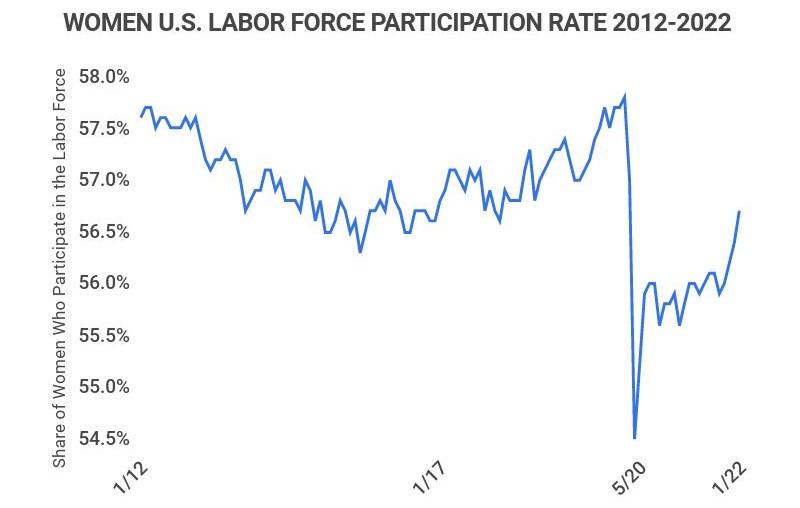
As of 2026, women represent approximately 46.6% of the workforce in the United States. This figure reflects a women’s labor force participation rate of 56.8%, compared to men’s labor force participation rate of 67.9%. Considering that women constitute the majority of the U.S. population, this statistic highlights their significant role in the labor market.
Historically, women’s labor force participation peaked in 1999, when 60% of working-age women were employed. While the pandemic temporarily impacted labor force participation for both genders, the recovery has been promising, with women’s labor force participation rate rebounding by 2.2% since April 2020.
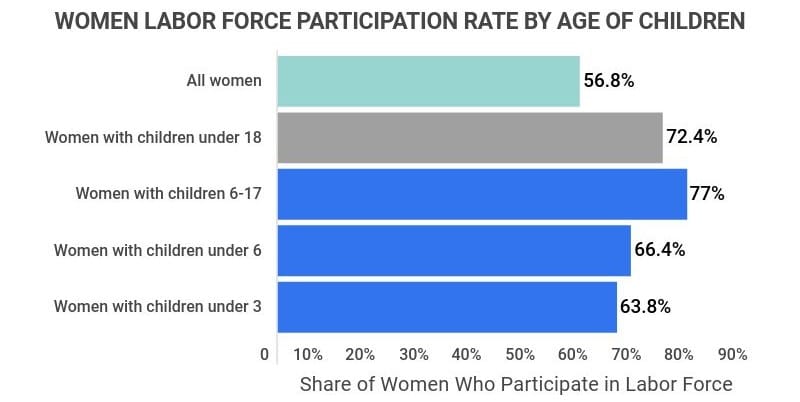
Childcare remains a crucial factor influencing women’s workforce participation. Currently, 72.4% of women with children under 18 are employed, significantly higher than the overall female workforce participation. Notably, 63.8% of mothers with children under 3 are also in the labor force.
Interestingly, the trend for fathers reflects a different pattern, with higher participation rates when children are younger and lower rates as children grow older.

Industries with High Female Employment
-
Which industries employ the highest percentage of women?
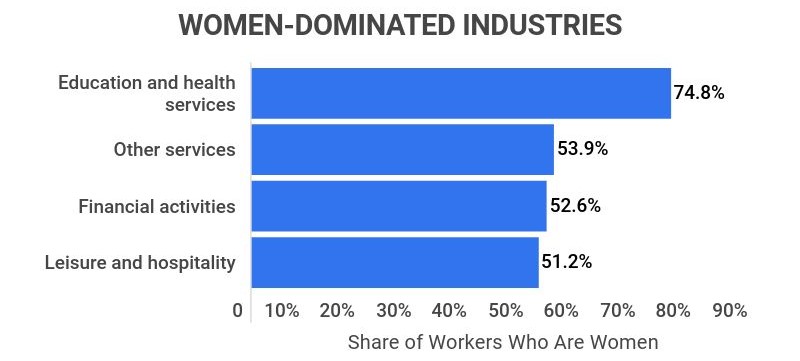
Education and health services lead the way with 74.8% of employees being women. These sectors are significantly more female-dominated than others, such as financial activities and leisure & hospitality, where women make up just over half of the workforce.
-
Which industries have the lowest percentage of female employees?
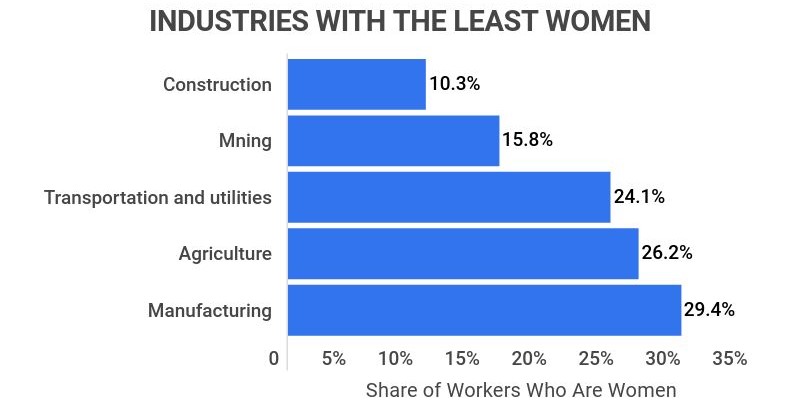
Construction and mining have the least female representation. Only 10.3% of construction workers and 15.8% of mining workers are women.
-
What occupations are most dominated by women?
Preschool and kindergarten teaching positions are predominantly filled by women, with 98.7% of these roles held by females in the U.S. Other occupations with high female representation include dental hygienists, speech-language pathologists, and dental assistants.
Job Share of Workers Who Are Women Preschool and kindergarten teachers 98.7% Dental hygienists 96% Speech-language pathologists 95.8% Dental assistants 94.9% Childcare workers 93.4% Medical records and health information technicians 93.3% Secretaries and administrative assistants 93.2% Medical assistants 92.7% Hairdressers, hairstylists, and cosmetologists 92.3% Dietitians and nutritionists 92.1% -
What jobs have the lowest female representation?
Brickmasons, blockmasons, and stonemasons have the lowest female representation, with only 0.7% of these roles filled by women. This low percentage is mirrored in other trades such as drywall installers and structural iron and steel workers.
Job Share of Workers Who Are Women Brickmasons, blockmasons, and stonemasons 0.7% Drywall installers, ceiling tile installers, and tapers 0.7% Structural iron and steel workers 0.9% Miscellaneous vehicle and mobile equipment mechanics, installers, and repairers 1.3% Bus and truck mechanics and diesel engine specialists 1.5% Heavy vehicle and mobile equipment service technicians and mechanics 1.5% Heating, air conditioning, and refrigeration mechanics and installers 1.5% Electrical power-line installers and repairers 1.6% Operating engineers and other construction equipment operators 1.7% Logging workers 1.8%
References
-
U.S. Bureau of Labor Statistics. “Women in the Labor Force: A Databook.” Accessed on February 28, 2022.
-
U.S. Bureau of Labor Statistics. “Labor Force Participation Rate – Women.” Accessed on February 28, 2022.

Author

Matthew Zane is the lead editor of Zippia's How To Get A Job Guides. He is a teacher, writer, and world-traveler that wants to help people at every stage of the career life cycle. He completed his masters in American Literature from Trinity College Dublin and BA in English from the University of Connecticut.