Explore jobs
Find specific jobs
Explore careers
Explore professions
Best companies
Explore companies
Job outlook for applications programmer senior analysts in the United States
Applications programmer senior analyst job growth summary. After extensive research, interviews, and analysis, Zippia's data science team found that:
The projected applications programmer senior analyst job growth rate is 9% from 2018-2028.
About 56,000 new jobs for applications programmer senior analysts are projected over the next decade.
Applications programmer senior analyst salaries have increased 8% for applications programmer senior analysts in the last 5 years.
There are over 126,312 applications programmer senior analysts currently employed in the United States.
There are 87,773 active applications programmer senior analyst job openings in the US.
The average applications programmer senior analyst salary is $105,895.
Are applications programmer senior analyst jobs in demand?
Applications programmer senior analyst job and salary trends over time
Applications programmer senior analyst jobs over time
Applications programmer senior analyst job growth rate over time
| Year | # of jobs | % of population |
|---|---|---|
| 2021 | 126,312 | 0.04% |
| 2020 | 151,824 | 0.05% |
| 2019 | 107,669 | 0.03% |
| 2018 | 178,277 | 0.05% |
| 2017 | 178,375 | 0.05% |
Average applications programmer senior analyst salary over time
Applications programmer senior analyst salary by year
| Year | Avg. salary | Hourly rate | % Change |
|---|---|---|---|
| 2026 | $105,895 | $50.91 | +3.4% |
| 2025 | $102,406 | $49.23 | +2.3% |
| 2024 | $100,087 | $48.12 | +0.5% |
| 2023 | $99,557 | $47.86 | +1.2% |
| 2022 | $98,373 | $47.29 | +1.7% |
Applications programmer senior analyst jobs by state
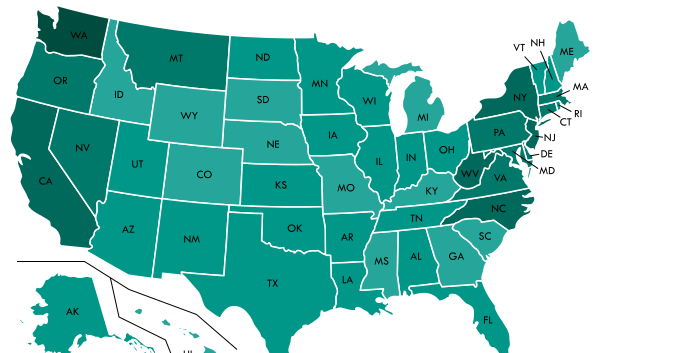
Most common states for applications programmer senior analysts
| Rank | State | Population | # of jobs | Employment/ 1000ppl |
|---|---|---|---|---|
| 1 | District of Columbia | 693,972 | 534 | 77% |
| 2 | Virginia | 8,470,020 | 1,918 | 23% |
| 3 | Massachusetts | 6,859,819 | 1,489 | 22% |
| 4 | Maryland | 6,052,177 | 1,161 | 19% |
| 5 | Delaware | 961,939 | 185 | 19% |
| 6 | Vermont | 623,657 | 119 | 19% |
| 7 | Oregon | 4,142,776 | 689 | 17% |
| 8 | Rhode Island | 1,059,639 | 176 | 17% |
| 9 | Alaska | 739,795 | 116 | 16% |
| 10 | Minnesota | 5,576,606 | 857 | 15% |
| 11 | New Hampshire | 1,342,795 | 203 | 15% |
| 12 | Montana | 1,050,493 | 156 | 15% |
| 13 | Illinois | 12,802,023 | 1,731 | 14% |
| 14 | North Carolina | 10,273,419 | 1,472 | 14% |
| 15 | New Jersey | 9,005,644 | 1,255 | 14% |
| 16 | Colorado | 5,607,154 | 774 | 14% |
| 17 | Utah | 3,101,833 | 427 | 14% |
| 18 | Nebraska | 1,920,076 | 274 | 14% |
| 19 | Washington | 7,405,743 | 984 | 13% |
| 20 | Connecticut | 3,588,184 | 470 | 13% |
Most common cities for applications programmer senior analysts
| Rank | City | # of jobs | Employment/ 1000ppl | Avg. salary |
|---|---|---|---|---|
| 1 | Atascocita | 1 | 2% | $99,118 |
| 2 | Tampa | 3 | 1% | $95,503 |
| 3 | Irving | 2 | 1% | $99,441 |
| 4 | Pasadena | 1 | 1% | $98,999 |
| 5 | Sugar Land | 1 | 1% | $99,024 |
| 6 | Houston | 1 | 0% | $99,053 |
| 7 | Jersey City | 1 | 0% | $109,484 |
Applications Programmer Senior Analyst job outlook: Expert opinions
Our panel of applications programmer senior analyst experts
University of Wisconsin - Eau Claire
Framingham State University
Aurora University
Southern Illinois University Edwardsville
Ashford University
University of Minnesota - Duluth
Taylor University
Southern Illinois University Edwardsville

Sam Houston State University

University of North Alabama

King University

Gannon University
Auburn University at Montgomery

Allegheny College

Saint Xavier University

Taylor University

Brigham Young University-Hawaii
What general advice would you give to an Applications Programmer Senior Analyst?
Dale Dzielski MBA, CMA®, PMP®, SAFe® 4 Agilist: Be prepared for a lifelong learning experience; it just begins now. Be confident in what you know but open to learn more because you will.
What will help Applications Programmer Senior Analysts increase their earning potential?
Dale Dzielski MBA, CMA®, PMP®, SAFe® 4 Agilist: Gain knowledge in Statistics, Data Analytics, cybersecurity, cloud computing, artificial intelligence as well as understanding of Agile Methodology, architecture and design principles/concepts, and development tools such as Jira and GitHub. These will continue to grow in importance to your career. Also, keep watching for disruptive technologies. These will change the way we live and perform our jobs such as the impact AI has already had. I can't name them now because they haven't been innovated or named yet. In fact, you may become a part of doing so.
What Applications Programmer Senior Analyst skills would you recommend for someone trying to advance their career?
Lyle Ford: Be flexible and open to new experiences. Technology changes rapidly and your skills will have to evolve to keep up. You will always need your creativity and problem solving skills, but the way in which you implement them will change with your environment which will require you to constantly update your skillset. Always look for opportunities to network. This can give you insights into developing areas and open doors for future paths you may be unaware of.
What general advice would you give to an Applications Programmer Senior Analyst?
Lyle Ford: Having a broad base of skills, both technical and interpersonal are very valuable. Often, physics majors are hired to be problem solvers and each problem has its own set of unique conditions that may require a different set of skills to solve. The ability to be an effective team member is vital and proof of that will make you stand out. Evidence of independent work is also helpful so highlight and research or internship experiences you have had.
What will help Applications Programmer Senior Analysts increase their earning potential?
Lyle Ford: Computer skills (programming, working effectively with AI, and the like) will be important as the world continues to automate. The ability to design, build, and repair electronic and electromechanical systems will also be important for the same reason.
What general advice would you give to an Applications Programmer Senior Analyst?
Erastus Ndinguri: A couple of ways to maximize your salary potential are;
Through first salary negotiation - By understanding the job market of your field, knowing what you can offer and preparing well for your salary negotiation you can positively maximize your first salary potential. This can affect your future earnings especially if you rise up the corporate ladder in the same organization.
Not settling, but continuing to learn- Learn a new skill that will help in building your resume. Network with colleagues in your organization and learn from them. Continuous learning and self-improvement create opportunities for higher earnings.
Embrace mentorships- Having a good seasoned colleague/mentor can open opportunities for higher earning. A mentor can help you prepare for a salary negotiation and also steer you to the right projects that lead to career advancements hence a higher salary.
What general advice would you give to an Applications Programmer Senior Analyst?
Anil Agarwal: Know what your strengths and weaknesses are. List them - think of things you can do really well for example leading a project, Social Skills, building a network, what areas of business do you love and enjoy. Find that field, have a passion and go for that job. Create your own unique LinkedIn page. Showcase your projects and your skills. Pick up endorsements, get letters or recommendation from your Professors or folks you have worked with. Never ever give up. Keep learning new skills and areas you like (like project management, interpersonal skills, handling objections, listening skills and many others). When you build your confidence you will feel great. Learn a foreign language (like Spanish or French). Speak in front of a mirror. Approach your job search methodically, find references who can help you reach the right people.
Dr. Ramona Baima
Senior Lecturer of Mathematics & Field Experience SupervisorAurora University
Mathematics
What general advice would you give to an Applications Programmer Senior Analyst?
Dr. Ramona Baima: For sure, in the next 3-5 years the level of technology will increase exponentially with the addition of AI. It is very important for graduates to continue to want to learn and improve their skills in the field of computer science and advanced mathematics in order to be able to be creative, come up with and implement unique ideas.
What general advice would you give to an Applications Programmer Senior Analyst?
Ahmed Imteaj PH.D.: Research Salary Trends, Acquire In-Demand Skills, Gain Relevant Experience, Customize Your Resume and Cover Letter, Prepare for Salary Negotiations, Consider Additional Benefits.
What will help Applications Programmer Senior Analysts increase their earning potential?
Ahmed Imteaj PH.D.: Research Salary Trends: Before entering the job market, research salary trends for entry-level positions in your field and location. Websites like Glassdoor, PayScale, and LinkedIn Salary can provide valuable insights into typical salary ranges for different roles.
Acquire In-Demand Skills: Identify in-demand skills and technologies in your field and focus on acquiring them through coursework, certifications, internships, or personal projects. Skills such as machine learning, cloud computing, cybersecurity, and data science are highly valued and can command higher salaries.
Gain Relevant Experience: Prioritize gaining relevant experience through internships, co-op programs, part-time jobs, or freelance projects. Practical experience can significantly increase your market value and make you more attractive to employers.Customize Your Resume and Cover Letter: Tailor your resume and cover letter to highlight your relevant skills, experiences, and achievements that align with the job requirements. Highlighting your unique qualifications can increase your chances of landing interviews and negotiating a higher salary.
Prepare for Salary Negotiations: Before entering salary negotiations, research the typical salary range for the position and location, considering factors such as cost of living and industry standards. Practice articulating your value proposition and be prepared to negotiate confidently for a salary that reflects your skills, experience, and market value.
Consider Additional Benefits: In addition to salary, consider other benefits and perks offered by employers, such as health insurance, retirement plans, paid time off, flexible work arrangements, professional development opportunities, and bonuses. These benefits can add significant value to your overall compensation package.
What general advice would you give to an Applications Programmer Senior Analyst?
Evgenia Smirni: I would say that quick pivoting and embracing changes is very important - this is a very fast changing field.
What will help Applications Programmer Senior Analysts increase their earning potential?
Evgenia Smirni: Focus on having a strong basis of the fundamentals. The purpose of your education is to teach you asking the right questions to be able to find the right solutions. This field is changing continuously. Learning how to pivot when new, emerging trends happen, is key for success. Last but not least, do not underestimate the value of liberal arts educations - combining CS with liberal arts can offer communication skills that are of paramount importance for your career trajectory in this tech field.
What will help Applications Programmer Senior Analysts increase their earning potential?
Anil Agarwal: Some skills will always be in Demand - such as Interpersonal communications , Project Management , Learning different languages and having great listening skills. What new skills will be in demand : Social media, content and Digital marketing. Data Analytics and or Business Analytics. Cross cultural management , Leadership Skills. Financial Management . Getting an MBA, MFS ( Masters of Finance ) , MSM ( Masters in Analytical Marketing ) or a Masters in Economics or an MHA ( Masters in Health Sciences. The fields of Bio Technology are also exploding if that is your bent of mind.
Rich Maclin
ProfessorUniversity of Minnesota - Duluth
Computer Systems Networking And Telecommunications
What will help Applications Programmer Senior Analysts increase their earning potential?
Rich Maclin: My advice to my students always starts with the fundamental question--what are you trying to achieve? What do you want out of job? Are you looking for a steady income, job security, a challenge, a particular field, etc.? When I talk to students in our upper division Software Engineering course my suggested approach is to try to understand the culture of the job you were taking on, and by extension, take whatever training they offer you. But honestly, I also tell them BEFORE they graduate that they need to think about what comes next and perhaps work on those other skills that may help them with jobs they want. If they want to go into a finance-related field maybe take some business courses in accounting, etc. If they play multiple instruments (seems like many of our students do) maybe take music courses and look for companies that work in the music field. Computer science and software at this point touch almost every industry, so before they leave I often suggest students take courses in areas that might lead them to be more attractive to companies in that field.
Dr. Jonathan Denning
Associate Professor and Department Co-chairTaylor University
Computer Science
What will help Applications Programmer Senior Analysts increase their earning potential?
Dr. Jonathan Denning: 1. Keep learning the fundamentals. The CS field is ever changing, so don't get caught up in understanding only the latest and greatest framework or language, as tomorrow there will be another one to replace it. Instead, focus on the fundamentals, so that you can quickly become familiar with whatever framework is decided upon.
What Applications Programmer Senior Analyst skills would you recommend for someone trying to advance their career?
Dr. Jonathan Denning: As with most things in this world, CS ideas come and go and return in cycles. Large monolithic systems with dumb terminals get replaced by smart personal devices, but then it will soon switch back to large servers and thin clients, followed by simple back ends with intelligent front ends... What was big about 5--10yrs ago will likely become the next greatest thing in 5yrs. As technology progresses (access to info, memory capacities, processing power, etc.), we will find new ways to apply old techniques, but these are still old techniques. Machine Learning / Artificial Intelligence is far from a new thing, having been around for as long as programming has been a thing, but it's a hot topic (again) at the moment. The important skill to hone is in communicating. If you know how to talk with people and to understand their problems, then you will be able to find a solution that is good for them. If you don't know how to work with people, then any solution will fall short of actually solving the problem.
John Matta
Associate Professor of CS, SIUESouthern Illinois University Edwardsville
Computer And Information Sciences
What general advice would you give to an Applications Programmer Senior Analyst?
John Matta: Networking. A lot of people feel weird about it, but you really can negotiate your job offers. Be sure to keep benefits in mind.
M. Douglas Berg
Associate ProfessorSam Houston State University
Economics and International Business
What skills stand out on Applications Programmer Senior Analyst resumes?
M. Douglas Berg: At the entry-level, the ability to construct data sets. This includes gathering, cleaning, and transforming the data.
Jason Imbrogno Ph.D.
Associate ProfessorUniversity of North Alabama
Department of Finance, Economics, and Data Analytics
What soft skills should all Applications Programmer Senior Analysts possess?
Jason Imbrogno Ph.D.: Communication for sure, especially knowing how to write and present well.
Jason Caudill Ph.D.
Professor of BusinessKing University
Management Information Systems
What hard/technical skills are most important for Applications Programmer Senior Analysts?
Jason Caudill Ph.D.: The number one technical skill for today's professionals is the ability to learn new systems. Regardless of expertise in a particular platform, there are going to be updates and changes, and different companies will likely be on different major platforms to perform the same functions. A strong foundation of technical skills in communications software, spreadsheets, and cloud applications will give someone the foundation they need to function in most modern workplaces, but the real skill is being able to translate that understanding of the architecture to multiple platforms so they can manage change.
What skills will help Applications Programmer Senior Analysts earn the most?
Jason Caudill Ph.D.: I think the two most profitable skills will be communication and adaptability. Almost nothing happens in a vacuum, so to be successful, today's professionals have to be able to effectively collaborate with others in various departments and in other organizations. That can only happen with effective communication skills. Coupled with that is the fact that dynamic markets, shorter product lifespans, and longer careers are demanding that people change their skill sets and adapt to different markets more than they ever have before. The professional who can continuously adapt to the demands of the market, who is willing to add new skills over time as a lifelong learner, will be the most prepared to offer continued value to a company, which will result in higher earnings.
Are there any particularly good places in the United States for Applications Programmer Senior Analysts to find work opportunities?
Dr. Stephen Frezza Ph.D.: Computing is ubiquitous, and with more industries moving to remote work, location is becoming less critical. If the internet reaches a place reliably, computing jobs can be located there.
How do you envision technology impacting Applications Programmer Senior Analysts in the next 5 years?
Dr. Stephen Frezza Ph.D.: Breadth and depth: Computing is becoming more like engineering; where the value of the product, its lifetime risks, costs, and benefits are more critical than just it's roll-out. So the engineering competencies that have always been a part of computing will become more central. Computing is also expanding; the role of data and the shift of once-research technologies (like machine learning) into production applications will continue to require computing graduates to broaden their base and continue as learners. This will cause shifts in what is considered 'fundamental' and the need for professionals to continue to hone and redevelop their technical skill sets.
Will there be an enduring impact of the coronavirus pandemic on Applications Programmer Senior Analysts?
Dr. Semih Dinc: I personally think there may be a positive impact of this pandemic for CS graduates in medium/long term. Even if many companies have frozen or slowed down their hiring process now, I believe this is a temporary decision. There is still a big need for new CS graduates in the industry. And to me it is more clear that people realized they can work remotely for many CS related positions. This means that many companies can cut their physical office budgets and hire more remote people. One of the factors for our students is the challenges/expenses of the city they would work. Some of them do not want to move to big cities. I am assuming with more remote working opportunities graduates will have more options.
Oliver Bonham-Carter Ph.D.
Assistant ProfessorAllegheny College
Department of Computer Science and Affiliated Faculty in Integrative Informatics
What are the biggest trends we'll see in the Applications Programmer Senior Analyst job market given the pandemic?
Oliver Bonham-Carter Ph.D.: Pandemic has accelerated social connectivity trends using technology, including technology for remote work, and e-learning, and technology to make e-commerce more comfortable and faster. I foresee these accelerated technology trends to continue, even after the pandemic, and therefore job markets in these areas to continue to grow. Another big surge we have seen is in data analytics, which has been increasing over the last decade, and COVID-19 has spotlighted this field. I expect data analyst jobs to continue to be in demand and to grow. Also, the pandemic showed us the interconnectedness of technology with other areas. As the need to develop better solutions to fight various diseases heightens, for example, I expect jobs in biotech to grow.
What are the best companies to work for an Applications Programmer Senior Analyst?
James Vanderhyde: The best companies to work for are companies that respect you as a person and not just a cog in the machine. They are inclusive, and they recognize and appreciate diversity. They have a track record of handling sick leave and family leave as needed. They will not expect you to eat dinner in your office and then go back to work after an already long day. All software companies experience crunch times around release dates, but the best companies do not experience constant crunch. That is a sign of poor management. The best companies will give you challenging problems to work on and reward innovation.
Will there be an increase or decrease in demand for Applications Programmer Senior Analysts in the next 5 years?
James Vanderhyde: There has been a steady increase in software and IT jobs for the last 20 years, and this is not going to slow down any time soon. In the next 5 years, demand will increase, particularly in software development and cybersecurity. The technology field changes so quickly that beyond 5 years, it is difficult to make predictions. That is why we thoroughly prepare our computer science and information systems students for technology changes and career shifts to discover the best in themselves and to be prepared to meet the demand and excel within the field.
Are there any particularly good places in the United States for Applications Programmer Senior Analysts to find work opportunities?
James Vanderhyde: Any big city will have lots of opportunities for computing, software, and IT work. Silicon Valley and the rest of the west coast are the most famous, but innovation is happening everywhere around the country and around the world, including here in Chicago. Chicago tech companies have hired our students upon graduation, and likewise, our graduates have found success and gratification in the field.
Dr. Jonathan Geisler
Associate ProfessorTaylor University
Department of Computer Science and Engineering
Will there be an increase or decrease in demand for Applications Programmer Senior Analysts in the next 5 years?
Dr. Jonathan Geisler: There will be a continued increase in demand for computer engineering
graduates as computers become more heavily integrated into the fabric
of our lives. Things like self-driving cars, the Internet of Things, and
mobile computing will become more commonplace and increase the demand for engineering talent; the long-term trend of using smartphones and web-based applications will not slow, leading to an increase in the
demand for computing talent.
What experience really stands out on Applications Programmer Senior Analyst resumes?
David Preece: Most employers look for indicators of character and "soft skills" related to leadership, problem-solving, teamwork, initiative, diligence, responsibility, and integrity. Naturally, each company and job position requires some minimal technical or functional capabilities, but many of those skills can be taught to new employees with strong potential. Character is more difficult, if not impossible, to develop in entry-level employees, and these soft skills are proven to impact organizational culture and productivity.