Explore jobs
Find specific jobs
Explore careers
Explore professions
Best companies
Explore companies
Job outlook for applied statisticians in the United States
Are applied statistician jobs in demand?
Applied statistician job and salary trends over time
Applied statistician jobs over time
Applied statistician job growth rate over time
| Year | # of jobs | % of population |
|---|---|---|
| 2021 | 32 | 0.00% |
| 2020 | 40 | 0.00% |
| 2019 | 40 | 0.00% |
| 2018 | 41 | 0.00% |
| 2017 | 38 | 0.00% |
Average applied statistician salary over time
Applied statistician salary by year
| Year | Avg. salary | Hourly rate | % Change |
|---|---|---|---|
| 2026 | $57,811 | $27.79 | +1.2% |
| 2025 | $57,116 | $27.46 | +3.9% |
| 2024 | $54,998 | $26.44 | +4.4% |
| 2023 | $52,667 | $25.32 | +4.4% |
| 2022 | $50,437 | $24.25 | +0.5% |
Applied statistician jobs by state
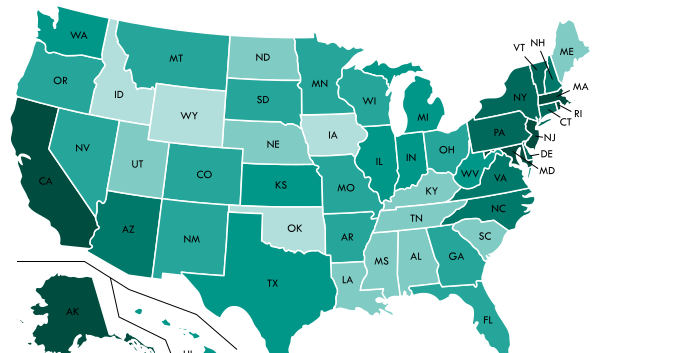
Most common states for applied statisticians
| Rank | State | Population | # of jobs | Employment/ 1000ppl |
|---|---|---|---|---|
| 1 | District of Columbia | 693,972 | 16 | 2% |
| 2 | Maryland | 6,052,177 | 38 | 1% |
| 3 | Utah | 3,101,833 | 21 | 1% |
| 4 | California | 39,536,653 | 70 | 0% |
| 5 | Illinois | 12,802,023 | 47 | 0% |
| 6 | Massachusetts | 6,859,819 | 28 | 0% |
| 7 | New York | 19,849,399 | 27 | 0% |
| 8 | North Carolina | 10,273,419 | 21 | 0% |
| 9 | Michigan | 9,962,311 | 18 | 0% |
| 10 | New Jersey | 9,005,644 | 17 | 0% |
| 11 | Pennsylvania | 12,805,537 | 17 | 0% |
| 12 | Virginia | 8,470,020 | 16 | 0% |
| 13 | Connecticut | 3,588,184 | 14 | 0% |
| 14 | West Virginia | 1,815,857 | 8 | 0% |
| 15 | Rhode Island | 1,059,639 | 3 | 0% |
| 16 | Hawaii | 1,427,538 | 3 | 0% |
| 17 | Kansas | 2,913,123 | 3 | 0% |
| 18 | Alaska | 739,795 | 2 | 0% |
| 19 | Delaware | 961,939 | 2 | 0% |
| 20 | Vermont | 623,657 | 0 | 0% |
Most common cities for applied statisticians
| Rank | City | # of jobs | Employment/ 1000ppl | Avg. salary |
|---|---|---|---|---|
| 1 | Cambridge | 1 | 1% | $75,820 |
Applied Statistician job outlook: Expert opinions
Our panel of applied statistician experts
San Francisco State University
University of North Carolina at Asheville
Saint Peter's University
What general advice would you give to an Applied Statistician?
Warren Johnson: Statistics/data science and computer science are great professions to enter now. Mathematics is involved in these fields. It allows working with talented students and gaining new insights.
What Applied Statistician skills would you recommend for someone trying to advance their career?
Warren Johnson: Some of us prove theorems on the frontiers of mathematics, but most of us really don't. A good mathematical training allows one to work on many different things in many contexts. Teaching is rewarding if you have good students.
What will help Applied Statisticians increase their earning potential?
Warren Johnson: Many of the greatest ideas that men and women have had are mathematical ideas. The thrill of understanding something difficult and explaining it to talented young people is rewarding. Dislike the grading aspect of the job.
What Applied Statistician skills would you recommend for someone trying to advance their career?
Luella Fu: I think Statisticians enjoy the quantitative reasoning aspect of their jobs, whether it’s designing the data collection, visualizing data, or creating insights from it. It’s also a pretty stable job with good pay. What Statisticians probably don’t like is the amount of time they spend in front of a computer to do their data analyses. It can create eye strain. Also, data cleaning can be full of unexpected challenges that take much longer to solve than one expects.
What will help Applied Statisticians increase their earning potential?
Luella Fu: It varies depending on if you’re an academic or an industry professional, but I think a common theme for all entry-level statisticians is that they’re going to be pulling data out of storage, finding ways to visualize it, and finding ways to summarize it. They’ll usually have very specific goals in mind, either to answer a research or business question, and so they’ll spend quite some time just thinking about what the data is answering and how to showcase the data in the way that best answers those important questions.
What general advice would you give to an Applied Statistician?
Kedai Cheng Ph.D.: For academic jobs, as a professor, we start off our day with a coffee. Thanks to the luxury of academic jobs, I spend most of my day reading and studying, and doing research. Research is totally different from learning. Learning is comparatively easy because everything is written in the book. If I do not under, I can always go over it again and again. It is a matter of time investment. Unlike learning, we do not have a certain answer for research. It is possible that we spend 1 year reviewing all existing literature and do our own experiment, and it turns out nothing worked out. It is a very strongly self-motivated job. And we need to be able to enjoy the loneliness. To other people, it may seem like our jobs are boring and lonely. However, to me, it is different. I rarely get bored, because I want to know what is going on. We can always dig a little deeper on what we have.
What Applied Statistician skills would you recommend for someone trying to advance their career?
Kedai Cheng Ph.D.: There is undoubtful that mathematics is the fundamental subject of all social and natural sciences. With a Mathematics or Statistics major, it should not be hard to find a job in finance, technology and many other fields. Even a minor in Mathematics or Statistics may support people finding a job. People know you have certain quantitative and analytical skills when they are needed. People know you have been through a lot of struggling and frustration, and you survived.
What general advice would you give to an Applied Statistician?
Bernd Schroeder: Learn as much abstract mathematics as you can and take classes in another field in which mathematics can be applied and that is interesting to you. Mathematics majors hold skilled positions in fields that may first seem surprising, such as medicine, accounting, or the gaming industry. The common denominator is that mathematical models can be applied in these and many other fields, and the key is to make the connection.
What Applied Statistician skills would you recommend for someone trying to advance their career?
Bernd Schroeder: The foundation of mathematics is logical and computational precision. Mathematical results are eternal in that there is no update needed once a result has been shown to be true. Consider Pythagoras' Theorem. It's rather old, but its statement and truth are unchanged, as is its applicability. This logical and computational precision will be of primary importance for as long as human beings practice mathematics, science, as well as have interactions in general. For the future, we need to continually refine our ability to use fundamental skills in mathematics/logic/computations to validate and improve results obtained through complex computations: For example, the computations that underly AI cannot and should not be double checked step-by-step, because they are much too intricate. However, simple test cases can often reveal problems in the system as well as features.
What will help Applied Statisticians increase their earning potential?
Bernd Schroeder: You want to be one who solves problems, not one who causes them. Ask for help when you need it, but also freely lend your help to others. You want to be one whose good front is backed by solid performance and to whom people look for help. The hardest part is to commit, but to not overcommit to the point where the quality of your work suffers.
What will help Applied Statisticians increase their earning potential?
Nickolas Kintos PhD: Don't think that you have to limit yourself to specific areas. Mathematics is used in many different fields. Keep your options open.