Explore jobs
Find specific jobs
Explore careers
Explore professions
Best companies
Explore companies
Job outlook for art supervisors in the United States
Are art supervisor jobs in demand?
Art supervisor job and salary trends over time
Art supervisor jobs over time
Art supervisor job growth rate over time
| Year | # of jobs | % of population |
|---|---|---|
| 2021 | 204 | 0.00% |
| 2020 | 198 | 0.00% |
| 2019 | 208 | 0.00% |
| 2018 | 195 | 0.00% |
| 2017 | 184 | 0.00% |
Average art supervisor salary over time
Art supervisor salary by year
| Year | Avg. salary | Hourly rate | % Change |
|---|---|---|---|
| 2025 | $66,352 | $31.90 | +3.2% |
| 2024 | $64,272 | $30.90 | +1.6% |
| 2023 | $63,290 | $30.43 | +0.3% |
| 2022 | $63,099 | $30.34 | +3.0% |
| 2021 | $61,270 | $29.46 | +0.1% |
Art supervisor jobs by state
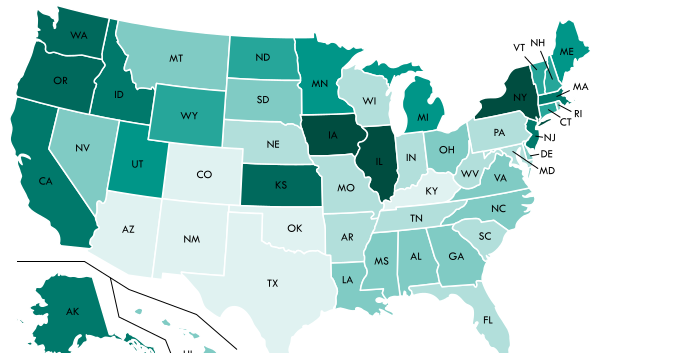
Most common states for art supervisors
| Rank | State | Population | # of jobs | Employment/ 1000ppl |
|---|---|---|---|---|
| 1 | District of Columbia | 693,972 | 25 | 4% |
| 2 | Vermont | 623,657 | 15 | 2% |
| 3 | California | 39,536,653 | 341 | 1% |
| 4 | New York | 19,849,399 | 235 | 1% |
| 5 | Illinois | 12,802,023 | 112 | 1% |
| 6 | Oregon | 4,142,776 | 56 | 1% |
| 7 | Washington | 7,405,743 | 53 | 1% |
| 8 | Massachusetts | 6,859,819 | 51 | 1% |
| 9 | New Jersey | 9,005,644 | 49 | 1% |
| 10 | Minnesota | 5,576,606 | 35 | 1% |
| 11 | Connecticut | 3,588,184 | 35 | 1% |
| 12 | Nevada | 2,998,039 | 18 | 1% |
| 13 | Utah | 3,101,833 | 16 | 1% |
| 14 | New Hampshire | 1,342,795 | 13 | 1% |
| 15 | Idaho | 1,716,943 | 9 | 1% |
| 16 | North Dakota | 755,393 | 7 | 1% |
| 17 | Maine | 1,335,907 | 7 | 1% |
| 18 | Montana | 1,050,493 | 7 | 1% |
| 19 | Wyoming | 579,315 | 5 | 1% |
| 20 | Alaska | 739,795 | 4 | 1% |
Most common cities for art supervisors
| Rank | City | # of jobs | Employment/ 1000ppl | Avg. salary |
|---|---|---|---|---|
| 1 | New York | 1 | 0% | $97,146 |
| 2 | San Francisco | 1 | 0% | $89,996 |
Art Supervisor job outlook: Expert opinions
Our panel of art supervisor experts
Moravian College

Humboldt State University
Villanova University
Los Angeles County Museum of Art
University of Pittsburgh
What general advice would you give to an Art Supervisor?
Dr. Joyce Stoner: Skills in imaging, Macro-XRF, weave counting, and cross-section microscopy are more and more important for practitioners in painting conservation in private work, regional centers, or in museums.
What will help Art Supervisors increase their earning potential?
Dr. Joyce Stoner: Salaries are not very high in art conservation as you start out. But if you work with a mentor, publish and give talks, have a high profile for your knowledge and expertise, and eventually go into private work, especially in modern and contemporary paintings, to my knowledge that is where the higher salaries are found.
Dr. MaryJo Rosania-Harvie
Assistant Professor of Practice | Art Education Coordinator | Interim Art Department ChairMoravian College
Fine And Studio Arts
What general advice would you give to an Art Supervisor?
Dr. MaryJo Rosania-Harvie: Definitely leadership skills - having the ability to express their ideas and be open to feedback; and the ability to give effective feedback. Artists learn to do this in school through critique and sharing their work with an audience. Also, entrepreneurial skills, critical thinking, and always creativity.
What will help Art Supervisors increase their earning potential?
Dr. MaryJo Rosania-Harvie: For someone beginning their career, I would advise them to consider the problem-solving and critical thinking skills they developed in school, and highlight those skills when meeting with potential employers and clients. They can consider themselves entrepreneurs, and should try to be flexible and open-minded.
What certifications/licenses/courses can have the biggest impact for Art Supervisors?
Elizabeth McPherson: College courses that focus on entrepreneurship, creativity, and flexibility are very important in this age.
What certifications/licenses/courses can have the biggest impact for Art Supervisors?
Rae Robison: This year has really hit home that performers need to have a better knowledge of lighting and costume. What does my light look like? Why is my white shirt flaring? Since so many are working from their homes they need answers to these questions so they can produce their best audition tape or performance. Everyone needs to embrace some tech knowledge so that we can continue to push our new art forms into the 21st century.
What will help Art Supervisors increase their earning potential?
Rae Robison: Less specificity and more holistic learning. If you only design sets, you are limited to art direction in a physical space or choosing Zoom backgrounds. If you know scenic, costume, lighting and sound your earning potential is so much more possible. I always train my students to work in live venues and multiple recorded formats to expand their marketability.
Edward Sobel
Associate Professor, Resident DirectorVillanova University
Department of Theatre
What general advice would you give to an Art Supervisor?
Edward Sobel: It's important to know that theater is a relationship-based career. Look to build relationships with those with whom you share a common aesthetic and a sense of purpose. Building relationships takes time and care, and only sometimes pays immediate dividends. Remember this is a marathon, not a sprint. Be persistent. You may not ever be able to make a living in the theater. But if you quit, you definitely won't.
I'll add, many but not all who obtain a degree in theater wish to work in the profession. A theater degree, particularly within a liberal arts context, offers highly marketable and desirable skills. The theater is a collaborative art form, making those with a theater degree experience working as part of a team. The theater is storytelling. Those with a theater degree have learned how to construct a compelling narrative and to communicate it clearly. They have practiced analytical and presentational skills. They have embodied empathy. All of this position a graduate well in many other occupations, including law, teaching, advertising/marketing, social work, etc.
What type of skills will young Art Supervisors need?
Cynthia Tovar: Young graduates should have received hands-on experience working with collections, if possible, through an internship or volunteering. Museum study helps one understand general concepts but working with and learning from those already in the field is often the best way of gathering skills in areas such as condition reporting, collection management and care, exhibition installation and art supervision, and the like.