Explore jobs
Find specific jobs
Explore careers
Explore professions
Best companies
Explore companies
Job outlook for artists-in residence in the United States
Are artist-in-residence jobs in demand?
Artist-in-residence job and salary trends over time
Artist-in-residence jobs over time
Artist-in-residence job growth rate over time
| Year | # of jobs | % of population |
|---|---|---|
| 2021 | 1,264 | 0.00% |
| 2020 | 1,484 | 0.00% |
| 2019 | 1,655 | 0.00% |
| 2018 | 1,558 | 0.00% |
| 2017 | 1,505 | 0.00% |
Average artist-in-residence salary over time
Artist-in-residence salary by year
| Year | Avg. salary | Hourly rate | % Change |
|---|---|---|---|
| 2026 | $53,528 | $25.73 | +3.5% |
| 2025 | $51,698 | $24.85 | +2.4% |
| 2024 | $50,501 | $24.28 | --0.3% |
| 2023 | $50,644 | $24.35 | --2.5% |
| 2022 | $51,943 | $24.97 | +9.3% |
Artist-in-residence jobs by state
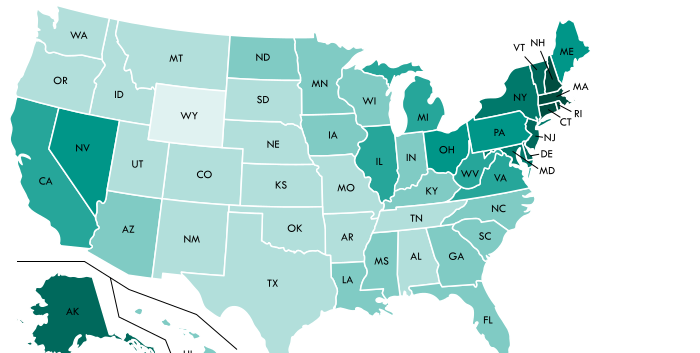
Most common states for artists-in residence
| Rank | State | Population | # of jobs | Employment/ 1000ppl |
|---|---|---|---|---|
| 1 | Iowa | 3,145,711 | 332 | 11% |
| 2 | Florida | 20,984,400 | 1,801 | 9% |
| 3 | New Hampshire | 1,342,795 | 121 | 9% |
| 4 | Delaware | 961,939 | 82 | 9% |
| 5 | North Dakota | 755,393 | 67 | 9% |
| 6 | Maine | 1,335,907 | 105 | 8% |
| 7 | Massachusetts | 6,859,819 | 500 | 7% |
| 8 | Colorado | 5,607,154 | 419 | 7% |
| 9 | Minnesota | 5,576,606 | 406 | 7% |
| 10 | Kansas | 2,913,123 | 204 | 7% |
| 11 | Wyoming | 579,315 | 43 | 7% |
| 12 | Vermont | 623,657 | 42 | 7% |
| 13 | Texas | 28,304,596 | 1,611 | 6% |
| 14 | Indiana | 6,666,818 | 411 | 6% |
| 15 | Arizona | 7,016,270 | 386 | 6% |
| 16 | Wisconsin | 5,795,483 | 334 | 6% |
| 17 | Connecticut | 3,588,184 | 209 | 6% |
| 18 | Arkansas | 3,004,279 | 181 | 6% |
| 19 | New Mexico | 2,088,070 | 134 | 6% |
| 20 | District of Columbia | 693,972 | 44 | 6% |
Most common cities for artists-in residence
| Rank | City | # of jobs | Employment/ 1000ppl | Avg. salary |
|---|---|---|---|---|
| 1 | Washington | 3 | 0% | $69,182 |
Artist-In-Residence job outlook: Expert opinions
Our panel of artist-in-residence experts
Michigan State University
Florida Gulf Coast University
Xavier University
Muhlenberg College
Rider University
University of Indianapolis

Art Academy of Cincinnati

Keene State College
Foothill College
Colby College

Azusa Pacific University

Greenville University

Northwestern Oklahoma State University
What general advice would you give to an Artist-In-Residence?
Wanda Sullivan MFA: In addition to full time practicing artists, our studio art graduates work in a variety of jobs. We have alumni in art administration positions, a tenured professor at Auburn, elementary and high school art teachers, an education director at the Center for Craft and even a curator at the Field Museum in Chicago. The common thread that they all have in common is a strong foundation in creative problem solving. Art is fundamental to the human condition. We are born wired to create. In a sense, art gives flavor to life through color, form, line, texture and shapes. Art is communication, a non-verbal language that connects us across backgrounds, cultures and generations, it is what makes us human.
What Artist-In-Residence skills would you recommend for someone trying to advance their career?
Wanda Sullivan MFA: Making art or working in an art related field is one of the most rewarding ways to earn a living. It is a privilege to contribute to the tradition of culture in one's community, region and country. People shape the creative fiber of communities, they do not happen on their own. The most common frustration creatives face is lack of funding in the arts and lack of understanding. These obstacles can be overcome and should not deter young people from studying art. Art was here before we were all born and will be here after we all leave, it gives life flavor and it will never go out of style.
What general advice would you give to an Artist-In-Residence?
Assistant Professor Trish Gianakis: A fine artist's day-to-day activities are basically focused on creating art. There are other tasks as well, such as marketing, networking, collaborating with other artists, research and teaching workshops or classes. At a beginner level when someone is entering the field of fine art, typical activities focus on building their skill and a specific style to stand out. While developing their portfolio, going to art shows and getting into the art community to meet other artists and gallery owners to establish themselves in the artistic community. Many artists work multiple jobs in order to sustain their income while they figure out the specific style to make themselves stand out.
What Artist-In-Residence skills would you recommend for someone trying to advance their career?
Assistant Professor Trish Gianakis: I like to say we are in the beginning of the digital Renaissance. Digital art is finally accepted as an art form. This career can be a dynamic and rewarding career if you have a passion for creativity, expression, and want to make a cultural impact by meaningful contribution to society.
What general advice would you give to an Artist-In-Residence?
Teresa Dunn: In general artists make because they are driven by internal impulse to create. I would not describe that as like or dislike, but as being compelled to make something from nothing or transform something into something else completely new. There are many layers to why a person chooses to be an artist including the personal satisfaction of making something beautiful, compelling, incredible, shocking, or even disturbing. There is also the pleasure of providing joy to others, being provocative or evocative—the reaction of an audience is exciting. Downsides to the profession are learning to cope with failure—not everything an artist makes is worth keeping or is well received; rejection—an artist does not always get the exhibitions, sales, awards, and opportunities they would like or are worthy of receiving; the bureaucracy—dealing with things like taxes, paperwork, and organization of schedules are the necessary but less glamorous aspects of being an artist.
What Artist-In-Residence skills would you recommend for someone trying to advance their career?
Teresa Dunn: Entering the profession in practical terms is complicated as being an artist can be challenging on many levels, leaving many artists to balance their creative practice with other work such as education, arts administration, or jobs unrelated to the arts. I would rephrase the question: why is it critical to be an artist today? Artists have the capacity to see and to distill the world around us in sensitive and rich ways that invite viewers to understand themselves or others, view the past/present/future in unexpected ways, and identify topics of vital importance that audiences may not have considered without the perceptiveness of an artist through their artwork. Communities, cultures, civilizations are rich because of the dedication of artists and other creatives to make artwork that helps one find meaning, validates the self, makes the unknown known, reveals purpose, provides hope, challenges the status quo, and asks us to grow as individuals and as collectives.
What will help Artists-In Residence increase their earning potential?
Teresa Dunn: For many artists a typical daily scenario and often the main priority is to be in the studio making their artwork. However, for those whose work is primarily performative or social practice, the studio might not be the most important place for creative discovery. In addition, artists have such varied practices and unique demands that there is not a simple way to answer this question. It can be a combination of many activities such as being in the studio making artwork, preparing materials to create their work, reading, doing research, traveling to see artwork in galleries and museums, attending exhibitions or residencies, working with assistants, networking, applying for shows, engaging with community, teaching, etc.
Steve Hughart II
Laboratory Coordinator I/ Adjunct ProfessorFlorida Gulf Coast University
Fine And Studio Arts
What will help Artists-In Residence increase their earning potential?
Steve Hughart II: The most important skills that I would suggest would be to learn and understand the Adobe Creative Cloud Applications such as Photoshop and Illustrator for example. These platforms will benefit you immensely in the art field in a ton of different ways. All artists will use these applications in one form or another. That being said, I would also encourage everyone to do as much work as possible with your hands. Learn to use power tools, pick up a piece of paper and pencil instead of the iPad, use a real camera instead of your phone. With AI growing so fast digital media work will all be AI generated, so focusing on improving your editing skills and creating with your hands will be where the jobs are.
What general advice would you give to an Artist-In-Residence?
Professor Kelly Phelps M.F.A.: Fine Artist work! We have professions like any other. Many fine artist have art as his or her primary gig. Some have use art as their secondary job. Fine Artist try to work in his or her craft on a daily basis. Artist work in the studio, work on self -promotion, fix equipment, seek opportunities, exhibit, network/collaborate with other artist.
What Artist-In-Residence skills would you recommend for someone trying to advance their career?
Professor Kelly Phelps M.F.A.: Fine Arts is a great profession because creativity is needed everywhere. Artist/Designers are the makers of everything! There is an opportunity where art can be found in nearly any career.
What will help Artists-In Residence increase their earning potential?
Emily Potts: Fine art requires strong discipline, constant creative thinking, problem-solving, and communication skills. While the breadth of the field might initially overwhelm some, the stereotype that there are no jobs in the arts is simply untrue. Artists need to find their niche and develop the skills and portfolio to back it up. A fine arts degree is not an ending point, but a springboard. By professionally presenting their creative work, artists can propel themselves into jobs they are passionate about and truly believe in.
What general advice would you give to an Artist-In-Residence?
Carol Pelletier: I think most people love the creative space of being in the studio working on the next project, exhibiting their work and having it viewed by other artists and the greater public. The greatest frustration for most artists is work-life balance, like any other field.
What Artist-In-Residence skills would you recommend for someone trying to advance their career?
Carol Pelletier: The Studio Arts is a great place for those individuals who want to enter creative fields while fostering the spirit of entrepreneurship, while Art Therapy utilizes the arts for healing.
What general advice would you give to an Artist-In-Residence?
Todd Dellinger: Know thyself. This response has many facets and implications - know your 'deep why' or vision of yourself as an artist and professional and frame around the impact you wish to have on others - this becomes a sort of 'lodestar' for the work ahead of crafting a career. Know who you are internally, as well as externally - as a 'package' because you are entering an industry where you - and the work you produce - are the commodity, for good or bad. As such, define and adhere to your boundaries - so that you cannot be taken advantage of, and can stay true to your vision. Know yourself in the context of the business - and know the business aspects of what you do. You are, at the end of the day, a business - too many artists ignore that. Then, stick to your knowledge of and vision for yourself as an artist and professional.
What Artist-In-Residence skills would you recommend for someone trying to advance their career?
Todd Dellinger: Have a diverse and relevant toolkit of skills and expertise - creative and artistic ones, yes - but perhaps even more importantly, skills and expertise which translate into multiple, diverse corners of arts & entertainment and into other sectors. Know how to translate your artistic wizardry from the stage to a phone, from the studio to a streaming platform, from one arts discipline or style or genre to multiple others. But also, know how to write up a marketing piece, a grant narrative, plan an event, manage a budget. You might find day-work in the very place where you're sharing your talent at night.
What general advice would you give to an Artist-In-Residence?
gerard brown: Folks starting out in the crafts and the fine arts often think the most important thing is the images of their work they put out in the world - through social media, on grant applications, etc. But you also need to be able to write and speak about your work in ways that inspire and motivate ordinary people to share your interests. Too often, people come out of school speaking the language of school and writing for an academic reader - I wish everyone would read more good journalism about art in magazines and news papers (yes, they are online!) and learn to communicate about their work in an accessible, approachable way earlier in their careers.
What Artist-In-Residence skills would you recommend for someone trying to advance their career?
gerard brown: Obviously, this is going to vary widely depending on the field you're entering within the art, craft, and design professions. In design, the next three to five years will be deeply shaped by AI and we'll need designers who can bring the human perspective to an increasingly technology dependent world. I think everyone in design should be taking a UX course. In the fine arts and crafts areas, we may see a cultural pushback against the drive toward technology and a greater emphasis on the personal, the unique, the handmade, and the narrative. It will be important for artists and artisans in these fields to be able to communicate their vision to their clients and patrons.
What general advice would you give to an Artist-In-Residence?
Todd Dellinger: Have a diverse and relevant toolkit of skills and expertise - creative and artistic ones, yes - but perhaps even more importantly, skills and expertise which translate into multiple, diverse corners of arts & entertainment and into other sectors. Know how to translate your artistic wizardry from the stage to a phone, from the studio to a streaming platform, from one arts discipline or style or genre to multiple others. But also, know how write up a marketing piece, a grant narrative, plan an event, manage a budget. You might find day-work in the very place where you're sharing your talent at night.
What Artist-In-Residence skills would you recommend for someone trying to advance their career?
Todd Dellinger: Adaptability to change - it's inescapable and has been forever in the arts - but change comes so swiftly and from so many directions now - particularly those changes brought about by technology and media/communications. Be ahead of the curve when it comes to what new uses of AI, what new applications for social media and how to manipulate those to your advantage, to your "business" of being an artist in this world. Entrepreneurial skills are vital in any business. You will need to be your own entrepreneur - exercising creative, innovative ways of using your talents and skills "outside the box" and applying these in parts of the industry and in other settings to expand your earning and learning potentia
What will help Artists-In Residence increase their earning potential?
Todd Dellinger: Know thyself. This response has many facets and implications - know your "deep why" or vision of yourself as an artist and professional and frame around the impact you wish to have on others - this becomes a sort of "lodestar" for the work ahead of crafting a career. Know who you are internally, as well as externally - as a "package" because you are entering an industry where you - and the work you produce - are the commodity, for good or bad. As such, define and adhere to your boundaries - so that you cannot be taken advantage of, and can stay true to your vision. Know yourself in context of the business - and know the business aspects of what you do. You are, at the end of the day, a business - too many artists ignore that. Then, stick to your knowledge of and vision for, yourself as an artist and professional.
Nathaniel Foley
Assistant Professor of Art & DesignUniversity of Indianapolis
Fine And Studio Arts
What general advice would you give to an Artist-In-Residence?
Nathaniel Foley: Creatives must possess the confidence to sell and speak about themselves and their multifaceted and transferable skill sets. As creative problem-solvers, artists place themselves in a unique position to be able to engage all facets of the job market to positively contribute to today's society. Never place yourself in a mindset of only being able to function as a starving artist as you have gone through extensive training to think, take risks, communicate, and make differently than other disciplines, which sets you apart and provides you a unique opportunity to craft your own path. Do not be afraid to take risks by pursuing jobs that might not completely fit your perceived path because they will open doors and opportunities in the future.
What will help Artists-In Residence increase their earning potential?
Nathaniel Foley: A career in fine art is never a linear path like other professional fields, so one must remain flexible and aware of all opportunities that they might fit or create. Additionally, they possess numerous skill sets that are unique and they must be able to highlight them to an employer to demonstrate their value.
What soft skills should all Artists-In Residence possess?
Paige Williams: The World Economic Forum has identified the four most important skills that ALL students graduating from college in the 21st century will need to be successful. These are the same skills that artists, designers, and creative writers explore through 21st Century Art Education at the Art Academy of Cincinnati (AAC): Critical Thinking, Creativity, Collaboration, and Communication. 21st Century creatives will need to understand how to explore solutions to complex problems, think outside of the box, work with others, and effectively articulate their ideas. At the Art Academy of Cincinnati, our students in first-year experience engage in courses whose focus is communication, collaboration, ideation, research, and discovery from day one.
What skills will help Artists-In Residence earn the most?
Paige Williams: A combination of the 21st Century Skills: Critical Thinking, Creativity, Collaboration, and Communication will provide the most effective skill base for those seeking success in creative fields.
Are there any particularly good places in the United States for Artists-In Residence to find work opportunities?
Dr. Daniel Carberg: Focusing on performers, graduates usually find work in the field of music by moving to a city and building a network there. Cities such as Boston, New York, Kansas City, Washington D.C., Los Angeles, and San Francisco, to name a few, have particularly strong classical music scenes, and there are numerous opportunities for an ambitious musician to make a living. Having said this, I am glad to live in a small town in New Hampshire during the pandemic. If I were just beginning my performing career, I believe this would be an incredibly difficult decision to make.
Will there be an enduring impact of the coronavirus pandemic on Artists-In Residence?
Tom Gough: Without a crystal ball, it will be impossible to tell. I will say the ones I have corresponded with are itching and aching for opportunities, mostly to interact live. I hope, coming out of this, there will be a bit of a gold rush as audiences are aching for the live social element of the performing arts. But the current circumstances are taking their toll on a number of smaller arts organizations as they struggle with the uncertain economics of the present time and the How? When? etc. A decline in opportunities would certainly be felt by emerging artists.
How do you envision technology impacting Artists-In Residence in the next 5 years?
Tom Gough: One thing the pandemic has prompted is some extraordinary creativity in using real-time technology. And I would say the greatest innovation from this is bridging geography. I personally have now done projects with people in different time zones and continents. I predict this sort of innovative use will continue to be employed in some respect though not replace the live experience.
Are there any particularly good places in the United States for Artists-In Residence to find work opportunities?
Annie Kloppenberg: As has been the case for many years, the vast majority of young artists need to carve their own paths in order to succeed. With theaters shuttered, much attention has been given to artists who have found creative ways to pursue and produce their work. But in reality, that is not new. Generally speaking, Americans don't value the live arts the way people in many other cultures do. Artists for whom this work matters have needed to find ways to do their work in their communities.
People working in performing arts have, for many years, needed to leverage all their skills both to make ends meet and to be able to do their work. They have found flexible jobs to support their creative practice, have pursued jobs in the arts sector off the stage, have created fundraising platforms and productive partnerships beyond the arts sector, and have built audiences for their work in communities large and small. Artists create opportunities for themselves, and the pressure will be on to continue to do so. These are lessons, by the way, that can be applied beyond the arts sector!
How do you envision technology impacting Artists-In Residence in the next 5 years?
Annie Kloppenberg: Technology has long been integrated into the performance. There are many productive ways in which technology enhances what the live body is capable of and extends our aesthetic possibilities. I think all of that will continue; as new technologies are developed, artists will find ways to integrate them into our work. But I also imagine-and perhaps this is a somewhat romantic notion-that after the pandemic, everyone will be thirsty for the ways live art brings people together to celebrate, challenge, and connect. There is a reason that touch and movement have become metaphors to explain how art makes meaning. When live bodies share space, there is a palpable physical exchange that has an impact, even in the absence of physical touch. Technologies can create dialogues that are not possible without it, but they cannot be a substitute for live exchange.
Will there be an enduring impact of the coronavirus pandemic on Artists-In Residence?
Annie Kloppenberg: I think there certainly will be-as there will be an enduring impact on our economy and culture at large. It is hard to predict exactly what shape those changes will take. I have faith that our health care researchers will create an antidote to coronavirus, but what the pandemic has also made visible in new ways is the range of inequities that are deeply woven into the fabric of our culture. Producing an antidote to that is less straightforward. While it may be harder to find entry-level jobs, I also think that graduates entering the workforce will do so with creativity and with a palpable commitment to social justice. Young people stepped up as organizers this summer, and it wouldn't surprise me one bit to see them continue to step up in their professional lives in the coming years. And I think we need to make room for them to do that.
How do you envision technology impacting Artists-In Residence in the next 5 years?
Gavan Wyrick: It has been especially interesting to see how various theatre companies have been using platforms like Zoom and Twitch to mount remote productions. As a result, physical distance doesn't seem to be the barrier that it once was in producing theatre. I expect that many individuals and companies will continue to experiment with the technology that enables remote productions even after it's safe to return to theaters-this could open up the potential for a wide variety of new and different performing, storytelling, and design methods and techniques. While I don't think the traditional theatre experience will disappear, I do think there is a great opportunity for anyone who can capitalize on this new technological landscape.
How do you envision technology impacting Artists-In Residence in the next 5 years?
Paul Sunderland: Without question, technology will be a required skill for worship leaders and church musicians in the future! Having technology skills relevant to online worship will be foundational for the work of worship leaders from this point forward. No longer can a church musician simply focus on creating music? They now must also know how to deliver their music (and the entire worship service) through recordings and live to stream. The visual side of worship will also be vital to understand. For an online worship service, you cannot invite people to "turn in your hymnal to page number ..." Projecting the lyrics through presentational software is becoming even more standardized due to COVID. The real question becomes, how do we practice "liturgical discernment" in order to determine how technology serves our worship services, rather than using technology in a way that treats worship as entertainment.
Will there be an enduring impact of the coronavirus pandemic on Artists-In Residence?
Alison Petty Ragguette: I think that jobs are very scary as art and design departments contract in size to weather the pandemic's financial setbacks.
I think new graduates understand it will take some time for things to get back to normal. Artists are resourceful and are finding new ways to get through this trying time.
It has been a very distressing time for these graduates, but they find resilience in their creativity, and it is changing their art practice.
What technology do you think will become more important and prevalent for Artists-In Residence in the next 3-5 years?
Kimberly Weast: I believe we will continue to see lighting, projection, and massive "screens" breaking down even more barriers. I think that streaming will become the norm. But nothing beats being in a live theatrical presentation.