Explore jobs
Find specific jobs
Explore careers
Explore professions
Best companies
Explore companies
Job outlook for assistant designers in the United States
Assistant designer job growth summary. After extensive research, interviews, and analysis, Zippia's data science team found that:
The projected assistant designer job growth rate is 3% from 2018-2028.
About 6,800 new jobs for assistant designers are projected over the next decade.
Assistant designer salaries have increased 12% for assistant designers in the last 5 years.
There are over 7,870 assistant designers currently employed in the United States.
There are 47,598 active assistant designer job openings in the US.
The average assistant designer salary is $52,475.
Are assistant designer jobs in demand?
Assistant designer job and salary trends over time
Assistant designer jobs over time
Assistant designer job growth rate over time
| Year | # of jobs | % of population |
|---|---|---|
| 2021 | 7,870 | 0.00% |
| 2020 | 8,144 | 0.00% |
| 2019 | 8,629 | 0.00% |
| 2018 | 8,239 | 0.00% |
| 2017 | 8,073 | 0.00% |
Average assistant designer salary over time
Assistant designer salary by year
| Year | Avg. salary | Hourly rate | % Change |
|---|---|---|---|
| 2026 | $52,475 | $25.23 | +2.4% |
| 2025 | $51,227 | $24.63 | +3.5% |
| 2024 | $49,516 | $23.81 | +3.4% |
| 2023 | $47,875 | $23.02 | +2.2% |
| 2022 | $46,833 | $22.52 | +1.6% |
Assistant designer jobs by state
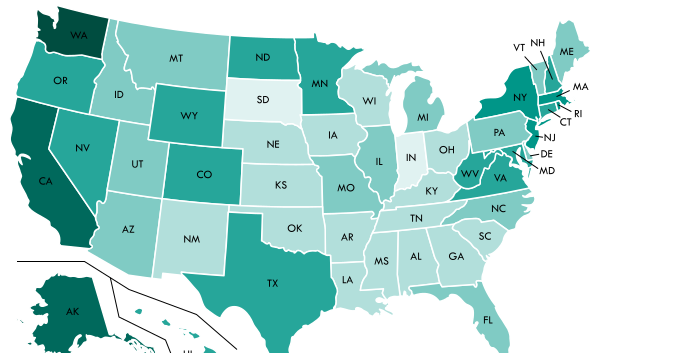
Most common states for assistant designers
| Rank | State | Population | # of jobs | Employment/ 1000ppl |
|---|---|---|---|---|
| 1 | District of Columbia | 693,972 | 227 | 33% |
| 2 | Washington | 7,405,743 | 942 | 13% |
| 3 | Massachusetts | 6,859,819 | 796 | 12% |
| 4 | Oregon | 4,142,776 | 493 | 12% |
| 5 | New Hampshire | 1,342,795 | 141 | 11% |
| 6 | Rhode Island | 1,059,639 | 102 | 10% |
| 7 | California | 39,536,653 | 3,446 | 9% |
| 8 | Virginia | 8,470,020 | 769 | 9% |
| 9 | Utah | 3,101,833 | 281 | 9% |
| 10 | Vermont | 623,657 | 57 | 9% |
| 11 | Georgia | 10,429,379 | 823 | 8% |
| 12 | Minnesota | 5,576,606 | 460 | 8% |
| 13 | Delaware | 961,939 | 78 | 8% |
| 14 | New York | 19,849,399 | 1,426 | 7% |
| 15 | Maryland | 6,052,177 | 442 | 7% |
| 16 | Wisconsin | 5,795,483 | 412 | 7% |
| 17 | Colorado | 5,607,154 | 410 | 7% |
| 18 | Connecticut | 3,588,184 | 238 | 7% |
| 19 | Maine | 1,335,907 | 98 | 7% |
| 20 | Wyoming | 579,315 | 39 | 7% |
Most common cities for assistant designers
| Rank | City | # of jobs | Employment/ 1000ppl | Avg. salary |
|---|---|---|---|---|
| 1 | Frankfort | 1 | 4% | $44,944 |
| 2 | Annapolis | 1 | 3% | $51,813 |
| 3 | Culver City | 1 | 3% | $65,513 |
| 4 | Dover | 1 | 3% | $49,152 |
| 5 | Juneau | 1 | 3% | $64,551 |
| 6 | Atlanta | 3 | 1% | $44,081 |
| 7 | Hartford | 1 | 1% | $54,165 |
| 8 | Lansing | 1 | 1% | $48,196 |
| 9 | Little Rock | 1 | 1% | $44,507 |
| 10 | Denver | 3 | 0% | $50,936 |
| 11 | Albuquerque | 1 | 0% | $43,659 |
| 12 | Baton Rouge | 1 | 0% | $44,135 |
| 13 | Boston | 1 | 0% | $58,725 |
| 14 | Des Moines | 1 | 0% | $42,869 |
| 15 | Indianapolis | 1 | 0% | $38,118 |
| 16 | Minneapolis | 1 | 0% | $50,738 |
| 17 | Montgomery | 1 | 0% | $42,110 |
Assistant Designer job outlook: Expert opinions
Our panel of assistant designer experts
Beloit College
Louisiana State University and A&M College
University of Akron
Kean University
Louisiana State University at Shreveport

Highline College
Santa Monica College
Santa Monica College

Eastern Illinois University
Kansas State University
Kansas State University
Kansas State University
Mansfield University of Pennsylvania
What general advice would you give to an Assistant Designer?
Tiffany Prater: As we emerge from the pandemic, it's crucial to hone your communication skills, particularly in areas such as presenting your design ideas, collaborating with team members, and effectively communicating with clients. This will not only build your confidence but also help you communicate your thought processes and informed design solutions, be open to correction and criticism, and gather experience while working with senior graphic designers, creative directors, and clients.
What general advice would you give to an Assistant Designer?
Shelbi Wilkin: Day to day work can vary when working as a designer for theatre. When not researching and analyzing plays, designers work on rendering designs, budgets, and sourcing materials. Designers can expect regular meetings with a production team and shop supervisors for their discipline. As a costume designer my role would be to meet with costume shop managers and drapers to ensure designs are realized per my vision, attend fittings for actors, tech rehearsals, photo calls, and strike for a performance. How much the costume designer engages with a shop or builds costumes themselves depends on the institution hiring.
What Assistant Designer skills would you recommend for someone trying to advance their career?
Shelbi Wilkin: Theatre is a highly collaborative artistic space. It allows artists the freedom to create and present their art while receiving a steady paycheck. This collaborative environment produces strong community ties to other theatre artists. As a designer, I get to wear many hats, I enjoy the diverse research and analysis that goes into every design for a production. I then get to use that research to create dynamic costume designs for the stage.
What will help Assistant Designers increase their earning potential?
Shelbi Wilkin: Not all theater's pay wages proportionately to the work and expertise asked of theatre artists. Many established theatre artists are working to change this culture in the industry, especially for early career professionals.
What general advice would you give to an Assistant Designer?
Dr. Mary Elliott: Thank you so much. We will be sure to feature your response in the article and send a draft over for your review before we promote it.
What Assistant Designer skills would you recommend for someone trying to advance their career?
Dr. Mary Elliott: The fashion industry is one of the largest industries in the world. According to McKinsey & Company, if the fashion industry were a country measuring GDP, it would be the 7th largest economy in the world. The fashion industry encompasses all of the processes needed to take raw product to finished textiles and then to the finished product ready for purchasing by the consumer. This diverse, fast-paced, constantly changing industry is generally divided into two categories for preparation purposes: the creative side and the business side.
What will help Assistant Designers increase their earning potential?
Dr. Mary Elliott: Because this industry is constantly changing and adapting to economic forces around the world, its employees need to be highly flexible critical thinkers who love working in fast-paced environments.
What will help Assistant Designers increase their earning potential?
Georges Fares: Starting a career in interior design can be both exciting and challenging. My advice is to stay curious and keep learning because the field of interior design is ever-evolving. Staying updated with the latest trends, materials, and technologies is crucial. Networking actively is also essential. Attend industry events, join professional organizations, and connect with peers and mentors, as these connections can open doors to opportunities and collaborations. Seek diverse experiences by gaining exposure to different types of projects and environments, whether residential, commercial, or hospitality. This will make you a more versatile designer. Lastly, stay resilient. The design field can be competitive and demanding, but by continuously honing your skills and maintaining a positive attitude, you can navigate through challenges successfully.
What general advice would you give to an Assistant Designer?
David Flynn: Everything that you see has been touched by a designer. The field is expanding with technology, but basic communication design principals remain paramount. It doesn’t matter if it’s a newspaper ad or a social post, you must have a professional that knows how to communicate a message, move the viewer's eye, and make the point. Designers work in every company and in every industry, worldwide.
What Assistant Designer skills would you recommend for someone trying to advance their career?
Dr. Denise Anderson: The skills graphic designers will need is learn artificial intelligence software AND how to masterfully use it. The masses will tinker with the new technology but designers need to harness the power of it and use their learned skills of ideation, art direction, and image manipulation skills (Photoshop). What they also need to develop is their storytelling skills which will help them with art directing and creating AI images.
What will help Assistant Designers increase their earning potential?
Dr. Denise Anderson: Similar to question 1, leverage what you have done prior to entering the field. It takes my students 6-8 weeks to complete their resumes and personal because the image and content needs to be authentic. Perception is a lot in our field and I train students to feel confident about themselves. Portfolios get students an interview but they need to communicate their value to get hired.
What general advice would you give to an Assistant Designer?
Allen Garcie MFA: I would tell a new graduate to begin replacing the student work in their portfolio with real-world projects as soon as possible. Sure, student work can be creative but, depending on the course it's created for, there could be other competing graduates using similar projects in their portfolios. To find real-world work, I recommend students begin looking for freelance work to gain experience working with clients. A great place to start is with local businesses. Many times, local business owners need a logo, website, flyers, etc. to promote their businesses and a new graduate can gain some great experience by working with them. I also recommend new graduates join a professional organization, such as the American Advertising Federation (AAF), so they can meet others in the field. This is a great way of developing professional relationships (People hire who they know!) and getting to know about jobs that are available.
What general advice would you give to an Assistant Designer?
Gina Pisut Ph.D.: 3D Design and AI technology for fashion design and product development. Their use for improving cost, efficiency and customer experience is pivotal. However, there will never be a replacement for the human element that contributes to fashion creativity.
What Assistant Designer skills would you recommend for someone trying to advance their career?
Gina Pisut Ph.D.: In addition to being well versed in computer design software for Apparel Design and Fashion Merchandising graduates, students need to truly be open to learning, have strong communication skills, and be able to work well in a team. The most common feedback we get from fashion and retail companies is students must be willing to do the work, be open to learning and doing different aspects of the business, and be adaptable and able to pivot when changes come within this fast-paced industry.
What will help Assistant Designers increase their earning potential?
Gina Pisut Ph.D.: Students should think in terms of always gaining experience or transferrable skills in every part-time job or volunteer experience. This can be incremental over time. In these positions, think in terms of build something with the company you are at. This may be a customer experience, a product, or a process. What this does is show your value to a new company and provide you a means to negotiate your worth.
What soft skills should all Assistant Designers possess?
Diana Boyd: -Collaboration/Teamwork
-Interpersonal
-Reliability
-Ethical behavior
-Self-starter
Lorrie Ivas
Full-time FacultySanta Monica College
Photo, Fashion Department
What skills stand out on Assistant Designer resumes?
Lorrie Ivas: Knowledge of the "entire" design process - from hand sketch to drape, draft, construction, digital skills in pattern drafting and design (i.e., Tukatech, Clo or similar), Adobe Creative Suite - Photoshop/Illustrator for presentation (look books, colorways, etc.) - is a standout, even though the actual position applying for may not require seasoned skills in every single step. The employer likes to know that the designer "gets" the process.
Companies like to see versatility... so even if a designer shows amazing swimwear in their portfolio, it is always important to show versatility in other design categories (and obviously whatever category the hiring company sells). Companies like to see what you can do for them and what they didn't realize you can do for them - i.e., new ideas in product collaborations, your genuine sustainability commitment, social media skills, etc.
What soft skills should all Assistant Designers possess?
Lorrie Ivas: Love the actual definition of "soft skills": personal attributes that enable someone to interact effectively and harmoniously with other people.
What is often overlooked is communicating professionally via email, text, phone, and/or personal interactions. Basic business etiquette is very important. Fashion is a creative field, yet it is also a business ... and professionalism always stands out... Attention to detail will set one apart from the others. So many resumes come in with spelling errors! It is often just one page! Not proofing once - and then proofing again, and then having someone else's fresh eyes proof it one more time - shows a lack of attention to detail.
Design is a collaborative proposition, so the ability to share ideas with a team is vital.
And again, knowledge of social media platforms, where professional and creative communication/writing skills are as important as the photographs, represents someone who will be a valuable addition to a design firm.
What hard/technical skills are most important for Assistant Designers?
Lorrie Ivas: The ability to communicate your design concepts to the team (or future boss/interviewer) is vital. Hand and digital fashion sketching and illustration skills are necessary at every step. Scholarships, competitions, or internships often request a sample portfolio, so it doesn't go any further if the illustrations don't "wow" the judging viewer. One can sew/tailor beautifully, but knowing how to "show" that skillset to the judge or employer is vital - i.e., photographing the step-by-step process with close-up details of tailoring skills and presenting it digitally... will win. One may not show actual garments... so knowing how to "sell" your skills is crucial.
What skills will help Assistant Designers earn the most?
Lorrie Ivas: Digital skills are the "unique" differential in being the most valuable to a company today, as international communication resampling and production are all done online. And as mentioned in the above questions, the traditional "hands-on" skills coupled with digital skills are the best mix.
I co-authored a Fairchild/Bloomsbury fashion textbook years ago (2006) entitled "From Pencil to Pen Tool: Understanding and Creating the Digital Fashion Image" since there wasn't a formalized curriculum including Photoshop and Illustrator training for fashion students. All the job opportunities required software skills, but graphic designers were applying because they had those software skills... but didn't have the fashion skills. Now, thankfully, college programs across the country provide appropriate training.
Lorrie Ivas
Full-time FacultySanta Monica College
Photo, Fashion Department
What general advice would you give to an Assistant Designer?
Lorrie Ivas: The most important skills are to be technically proficient - whether it means in the product development phase (Adobe Creative Suite, TukaTech, CLO, et al) or production tracking and/ or sales arena (AIMS360, et al). It is important to know both the "hand" skills as well as the "digital" skills, as both are important to the company you will work for as you begin your career.
What Assistant Designer skills would you recommend for someone trying to advance their career?
Lorrie Ivas: Know that every single class you may have thought didn't specifically apply to 'what career you thought you wanted' will definitely benefit you and your success in the fashion industry. Your major in apparel and textiles has prepared you for the business and the art of this industry, as it is truly an art and a business. You have picked a career that you will never tire of, as you will be exposed to so many facets of the creation of fashion apparel / accessories/ textiles/interiors, et al. The fashion industry works with so many other industries that a textile designer may use their color knowledge in the beauty industry or may want to enter the lifestyle merchandising area (interiors, set design, etc.). Fashion promotion may steer one to fashion photography or styling while creating lookbooks or working on a fashion editorial. Long story short, take a chance in entering any facet of the apparel industry, as you will experience so many interesting paths that you never thought existed.
Samantha Osborne
Assistant Professor of Graphic Design, Owner, Samantha Osborne DesignEastern Illinois University
Art + Design
What skills stand out on Assistant Designer resumes?
Samantha Osborne: Soft skills are equally important to hard skills. Graphic designers are visual communicators. Visual communication is a universal learned skill, vs. a linguistic capability. This means that graphic designers must learn to recognize and effectively utilize mood and tone in their own visual compositions in regard to color theory and psychology, gestalt principles, and font or lettering design. Essentially a well-skilled graphic designer becomes part psychologist in working through design problems and deciphering client direction, part problem-solver in developing an effective solution to the design problem, and part artist in bringing astonishing and original visual communication and graphics to reach a solution.
What soft skills should all Assistant Designers possess?
Samantha Osborne: Three soft skills stand out most: an ability to see the big picture, an ability to "read" people, and an ability to make a convincing argument for your design solution(s).
i. An ability to see big picture: there are an infinite number of details in graphic design, whether you work in website design on the front or back end, or in print media with physical outputs. It's easy to get caught up on the details, especially when clients are making specific demands about things such as paper type. A skilled designer must be able to see beyond the details and look at the big picture for an effective design solution. For example, a client may be asking for an invitation design for an up-coming event. A skilled designer will ask questions and dig in, eventually uncovering that perhaps for a successful event, the client also needs a splash page and social media, either in place of or in addition to an invitation. A skilled designer addresses design problems holistically, rather than minutely.
ii. An ability to "read" people: designers are trained in art-specific vocabulary. Hue, saturation, pixels, gestalt...most non-art folks don't use or speak that language. When clients are describing their goals, they aren't using art-vocabulary. It's a designer's job to translate what the client is saying into an advanced and effective creative solution. They must be able to speak and understand the language of non-creative folks, as well as the language of the broader creative industry.
iii. An ability to make a convincing argument for your design solution(s): many young and inexperienced designer tend to get their hearts broken when a client smashes one of their [very well thought-out] ideas. Rather than rolling over, a designer must learn to navigate how best to build support for their idea(s). That might mean in some instances you work more fluidly with the client throughout the design process, so that they feel they have ownership in the development of the solution. In other instances it might mean that the designer is presenting options, rather than a single solution, so that the client feels empowered to make choices throughout the design process. And in some instances, it might be a matter of better explaining and presenting your idea to a client; perhaps the designer needs to push back more, perhaps they need to provide more research as to why their solution is best, or maybe they simply need to present it with more excitement and enthusiasm.
Barbara Anderson
Professor and HeadKansas State University
Department of Interior Design and Fashion Studies
What type of skills will young Assistant Designers need?
Barbara Anderson: Technology in buildings and using technology to design buildings and communicate with teams and clients will be more critical than ever.
Barbara Anderson
Professor and HeadKansas State University
Department of Interior Design and Fashion Studies
Will there be an enduring impact of the coronavirus pandemic on Assistant Designers?
Barbara Anderson: Design students graduating after experiencing the pandemic as a student will have a greater awareness of the health impacts of design because they will have a greater sensibility to the design challenges presented by airborne diseases. I believe they are also learning about working remotely and taking the initiative for their success, even though they do not have the usual social prompts to influence their behavior.
Are there any particularly good places in the United States for Assistant Designers to find work opportunities?
Barbara Anderson: Our graduates gain employment across the United States with ease. I believe some use-type sectors will see a slight decline in demand, including hospitality and retail design. However, there will be plenty of professional opportunities to reimagine the post-pandemic use of existing facilities.
Barbara Anderson
Professor and HeadKansas State University
Department of Interior Design and Fashion Studies
How do you envision technology impacting Assistant Designers in the next 5 years?
Barbara Anderson: The integration of technology in buildings and the use of technology to design and communication design to clients and users will continue to accelerate in the next five years. I expect the technology integrated into buildings to focus on communications, health and well-being, and Net Zero and water efficiency with the goal of resilience/sustainability.
Will there be an enduring impact of the coronavirus pandemic on Assistant Designers?
Michelle Lockwood: Oh, yes! There will be an enduring impact of the coronavirus pandemic on graduates, and all of us. It has already changed so much about how we interact, do business, socialize, learn, love, and just plain live. There is no way that it could not impact the future of this field, or any area, in my opinion. I think the job market will look very different in the months and years to come. We will adapt, and there will be more opportunities for creativity, more problems to solve, and more chances to engage and inform. But those practicing will need to remain flexible, adapt gracefully to changing circumstances, and find pockets where they can solve problems, and use their unique skillset to illuminate, inform, and delight -- just as we have always done -- only differently.