Explore jobs
Find specific jobs
Explore careers
Explore professions
Best companies
Explore companies
Job outlook for assistant editors in the United States
Assistant editor job growth summary. After extensive research, interviews, and analysis, Zippia's data science team found that:
The projected assistant editor job growth rate is -5% from 2018-2028.
About -5,500 new jobs for assistant editors are projected over the next decade.
Assistant editor salaries have increased 11% for assistant editors in the last 5 years.
There are over 53,297 assistant editors currently employed in the United States.
There are 8,716 active assistant editor job openings in the US.
The average assistant editor salary is $52,284.
Are assistant editor jobs in demand?
Assistant editor job and salary trends over time
Assistant editor jobs over time
Assistant editor job growth rate over time
| Year | # of jobs | % of population |
|---|---|---|
| 2021 | 53,297 | 0.02% |
| 2020 | 55,913 | 0.02% |
| 2019 | 57,559 | 0.02% |
| 2018 | 57,440 | 0.02% |
| 2017 | 58,169 | 0.02% |
Average assistant editor salary over time
Assistant editor salary by year
| Year | Avg. salary | Hourly rate | % Change |
|---|---|---|---|
| 2026 | $52,284 | $25.14 | +3.3% |
| 2025 | $50,610 | $24.33 | +3.2% |
| 2024 | $49,051 | $23.58 | +1.2% |
| 2023 | $48,466 | $23.30 | +2.7% |
| 2022 | $47,179 | $22.68 | +2.1% |
Assistant editor jobs by state
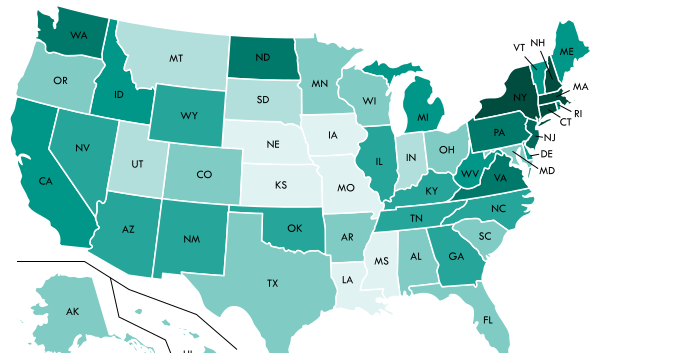
Most common states for assistant editors
| Rank | State | Population | # of jobs | Employment/ 1000ppl |
|---|---|---|---|---|
| 1 | District of Columbia | 693,972 | 220 | 32% |
| 2 | Virginia | 8,470,020 | 408 | 5% |
| 3 | Maryland | 6,052,177 | 320 | 5% |
| 4 | Oregon | 4,142,776 | 189 | 5% |
| 5 | Wyoming | 579,315 | 29 | 5% |
| 6 | New York | 19,849,399 | 882 | 4% |
| 7 | Massachusetts | 6,859,819 | 306 | 4% |
| 8 | Alaska | 739,795 | 32 | 4% |
| 9 | Vermont | 623,657 | 23 | 4% |
| 10 | Washington | 7,405,743 | 211 | 3% |
| 11 | Utah | 3,101,833 | 83 | 3% |
| 12 | Nebraska | 1,920,076 | 53 | 3% |
| 13 | North Dakota | 755,393 | 22 | 3% |
| 14 | California | 39,536,653 | 905 | 2% |
| 15 | Pennsylvania | 12,805,537 | 225 | 2% |
| 16 | New Jersey | 9,005,644 | 187 | 2% |
| 17 | Connecticut | 3,588,184 | 79 | 2% |
| 18 | Idaho | 1,716,943 | 33 | 2% |
| 19 | New Hampshire | 1,342,795 | 29 | 2% |
| 20 | Rhode Island | 1,059,639 | 23 | 2% |
Most common cities for assistant editors
| Rank | City | # of jobs | Employment/ 1000ppl | Avg. salary |
|---|---|---|---|---|
| 1 | Burbank | 2 | 2% | $52,998 |
| 2 | Newport Beach | 1 | 1% | $52,148 |
| 3 | Redding | 1 | 1% | $60,644 |
| 4 | Los Angeles | 2 | 0% | $52,874 |
| 5 | Baton Rouge | 1 | 0% | $35,443 |
| 6 | Boston | 1 | 0% | $66,893 |
| 7 | Des Moines | 1 | 0% | $34,723 |
| 8 | Jersey City | 1 | 0% | $62,182 |
| 9 | New York | 1 | 0% | $70,149 |
| 10 | San Francisco | 1 | 0% | $60,670 |
| 11 | Washington | 1 | 0% | $61,678 |
Assistant Editor job outlook: Expert opinions
Our panel of assistant editor experts
California State University - Sacramento
The University of Findlay
Western Kentucky University
Montclair State University
New Mexico State University
Metropolitan State University of Denver
American University
Butler University
University of Central Missouri
The University of Kansas
California University of Pennsylvania

Ferrum College
Viola Ardeni
Assistant Professor & Italian Language Area HeadCalifornia State University - Sacramento
Romance Languages, Literatures, And Linguistics
What general advice would you give to an Assistant Editor?
Viola Ardeni: To recent graduates in any field, I would recommend making sure they are doing two things: 'Ask questions' and 'Show up.' In the Romance languages, literatures, and linguistics field, asking questions may mean asking for a long of informational interviews, even in places where there are no current jobs openings. You never know what you will learn from talking to someone who is working and has your same degree. Asking questions also means to be present, aware, and critical. Showing up may instead mean trying different things. Besides teaching, there is no clear job following degrees in Romance languages etc. (and even 'teaching' includes a variety of jobs), so taking advantage of different opportunities may come in handy.
What Assistant Editor skills would you recommend for someone trying to advance their career?
Viola Ardeni: The editing of texts produced by others, above all. Being good editors will be crucial. In addition, to the ability to summarize in short, easy bit very large and complex amounts of information, possibly coming from different linguistic sources. Diplomacy seems also increasingly useful, however you interpret it and wherever you stand politically. Because of the world's areas where Romance languages are mainly used, the political issues associated with those areas, and the lack of institutional support for studies in Romance languages, literatures, and linguistics in the United States, the ability of being diplomatic in navigating people, committees, donors, stakeholders, speakers, etc. is and will be important.
What will help Assistant Editors increase their earning potential?
Viola Ardeni: Negotiate your job offer, even where your position is represented by a labor union (you may negotiate other perks and benefits). I would also recommend considering extremely carefully whether a higher degree in the field (master's or PhD) would enhance your options for a higher salary. The mental, emotional, and financial cost of graduate studies may not make it worth it, if the primary objective is earning more money.
What will help Assistant Editors increase their earning potential?
Amy Rogan: People working in journalism probably most dislike the hours and the pay but it’s truly one of the most rewarding fields to work in. It can be stressful but also exciting and challenging. Whether at the local level or a larger stage, it’s truly a service to your community to provide vital information.
What general advice would you give to an Assistant Editor?
Professor Mac McKerral: Producing quality journalism is not easy. It’s hard work and requires a variety of skills, all of which contribute to quality journalism. The writing, reporting and editing must all be in balance and strong. Anyone can be a journalist these days. But not everyone should. Continue to learn on the job. Find a good mentor/editor and milk that individual for everything he or she can offer. If you want to write about yourself rather than others, seek a different career. Your first job might not be your ideal job, but it will be the ticket to your ideal job. Approach every assignment, regardless of how menial, as if it is the most important story ever. You cannot pick and choose what you want to do well. Anything you report will impact someone. Always remember that. Develop a visceral hate for mistakes. Know what your ethical line in the sand is before you are faced with an ethical conundrum. Understanding where you stand before making ethical decisions will enhance your chances of making the right choice.
Associate Professor Thomas Franklin
Associate Professor, Multimedia JournalismMontclair State University
Radio, Television, And Digital Communication
What general advice would you give to an Assistant Editor?
Associate Professor Thomas Franklin: In the media industry, making substantial income right from the start can be particularly challenging. However, by cultivating a strong network, seeking guidance from mentors and sources, and securing top internships, you can enhance your prospects of landing a position at a solid media outlet, where earning potential may be greater. I believe strongly in having several side hustles at all times. By maintaining side hustles, it can provide supplementary income and also be a way to nurture your passion if your main gig is not doing it for you. For early career professionals, I advocate prioritizing skill development and pursuing your passions, rather than fixating solely on monetary gain. Instead of focusing on immediate financial rewards, concentrate on gaining valuable experience and recognition for your work. While this may require patience, it ultimately lays a solid foundation for long-term success. In the grand scheme of things, prioritizing experience and long-term growth over immediate financial gain is solid advice when trying to build a sustainable career in the media industry.
What Assistant Editor skills would you recommend for someone trying to advance their career?
Darren Phillips M.A.: First and foremost, I would advise journalists starting out to be curious and to read, read, and read some more. The best storytellers are voracious consumers of information — credible information — and they’re infinitely curious about world events, politics, history, and the like. Knowledge is power. It’s also marketability. Be an expert, or at least know enough about the wider world to be able to bring relevant context and nuance to your work. This requires you to read. For journalism students still in school, this also means taking elective courses in government and economics, geography, and other subjects outside your major that will help you make greater sense of complex topics. Reading and just a life-long commitment to learning are so important.
What will help Assistant Editors increase their earning potential?
Darren Phillips M.A.: Maximizing salary potential as a media professional starts with everything I’ve already mentioned. Journalists and even PR and advertising professionals must be extremely well informed on a broad range of topics. This starts with reading and just being a voracious media consumer. This also requires one to think critically, to consume media from disparate sources, to not shy away from contrarian viewpoints, and to work hard and in good faith to synthesize information responsibly. This ties in with maintaining strict allegiance to industry best practices including media ethics. Reputation is everything. Make sure your employers, prospective employers, and clients all understand and appreciate your professional integrity and just your commitment to truth and accuracy. Moreover, embrace change, lean into technological change, and become a bit of a techno geek. Work hard making contacts and building a professional network. Work hard, generally. Hard work goes a long way in any vocation. Beyond that, attend industry conferences, pay close attention to your online presence, curate your social media profiles carefully and put some real time and thought into things like your LinkedIn profile and online portfolio. Lastly, don’t be put off by rejection. Rejection comes with the territory in any competitive career field. Believe in yourself, stay positive, stay open minded, learn all you can, read like crazy, keep grinding, and success will follow eventually.
What Assistant Editor skills would you recommend for someone trying to advance their career?
Alfredo Sanchez ACUE: Students will need to become more digital and Social Media savvy. As digital platforms continue to reshape how audiences consume news and information, digital and social media proficiency will be increasingly crucial. However, Multimedia Storytelling must be a cornerstone of our industry. Integrating multimedia elements such as video, audio, graphics, and interactive elements will become more prevalent in broadcast journalism. Professionals who can tell compelling stories using a combination of multimedia formats will be in high demand. I always encourage students to enroll in Data Visualization courses. The ability to extract meaningful insights from data and present them visually engagingly will help broadcasters provide deeper insights and context to their stories. We must remember Mobile Journalism (MoJo). Using your mobile devices to capture, edit, and publish news content will become a standard for journalists. Last but not least, journalists must build meaningful connections with audiences through interactive storytelling, live chats, audience polls, and user-generated content will become increasingly important. Broadcasters who can foster active engagement and dialogue with their audience will be able to cultivate loyal viewership and build community around their content.
Assistant Amy Eisman
Assistant ProfessorAmerican University
Arts, Entertainment, And Media Management
What general advice would you give to an Assistant Editor?
Assistant Amy Eisman: One skill is easy: be flexible. The technology is changing at lightning speed. At the moment, it helps to be strong at data journalism and understanding emergent technology, such as AI. Topic areas of interest include climate coverage, health and education. It also helps to be a great team player; the speed of news means you rarely work alone. Overall, make sure you embrace the basics in the field: accuracy, fairness, transparency, independence and accountability. Be a solid writer and an even better editor and producer. No one can predict what is next for technology. Employers therefore will look for people who uphold the values of the past, are enthusiastic about the present and are curious about the future.
What general advice would you give to an Assistant Editor?
Joseph Valenzano III: Beginning a career must always come with the understanding that your first job is not your career, and it won’t pay you as much as you might think. Maximizing your potential in this scenario depends on many variables, some of which you cannot control. The ones you can control are the quality of your writing samples, having a record of published work in outlets (including the school paper), the clarity of your resume, and the strength of your interview. It also would be helpful to do homework on the market, the employer, and any data on comparisons you can collect. This can help you calibrate your expectations in advance of any offer. One don’t in this process: don’t expect to have a simple 9-5 job; going the extra mile when asked, and even when not asked, can help demonstrate your value to the employer and accelerate the rate of your growth in the industry as well.
What will help Assistant Editors increase their earning potential?
Joseph Valenzano III: In the developing field of journalism some classic skills will never cease to be important, but new skills will also become more essential. Writing and the ability to edit your own work will always be crucial to a journalist, as will fact-checking and copyediting. Clean, accurate, engaging writing and the ability to interview and engage with sources and stories will always be the coin of the realm. That said, more and more journalists need to be well versed in multimedia skills and social media. Writing in these formats is different than writing in column spaces for a paper, and so learning how to translate stories to these media is becoming a skill that separates good journalists from great ones. Additionally, video skills such as editing and shooting for short formats is also becoming more important as journalists are often asked to do most, if not all, of the tasks associated with producing a video story.
Joe Moore Ph.D.
Professor of Communication Program Coordinator, Digital Media ProductionUniversity of Central Missouri
Department of Communication
What Assistant Editor skills would you recommend for someone trying to advance their career?
Joe Moore Ph.D.: Versatility is going to be critical. Radio stations are no longer 'mobile jukeboxes', television stations aren't just talking heads, newspapers aren't only in print. If you want to work for a newspaper, know how to produce a podcast. If you are going to work in radio, be able to develop and produce a video news package. If you are going to work in television, know AP Style and how to write. All upcoming journalists should consider themselves multimedia journalists who can write, film, record, edit and produce.
Steve Rottinghaus
Career and outreach coordinatorThe University of Kansas
William Allen White School of Journalism
What Assistant Editor skills would you recommend for someone trying to advance their career?
Steve Rottinghaus: It is important for a journalist to provide valuable information on current events to community members and hold public officials accountable. News consumption is in high demand.
What type of skills will young Assistant Editors need?
Dr. Christina Fisanick: College graduates in 2021 and beyond, need all of the skills that English programs have to offer: critical thinking, effective communication, creativity, and flexibility. New hires need to be able to adapt to workplace changes quickly and with aplomb, which requires critical thinking and problem solving and the ability to communicate those solutions to a diverse audience clearly and effectively. Those skills are refined and practiced regularly in English programs.
What general advice would you give to an Assistant Editor?
Allison Harl Ph.D.: Develop as many multimedia skills as possible. Writing in the 21st century is about visual rhetoric as well as just words on a page.