Explore jobs
Find specific jobs
Explore careers
Explore professions
Best companies
Explore companies
Job outlook for assistant professors of biology in the United States
Are assistant professor of biology jobs in demand?
Assistant professor of biology job and salary trends over time
Assistant professor of biology jobs over time
Assistant professor of biology job growth rate over time
| Year | # of jobs | % of population |
|---|---|---|
| 2021 | 3,173 | 0.00% |
| 2020 | 3,426 | 0.00% |
| 2019 | 3,532 | 0.00% |
| 2018 | 3,444 | 0.00% |
| 2017 | 3,321 | 0.00% |
Average assistant professor of biology salary over time
Assistant professor of biology salary by year
| Year | Avg. salary | Hourly rate | % Change |
|---|---|---|---|
| 2026 | $69,313 | $33.32 | +2.8% |
| 2025 | $67,451 | $32.43 | +0.9% |
| 2024 | $66,843 | $32.14 | +5.5% |
| 2023 | $63,353 | $30.46 | +2.1% |
| 2022 | $62,066 | $29.84 | +1.8% |
Assistant professor of biology jobs by state
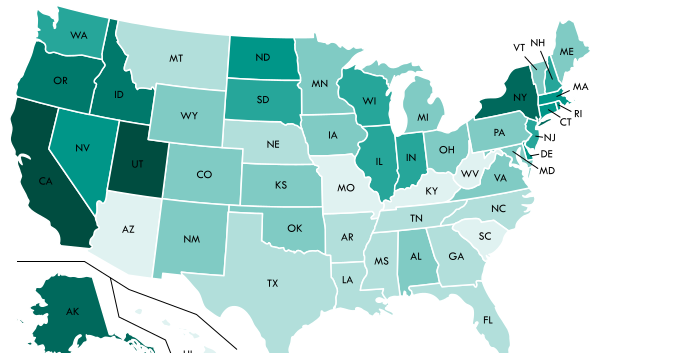
Most common states for assistant professors of biology
| Rank | State | Population | # of jobs | Employment/ 1000ppl |
|---|---|---|---|---|
| 1 | District of Columbia | 693,972 | 111 | 16% |
| 2 | Vermont | 623,657 | 72 | 12% |
| 3 | West Virginia | 1,815,857 | 152 | 8% |
| 4 | Alaska | 739,795 | 60 | 8% |
| 5 | Massachusetts | 6,859,819 | 447 | 7% |
| 6 | Colorado | 5,607,154 | 395 | 7% |
| 7 | New York | 19,849,399 | 1,155 | 6% |
| 8 | Virginia | 8,470,020 | 536 | 6% |
| 9 | Oregon | 4,142,776 | 265 | 6% |
| 10 | Nebraska | 1,920,076 | 117 | 6% |
| 11 | South Dakota | 869,666 | 54 | 6% |
| 12 | Pennsylvania | 12,805,537 | 679 | 5% |
| 13 | Kentucky | 4,454,189 | 235 | 5% |
| 14 | Utah | 3,101,833 | 156 | 5% |
| 15 | Mississippi | 2,984,100 | 146 | 5% |
| 16 | Rhode Island | 1,059,639 | 51 | 5% |
| 17 | New Jersey | 9,005,644 | 369 | 4% |
| 18 | Wisconsin | 5,795,483 | 235 | 4% |
| 19 | Alabama | 4,874,747 | 191 | 4% |
| 20 | Kansas | 2,913,123 | 105 | 4% |
Most common cities for assistant professors of biology
| Rank | City | # of jobs | Employment/ 1000ppl | Avg. salary |
|---|---|---|---|---|
| 1 | Newark | 3 | 9% | $77,460 |
| 2 | Amherst | 1 | 3% | $77,033 |
| 3 | Cedar City | 1 | 3% | $106,208 |
| 4 | Salisbury | 1 | 3% | $67,903 |
| 5 | Washington | 11 | 2% | $76,351 |
| 6 | Fairfield | 1 | 2% | $76,556 |
| 7 | Des Moines | 2 | 1% | $64,291 |
| 8 | Cambridge | 1 | 1% | $77,302 |
| 9 | Lawrence | 1 | 1% | $69,345 |
| 10 | Atlanta | 1 | 0% | $62,346 |
| 11 | Aurora | 1 | 0% | $67,586 |
| 12 | Baltimore | 1 | 0% | $67,963 |
Assistant Professor Of Biology job outlook: Expert opinions
Our panel of assistant professor of biology experts
Kean University
North Carolina State University
University of Kentucky College of Medicine
University of South Florida
What will help Assistant Professors Of Biology increase their earning potential?
Alex Holte PhD: When you are starting out at any career, it is important to negotiate your salary. Many candidates feel that they have to accept their first offer, but in reality, at many jobs, there is some room for negotiation. Be mindful however, to not request a salary that is much higher than what is being offered as they may feel like a compromise would not be possible and move on to the next candidate.
What general advice would you give to an Assistant Professor Of Biology?
Mia Fiore Ph.D.: First, I would tell all students that it is VERY different from teaching k-12. Unlike K-12, you are not placed in a school with a teaching job upon graduation; teaching in higher education is one of the most competitive fields, period. The next difference is that you are expected to be an expert/ master of your field. If you're also willing to accept that you will likely have to work as an adjunct professor (for low pay) first, then go for it! Teaching in higher education is the most rewarding job, especially for people who love learning.
What Assistant Professor Of Biology skills would you recommend for someone trying to advance their career?
Mia Fiore Ph.D.: Awareness and familiarity with technology has become more important, and it will continue to be more important in the next 3-5 years. With everything from peer-reviewed journals available online, to AI, technology is an important part of higher education.
What will help Assistant Professors Of Biology increase their earning potential?
Mia Fiore Ph.D.: Maximize your salary potential by teaching at a state school- if you do you can join the PSLF program and after ten years, your student loans will be forgiven.
What Assistant Professor Of Biology skills would you recommend for someone trying to advance their career?
Justin Whitehill Ph.D.: In the area of genetics and genomics, the identification of areas of the genome that can be CRISPR’d and used to add an immediate benefit is going to be very important as every cropping system races to make genome editing a reality. AI will likely play a huge role in predicting genes/regions of the genome that will provide the biggest benefits.
What will help Assistant Professors Of Biology increase their earning potential?
Justin Whitehill Ph.D.: I wouldn’t know, I’m a professor.
Jane Kuandre
Associate ProfessorWhat Assistant Professor Of Biology skills would you recommend for someone trying to advance their career?
Jane Kuandre: Some essential skills for success in academia include critical thinking, effective communication, time management, and the ability to work both independently and collaboratively.
What will help Assistant Professors Of Biology increase their earning potential?
Jane Kuandre: Networking is crucial for career advancement in academia as it allows individuals to establish collaborations, gain access to resources, and stay updated on the latest research trends.
Kristen Platt Ph.D.
Assistant ProfessorUniversity of Kentucky College of Medicine
Department of Neuroscience
What skills stand out on Assistant Professor Of Biology resumes?
Kristen Platt Ph.D.: I think several skills stand out when looking at an applicant's resume. One is experience with human donor cadaver dissection. It seems that it's becoming rarer, in general, for anatomy instructors to have both background and interest in gross anatomy.
The second skill that stands out on a resume is a breadth of technological expertise. Instructors need to be comfortable with various teaching technologies, from learning management systems to publisher websites/resources and the vast array of apps and other prevalent media in anatomy education. Now, of course, no one can know how to use every piece of technology, but having a breadth of experience across various platforms helps the instructor adapt to and adopt new media.
Third and finally, it really stands out when a candidate has training in and commitment to diversity & inclusion initiatives. This is so important that it can't be overstated. We could all do well with seeking every opportunity to increase our competence in this area.
What skills stand out on Assistant Professor Of Biology resumes?
Lee Braver: Colleges and universities fall into different categories which value different skills and accomplishments. The most obvious division is between schools that emphasize research and those that pride themselves on their teaching. Research institutions are looking for scholars who can publish a lot in exclusive journals and presses, thereby enhancing their reputation. They are looking for evidence of research skills: publications, awards, letters of recommendation that praise the candidate's writing and thinking. Teaching schools, on the other hand, are looking for excellent teachers. In the buyer's market we now have, they can require high research ability as well, but some will actually be scared off by too much research. They will worry that the candidate will focus on their research instead of their teaching and that they will seek to leave as soon as they can. These schools are typically looking for teaching experience, high student evaluations, and letters that single out these qualities for praise, whereas research schools typically don't care a lot about these sorts of things. Thus, the qualities one type of institution values, the other can be apathetic towards or even avoid. Teaching schools far outnumber research schools, so there are far more jobs in the former than in the latter.
What skills will help Assistant Professors Of Biology earn the most?
Lee Braver: Let's see-an M.B.A., the ability to pick winning lottery numbers, being repelled by the humanities so that one goes into business-those would be pretty useful for making money. No one should go into academia for the money, not just not for wealth but even for a comfortable living, which is becoming more difficult to achieve in America in general. It is nearly impossible to make a living as an adjunct professor, which is where the profession is heading. There are many good-paying jobs, but those tend to congregate at the elite schools, the ones that emphasize research the most, and these are the fewest and hardest to get. Worse-paying jobs are also hard to come by, and the competition is just getting stiffer as more Ph.D.'s get dumped into the market each year which is itself accreting all those who did not land jobs in the previous years. At many institutions, raises are minimal since jobs are so hard to come by, and there's little else that rewards a humanities Ph.D. The only way to get a substantial raise is to get a credible offer from another institution and hope that yours wants to keep you enough to overbid them; otherwise, you're stuck, especially after getting tenure, and they know it. That's why tenure is called "golden handcuffs," though I think a better name might be something like velvet handcuffs, given gold's connotation of wealth.
What soft skills should all Assistant Professors Of Biology possess?
Lee Braver: Soft skills are most important to working once one has gotten a job rather than important to getting a job since those are quite difficult to discern from applications and brief interviews. That is one of the reasons schools can be wary of hiring with tenure; a person could look great on paper but be a nightmare to work with, and you're stuck with them.
I believe that tenacity, organizational skills and time management, and the ability to work long hours are crucial to getting tenure and succeeding in academia more broadly, in some ways more important than raw intelligence (if such a notion is coherent). Failure and rejection are endemic to the job; anyone who gets discouraged easily will do so. One must persevere in the face of sometimes harsh criticism and hostile conditions (especially now that much of the country has turned against higher education and the humanities in particular), and one must be able to juggle multiple responsibilities that make considerable time demands. In this, the tenure track resembles other early-career positions, such as medical residency or working towards partnership in a law firm. The untenured often must do the scut work that no one else wants to do, made more difficult by the fact that they are frantically trying to learn on the job with little to no guidance. It is not at all unusual for early-career professors to teach 4 classes per semester, at least some of which are new and/or large, do all the grading for them, serve on multiple committees, and write for elusive publications, all at once.
What hard/technical skills are most important for Assistant Professors Of Biology?
Lee Braver: Well, a Ph.D. is necessary, although one can sometimes be hired within striking distance of it. The ability to teach so as to bring students to the major and get high student evaluations are often requirements at teaching schools while writing well enough to publish, often in journals with single-digit acceptance rates, is crucial to research schools. Comfort with technology is becoming more and more important.