Explore jobs
Find specific jobs
Explore careers
Explore professions
Best companies
Explore companies
Job outlook for associate professors of english in the United States
Are associate professor of english jobs in demand?
Associate professor of english job and salary trends over time
Associate professor of english jobs over time
Associate professor of english job growth rate over time
| Year | # of jobs | % of population |
|---|---|---|
| 2021 | 2,969 | 0.00% |
| 2020 | 3,290 | 0.00% |
| 2019 | 3,449 | 0.00% |
| 2018 | 3,471 | 0.00% |
| 2017 | 3,511 | 0.00% |
Average associate professor of english salary over time
Associate professor of english salary by year
| Year | Avg. salary | Hourly rate | % Change |
|---|---|---|---|
| 2026 | $56,357 | $27.09 | +0.7% |
| 2025 | $55,940 | $26.89 | +2.9% |
| 2024 | $54,388 | $26.15 | +2.6% |
| 2023 | $53,016 | $25.49 | +1.9% |
| 2022 | $52,052 | $25.03 | +2.8% |
Associate professor of english jobs by state
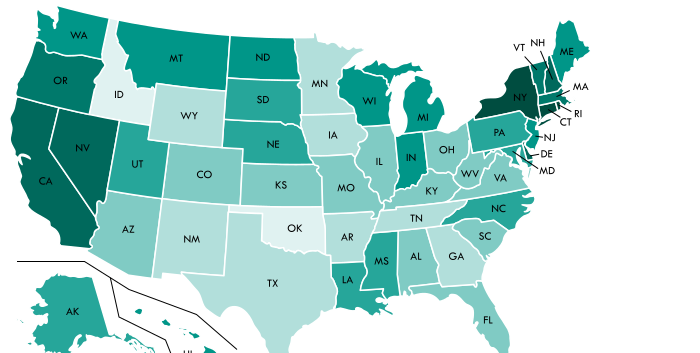
Most common states for associate professors of english
| Rank | State | Population | # of jobs | Employment/ 1000ppl |
|---|---|---|---|---|
| 1 | District of Columbia | 693,972 | 91 | 13% |
| 2 | Vermont | 623,657 | 51 | 8% |
| 3 | Colorado | 5,607,154 | 320 | 6% |
| 4 | West Virginia | 1,815,857 | 106 | 6% |
| 5 | South Dakota | 869,666 | 51 | 6% |
| 6 | Virginia | 8,470,020 | 438 | 5% |
| 7 | Oregon | 4,142,776 | 211 | 5% |
| 8 | Utah | 3,101,833 | 140 | 5% |
| 9 | Nebraska | 1,920,076 | 93 | 5% |
| 10 | Alaska | 739,795 | 36 | 5% |
| 11 | New York | 19,849,399 | 753 | 4% |
| 12 | Kentucky | 4,454,189 | 173 | 4% |
| 13 | Mississippi | 2,984,100 | 118 | 4% |
| 14 | Pennsylvania | 12,805,537 | 441 | 3% |
| 15 | New Jersey | 9,005,644 | 247 | 3% |
| 16 | Wisconsin | 5,795,483 | 182 | 3% |
| 17 | Louisiana | 4,684,333 | 158 | 3% |
| 18 | Maine | 1,335,907 | 39 | 3% |
| 19 | Rhode Island | 1,059,639 | 34 | 3% |
| 20 | Montana | 1,050,493 | 31 | 3% |
Most common cities for associate professors of english
| Rank | City | # of jobs | Employment/ 1000ppl | Avg. salary |
|---|---|---|---|---|
| 1 | Newark | 1 | 3% | $70,767 |
| 2 | Baltimore | 1 | 0% | $57,579 |
Associate Professor Of English job outlook: Expert opinions
Our panel of associate professor of english experts
University of Oregon
Kean University
North Carolina State University
The University of Texas at San Antonio
University of Maine
University of Arizona
Skidmore College
Ashford University

Hanover College
Concordia University
Arizona State University
Pennsylvania State University Altoona

Jackson State University

California University of Pennsylvania
What general advice would you give to an Associate Professor Of English?
Alex Holte PhD: My advice for someone new to the field of academia is to learn time management skills early and learn what type of service work you find interesting and would like to contribute to. From there, learn how to say “no” to opportunities that may not align with your goals as well. I feel a lot of new professors tend to find the need to be involved in everything, which can result in burning out later in their career.
Mary Wood
Professor of EnglishUniversity of Oregon
English Language And Literature
What general advice would you give to an Associate Professor Of English?
Mary Wood: It depends on what level the teacher is at (college level or K-12 and if K-12 do you mean elementary, middle, or high school), whether they're in public or private education, etc. Those who wish to become K-12 English teachers would take some literature classes in our department but would do most of their teacher training in the School of Education.
What Associate Professor Of English skills would you recommend for someone trying to advance their career?
Mary Wood: It's a great time to become an English teacher because it's more important than ever for students to be savvy about how language works, given the ways that language is being manipulated in media (including social media) as well as in the explosion of AI applications. It's also a good time to remind students of the human values and age-old questions about life that are found in novels, plays, poetry, and short stories.
What will help Associate Professors Of English increase their earning potential?
Mary Wood: Dislike: Administrative meetings, Grading papers, Bureaucratic paperwork, Lack of robust funding for research and teaching. Like: Working with students, Talking, writing, and reading about literature and getting paid for it, My co-workers and their commitment to their students, Having flexibility in my workday (available to college teachers, not K-12)
What general advice would you give to an Associate Professor Of English?
Dr. Lisa Sisler D.Litt, MFA: Regardless of the level the educator is at (high school/ college), most of the day is spent in the classroom teaching. There is prep for each class: lesson planning, reading, researching. Then there is the grading of papers. We also spend a lot of time mentoring and advising students, working one-on-one with students to help them achieve both class goals and their personal goals.
What Associate Professor Of English skills would you recommend for someone trying to advance their career?
Dr. Lisa Sisler D.Litt, MFA: After Covid, many teachers left the profession so the profession needs teachers. As well, with a return to in-person learning we have noticed significant gaps in learning. And with the emergence of AI Writing tools, a strong foundation in reading and writing is critical.
What will help Associate Professors Of English increase their earning potential?
Dr. Lisa Sisler D.Litt, MFA: I would say, personally, the best part of being an English educator is being in the classroom, working with the students. There's a kind of magic that happens in that space-- a shared space of ideas and literature and writing-- nothing beats that. The hardest part about being an English educator is the grading-- finding the time to get it done is often difficult, especially with all the meetings and other responsibilities that pile up throughout the semester. Though reading the students' work is often enlightening and gratifying.
What general advice would you give to an Associate Professor Of English?
Justin Whitehill Ph.D.: Perseverance pays off. Its worth it to pursue the career you want and not settle and be unhappy.
What will help Associate Professors Of English increase their earning potential?
Justin Whitehill Ph.D.: I wouldn’t know, I’m a professor.
Jane Kuandre
Associate ProfessorWhat general advice would you give to an Associate Professor Of English?
Jane Kuandre: My advice for someone looking to pursue a career in academia would be to focus on building a strong publication record, developing a network of collaborators, and continuously seeking opportunities for professional development.
Senior Lecturer Isabelle Hall Program coordinator
Senior LecturerThe University of Texas at San Antonio
Romance Languages, Literatures, And Linguistics
What Associate Professor Of English skills would you recommend for someone trying to advance their career?
Senior Lecturer Isabelle Hall Program coordinator: Teaching has to be a passion. The interaction with the students is extremely rewarding. The quality of the team of professors we work along with is essential to everyone's well-being in the department. In my case, I have extraordinary colleagues and leadership. The paycheck is lower than other positions with similar degrees. We often work 6 days a week (especially at the beginning) and we usually work in the summer to prep, do research, take students abroad, participate in conferences ...
Dr. Elizabeth Neiman
Director of Women's, Gender, and Sexuality Studies ProgramUniversity of Maine
Ethnic, Cultural Minority, Gender, And Group Studies
What will help Associate Professors Of English increase their earning potential?
Dr. Elizabeth Neiman: Rather than answer your questions, I'll give you some background information: Since becoming Director of the Women's, Gender and Sexuality Studies program at UMaine in fall 2022, I have been doing a great deal of outreach to faculty in other departments across the university.
What general advice would you give to an Associate Professor Of English?
Dr. Dennis Wise Professor Practice: It's an extremely challenging moment to be entering the profession. Since 2008, state legislatures have been cutting back funding for higher education, and that has hurt English Departments because courses that require writing instruction (as our do) can't be run at ultra-large, 200-students a class levels. That has limited the willingness of administrations to hire tenure-track faculty, and has contributed to a proliferation of contingent (or year-to-year) labor. In addition, graduate programs across the country tend to significantly over-produce doctoral students, graduating far more each year than the job market can handle. All this goes to make the job prospects of anyone fresh out of graduate school relatively bleak. Many are forced into adjuncting, more and more of the former professoriate are becoming adjuncts.
What Associate Professor Of English skills would you recommend for someone trying to advance their career?
Dr. Dennis Wise Professor Practice: The major benefit of the profession is flexibility of hours. Even for someone contracted for 40 hours a week of teaching, only about 12-15 of those hours are spent in the classroom – the grading and lesson prepping one can do anytime, anywhere. Likewise, working with the students is often increasingly rewarding. At the same time, burn-out from overwork and increasingly poor labor conditions is increasingly common, and our profession receives very poor compensation given the level of education professors are required to have.
What will help Associate Professors Of English increase their earning potential?
Dr. Dennis Wise Professor Practice: The basic requirements on the profession are teaching, research, and service (whether service to the department, the university, or the field), in that order, but also job duties depend on the type of institution. In community colleges, your focus is almost exclusively on teaching, and at research universities, tenure-track faculty often have 40/40/20 workloads (i.e., 40% teaching, 40% research, and 20% service). However, even within institutions, there are different ranks of professors. at my institution, tenure-track faculty have the 40/40/20 workload that I described, but career-track faculty generally have a 80/20 workload – 80% teaching, 20% service. Below this rank are adjuncts. Adjuncts are paid on a per-course basis, and they're roughly equivalent to minimum wage McDonald's workers despite the quality of teaching work they do. They are not benefits eligible. Teaching encompasses not only classroom time, which is actually only a small proportion of the job, but class prep, office hours, conferencing with students, and grading (especially grading). It's also common to keep up with professional trainings. Research in an English Department requires that you publish with peer-reviewed journals and publish books with university presses. It also includes presenting at conferences. Service can encompass anything from serving on committees, directing thesis students, working in academic publishing (which is unpaid), and anything else.
Aurelie Matheron
Assistant Professor of FrenchSkidmore College
Romance Languages, Literatures, And Linguistics
What general advice would you give to an Associate Professor Of English?
Aurelie Matheron: Present yourself as a professional in your cover letter and interviews. The people who interview you will look at you as a future colleague and not a student. Use the past “I” to show what the future “I” will do. Meaning: in your interviews, say “I have developed X courses/projects and I have acquired X skills useful for a collaborative project at your institution. For instance, one project I will develop is XYZ.” You show your experience/expertise and how you will be using your skills. Don’t dwell too much on the “past I” and, I’d say, don’t use the past “we” => “at my former institution, we would do X or Z.” => this shows that you still view yourself as part of that community and don’t project yourself at your new institution. Once you have the job: observe the dynamics of your new work place. Meet with colleagues who also recently got a job at your institution. They will help you navigate the first year.
What Associate Professor Of English skills would you recommend for someone trying to advance their career?
Aurelie Matheron: Leadership: you will be in positions of leading a program/department. Learn from current chairs by observing their own skills during meetings and moments of decision. Collaboration: develop interpersonal and interprofessional relationships that will allow you to build collaborative projects (interdepartmental courses, for instance).
What will help Associate Professors Of English increase their earning potential?
Aurelie Matheron: Do some research online about how much someone earns at your stage of the career. If there is a significant gap, point out (diplomatically) that, because of your extensive experience in XYZ, you would like to get a X% increase in your salary. Be reasonable: if you want a 3% increase, ask for 5% (not 10% or more). Justify your negotiation: why should they pay me more? What experience can I show them to justify my request? If you have a higher offer from another place, you can say that “I have received another generous offer and would like to know about the possibility for matching that offer.” Salary is not the only thing you can negotiate: office space, computer/laptop, sabbaticals, course release, etc. Again, be reasonable: if you think you are entitled to XYZ requests, you also have to show why.
Fabio Lanza
ProfessorAshford University
History
What Associate Professor Of English skills would you recommend for someone trying to advance their career?
Fabio Lanza: To put it bluntly, if you want to make money, this is really not the career for you.
Alejandra Rodriguez-Villar Ph.D.
Assistant Professor of SpanishHanover College
Department of Modern Languages
What soft skills should all Associate Professors Of English possess?
Alejandra Rodriguez-Villar Ph.D.: As professionals with expertise in the past, our best contribution is to help people see history from a non-presentist point of view. Presentism tends to judge history with our present values and morals, which highly prevents us from understanding the studied period itself. While this type of judgment is debunked at a synchronic level -we don't apply our values spatially- we still see examples of this perspective diachronically applied when comparing different periods to ours. Judging history this way is unfair to the period we are analyzing. It can also lead us to dismiss significant advancements as just backward attitudes because, of course, everything that happened before us will look "obsolete" to our eyes. Although we can see a particular event in history as something negative according to our standards, it could have represented a major step ahead for the world at that moment. So, for professionals who deal with previous ages, connecting humans across time and not only across space is a priceless skill nowadays. With the vast increase in scholarship on the past, we will need more professionals able to transport people from one period to the other and help them understand its importance in the whole picture of a specific human group or the whole of humankind. This is what will allow us to value our present correctly. The most precious soft skill for everyone is often to try to understand before judging. Connectors are a great source of creativity and growth.
What skills stand out on Associate Professor Of English resumes?
Alejandra Rodriguez-Villar Ph.D.: Something that stands out in any resume is the ability to speak two or more languages. If we are thinking of medievalists and early modern professionals, having a good command of romance languages and other European languages will be a great asset without any type of doubt. In any case, for anybody interested in history, it is critical to know the languages spoken in the studied space and those in the surrounding areas as an excellent way to understand and monitor mutual influences. Likewise, grads with a major in medieval, early modern, or general history, will have more opportunities in the job market if they show imagination and creativity as skills in their resumes. Unfortunately, we can only travel in time with our minds; being able to supply with our imagination and creativity what we cannot see presently is extremely important for a good historian. We often count on scarce, disconnected pieces of information, and having the necessary imagination to sense the possible connections is essential to develop a meticulous methodology to support our research findings. Talking about methods, if it is true that we need to be very imaginative to set the first steps to reconstruct history, we also need to be very systematic to produce a rigorous vision that we can call history and not fiction!
What skills will help Associate Professors Of English earn the most?
Alejandra Rodriguez-Villar Ph.D.: If we focus on the future, we are observing a merging between the sciences and the humanities. We are experiencing the rise of what C.P. Snow called "the third culture." And it makes sense because, with our current ability to process extensive amounts of information, we are opening doors to study history and the past in many disciplines from a more holistic perspective. People in the humanities and the sciences are getting closer in methodologies, technologies, and languages. Anybody wanting to have a flourishing career will need to have an interdisciplinary education that will enable them to cross-disciplinary boundaries. While scientists are getting more acquainted with disciplines like philosophy or literature (for instance, narrative medicine), humanists need to become familiar with statistics, coding, or cognitive sciences. With the rise of automation, humans who can see the whole picture will be more necessary than ever.
What are the biggest trends we'll see in the Associate Professor Of English job market given the pandemic?
John Norton Ph.D.: A need to communicate clearly and creatively through different medium
How have salaries changed over time for Associate Professors Of English?
Jessica Early Ph.D.: In many parts of the country, like Arizona, teacher salaries have not grown at a rate to support an increased cost of living, which has led to a sever teaching shortage and high turnover rates. Teachers continue to be asked to do more, to juggle more, and are paid less. One of the things I hope this past year has shown is just how integral teachers and schools are to the health, well-being, and advancement of our communities and the work they do needs to be supported.
What Associate Professor Of English skills would you recommend for someone trying to advance their career?
Roselyn Costantino Ph.D.: Most important advice: Take initiative and be productive.
Find practical ways to use skills even if unpaid. Volunteer work is good. Use language skills. Technology skills. Exploit technology skills around the area of interest. If you want to be a teacher find out what software they are using today; what research skills are they utilize. Make sure you log your activities during the gap year especially those that relate to the area in which you want to work. If you want to go into finance, and you're working at a lawn service, understand and learn the business model and the accounting. If you're working at Starbucks (or in any commercial environment), get a chance to do inventories, learn about the ordering process and sources and suppliers for those orders; and how people are scheduled for work. All of that is relevant experience for business.
The CFO and recruiter for Keystone Staffing Solutions emphasized having evidence in your resume of of being productive during the gap time, no matter if it's one, two or three years. Evidence of being productive is what recruiters want to see on your resume: He stresses: "What did you do to expand your knowledge and skills not only in your selected area but beyond. BEING PRODUCTIVE for yourself proves to be an indicator of how productive you will be for me."
Still on gap year. How to go about it? Use teachers, friends, family, anyone in the field or related to it to provide guidance, insight, suggestions. This can lead to projects or experience that will help in learning and growth.
How have salaries changed over time for Associate Professors Of English?
Leticia Pérez Alonso Ph.D.: With the passage of time, my impression is that salaries have gradually increased in the academic field, but not in a manner that have adjusted to living expenses today. Salaries also vary depending on the position and the state. For instance, an English teacher of secondary education in a large metropolis is likely to receive a higher remuneration than one who performs the same activity in a less populated area.
What type of skills will young Associate Professors Of English need?
Dr. Christina Fisanick: College graduates in 2021 and beyond need all of the skills that English programs have to offer: critical thinking, effective communication, creativity, and flexibility. New hires need to be able to adapt to workplace changes quickly and with aplomb, which requires critical thinking and problem solving and the ability to communicate those solutions to a diverse audience clearly and effectively. Those skills are refined and practiced regularly in English programs.
Are there any particularly good places in the United States for Associate Professors Of English to find work opportunities?
Dr. Christina Fisanick: Although employers prior to COVID-19 knew that remote work was not only possible, but in some cases even more productive than in the traditional workplace, the pandemic has reinforced the idea that employees can work from anywhere in the world. While this gives graduates the potential to work globally in a way that was never possible before, it also means that English majors in the US are now competing in a worldwide marketplace against graduates from universities not just in their region or country, but from around the globe. It is both exciting and intimidating, and we must prepare our graduates to meet the demands of this ever-expanding job market.
How do you envision technology impacting Associate Professors Of English in the next 5 years?
Dr. Christina Fisanick: Given that English majors are placed in a broad range of fields after graduation, it is difficult to identify which specific technologies will be used most, which is why critical thinking and adaptability are key skills. I can imagine that editing and word processing software will remain in heavy use by our graduates in the workplace, along with social media and other communication applications. Exposing students to the many possibilities of how technology changes the production and consumption of texts is vital to what English programs do best.