Explore jobs
Find specific jobs
Explore careers
Explore professions
Best companies
Explore companies
Job outlook for associate professors of psychology in the United States
Associate professor of psychology job growth summary. After extensive research, interviews, and analysis, Zippia's data science team found that:
The projected associate professor of psychology job growth rate is 12% from 2018-2028.
About 159,400 new jobs for associate professors of psychology are projected over the next decade.
Associate professor of psychology salaries have increased 7% for associate professors of psychology in the last 5 years.
There are over 4,474 associate professors of psychology currently employed in the United States.
There are 12,530 active associate professor of psychology job openings in the US.
The average associate professor of psychology salary is $82,073.
Are associate professor of psychology jobs in demand?
Associate professor of psychology job and salary trends over time
Associate professor of psychology jobs over time
Associate professor of psychology job growth rate over time
| Year | # of jobs | % of population |
|---|---|---|
| 2021 | 4,474 | 0.00% |
| 2020 | 4,531 | 0.00% |
| 2019 | 4,650 | 0.00% |
| 2018 | 4,669 | 0.00% |
| 2017 | 4,602 | 0.00% |
Average associate professor of psychology salary over time
Associate professor of psychology salary by year
| Year | Avg. salary | Hourly rate | % Change |
|---|---|---|---|
| 2026 | $82,073 | $39.46 | +2.0% |
| 2025 | $80,436 | $38.67 | --0.1% |
| 2024 | $80,530 | $38.72 | +4.0% |
| 2023 | $77,444 | $37.23 | +0.9% |
| 2022 | $76,782 | $36.91 | +4.1% |
Associate professor of psychology jobs by state
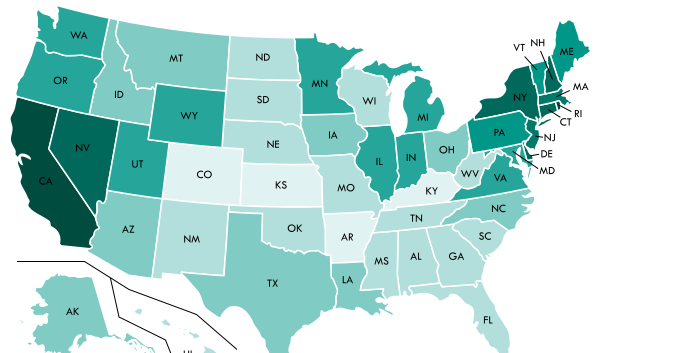
Most common states for associate professors of psychology
| Rank | State | Population | # of jobs | Employment/ 1000ppl |
|---|---|---|---|---|
| 1 | District of Columbia | 693,972 | 86 | 12% |
| 2 | Vermont | 623,657 | 51 | 8% |
| 3 | Colorado | 5,607,154 | 322 | 6% |
| 4 | West Virginia | 1,815,857 | 112 | 6% |
| 5 | South Dakota | 869,666 | 51 | 6% |
| 6 | Virginia | 8,470,020 | 438 | 5% |
| 7 | Oregon | 4,142,776 | 217 | 5% |
| 8 | Nebraska | 1,920,076 | 94 | 5% |
| 9 | Alaska | 739,795 | 34 | 5% |
| 10 | New York | 19,849,399 | 832 | 4% |
| 11 | Pennsylvania | 12,805,537 | 451 | 4% |
| 12 | Kentucky | 4,454,189 | 178 | 4% |
| 13 | Utah | 3,101,833 | 138 | 4% |
| 14 | Mississippi | 2,984,100 | 124 | 4% |
| 15 | Texas | 28,304,596 | 796 | 3% |
| 16 | New Jersey | 9,005,644 | 262 | 3% |
| 17 | Alabama | 4,874,747 | 157 | 3% |
| 18 | Louisiana | 4,684,333 | 147 | 3% |
| 19 | Maine | 1,335,907 | 41 | 3% |
| 20 | Rhode Island | 1,059,639 | 36 | 3% |
Most common cities for associate professors of psychology
| Rank | City | # of jobs | Employment/ 1000ppl | Avg. salary |
|---|---|---|---|---|
| 1 | Fremont | 1 | 4% | $61,929 |
| 2 | Amherst | 1 | 3% | $88,261 |
| 3 | Newark | 1 | 3% | $99,317 |
| 4 | Ames | 1 | 2% | $65,334 |
| 5 | Bowling Green | 1 | 2% | $52,747 |
| 6 | Gainesville | 1 | 1% | $63,243 |
| 7 | Naperville | 1 | 1% | $76,081 |
| 8 | Washington | 2 | 0% | $96,231 |
| 9 | Denver | 1 | 0% | $52,068 |
Associate Professor Of Psychology job outlook: Expert opinions
Our panel of associate professor of psychology experts
North Carolina State University
Skidmore College

Wright State University Lake Campus

Mansfield University

University of Texas at Austin

University of North Florida

Texas Woman's University
Gannon University

California State University, Fullerton

Eastern Washington University

Wayland Baptist University

Springfield College

Fayetteville State University

University of Manchester

North Carolina State University
University of California, Santa Barbara
Bluefield College
University of Kansas

Columbus State University
What general advice would you give to an Associate Professor Of Psychology?
Alex Holte PhD: My advice for someone new to the field of academia is to learn time management skills early and learn what type of service work you find interesting and would like to contribute to. From there, learn how to say “no” to opportunities that may not align with your goals as well. I feel a lot of new professors tend to find the need to be involved in everything, which can result in burning out later in their career.
What will help Associate Professors Of Psychology increase their earning potential?
Alex Holte PhD: When you are starting out at any career, it is important to negotiate your salary. Many candidates feel that they have to accept their first offer, but in reality, at many jobs, there is some room for negotiation. Be mindful however, to not request a salary that is much higher than what is being offered as they may feel like a compromise would not be possible and move on to the next candidate.
Aurelie Matheron
Assistant Professor of FrenchSkidmore College
Romance Languages, Literatures, And Linguistics
What will help Associate Professors Of Psychology increase their earning potential?
Aurelie Matheron: Do some research online about how much someone earns at your stage of the career. If there is a significant gap, point out (diplomatically) that, because of your extensive experience in XYZ, you would like to get a X% increase in your salary. Be reasonable: if you want a 3% increase, ask for 5% (not 10% or more). Justify your negotiation: why should they pay me more? What experience can I show them to justify my request? If you have a higher offer from another place, you can say that “I have received another generous offer and would like to know about the possibility for matching that offer.” Salary is not the only thing you can negotiate: office space, computer/laptop, sabbaticals, course release, etc. Again, be reasonable: if you think you are entitled to XYZ requests, you also have to show why.
Joshua Ricker Ph.D.
Instructor of PsychologyWright State University Lake Campus
Lake Campus Science & Mathematics
What skills stand out on Associate Professor Of Psychology resumes?
Joshua Ricker Ph.D.: When looking through psychology instructor resumes, the skills that would stand out above all others involve experience. When speaking of experience, we are looking at it through a broad scope. Clearly, having taught previous courses would put one ahead of others, especially if this includes multiple courses. For example, many universities look for instructors capable of teaching in their focus areas and courses, including research methods or statistics.
Experience in other realms of psychology will put you ahead as well. It is always advisable to try to become involved in a hands-on manner. Volunteer work in behavioral health services is a great way to learn more about psychology and develop clinical skills that will aid in teaching later on. Many places are taking in lab assistants that will give you knowledge of how psychological research is performed. All-in-all, actively participating in the world of psychology through one of these outlets will boost your resume.
What soft skills should all Associate Professors Of Psychology possess?
Joshua Ricker Ph.D.: Two specific soft skills are significant in terms of psychology. First, to be effective and successful in this field, one needs to develop critical thinking skills. You will end up working with research much more than you may initially think, and the ability to dissect the science and interpret things on your own is essential. Psychology is also becoming very mainstream in many aspects, so you will often be confronted with erroneous or misinterpreted information based on psychological research. Being able to sift through this and stop the propagation of this type of information is vital.
The second soft skill that is highly valued is the ability to work with others. Psychology is the scientific study of mind and behavior, and much of the time, we observe human behaviors. This means you will be working with others and having people participate in your research if you take that route. You will have much more success if you can harbor healthy relationships with others that you will come across in your career.
What skills will help Associate Professors Of Psychology earn the most?
Joshua Ricker Ph.D.: If there was one skill that would help you earn the most, it would be versatility. Psychology is a much broader field than most people think, which means it has the potential to open a huge variety of doors. As mentioned before, you will need experience, and that can occur in any of these subareas. If you are willing to try new things and open yourself up to multiple outlets, you make yourself a possible candidate for a nearly endless list of careers.
What hard/technical skills are most important for Associate Professors Of Psychology?
Joshua Ricker Ph.D.: The hard skills needed in this field are particularly dependent upon which area you find yourself in. Those who are teaching-focused will find that keeping up with your typical technical skills, such as being fluent in different computer programs, will make your life much easier. There is a good chance you will teach online at some point in your career, so having confidence in your ability to navigate various software programs is crucial.
If you find yourself involved in research or even teaching a research-related course, then it would be beneficial to establish a sound knowledge-base of statistical programs such as SPSS or R. Even if you are not doing the research yourself, you will always be relying on the interpretation of research and statistics for your courses, and these programs will eventually come in useful.
What skills stand out on Associate Professor Of Psychology resumes?
Dr. Nicolle Mayo Ph.D.: Psychology professors should be keeping up-to-date on the latest research and information in their field. To show that they are staying current and have the skills to understand and contribute to their field, there should be several research publications and presentations listed on their resume. These should be current. Familiarity and regularity with statistical software, like SPSS, NVivo, and others also stands out because skills are needed to operate these programs to conduct research. Taking leading positions, like the chair of a committee, shows an instructor can take charge and lead a team of people. The type of committee an instructor leads is another important variable. If they lead a curriculum committee, that is often viewed more impressively than a student group, for example. How effective their leadership is can be further explained through their references. Finally, the number, types, and frequency of courses taught are vital to note. The more experience an instructor has with teaching a course shows expertise. Of course, how effective that instructor is at teaching the course should be taken into consideration. Usually, student evaluations, separate from a resume or CV, can elaborate on this piece. These components represent both the hard and soft skills.
What skills will help Associate Professors Of Psychology earn the most?
Dr. Nicolle Mayo Ph.D.: Many of the above skills can contribute to your path of attaining the next promotion, which a Professor can apply to earn every five years. Effective teaching, regular research, and consistent service to the campus and community are tickets to getting promoted. How you do these things contributes to whether you receive a promotion. Student evaluations of your creative and flexible teaching, frequent research publications and/ or presentations, consultations, and leadership on committees boast promise and credibility.
What hard/technical skills are most important for Associate Professors Of Psychology?
Dr. Nicolle Mayo Ph.D.: Hard/ technical skills include the expertise to run statistical software for conducting research more effectively and efficiently. Using programs, as I mentioned above (SPSS, NVivo, etc.), suggests you are staying current with conducting research. Other computer programming skills unique to the field or to teaching are also helpful. Familiarity with things like Nearpod can make teaching more interactive and accessible to students. Navigating online learning platforms (including D2L, Blackboard) and utilizing them beyond their basic capacities guides students to perform better in the classroom. Knowledge and regular use of other spoken languages also enhance communication with students who have different language backgrounds. Spanish and Chinese are becoming much more prominent for both native and foreign exchange students.
What soft skills should all Associate Professors Of Psychology possess?
James Pennebaker: If you have basic social skills and can work with people from various backgrounds, you will be more likely to get hired, promoted, and build a stable social network at your job(s). Almost all companies and organizations value people who can write well and who can speak to their peers, management, and customers. It also helps to have a high level of energy and enthusiasm for your job. Virtually every employer I know is thrilled to find an employee who loves learning about the company and can troubleshoot problems without being asked.
What hard/technical skills are most important for Associate Professors Of Psychology?
James Pennebaker: Most jobs require a basic understanding of statistics. Even the basic working of Excel and spreadsheets is invaluable. The more you know about database management, PowerPoint, graphing, the business uses of social media, apps, and web design, the better. If you are still in school, consider researching with a faculty member to learn more about some of these issues. Also, take courses in other departments that really interest you, and that may provide skills that might help you in the kinds of jobs you might like to have. Try to find an internship or part-time job to learn more about the kinds of skills you lack and can learn.
What skills will help Associate Professors Of Psychology earn the most?
James Pennebaker: Don't think about what skills will help you earn the most. Think about the skills that will help you learn the most. The jobs that make you the happiest and challenge you the most will be the ones you will excel in. If you become an expert in a job you care about, you will earn what you need and love going to work every day. And you can't beat that.
C. Dominik Güss
ProfessorUniversity of North Florida
Department of Psychology, College of Arts and Sciences
What soft skills should all Associate Professors Of Psychology possess?
C. Dominik Güss: - Ability to connect with students
- Ability to engage the listener
- Ability to explain complex material in an understandable way
- Being empathetic
- Mentoring students in projects
Lisa Rosen Ph.D.
Associate Professor, Director, Undergraduate Psychology Program, Southwest Region Vice President, Psi ChiTexas Woman's University
Department of Psychology & Philosophy
What hard/technical skills are most important for Associate Professors Of Psychology?
Lisa Rosen Ph.D.: Undergraduate psychology coursework centers largely on developing research and analytical skills. Psychology majors can review the literature, identify relevant information, and evaluate research conducted by others. However, psychology majors also develop the skills to conduct their own research. Many majors can complete a research project from start to finish, which allows them to hone data analysis and interpretation skills and other skills critical to project management. Psychology majors also develop their communication skills as written papers and oral presentations are quite common. Through research and writing, psychology majors develop various computer skills, including word processing and statistical software.
What skills stand out on Associate Professor Of Psychology resumes?
Lisa Rosen Ph.D.: Majoring in psychology equips students with many transferable skills that prepare them for work in diverse fields. Given the collaborative nature of many workplaces, I think it is noteworthy that psychology majors develop skills that promote successful teamwork. Psychology courses cover topics such as interpersonal communication, which may facilitate group interactions. Further, psychology courses foster an appreciation of diversity by focusing on individual differences, biases, and prejudice, preparing students to work collaboratively with diverse team members.
Psychology majors also have the opportunity to hone their critical thinking and problem-solving skills. Coursework in cognitive psychology and learning highlights effective learning strategies that allow majors to develop new skills on the job, which may be especially critical as the pandemic has brought many changes to the workplace and increased reliance on new technologies. Psychology majors are also skilled at collecting and analyzing information for effective problem-solving.
What soft skills should all Associate Professors Of Psychology possess?
Lisa Rosen Ph.D.: Psychology majors have the opportunity to develop soft skills through coursework. Common courses in the major include Psychology of Adjustment, Psychology of Stress, and Introduction to Counseling Psychology. Through these courses, students develop skills for success at work, including identifying and employing effective time management and coping strategies, which foster adaptability, self-awareness, and resilience. Coursework may also focus on listening and other helping skills that can foster empathy and service orientation. These soft skills will be a benefit almost any career.
Will there be an enduring impact of the coronavirus pandemic on Associate Professors Of Psychology?
Lucy Parker-Barnes Ph.D.: Many graduates and undergraduates are impacted by the changes that COVID and the post-COVID vaccine world have had on the job market. Particularly, in the mental health field, our students have been impacted by an increase in the clients they need to serve while also being limited due to safety concerns. Additionally, our students endure common existential angst that other students are dealing with during COVID, including isolation due to being home, Zoom fatigue, and the existence of continued ambiguity due to the pandemic.
What certifications/licenses/courses can have the biggest impact for Associate Professors Of Psychology?
Lucy Parker-Barnes Ph.D.: For our counseling program, the various certifications and license requirements needed for career seekers include obtaining their National Counselor credential (i.e., by passing the National Counselor Examination), their state licensure, which in Pennsylvania includes the Licensed Professional Counselor (LPC) status, among others.
What will help Associate Professors Of Psychology increase their earning potential?
Lucy Parker-Barnes Ph.D.: Students graduating from counseling programs will increase their earning potential through specializing in their practice. For example, various private practice facilities and agencies seek to have various counselors representing folks focused in various areas. One such credential includes the CADC or Certified Alcohol and Drug Counselor status. As described earlier, the most efficient way for students to earn more money includes gaining their full certification and licensure (NCC and LPC).
How have salaries changed over time for Associate Professors Of Psychology?
Melinda Blackman Ph.D.: As for faculty/professors' salaries, they have increased moderately over the years with the cost of living.
What are the biggest trends we'll see in the Associate Professor Of Psychology job market given the pandemic?
Melinda Blackman Ph.D.: I think that organizations will see that for many positions that their employees can successfully work from home. Many organizations may give up their physical space and turn into virtual workplaces to save money.
What technical skills for an Associate Professor Of Psychology stand out to employers?
Melinda Blackman Ph.D.: Statistical analysis skills are key for organizations that want to evaluate their productivity, the effectiveness of their training programs and look at trends within their company. Also survey development skills are another bonus to have as well as critical thinking skills.
Will there be an enduring impact of the coronavirus pandemic on Associate Professors Of Psychology?
Jillene Seiver Ph.D.: Of course. I am in psychology, and there are two main types of psychologists: Applied (counseling, clinical, I/O, and school) and Basic Research/Academia.
Applied: One known change is the increase in telehealth. Psychology pioneered this method of treatment, but it has really become mainstream, and I suspect many clinical psychologists and counselors will spend at least part of their day in this type of therapy session.
Basic Research/Academia:
-More classes will be online and hybrid, now that everyone has been forced to adopt this strategy.
-More research studies will be conducted online in one way or another.
-Fewer faculty jobs will be tenure-track.
Will there be an enduring impact of the coronavirus pandemic on Associate Professors Of Psychology?
Dr. Perry Collins: I am not convinced that there will be an enduring impact. However, graduating students need to understand that it may take longer to find their first professional job and to not get discouraged. The economy wants to get back on track.
What will help Associate Professors Of Psychology increase their earning potential?
Elizabeth Morgan Ph.D.: A clear one for graduates in psychology is to seek a graduate degree - typically a master's or potentially a doctorate. There are also additional certifications that can be obtained to help students become eligible for different positions or job duties. Also, because psychology degrees prepare graduates for such a broad array of potential jobs that have various earning potential means that graduates can seek jobs in fields that pay more, in addition to seeking graduate degrees or certifications.
Will there be an enduring impact of the coronavirus pandemic on Associate Professors Of Psychology?
Whitney Wall Ph.D.: While we have all felt the impact of the pandemic and there will be many enduring impacts yet to be seen, I'm proud of our students' ability to remain on-track academically throughout this past year. Many had to adjust to online learning for the first time while caring for children and other family members and managing their own health and wellness. On top of all this, many of our students work full time. Despite these tremendous barriers, most of our students remained on-track with their degree plans. We've also been able to provide student struggling during the COVID pandemic with additional COVID-specific accommodations to limit the academic impacts. While some enduring impacts related to this year are inevitable, I think our students have demonstrated great resiliency! I also believe that there will be positive enduring outcomes that will come from this year: faculty have increased their knowledge of technical resources, students have become more familiar and confident with online learning (a growing trend prior to the pandemic), and we've certainly all been forced outside of our comfort zones which is where personal growth happens.
What will help Associate Professors Of Psychology increase their earning potential?
Whitney Wall Ph.D.: Psychology majors experience great training in communication, writing, critical thinking, and research, which are great assets to the workforce and are skills that increase earning potential. As with most fields, obtaining a graduate degree also increases earning potential.
What certifications/licenses/courses can have the biggest impact for Associate Professors Of Psychology?
Whitney Wall Ph.D.: The field of psychology is broad, which is great, however, any specific training/skills that you can gain/demonstrate within your area of interest can be helpful. Depending on your personal goals, gaining hands-on research experience can be very important and can open doors, especially if you hope to attend graduate school. Internships and/or relevant work experience are also recommended.
What will help Associate Professors Of Psychology increase their earning potential?
Dr. Doron Cohen: The number one piece of advice here is getting experience during their degree. Even during the pandemic, there are organizations that are offering virtual and/or socially distanced internships and volunteering opportunities and any kind of experience will really make applicants stand out from the crowds. In addition, final year students should talk to academic within their departments (or look for opportunities across their institution) to undertake research internships or any other relevant opportunity that allows them to develop skills commensurate with those expected of graduates.
Jessica DeCuir-Gunby Ph.D.
Department Head and Professor of Educational PsychologyNorth Carolina State University
Department of Teacher Education and Learning Sciences
What are the biggest trends we'll see in the Associate Professor Of Psychology job market given the pandemic?
Jessica DeCuir-Gunby Ph.D.: Educational psychology graduates often target jobs in higher education, K-12 education organizations, or education research organizations. However, the pandemic and the lack of academic jobs has forced recent educational psychology graduates to consider positions in other areas. Many graduates are considering education-related positions in non-profits, business firms, and health care organizations. Some graduates are becoming entrepreneurs and becoming education, research, and statistical consultants. The pandemic has helped educational psychology graduates to expand how they see themselves and the work they can do.
How have salaries changed over time for Associate Professors Of Psychology?
Jessica DeCuir-Gunby Ph.D.: Salaries for educational psychologists have increased well over time but are lower than many other subfields of psychology. According to the American Psychological Association, the average salary for educational psychologists is $75,000 with the median salary for psychologists in general is $85,000 www.apa.org. Educational psychologists with doctoral degrees can earn substantially more.
Spencer Mermelstein
Graduate Student Researcher and InstructorUniversity of California, Santa Barbara
Psychological & Brain Sciences
What are the biggest trends we'll see in the Associate Professor Of Psychology job market given the pandemic?
Spencer Mermelstein: I first note that Psychology is a very versatile undergraduate degree. With a Bachelor's you can pursue a career within the field of Psychology (such as academic research, clinical, or applied) or in many different fields from education to business to healthcare to computer science and more. I think employers do value Psychology students' knowledge of human behavior, and they especially value the research skills and statistical literacy that are core to the science.
The effects of the COVID pandemic on the job market might depend then on what industry one is looking to join. Nonetheless, I have seen a few general trends from my point of view as a soon-to-graduate PhD candidate in an experimental psychology program. First, there was a major surge this year in applications to graduate school programs including PhD programs. As in past economic downturns, it seems like the relative current scarcity of jobs and other opportunities increases the demand for graduate education. In turn, this made graduate programs potentially a bit more selective given the greater number of applications. It will be interesting to see the next application cycle for grad school as the economy recovers.
At the other end of grad school, current PhD students seeking tenure track professorships in academic research are facing a very tough job market. Even before the pandemic, there were relatively few jobs for the number of new doctorates, but the pandemic has exacerbated the problem. Funding and hiring freezes at colleges and universities are likely to shrink the number of new professorships even further. I think we are going to see new PhDs increasingly consider careers outside of academia, where their research and data analysis skills can be put to use in fields like User Experience or Data Science.
I think these concerns are specific to my particular field of academic research at the moment, as I believe clinical psychology and applied psychology job opportunities will continue to grow for those with Bachelor's and graduate degrees.
What certifications/licenses/courses can have the biggest impact for Associate Professors Of Psychology?
Spencer Mermelstein: I have two responses to this question. First, during your time in your degree program, you should try to find the topic or subject that just captivates you. Find out what your passion is and learn what career options are available to enact that passion. Perhaps beyond a particular course or license, I would say to try to speak with someone in that career and from there begin working in that field even as an intern or assistant. For example, to gain research experience in preparation for graduate school, meeting with professors whose work interests you and gaining a position in their lab as a research assistant is invaluable. Assistantships and internships will open all sorts of doors to where you want to go.
Secondly, what often makes Psychology graduates valuable to employers is our research skills. Increasingly, this means computer skills. Computer programming and coding is such a powerful, desirable, and just useful skill. Within Psychology, we need programming for putting together surveys and experiments and for analyzing data. Outside of Psychology, programming and data analysis are in huge demand by all sorts of industries. So I would recommend any and all courses, certificates, licenses in computer programming. RStudio, JavaScript, and/or Python seem to be the most commonly used languages. Along with this, expertise in psychological research methods and statistics is highly marketable.
How have salaries changed over time for Associate Professors Of Psychology?
Spencer Mermelstein: I think we are currently seeing salaires really grow for psychology degree holders. More industries and employers are seeing what skills and insight psychologists can bring, especially for those with graduate degrees working in applied or clinical fields. Academic research salaries, however, are potentially a bit more stagnant, again a consequence of a tough job market and tight funding at universities. On the other hand, professors have a lot of flexibility with their work and time, which is it's own form of compensation.
Dr. Richard Farmer
Assistant Professor of Psychology and Human ServicesBluefield College
Department of Psychology and Human Services
Will there be an enduring impact of the coronavirus pandemic on Associate Professors Of Psychology?
Dr. Richard Farmer: Yes. Two major changes will be a continuation of remote learning for athletes and those stuck in rooms or at home. This will require new technologies and teaching strategies. Second, this year has opened up a new phase of online learning for us as an institution.
What certifications/licenses/courses can have the biggest impact for Associate Professors Of Psychology?
Dr. Richard Farmer: 1. Our New Faith and Mental Health classes.
2. Combination of Graduate and Undergraduate Courses for Seniors and our new MA Programs in Counseling Psychology.
3. Our Addiction course offerings.
What will help Associate Professors Of Psychology increase their earning potential?
Dr. Richard Farmer: Quality internships, practical skills emphasis, combination of psychology and human services, and liscensure in large need areas.
What are the biggest trends we'll see in the Associate Professor Of Psychology job market given the pandemic?
Nancy Ann Hamilton: It is really too soon to tell. Prior to the pandemic there was a large gap between the workforce demand for PhD clinical psychologists (as well as mental health professionals), especially those who work in hospitals, and the number of PhD clinical psychologists being trained. There is little doubt that the pandemic has increased the number of people in need of mental health services. However, funding at all levels has been strained to the breaking point and sadly, mental health care is often treated as a luxury, rather than a necessity. So, it is difficult to know how the tension for need and funding will be resolved.
How have salaries changed over time for Associate Professors Of Psychology?
Nancy Ann Hamilton: Salaries for clinical psychologists have remained rather flat because there are constraints in billing that limit psychological practice.
What certifications/licenses/courses can have the biggest impact for Associate Professors Of Psychology?
Nancy Ann Hamilton: Clinical psychologist training follows strict accreditation guidelines from the American Psychological Association. So, all clinical psychologists have competency in a range of skills including delivery of empirically supported treatments for a range of common types of mental illness including depression, anxiety disorders, Post Traumatic Stress Disorder, etc., psychological assessment, and research methodology. Some psychologists, called Health Psychologists, receive additional training that allows us to practice in medical settings in order to work with patients who have mental health needs that interact with their physical health problems. It seems likely that during and post-pandemic these types of skills will be in higher demand.
Dr. Diana Riser Ph.D.
Associate Professor of PsychologyColumbus State University
Psychology Department
What are the biggest trends we'll see in the Associate Professor Of Psychology job market given the pandemic?
Dr. Diana Riser Ph.D.: I think while we are likely to see some jobs becoming more limited, we are seeing an increased need for other jobs. For example, there has been a greater demand for helping positions and positions that support positive mental health & wellbeing (e.g., counselors). In terms of all jobs, there is an increased demand for flexibility and well-rounded skills. Job places may need candidates with more flexible schedules or candidates with the ability to work remotely with proficiency. It's an interesting and changing phase in our world as we get a better sense of what jobs can operate in a work from home/telehealth capacity versus those that truly need to be in person. We are also seeing a focus on increasing diversity in mental health fields as there is a clear need for practitioners from underrepresented or historically marginalized groups.