Explore jobs
Find specific jobs
Explore careers
Explore professions
Best companies
Explore companies
Job outlook for associate programmers in the United States
Associate programmer job growth summary. After extensive research, interviews, and analysis, Zippia's data science team found that:
The projected associate programmer job growth rate is -7% from 2018-2028.
About -17,900 new jobs for associate programmers are projected over the next decade.
Associate programmer salaries have increased 12% for associate programmers in the last 5 years.
There are over 71,878 associate programmers currently employed in the United States.
There are 158,716 active associate programmer job openings in the US.
The average associate programmer salary is $71,595.
Are associate programmer jobs in demand?
Associate programmer job and salary trends over time
Associate programmer jobs over time
Associate programmer job growth rate over time
| Year | # of jobs | % of population |
|---|---|---|
| 2021 | 71,878 | 0.02% |
| 2020 | 94,083 | 0.03% |
| 2019 | 89,451 | 0.03% |
| 2018 | 198,654 | 0.06% |
| 2017 | 208,515 | 0.06% |
Average associate programmer salary over time
Associate programmer salary by year
| Year | Avg. salary | Hourly rate | % Change |
|---|---|---|---|
| 2026 | $71,595 | $34.42 | +3.4% |
| 2025 | $69,236 | $33.29 | +2.3% |
| 2024 | $67,669 | $32.53 | +2.5% |
| 2023 | $66,031 | $31.75 | +3.0% |
| 2022 | $64,104 | $30.82 | +0.4% |
Associate programmer jobs by state
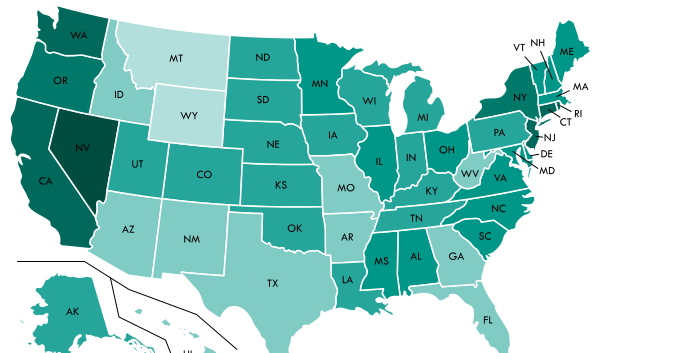
Most common states for associate programmers
| Rank | State | Population | # of jobs | Employment/ 1000ppl |
|---|---|---|---|---|
| 1 | District of Columbia | 693,972 | 405 | 58% |
| 2 | Delaware | 961,939 | 266 | 28% |
| 3 | Rhode Island | 1,059,639 | 285 | 27% |
| 4 | Washington | 7,405,743 | 1,912 | 26% |
| 5 | Vermont | 623,657 | 156 | 25% |
| 6 | Massachusetts | 6,859,819 | 1,676 | 24% |
| 7 | Maryland | 6,052,177 | 1,428 | 24% |
| 8 | Oregon | 4,142,776 | 991 | 24% |
| 9 | Virginia | 8,470,020 | 1,754 | 21% |
| 10 | Utah | 3,101,833 | 646 | 21% |
| 11 | New Hampshire | 1,342,795 | 261 | 19% |
| 12 | Montana | 1,050,493 | 192 | 18% |
| 13 | California | 39,536,653 | 6,747 | 17% |
| 14 | Minnesota | 5,576,606 | 953 | 17% |
| 15 | Colorado | 5,607,154 | 934 | 17% |
| 16 | Nebraska | 1,920,076 | 298 | 16% |
| 17 | Wyoming | 579,315 | 91 | 16% |
| 18 | New Jersey | 9,005,644 | 1,391 | 15% |
| 19 | Idaho | 1,716,943 | 255 | 15% |
| 20 | North Dakota | 755,393 | 117 | 15% |
Most common cities for associate programmers
| Rank | City | # of jobs | Employment/ 1000ppl | Avg. salary |
|---|---|---|---|---|
| 1 | Alameda | 1 | 1% | $87,414 |
| 2 | Cambridge | 1 | 1% | $75,104 |
| 3 | Raleigh | 1 | 0% | $72,895 |
Associate Programmer job outlook: Expert opinions
Our panel of associate programmer experts
Portland State University
Nova Southeastern University
Mount St. Joseph University
Idaho State University

University of Guam

University of Hawaii at Hilo

Indiana University Southeast

Gannon University
Florida Atlantic University
Auburn University at Montgomery
University of Central Missouri

Furman University

Murray State University

University of Pittsburgh - Bradford

Montana State University
North Dakota State University

Allegheny College

Saint Xavier University

Taylor University

New York Institute of Technology
What will help Associate Programmers increase their earning potential?
Wu-chang Feng: I believe so. With the advent of generative AI, it is now much easier to go from idea to implementation. We can now build things closer to the limits of our imagination.
What will help Associate Programmers increase their earning potential?
Dr. Frank Mitropoulos Ph.D.: As we look toward the future of careers in Computer Applications, several skills stand out for their growing importance. These skills revolve around specific technologies that are expected to continue to grow and evolve. Technologies related to Cloud Computing, Artificial Intelligence (AI), Cybersecurity, and Data Science are quickly evolving and being applied across the technology sector. Cloud Computing: Given the widespread adoption of Cloud services, Cloud computing expertise is indispensable. Understanding how to leverage platforms like Azure, AWS, and Google Cloud is crucial to developing scalable, efficient solutions that meet business needs. Artificial Intelligence: AI and Machine Learning are transforming the world. Skills in these areas to solve real-world problems will be even more critical in the future. Cybersecurity: Digital threats are becoming more sophisticated. Safeguarding data, networks, and systems will require encryption, intrusion detection, development, and regulation skills. Data Science: Skills in Data Science will be increasingly sought after as businesses embrace data-driven decision-making. Extracting meaningful insights from extensive datasets and effectively communicating these findings will be essential. Soft skills: Finally, soft skills such as teamwork, problem-solving, and effective communication cannot be overlooked. Adapting, communicating, and leading will be essential for success.
Rebecca Allen
Mount St. Joseph University
Special Education And Teaching
What general advice would you give to an Associate Programmer?
Rebecca Allen: AI, for sure. I have heard it said that AI might not replace humans, rather humans who know how to use AI well may replace humans who don't.
What Associate Programmer skills would you recommend for someone trying to advance their career?
Nikyra Capson: Don't be afraid of being rejected. If they see a job they want, apply. Even if they don't think they'll get it, still apply. The worst thing that could happen is being told no. Not applying is an automatic no, so they might as well try.
James Sellmann Ph.D.
Dean, Professor of Philosophy and Micronesian StudiesUniversity of Guam
College of Liberal Arts & Social Sciences
What general advice would you give to an Associate Programmer?
James Sellmann Ph.D.: General advice is to keep in mind that you must leverage your skills, especially your soft skills of being able to work with people, to communicate effectively and to be able to solve problems. Be real. Don't try to pretend to be someone else to impress others. Be your authentic self. And show up on time.
Travis Mandel Ph.D.
Assistant ProfessorUniversity of Hawaii at Hilo
Department of Computer Science
What soft skills should all Associate Programmers possess?
Travis Mandel Ph.D.: Although computer science seems like a highly technical field, soft skills are really what differentiates software engineers. One of the most important qualities of any software engineer is explaining their code clearly at various levels of technical depth and explaining why certain design decisions were made. You could write code that does amazing things, but if that code consists of snippets you pasted from StackOverflow without really fully understanding them, it will be a huge headache for anyone who needs to come into the codebase later and maintain or update it.
Another one is asking the right questions. Imagine you are dropped into a huge codebase and asked to add a new feature (very common!). There's no time to understand everything that is going on, but on the other hand, you need to understand enough of the code to do your task effectively, which involves asking questions. A failure to ask questions will likely result in you wasting a huge amount of time working on something that is ultimately not useful, for instance, re-implementing a complex function that already exists somewhere in the codebase.
Chris Sexton
Visiting Lecturer of Computer ScienceIndiana University Southeast
Computer Science Department
What skills stand out on Associate Programmer resumes?
Chris Sexton: The biggest thing that stands out to me in a candidate is how much effort in self-improvement is apparent on the resume. A candidate that lists a few jobs and bullet points of skills is acceptable but not impressive. But on the other hand, a candidate that lists a portfolio of projects to show those skills are real and how those skills made them a game-changing employee at their previous jobs is a clear winner.
What soft skills should all Associate Programmers possess?
Chris Sexton: Teamwork is the obvious soft skill that is vital. It encompasses more than just being willing to work together but also includes strong documentation skills, textual communication skills, and precision in language. For an example of precision, which of the following is a task that can be completed:
"The login system will require strong passwords."
or
"The login system will require passwords of no less than 16 characters including at least two numbers and two non-alpha numeric characters."
It is easy for an engineer to be lax and use informal language that subtly confuses development efforts, but the valuable candidate will have strong technical communication skills.
Are there any particularly good places in the United States for Associate Programmers to find work opportunities?
Dr. Stephen Frezza Ph.D.: Computing is ubiquitous, and with more industries moving to remote work, location is becoming less critical. If the internet reaches a place reliably, computing jobs can be located there.
How do you envision technology impacting Associate Programmers in the next 5 years?
Dr. Stephen Frezza Ph.D.: Breadth and depth: Computing is becoming more like engineering; where the value of the product, its lifetime risks, costs, and benefits are more critical than just it's roll-out. So the engineering competencies that have always been a part of computing will become more central. Computing is also expanding; the role of data and the shift of once-research technologies (like machine learning) into production applications will continue to require computing graduates to broaden their base and continue as learners. This will cause shifts in what is considered 'fundamental' and the need for professionals to continue to hone and redevelop their technical skill sets.
Maria Larrondo Petrie Ph.D.
ProfessorFlorida Atlantic University
Department of Computer and Electrical Engineering and Computer Science
Will there be an enduring impact of the coronavirus pandemic on Associate Programmers?
Maria Larrondo Petrie Ph.D.: Students graduating during the pandemic are missing career fair and career service events that the universities and professional association offer, which are very important to get an internship and an entry level position. So their entry-level position may be not in their major and not at the salary and responsibilities that they had hoped. This impacts subsequent offers.
What experience really stands out on Associate Programmer resumes?
Dr. Semih Dinc: According to my experience, most companies are not looking for "straight A" students. Instead, they look for someone with real world experience in their field. A recent graduate will most likely stand out if he/she has somehow contributed real projects. This can be achieved through internships. For many students, who do not have this option, they can still stand out by sharing their "good" school projects to platforms like GitHub. This way they can show companies that they are aware of these tools, and they will be ready to adopt the new company environment.
Dr. Phoebe McLaughlin
Professor of Statistics & Mathematics Assistant Chair of Mathematics Programs Actuarial Science and Statistics Program CoordinatorUniversity of Central Missouri
School of Computer Science and Mathematics
What's a good job out of college for Associate Programmers?
Dr. Phoebe McLaughlin: A good job out of college is some sort of entry-level actuarial job as an analyst. Typically, this is the first position in a traditional rotational program for insurance companies. Also, most employers will only expect this candidate to have 0-2 exams with a possible internship.
In general, any job within the field that pays would be good; experience is great, even if it's underwriting. An employee can always jump from job to job within a company. I just need to find a company where this is expected.
To be more specific, students should look for a work team that fits well. Some work teams are very distant, while others spend a lot of time together even outside of work. Also, they should consider the company and its values. They need to make sure that their personal goals fit within the values of the company.
What general advice would you give to an Associate Programmer?
Kevin Treu Ph.D.: Be a sponge! Use every resource at your disposal to learn all you can, not only about the tools and techniques for the projects you've been assigned but for everything your new company does. These resources will most likely include in-house training, but don't stop there. Do online research, work through tutorials, pick the brains of your new colleagues. Never stop learning! That is a huge key to success.
Also, start your career with attention to a healthy work-life balance. Most companies explicitly value this concept and provide opportunities for you to tend to your own mental and physical wellness through various programs. Take the time to rest and recharge, and most importantly, enjoy what you're doing!
Dr. Matthew Tennyson Ph.D.
Associate Professor of Computer ScienceMurray State University
Computer Science and Information Systems
What are the biggest trends we'll see in the Associate Programmer job market given the pandemic?
Dr. Matthew Tennyson Ph.D.: I'm no economist, but based on what I've seen, the job market in the computing industry has stayed relatively strong. There are still lots of software development and IT job openings right now. Since the pandemic has started, the biggest change is the move to working remotely. More people are just working from home now. There are currently way more remote job postings now than I've ever seen, though many of them state that working remotely is only temporary. Since schools have closed, that also means people have to deal with working while also trying to keep their kids on track with their school work. It's a difficult time for everyone right now.
What certifications/licenses/courses can have the biggest impact for Associate Programmers?
Dr. Matthew Tennyson Ph.D.: A bachelor's degree in computer science is extremely valuable. It has been and continues to be one of the most valuable college degrees a student can pursue. I really think all areas of computing are in demand, but web and mobile computing might be one of the strongest. Some employers do like to see extra certifications in addition to the bachelor's degree. There are literally hundreds of certifications available in the computing industry. They all vary in the required amount of time, effort, and money. I think anything that can set a candidate apart from other candidates is valuable, and that includes any certification. I would not recommend investing thousands of dollars into additional certifications after completing a bachelor's degree, but I don't think it's a bad idea for students to pursue one of the free or lower-cost certifications that are available - especially those students who might not have strong internship experience, extracurricular activities, projects, etc. to put on their resumes. I think anything DevOps related or cloud-based like Amazon's AWS or Microsoft's Azure are especially valuable right now.
Are there any particularly good places in the United States for Associate Programmers to find work opportunities?
Dr. Y. Ken Wang: Other than San Francisco Bay, Seattle, New York, Boston, DC, we found Pittsburgh is a popular place for our students as well.
What are the biggest trends we'll see in the Associate Programmer job market given the pandemic?
Dr. Brock LaMeres Ph.D.: Businesses that do primarily computer-based work have not been impacted by COVID as much as trade-based businesses. They have figured out how to continue operations with the majority of their employees working from home. I feel like the types of jobs that people will hire into will have a significant "work-at-home" component. There will also be a surge in businesses trying to provide the resources for work-at-home employees.
What type of skills will young Associate Programmers need?
Dr. Simone Ludwig: The different roles our students take on once they complete our program are developer, programmer, software engineer, and development analyst positions. All of these positions involve some type of software development, be it on the front end, e.g. application development, or on the back end programming server or database applications. Besides the technical skills, the ability to communicate well and to work individually but also collaborate in a team environment are important.
Oliver Bonham-Carter Ph.D.
Assistant ProfessorAllegheny College
Department of Computer Science and Affiliated Faculty in Integrative Informatics
What are the biggest trends we'll see in the Associate Programmer job market given the pandemic?
Oliver Bonham-Carter Ph.D.: Pandemic has accelerated social connectivity trends using technology, including technology for remote work, and e-learning, and technology to make e-commerce more comfortable and faster. I foresee these accelerated technology trends to continue, even after the pandemic, and therefore job markets in these areas to continue to grow. Another big surge we have seen is in data analytics, which has been increasing over the last decade, and COVID-19 has spotlighted this field. I expect data analyst jobs to continue to be in demand and to grow. Also, the pandemic showed us the interconnectedness of technology with other areas. As the need to develop better solutions to fight various diseases heightens, for example, I expect jobs in biotech to grow.
Will there be an increase or decrease in demand for Associate Programmers in the next 5 years?
Oliver Bonham-Carter Ph.D.: More technology and expertise to use online productivity, development, and communication technologies, is now needed to build and maintain online infrastructures to bring people together in a smaller world. The increase in demand for graduates in the areas mentioned above will result from the current dependence that the pandemic has forced upon Internet-based technologies for communications and productivity. For instance, more will likely be done online after the pandemic since companies have grown used to the convenience of organizing online meetings, working in the cloud, and completing development and scheduling tasks, using freshly-minted, online productivity technologies from GitHub, Zoom, Google Meet, and similar organizations.
In academia, conferences used to be in-person only, and so if you wanted to meet colleagues in your research area, you had to attend in person. Due to the lessons learned from conducting meetings during the pandemic, participants are encouraged to attend conferences virtually, give presentations, develop collaborations, and become involved in new and exciting projects without leaving their living rooms.
These events have grown used to this freedom to organize events, without physical boundaries, when getting people together to meet, think, and work. It is logical to perform more online work now, to be done so conveniently to include more people and more productivity, with less travel and hotels to worry about. It would seem that those who design technological innovations, permitting better communication, development, and productivity for online users will be the creators of the collaboration spaces of tomorrow.
What technology do you think will become more important and prevalent for Associate Programmers in the next 3-5 years?
Oliver Bonham-Carter Ph.D.: In the next few years, technologies related to artificial intelligence, data analytics, cloud computing, container-orchestration systems, and cybersecurity will continue to become more important and prominent. These technologies have the foundation to improve the quality of life in terms of health, education, fighting misinformation, creating better connections, fighting climate change, etc. IoT with smart devices connected online will continue to rise, thus producing more data, which will necessitate AI, data analytics, and security solutions. Additionally, I foresee 5G technology to play an essential role in the next few years, as e-commerce expands into autonomous delivery services. In the software engineering field, to enable fast, secure, and connected software development, technologies allowing to automate a part of that process, such as version control, containerization, and Kubernetes, will also become increasingly important.
Will there be an increase or decrease in demand for Associate Programmers in the next 5 years?
James Vanderhyde: There has been a steady increase in software and IT jobs for the last 20 years, and this is not going to slow down any time soon. In the next 5 years, demand will increase, particularly in software development and cybersecurity. The technology field changes so quickly that beyond 5 years, it is difficult to make predictions. That is why we thoroughly prepare our computer science and information systems students for technology changes and career shifts to discover the best in themselves and to be prepared to meet the demand and excel within the field.
Are there any particularly good places in the United States for Associate Programmers to find work opportunities?
James Vanderhyde: Any big city will have lots of opportunities for computing, software, and IT work. Silicon Valley and the rest of the west coast are the most famous, but innovation is happening everywhere around the country and around the world, including here in Chicago. Chicago tech companies have hired our students upon graduation, and likewise, our graduates have found success and gratification in the field.
What are the best companies to work for an Associate Programmer?
James Vanderhyde: The best companies to work for are companies that respect you as a person and not just a cog in the machine. They are inclusive, and they recognize and appreciate diversity. They have a track record of handling sick leave and family leave as needed. They will not expect you to eat dinner in your office and then go back to work after an already long day. All software companies experience crunch times around release dates, but the best companies do not experience constant crunch. That is a sign of poor management. The best companies will give you challenging problems to work on and reward innovation.
Dr. Jonathan Geisler
Associate ProfessorTaylor University
Department of Computer Science and Engineering
What are the best companies to work for an Associate Programmer?
Dr. Jonathan Geisler: The best companies to work for are the ones that are responsive to both their customers' and employees' needs. They are the ones that have tried to be proactive during the pandemic and not just survive until everything got "back to normal." They know that a damaged workforce leads to a damaged company, and so they provide good management, encouraging everyone to be healthy mentally and physically.
Will there be an increase or decrease in demand for Associate Programmers in the next 5 years?
Dr. Jonathan Geisler: There will be a continued increase in demand for computer engineering
graduates as computers become more heavily integrated into the fabric
of our lives. Things like self-driving cars, the Internet of Things, and
mobile computing will become more commonplace and increase the demand for engineering talent; the long-term trend of using smartphones and web-based applications will not slow, leading to an increase in the
demand for computing talent.
What technology do you think will become more important and prevalent for Associate Programmers in the next 3-5 years?
Babak Beheshti Ph.D.: -The enormous growth of IoT and wearables. The number of connected devices is expected to be more than 26 billion in 2020. That includes things like household appliances, controllable lighting, and much more. This trend is likely to continue as it is expected to see the industry grow to 661 billion dollars by 2021.
-We will be witnessing a more widespread commercial deployment of 5G in 2020. With the implementation of the Standalone 5G devices based on the 3gpp release 16, we should be seeing the more robust mobile broadband deployment of 5G, wider availability of 5G smartphones, and a push towards an all 5G Network in select urban areas around the world.
-Significant growth in AI-based technologies, from face recognition and voice recognition to business intelligence and market predictions. As machines and deep learning algorithms get integrated into many applications, many industries will undergo substantial changes. AI systems will continue to interact with our phones; cars will interpret and analyze their surroundings and intelligently drive themselves. Online vendors will monitor our browsing habits, and Google decides what kind of search results to give us, based on who it thinks we are.