Explore jobs
Find specific jobs
Explore careers
Explore professions
Best companies
Explore companies
Job outlook for associate staff scientists in the United States
Are associate staff scientist jobs in demand?
Associate staff scientist job and salary trends over time
Associate staff scientist jobs over time
Associate staff scientist job growth rate over time
| Year | # of jobs | % of population |
|---|---|---|
| 2021 | 32 | 0.00% |
| 2020 | 38 | 0.00% |
| 2019 | 38 | 0.00% |
| 2018 | 36 | 0.00% |
| 2017 | 33 | 0.00% |
Average associate staff scientist salary over time
Associate staff scientist salary by year
| Year | Avg. salary | Hourly rate | % Change |
|---|---|---|---|
| 2026 | $88,792 | $42.69 | +3.1% |
| 2025 | $86,153 | $41.42 | +4.7% |
| 2024 | $82,291 | $39.56 | +3.3% |
| 2023 | $79,652 | $38.29 | +1.9% |
| 2022 | $78,138 | $37.57 | --2.1% |
Associate staff scientist jobs by state
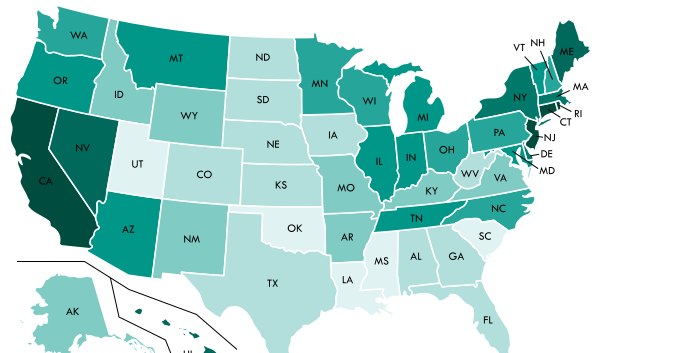
Most common states for associate staff scientists
| Rank | State | Population | # of jobs | Employment/ 1000ppl |
|---|---|---|---|---|
| 1 | Massachusetts | 6,859,819 | 2,286 | 33% |
| 2 | District of Columbia | 693,972 | 229 | 33% |
| 3 | Maryland | 6,052,177 | 1,297 | 21% |
| 4 | Rhode Island | 1,059,639 | 215 | 20% |
| 5 | Vermont | 623,657 | 126 | 20% |
| 6 | Pennsylvania | 12,805,537 | 2,409 | 19% |
| 7 | Virginia | 8,470,020 | 1,605 | 19% |
| 8 | Delaware | 961,939 | 186 | 19% |
| 9 | New Jersey | 9,005,644 | 1,633 | 18% |
| 10 | New Hampshire | 1,342,795 | 239 | 18% |
| 11 | Washington | 7,405,743 | 1,275 | 17% |
| 12 | Oregon | 4,142,776 | 662 | 16% |
| 13 | Maine | 1,335,907 | 219 | 16% |
| 14 | California | 39,536,653 | 6,124 | 15% |
| 15 | Illinois | 12,802,023 | 1,928 | 15% |
| 16 | Minnesota | 5,576,606 | 835 | 15% |
| 17 | Utah | 3,101,833 | 469 | 15% |
| 18 | Montana | 1,050,493 | 161 | 15% |
| 19 | Connecticut | 3,588,184 | 486 | 14% |
| 20 | South Dakota | 869,666 | 122 | 14% |
Most common cities for associate staff scientists
| Rank | City | # of jobs | Employment/ 1000ppl | Avg. salary |
|---|---|---|---|---|
| 1 | Lexington | 3 | 10% | $85,054 |
| 2 | Atlanta | 1 | 0% | $58,158 |
Associate Staff Scientist job outlook: Expert opinions
Our panel of associate staff scientist experts
Southern Illinois University Carbondale
Jackson State University
Washington State University
Purdue University
University of Pittsburgh
University of Nebraska - Omaha
Western Washington University
University of Houston

Drexel University

University of New Hampshire
University of California, Berkeley

Rutgers University

Arizona State University

University of Illinois at Urbana-Champaign

Villanova University
California State University San Marcos
Stevenson University

Doverspike Consulting/HR LItehouse
Robert Morris University

Tiffin University
What general advice would you give to an Associate Staff Scientist?
Jacob Nordman: Salary potential in my field of neuroscience almost always involves publications, awards, and technical acumen. Therefore, as I mentioned, it is important to start early looking for opportunities that can strengthen these areas. Another important aspect of getting high-profile, and thus high-paying, positions, is being able to tell a story with your research and career. Employers want to see that you have thought deeply and strategically about your career and where it’s going. This will allow them to believe you are a safe bet and worthy of their investment.
What general advice would you give to an Associate Staff Scientist?
Hung-Chung Huang: Master key concepts in genetics, molecular biology and biochemistry; also learn at least one programming language like R or Python.
What will help Associate Staff Scientists increase their earning potential?
Lindsey du Toit: Take every opportunity you can to learn, network, and build an effective team of people that bring a greater breadth and depth of skills and expertise to the work on which you will be focusing. Cultivate a life-long sense of intellectual curiosity and learning. Don’t be afraid to ask questions. Treat ignorance as an opportunity to learn. Questions demonstrate you want to understand the situation/problem effectively and that you are paying attention. Always demonstrate integrity in your work. It is one of the most valuable traits you can bring to your career. Be kind and supportive of your colleagues.
Yan Cong
Purdue University
Romance Languages, Literatures, And Linguistics
What will help Associate Staff Scientists increase their earning potential?
Yan Cong: Develop some in-demand skills such as programming or generating content from text models via prompt engineering, et cetera. Get experience and extra income via paid summer internships.
What will help Associate Staff Scientists increase their earning potential?
Arjumand Ghazi Ph. D: Having an advanced degree such as a PhD and even a few years postdoc is a good way to start at a higher level. It often allows one to make up for the reduced earnings during the training periods while increasing long-term earnings.
Andrew Riquier Ph.D.
InstructorUniversity of Nebraska - Omaha
Neurobiology And Neurosciences
What general advice would you give to an Associate Staff Scientist?
Andrew Riquier Ph.D.: Apply for the positions you want, even if you feel underqualified. I know plenty of people who have applied for jobs they didn't quite meet the requirements for, and got hired for other reasons. In my experience, many recent graduates choose to take time to strengthen their resumes by retaking classes, working jobs they don't particularly want to get experience, etc. There is some value in that, particularly if you have been unsuccessful attaining the position you want, or if you want to see if you even enjoy that type of work. But if you are confident in what you want to do, go for it; in the worst-case scenario, you are in the same position you would be if you hadn't applied, but now you have experience applying and have potentially gained a contact in the field.
What Associate Staff Scientist skills would you recommend for someone trying to advance their career?
Josh Kaplan Ph.D.: Demonstrating a skill set that is unique, such as experience with a rare technical research approach, or demonstrating that you can save your employer money by utilizing free resources, can be used to negotiate a higher salary.
Badri Roysam D.Sc.
Hugh Roy and Lillie Cranz Cullen University Professor Chair, Electrical & Computer Engineering Department University of HoustonUniversity of Houston
Petroleum Engineering
What will help Associate Staff Scientists increase their earning potential?
Badri Roysam D.Sc.: Make yourself valuable, and become good at articulating your value proposition.
What certifications/licenses/courses can have the biggest impact for Associate Staff Scientists?
Dr. Richard Knight Ph.D.: MSE majors, at least at Drexel, typically do not complete the Fundamentals of Engineering (FE) exam while in college. In the last 5 or 6 years only one student has done this. Few graduating students enter into careers in the Product Liability or Expert Witness areas for which PE licensure would be necessary. A small number of students have taken classes relating to lean manufacturing/Six-Sigma techniques, which are increasingly important in industry.
A significant number of MSE majors do, however, pursue a broad range of minors in addition to their MSE major. Popular minors include Chemistry, Business, Nuclear Engineering, and other Engineering disciplines.
How have salaries changed over time for Associate Staff Scientists?
Dr. Richard Knight Ph.D.: Starting salaries for MSE program graduates have increased steadily over time. Pandemic era starting salaries for 2020 and 2021 appear to be holding up reasonably well compared to previous years. For MSE majors who graduated in 2020, and for whom only their final term was impacted by the pandemic, more than 60% reported starting salaries in the $80-90k range. In contrast, MSE majors graduating in 2021, for whom the majority of their senior year was remote/online, and who already have a job, report starting salaries in the $75-80k range, somewhat lower. Over time, more packages include incentives such as signing bonuses, relocation expenses, assistance with finding accommodation, and competitive benefits packages.
How have salaries changed over time for Associate Staff Scientists?
Stephanie Whitney: In general, they've been steadily trending upwards. Covid caused a decrease last year, but I suspect there will be a quick rebound.
What are the biggest trends we'll see in the Associate Staff Scientist job market given the pandemic?
Dennis Baldocchi: We received 130 applications for a plant ecology position, with 70 who are postdocs. So supply is surely outpacing demand. We got a lot of people interested in below ground processes, so if there is a trend, connecting below ground is becoming more possible and more important. With all the dna sequencing we are starting. Another cohort is working on the Earth System modeling connection to Ecology and how ecosystems are responding to land use change, changing climate etc
How have salaries changed over time for Associate Staff Scientists?
Dennis Baldocchi: I think 9-month appointments at Univ are vastly under paying these talented people, who I am sure do better at National Labs and Industry.
What are the biggest trends we'll see in the Associate Staff Scientist job market given the pandemic?
Jay Tischfield: In terms of the largest number of jobs, companies are hiring people familiar with medium and large-scale lab automation, quality assurance protocols and data
How have salaries changed over time for Associate Staff Scientists?
Jay Tischfield: Salaries have increased for newish graduates with some experience.
What certifications/licenses/courses can have the biggest impact for Associate Staff Scientists?
Patricia Rankin: Experience with computing/computational physics is important (but also pretty standard for any physics degree). Work in a lab can help show ability to work independently/problem solve.
How have salaries changed over time for Associate Staff Scientists?
Patricia Rankin: Salaries have been trending up - but there is a wide range and it depends on the level you look at e.g Bachelor's degrees or PhD's . If you have a PhD you earn more on average but the range is also larger (the AIP has some good statistics here e.g. https://www.aip.org/taxonomy/term/152 ). Physicists are generally at the higher end of pay scales and competitive with most engineering fields (not computer science). Physics graduates are problem solvers with excellent quantitative skills that puts them in high demand which helps protect salaries.
Dr. Joey Neilsen
Assistant ProfessorVillanova University
Physics Department
How have salaries changed over time for Associate Staff Scientists?
Dr. Joey Neilsen: Salaries for new Physics graduates are rising fairly steadily. For example, US Physics majors from the class of 2013-2014 reported making between about $42,000 and about $65,000 per year while working in private sector STEM jobs (that's the middle 50% of salaries). For 2017-2018 (the most recent years where national data are available), that same range is more like $50,000 to $70,000 per year.
Will there be an enduring impact of the coronavirus pandemic on Associate Staff Scientists?
Jacqueline Trischman Ph.D.: The most important attribute companies are looking for in our graduates this year is adaptability. Students who have been successful in the classroom and lab AND in the Zoom environment are highly sought after in our local industries. In fact, our local life science economy is booming as we have test kits, antibody treatments, and vaccines all being manufactured in San Diego County. Graduates are expected to transition easily between working in a COVID-safe environment on-site and working productively at a home office. Being open to trying new ways of working, maintaining a positive attitude, and handling adversity well will all rise to more importance in interviews this year.
What technology do you think will become more important and prevalent for Associate Staff Scientists in the next 3-5 years?
Neil Rothman Ph.D.: Based on the past year, the rapid development of diagnostics, vaccines, and therapeutics would seem to be an area that will be very important. I am talking about developing a specific vaccine or therapeutic and the equipment and laboratory methods necessary for their product. Running a diagnostic test on an "easy to acquire" sample will be essential to enable rapid and widespread testing and diagnosis. Detection of pathogens in water and food will likely continue and potentially increase in importance as the effects of climate change impact the water supply.
I also think that the strategy behind diagnostic testing may become more critical. Rather than going for very high sensitivity and specificity, it may be more useful to have a "good" test that can be conducted more quickly and often to prevent disease spread. This directly impacts what technologies are developed and how they are applied.
What type of skills will young Associate Staff Scientists need?
Dennis Doverspike Ph.D.: Seemingly a paradox, there will continue to be a need for very general, but highly fungible, skills and demand for too specialized skills, requiring advanced education. Coding, statistics, and data analysis related skills will remain a hot growth area. The aging of the baby boomers will create demand for medical and healthcare-related regions, especially nursing, nursing aides, and emergency services. Despite the automation of many people facing jobs, there will continue to be a demand for interpersonal and people skills, including various types of sales. The switch to remote work, due to COVID, will create a substantial future market to fill the leadership and managerial skills gap. In many areas of Technology and engineering, it is already challenging to find a combination of technical knowledge and people skills, and this demand will intensify.
Will there be an increase or decrease in demand for Associate Staff Scientists in the next 5 years?
Paul Badger Ph.D.: The demand for skilled research scientists in the healthcare industry or related industries will almost certainly grow in the next five years. There is nearly always a need for entry-level positions, such as laboratory scientists or medical laboratory technicians. The recent increase in pressures placed on the health care sector will likely lead to more hiring as testing facilities, and analytical labs are expanded.
Sami Mejri Ph.D.
Associate Professor of Science, Assistant Dean, Graduate ProgramsTiffin University
School of Arts & Sciences
Are there any particularly good places in the United States for Associate Staff Scientists to find work opportunities?
Sami Mejri Ph.D.: With the rising cost of living, a college graduate's ideal first job may not be in their home state or favorite vacation town. According to Business Insider, MidWestern cities like Columbus-Ohio, Cincinnati-Ohio, Madison-Wisconsin, Milwaukee-Wisconsin, and Indianapolis-Indiana were some of the best geographical areas to live for college graduates. The cost of living in these Midwestern states remains relatively lower than coastal areas, making these locations ideal for college graduates entering the workforce. However, college graduates with degrees in healthcare, computer science, and data analytics may not be limited to these geographical areas, given employers' incentives to these in-demand jobs.