Explore jobs
Find specific jobs
Explore careers
Explore professions
Best companies
Explore companies
Job outlook for bioinformatics software engineers in the United States
Are bioinformatics software engineer jobs in demand?
Bioinformatics software engineer job and salary trends over time
Bioinformatics software engineer jobs over time
Bioinformatics software engineer job growth rate over time
| Year | # of jobs | % of population |
|---|---|---|
| 2021 | 15 | 0.00% |
| 2020 | 25 | 0.00% |
| 2019 | 17 | 0.00% |
| 2018 | 37 | 0.00% |
| 2017 | 35 | 0.00% |
Average bioinformatics software engineer salary over time
Bioinformatics software engineer salary by year
| Year | Avg. salary | Hourly rate | % Change |
|---|---|---|---|
| 2026 | $99,311 | $47.75 | +3.4% |
| 2025 | $96,039 | $46.17 | +2.3% |
| 2024 | $93,865 | $45.13 | +1.8% |
| 2023 | $92,207 | $44.33 | +1.7% |
| 2022 | $90,658 | $43.59 | +1.9% |
Bioinformatics software engineer jobs by state
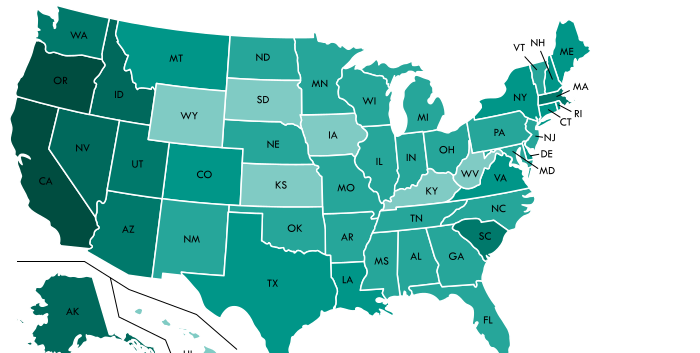
Most common states for bioinformatics software engineers
| Rank | State | Population | # of jobs | Employment/ 1000ppl |
|---|---|---|---|---|
| 1 | District of Columbia | 693,972 | 802 | 116% |
| 2 | Washington | 7,405,743 | 5,015 | 68% |
| 3 | Virginia | 8,470,020 | 4,332 | 51% |
| 4 | Massachusetts | 6,859,819 | 3,372 | 49% |
| 5 | Delaware | 961,939 | 473 | 49% |
| 6 | Rhode Island | 1,059,639 | 500 | 47% |
| 7 | Oregon | 4,142,776 | 1,896 | 46% |
| 8 | Maryland | 6,052,177 | 2,613 | 43% |
| 9 | Vermont | 623,657 | 261 | 42% |
| 10 | Utah | 3,101,833 | 1,250 | 40% |
| 11 | California | 39,536,653 | 14,654 | 37% |
| 12 | Colorado | 5,607,154 | 2,058 | 37% |
| 13 | New Hampshire | 1,342,795 | 469 | 35% |
| 14 | Montana | 1,050,493 | 333 | 32% |
| 15 | Minnesota | 5,576,606 | 1,714 | 31% |
| 16 | Wyoming | 579,315 | 169 | 29% |
| 17 | New Jersey | 9,005,644 | 2,393 | 27% |
| 18 | Nebraska | 1,920,076 | 478 | 25% |
| 19 | Idaho | 1,716,943 | 428 | 25% |
| 20 | Illinois | 12,802,023 | 3,069 | 24% |
Most common cities for bioinformatics software engineers
| Rank | City | # of jobs | Employment/ 1000ppl | Avg. salary |
|---|---|---|---|---|
| 1 | Gaithersburg | 2 | 3% | $84,460 |
| 2 | Burlington | 1 | 2% | $79,006 |
| 3 | Cambridge | 1 | 1% | $97,749 |
| 4 | Daly City | 1 | 1% | $136,523 |
| 5 | Santa Clara | 1 | 1% | $135,475 |
| 6 | South San Francisco | 1 | 1% | $136,325 |
| 7 | Baltimore | 3 | 0% | $84,918 |
| 8 | Boston | 2 | 0% | $97,811 |
| 9 | San Diego | 2 | 0% | $111,242 |
Bioinformatics Software Engineer job outlook: Expert opinions
Our panel of bioinformatics software engineer experts
Portland State University
Kettering University
What will help Bioinformatics Software Engineers increase their earning potential?
Wu-chang Feng: I believe so. With the advent of generative AI, it is now much easier to go from idea to implementation. We can now build things closer to the limits of our imagination.
What general advice would you give to a Bioinformatics Software Engineer?
Dr. Jim Huggins: Computer science is a problem-solving discipline. Computer scientists help people solve problems. Typically, those problems deal with data; someone has a large set of data and needs to answer questions about that data, or process it in some way. Computer scientists write programs that run on computers to help their clients answer those questions and perform those processing tasks. On a given day, a computer scientist might do any or all of the following tasks, working alone or in teams: - Meet with clients to understand their problems and how a computing system might help them solve their problems. - Design computing systems to meet client needs. - Build computing systems to meet design specifications. - Test computing systems in order to find errors in their construction and fix those errors. - Repair computing systems that are not functioning properly. - Instruct users how to use the computing systems the computer scientist has designed for them. - Brainstorm new ideas for computing systems that would meet the needs of new customers.
What Bioinformatics Software Engineer skills would you recommend for someone trying to advance their career?
Dr. Jim Huggins: Demand for computer scientists in the marketplace is high right now. The US Bureau of Labor Statistics states that employment in computer science is projected to grow much faster than all other occupations in the next ten years and currently pays salaries twice the national average. Working conditions for computer scientists are generally good: pleasant office environments, with the potential for flexible work environments and flexible schedules. But beyond the economic reasons, choosing computer science as a career means choosing a career that helps people solve their problems. Everyone uses computers to perform hundreds of tasks per day; computer scientists design the systems that people are using to make their everyday life more fulfilling.
What will help Bioinformatics Software Engineers increase their earning potential?
Dr. Jim Huggins: Computer scientists enjoy the opportunity to be creative every day. Every computing system being designed is different from the last one or the next one; creativity is required to solve new problems every day. Computer scientists enjoy the opportunity to solve problems. There is a great feeling of accomplishment when a team finishes developing a computing system or helps a client solve their problems by using a computing system they designed. Computer scientists are innovative. By definition, they create systems that never existed beforehand. People enjoy knowing that they're creating the future of our world. Each benefit of being a computer scientist can also be a challenge. Working with people, both to determine the requirements for a system that's never existed, and to build that system, can be subject to the same interpersonal conflicts of any discipline. Problem-solving can be frustrating if the solution is not immediately apparent. Building computing systems requires technical skills that can take time to learn and to master.