Explore jobs
Find specific jobs
Explore careers
Explore professions
Best companies
Explore companies
Job outlook for certifying scientists in the United States
Are certifying scientist jobs in demand?
Certifying scientist job and salary trends over time
Certifying scientist jobs over time
Certifying scientist job growth rate over time
| Year | # of jobs | % of population |
|---|---|---|
| 2021 | 159 | 0.00% |
| 2020 | 184 | 0.00% |
| 2019 | 186 | 0.00% |
| 2018 | 176 | 0.00% |
| 2017 | 163 | 0.00% |
Average certifying scientist salary over time
Certifying scientist salary by year
| Year | Avg. salary | Hourly rate | % Change |
|---|---|---|---|
| 2025 | $92,486 | $44.46 | +3.1% |
| 2024 | $89,737 | $43.14 | +4.7% |
| 2023 | $85,714 | $41.21 | +3.3% |
| 2022 | $82,965 | $39.89 | +1.9% |
| 2021 | $81,389 | $39.13 | --2.1% |
Certifying scientist jobs by state
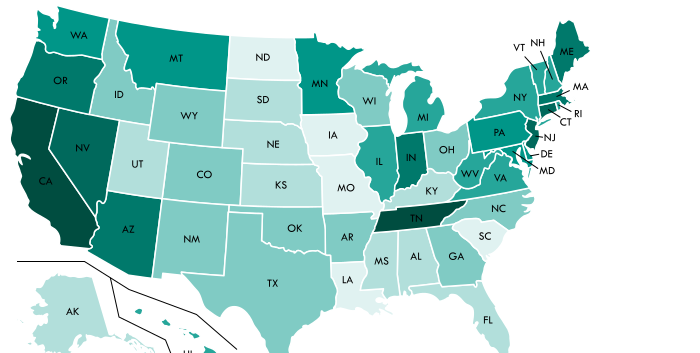
Most common states for certifying scientists
| Rank | State | Population | # of jobs | Employment/ 1000ppl |
|---|---|---|---|---|
| 1 | Massachusetts | 6,859,819 | 1,607 | 23% |
| 2 | District of Columbia | 693,972 | 115 | 17% |
| 3 | Delaware | 961,939 | 156 | 16% |
| 4 | Maryland | 6,052,177 | 798 | 13% |
| 5 | South Dakota | 869,666 | 104 | 12% |
| 6 | Virginia | 8,470,020 | 971 | 11% |
| 7 | New Jersey | 9,005,644 | 928 | 10% |
| 8 | Washington | 7,405,743 | 758 | 10% |
| 9 | New Hampshire | 1,342,795 | 132 | 10% |
| 10 | Vermont | 623,657 | 61 | 10% |
| 11 | North Dakota | 755,393 | 68 | 9% |
| 12 | California | 39,536,653 | 3,161 | 8% |
| 13 | North Carolina | 10,273,419 | 807 | 8% |
| 14 | Oregon | 4,142,776 | 320 | 8% |
| 15 | Connecticut | 3,588,184 | 292 | 8% |
| 16 | New Mexico | 2,088,070 | 160 | 8% |
| 17 | Montana | 1,050,493 | 81 | 8% |
| 18 | Rhode Island | 1,059,639 | 81 | 8% |
| 19 | Alaska | 739,795 | 62 | 8% |
| 20 | Wyoming | 579,315 | 44 | 8% |
Most common cities for certifying scientists
| Rank | City | # of jobs | Employment/ 1000ppl | Avg. salary |
|---|---|---|---|---|
| 1 | Lenexa | 2 | 4% | $57,229 |
| 2 | Azusa | 1 | 2% | $106,165 |
| 3 | Houston | 1 | 0% | $62,351 |
| 4 | Los Angeles | 1 | 0% | $106,447 |
Certifying Scientist job outlook: Expert opinions
Our panel of certifying scientist experts
University of Hawaii at Manoa
Washington State University
Quinnipiac University

Elmhurst University
Case Western Reserve University

Creighton University
The College of New Jersey
Stevenson University
University of Wisconsin - Platteville

Doverspike Consulting/HR LItehouse
Robert Morris University
Morgan State University
Brigham Young University – Idaho

Tiffin University

University of Maine

Murray State University
Brenau University
Washington State University
University of Southern California

University of Massachusetts
What Certifying Scientist skills would you recommend for someone trying to advance their career?
Qing Li: AI will become more important and prevalent in the field in the next 3-5 years but laboratory experiments will continue to make new discoveries.
What will help Certifying Scientists increase their earning potential?
Lindsey du Toit: Take every opportunity you can to learn, network, and build an effective team of people that bring a greater breadth and depth of skills and expertise to the work on which you will be focusing. Cultivate a life-long sense of intellectual curiosity and learning. Don’t be afraid to ask questions. Treat ignorance as an opportunity to learn. Questions demonstrate you want to understand the situation/problem effectively and that you are paying attention. Always demonstrate integrity in your work. It is one of the most valuable traits you can bring to your career. Be kind and supportive of your colleagues.
Lisa Cuchara Ph.D.
Professor of Biomedical SciencesQuinnipiac University
Microbiological Sciences And Immunology
What Certifying Scientist skills would you recommend for someone trying to advance their career?
Lisa Cuchara Ph.D.: The first and foremost would be Critical Thinking. We live in a world where facts can be easily acquired, sometimes even by asking Siri/Alexa/ChatGPT/Google/etc. But critical thinking is timeless and priceless. I can ask anyone on the street what xyz is and they can look it up, but can they provide advice or interpret.
Also being a good steward towards science and being willing and able to communicate not just with peers as we are trained, but also with the public, the politicians, the board members. John Holdren*, stated that Scientists should be tithing at least 10 percent of their time to public service ... including activism. In the ever growing science denialism that is happening in our country being able to communicate science with the public is important. As Peter Hotaz states, "Anti-science propaganda is "killing Americans in unprecedented numbers,""
*Holdren is an American scientist who served as the senior advisor to President Barack Obama on science and technology issues through his roles as assistant to the president for science and technology, director of the White House Office of Science and Technology Policy, and co-chair of the President's Council of Advisors on Science and Technology and a Research Professor in Harvard University's Kennedy School of Government
What will help Certifying Scientists increase their earning potential?
Lisa Cuchara Ph.D.: Be passionate! Be curious! When I write a letter of recommendation I write a little about the obligatory "IQ" elements, how well their exam/assignment/course grade were, then I speak to their EQ, are they kind, helpful, respectful, considerate, etc. and I try to include an example of something that I witnessed regarding EQ. But the majority of the letter discussing PQ and CQ, their passion quotient and their curiosity quotient. A can write a much much better LOR for a student with high PQ and CQ than I can for one with just good grades. What have they read and what do they do in their spare time (and don't say that you can't afford a hobby, you can't afford not to have a hobby or an outlet, otherwise stress takes too much of a toll. Some of my most memorable student conversations are conversations that involved their curiosity, like a conversation about Bonnie Bassler's quorum sensing. Make sure that as you go through life you embrace Einstein's quote 'There are only two ways to live your life. One is as though nothing is a miracle. The other is as though everything is a miracle.'
The second piece of advice is: Know what you know, know what you don't know, be willing to admit what you don't know, and don't be afraid to ask questions, but try not to ask questions about simple things that one can easily look up as that indicates laziness rather than inquisitiveness.
The third piece of other advice would be to never give up. As "Nothing in this world can take the place of persistence. Talent will not: nothing is more common than unsuccessful men with talent. Genius will not; unrewarded genius is almost a proverb. Education will not: the world is full of educated derelicts. Persistence and determination alone are omnipotent." Calvin Coolidge
What general advice would you give to a Certifying Scientist?
Lisa Cuchara Ph.D.: Practice both public speaking (presentations, journal clubs, research meetings) as much as possible and also practice "elevator speeches".
Do more than the minimum. Is there a conference you can present at, a journal club you can be involved in, an ASM branch or student chapter to participate in.
Zoey Hua Ph.D.
Assistant ProfessorElmhurst University
Department of Chemistry and Biochemistry
What skills stand out on Certifying Scientist resumes?
Zoey Hua Ph.D.: This goes for biochemists but also more generally for scientists: besides experience at the bench performing biochemical and other related experiments, problem-solving and critical thinking skills developed through data analysis and interpretation are of high importance. For any senior role in academia and industry, being able to draw evidence-based conclusions is a premium skill, and demonstrating that in your resume or CV can come in the form of publications, conference presentations, and recommendation letters that highlight intellectual contributions to research.
What skills will help Certifying Scientists earn the most?
Zoey Hua Ph.D.: The biotech industry is hot right now, particularly after the successful deployment of vaccines based on new technology. Experience handling viruses and performing experiments to conduct viral research will help land high-paying jobs in this field. CRISPR and biologics are all the rage in therapeutics; experience with gene-editing, antibody engineering, or CAR-T technologies are highly sought after. These skills should be in demand for years to come. The bedrock of all these technologies is decades of academic research, and from this perspective, there should be considerable research funding in these areas for the foreseeable future.
What soft skills should all Certifying Scientists possess?
Zoey Hua Ph.D.: In both academia and industry, senior biochemist roles typically involve presenting research and mentorship. The ability to effectively communicate research in written and oral form, both to expert and non-expert audiences, is an undervalued skill. Mentorship is required for senior roles: this can involve providing scientific direction and guidance, critical feedback of experimental design and data, and teaching the necessary skills to perform experiments. Significant experience in this area will help a candidate stand out. Additionally, science is increasingly a team effort, with some major recent advances the result of large-scale collaborations. Traditional academic science is often an individual pursuit, so the ability to work in teams and well with others will help candidates stand out. Finally, professionalism is often taken for granted but is as important as all the other soft skills.
What's a good job out of college for Certifying Scientists?
Ashley Nemes-Baran Ph.D.: With a Bachelor's degree in a field of science (biology, chemistry, neuroscience, etc.) graduates can work in academia or industry, and these jobs may be more or less prevalent based on location. Below are a list of different jobs that someone with a Bachelor's degree in Neuroscience or a related field can pursue:
Research and Education
-Research Technician: A recent graduate can work in a research laboratory as a research technician and decide to further their education with graduate school, or rise through the ranks and eventually become a laboratory manager.
-Instructor or Lecturer: With some experience, a recent graduate can teach science at a college or university, or even in a K-12 school (different states have requirements for teaching certifications).
-Data Analyst: Recent graduates can analyze data for various companies such as insurance, biotech, advertising, etc.
Health and Medicine.
-Social Worker, Case Manager, Therapist: With some additional training, recent graduates can become therapists or work in behavioral health.
-MRI Technician, Histopathologist: Some positions may require further certifications.
-Biostatistician: Recent graduates can work with healthcare providers to statistically analyze patient data
Writing and Publishing.
-Scientific Writer: There are now many companies hiring scientists to work as scientific writers, which can include helping to publish research, write up studies for the general public or work with pharmaceutical companies.
-Editor, Publisher, Graphic Artist, Medical Illustrator: Graduates can contribute to scientific journals and art departments within educational institutions.
-Science Educator: With background knowledge of science, graduates can write blogs or provide presentations to offer the community scientific information or act as a scientific consultant for companies without the background.
Business and Law.
-Grants Specialist: Graduates can work with private companies or foundations to aid in writing and submitting grants.
-Medical Science Liaison, Spokesperson or Sales Representative: Pharmaceutical companies need people who have a background in science to help explain and promote their product to consumers who may not have a background in science.
What are the biggest trends we'll see in the Certifying Scientist job market given the pandemic?
April Buschelman: Teacher shortage was an issue before the pandemic, and I see this increasing tenfold in the next year. I get weekly notices or requests for graduates that could fill roles in different schools and districts, some are immediate, and others are for the next semester.
Besides only needing more teachers, I think there will be a great demand for teachers with instructional technology concentrations. The pandemic highlighted the need to think outside the traditional brick and mortar "box" of school systems. While newer teachers are being educated in ways to use technology in the classroom, it's rare students are being educated to make the technology the classroom.
One final trend to be aware of is educator burnout and the need for self-preservation. I could see (and hope we will see) schools and districts focusing on the educators' mental health. Inservice days could become more laid back and focus on mental well-being as much as the newest trends and requirements. If we want students to have the best experience and education with school, we need to focus on the educators' mental and physical well-being first.
What technology do you think will become more important and prevalent for Certifying Scientists in the next 3-5 years?
April Buschelman: I think virtual learning and working from home are here to stay. I see many more classes being offered online with a mixture of synchronous and asynchronous class sessions. Homeschooling across the country has doubled due to the pandemic, and parents would love to have the option of still having their child(ren) on track and "in" school without needing to plan every piece of the curriculum. A remote option that allows students to come into the school for portions of the day for specials or electives gives parents a great choice. This option would also enable secondary students to work during the day to support themselves or their families.
One other technology that will become more prevalent is the virtual lessons taught through animated videos rather than an actual teacher. Similar to corporate training or the online curriculum alternatives out there, I see this as an option for schools struggling to hire teachers.
Will there be an increase or decrease in demand for Certifying Scientists in the next 5 years?
April Buschelman: I think there will be a definite increase in graduates in the next five years. This pandemic is causing many educators to leave the field due to the strain of teaching with multiple restrictions and requirements placed on them to keep everyone safe and healthy. Teachers are split with their desire to be teachers and help students and the teacher's desire to stay healthy and safe. Some are choosing to leave the profession instead and creating this new demand. It will be interesting to see what the future will hold!
Janet Gray Ph.D.
Professor and Department ChairThe College of New Jersey
Women’s, Gender, and Sexuality Studies
What are the biggest trends we'll see in the Certifying Scientist job market given the pandemic?
Janet Gray Ph.D.: Future trends in the job market will depend on some significant degree in public policy and funding changes following the 2020 elections. I would expect public health, health care, mental health, public policy, social work, social advocacy, and other social service forms to continue to be growing fields. The recent legalization of drugs for medicinal and recreational use in several states will open up new employment areas related not only to distribution but also to policy and social services, as addiction care replaces incarceration. STEM skills will be essential across employment sectors as people continue to depend on remote access for a wide range of needs and activities.
What technology do you think will become more important and prevalent for Certifying Scientists in the next 3-5 years?
Janet Gray Ph.D.: WGSS graduates enter every employment sector, so technological trends for our graduates will follow various sectors' directions. Among the most common careers for WGSS graduates are law, social work, and education. The capacity to work remotely and do so effectively--may depend more on having access to sound technology and good training, and devising more effective ways to use the tools available, than on any new technology becoming available.
Will there be an increase or decrease in demand for Certifying Scientists in the next 5 years?
Janet Gray Ph.D.: I think an increase, though not dramatic. WGSS majors graduate with a capacity to analyze and strategize about a wide range of social justice issues, including racial justice, LGBTQ rights, immigration rights, and disability rights, in addition to gender equity. Very few employers require a degree specifically in WGSS. Still, many employers value the skills students gain through their major, and I would expect social justice skills to be increasingly in demand across employment sectors in the coming years. Most WGSS majors take second majors as well, and their combined majors give them an edge in a broad range of fields--including mental health, public health, law, education, politics, business, and government.
What experience really stands out on Certifying Scientist resumes?
Neil Rothman Ph.D.: Above all, demonstrating the ability to apply what you have learned to a practical problem is the best evidence that a candidate will contribute to an organization. Therefore, projects that were undertaken by the candidate (especially team projects) should be highlighted and must include specific contributions made to the project. Since the purpose of the resume is to get an interview, the candidate should have a solid command of the project's overall goals and explain how their contribution was directly related to those goals. The ability to function well on a team is also crucial.
What Certifying Scientist skills would you recommend for someone trying to advance their career?
Neil Rothman Ph.D.: Any gap year experience should be complementary to their degree program and career goals. If they lack a specific skill that is important in their field of choice, they should focus on that. Otherwise, any experience is useful knowledge, but an experience that provides a better perspective on why they are pursuing a particular career would be best. Most jobs require a multidisciplinary approach to problem-solving, but most degree programs don't necessarily provide this. Software development and data analysis will be crucial in almost any career, so that might be something to look at (e.g., Python, R, etc.).
What technology do you think will become more important and prevalent for Certifying Scientists in the next 3-5 years?
Neil Rothman Ph.D.: Based on the past year, the rapid development of diagnostics, vaccines, and therapeutics would seem to be an area that will be very important. I am talking about developing a specific vaccine or therapeutic and the equipment and laboratory methods necessary for their product. Running a diagnostic test on an "easy to acquire" sample will be essential to enable rapid and widespread testing and diagnosis. Detection of pathogens in water and food will likely continue and potentially increase in importance as the effects of climate change impact the water supply.
I also think that the strategy behind diagnostic testing may become more critical. Rather than going for very high sensitivity and specificity, it may be more useful to have a "good" test that can be conducted more quickly and often to prevent disease spread. This directly impacts what technologies are developed and how they are applied.
Afzal Upal
Professor & Department ChairUniversity of Wisconsin - Platteville
Computer Science & Software Engineering Department
What are the biggest trends we'll see in the Certifying Scientist job market given the pandemic?
Afzal Upal: I believe that this will accelerate the trend towards automation of various aspects of life. This will lead to automation technologies' rapid growth, particularly Artificial Intelligence and Machine Learning (incredibly deep learning). I do not believe that work from home (WFH) will continue at the high levels at which it is currently happening in the middle of the current pandemic. Although post-pandemic, WFH will continue at a higher level than it was happening in February 2020. Differences in employee productivity, however small, will force most employers to ask many employees to return to their offices. The trend toward automation yet will continue and will lead to an even more massive expansion of jobs in computer science.
What technology do you think will become more important and prevalent for Certifying Scientists in the next 3-5 years?
Afzal Upal: Artificial Intelligence and Machine Learning, as discussed above. I also see rapid growth in epidemiology and public health, given their prominence in the news and given the fact that governments and research institutions, at all levels, will be bolstering their epidemiology and public health personnel.
Will there be an increase or decrease in demand for Certifying Scientists in the next 5 years?
Afzal Upal: I do see an increase in demand for graduates in both Artificial Intelligence/Machine Learning and epidemiology/public health, even in the longer time horizon of 5 years. This is because AI/ML jobs were growing, even before the pandemic, and that trend has only accelerated due to the epidemic. I also expect epidemiology and public health to continue to grow because the public has become sensitive to the pandemic. There's no reason to believe that this is the last pandemic we'll see, given the ease with which people can and travel around the globe.
What type of skills will young Certifying Scientists need?
Dennis Doverspike Ph.D.: Seemingly a paradox, there will continue to be a need for very general, but highly fungible, skills and demand for too specialized skills, requiring advanced education. Coding, statistics, and data analysis related skills will remain a hot growth area. The aging of the baby boomers will create demand for medical and healthcare-related regions, especially nursing, nursing aides, and emergency services. Despite the automation of many people facing jobs, there will continue to be a demand for interpersonal and people skills, including various types of sales. The switch to remote work, due to COVID, will create a substantial future market to fill the leadership and managerial skills gap. In many areas of Technology and engineering, it is already challenging to find a combination of technical knowledge and people skills, and this demand will intensify.
Are there any particularly good places in the United States for Certifying Scientists to find work opportunities?
Dennis Doverspike Ph.D.: Not sure if this question meant geographic locations or industries. I will assume it means geographic areas. Both government and the health care industries will continue to grow, along with a decline in traditional manufacturing, so this will increase jobs around Washington, DC, state capitals, and large regional medical centers. It is harder to predict the impact of COVID and remote work on our cities, especially those located in high housing cost areas and on the coasts. Nevertheless, the movement to remote work and small education continues to expand, making it more and more accurate that choosing where to live will depend upon personal preferences. Thus, location will become less of a factor in work decisions and be driven more by family and leisure choices. One exception might be the aging of the baby boomers. If we see more and more Villages created, then those communities for older individuals will need service staff living in the area to provide personalized medical care, along with a range of recreational and entertainment options.
How do you envision technology impacting Certifying Scientists in the next 5 years?
Dennis Doverspike Ph.D.: Technology will have a considerable impact. Self-driving vehicles and the replacement of call-center employees with artificial agents will eliminate a large number of high paying, low skill jobs. COVID and Technology will continue to combine to shape how we work, whether we have to commute to work, how we do that, and how we educate ourselves and our children. This will then impact where we live, our cities, the way we fund governments, and the percentage of people in the workforce.
Will there be an increase or decrease in demand for Certifying Scientists in the next 5 years?
Paul Badger Ph.D.: The demand for skilled research scientists in the healthcare industry or related industries will almost certainly grow in the next five years. There is nearly always a need for entry-level positions, such as laboratory scientists or medical laboratory technicians. The recent increase in pressures placed on the health care sector will likely lead to more hiring as testing facilities, and analytical labs are expanded.
Are there any particularly good places in the United States for Certifying Scientists to find work opportunities?
Paul Badger Ph.D.: Any area of the U.S. that has current or projected population growth, like the southern Atlantic states and the Rocky Mountain regions, will have an increased demand for biology graduates in a variety of occupations.
What are the best companies to work for a Certifying Scientist?
Paul Badger Ph.D.: Some of the best companies to work for are companies or industries with a long history of research and development in the general field of biology. Explicitly speaking, companies associated with the healthcare industry, life sciences, or environmental sciences usually hire graduates with degrees in science fields.
Those jobs are relatively secure with opportunities for advancement over the long term. Another occupation with potential for growth that traditionally hires biology graduates in the field of forensic science. The demand for qualified biology educators has been relatively steady over the years and offers another lot where biology graduates may find employment. Science is the driver for innovation in many areas, from technology to healthcare to agriculture, and design in these areas can lead to market growth and job creation.
Dr. Diane Wilson Ph.D.
Medical Laboratory Science Program Director and Associate ProfessorMorgan State University
Medical Laboratory Science
Will there be an increase or decrease in demand for Certifying Scientists in the next 5 years?
Dr. Diane Wilson Ph.D.: According to the Bureau of Labor Statistics, the demand for Medical Laboratory Science professionals in the next five years will increase by 7% from 2019-2029*. The Bureau also adds that the growth will be faster than the average for all occupations*.
What are the best companies to work for a Certifying Scientist?
Dr. Diane Wilson Ph.D.: In the Mid-Atlantic region, some of the companies, i.e., hospitals or reference laboratories that offer considerable opportunities and professional growth, include Johns Hopkins Hospital, University of Maryland System, MedStar Hospital System, Kaiser Permanente, Becton Dickinson, Quest Diagnostics and LabCorp.
Are there any particularly good places in the United States for Certifying Scientists to find work opportunities?
Dr. Diane Wilson Ph.D.: There are numerous employment opportunities and experiences nationwide. Increased laboratory testing due to the pandemic has increased the demand for Medical Laboratory Scientists nationally.
Many of the graduates receive numerous job offers from all areas of the country.
Nels Hansen Ph.D.
Department ChairBrigham Young University – Idaho
Department of Applied Plant Science
What Certifying Scientist skills would you recommend for someone trying to advance their career?
Nels Hansen Ph.D.: If someone needs to take a gap year, I recommend the following:
-Complete the requirements to become a Certified Crop Advisor through the American Society of Agronomy. Each State or region has its unique needs. The requirements can be found online at agronomy.org.
-Complete the requirements to become a licensed Commercial Pesticide Applicator. Each State will provide study materials and testing locations.
-Continue to work on Spanish fluency, if not already fluent.
What experience really stands out on Certifying Scientist resumes?
Nels Hansen Ph.D.: I think that the following areas stand out to employers when they review a resume. Students who acquire real-world experience in one or more (and hopefully more) of the following will likely have their resumes rise to the top.
-Irrigation planning and system management.
-Safe chemical handling and application.
-Pest identification and management.
-Soil and plant testing combined with plant nutrient recommendations.
-Data gathering, power, and analysis.
-Verbal fluency in Spanish.
What technology do you think will become more important and prevalent for Certifying Scientists in the next 3-5 years?
Nels Hansen Ph.D.: Autonomous agricultural equipment and artificial intelligence-driven decision support systems will continue to be emerging technologies that help crop producers and advisors make better decisions and improve operations efficiency. Students should look for opportunities to learn more about basic computer programming and information systems to be knowledgeable in these areas.
Sami Mejri Ph.D.
Associate Professor of Science, Assistant Dean, Graduate ProgramsTiffin University
School of Arts & Sciences
How do you envision technology impacting Certifying Scientists in the next 5 years?
Sami Mejri Ph.D.: Technology and artificial intelligence will continue to change the workplace, so learning does not end with earning a college degree. According to a recently-published book by Joanne Soliday and Mark Lombardi, 30-to-40 million workers around the country require continuous education (CE) to remain gainfully employed. Though (CE) is not new, particularly in healthcare and education, the emphasis is on incorporating virtual spaces for collaboration and efficiency, both of which are critical to reducing operational costs and maximizing productivity. In the next five to ten years, employers will continue to infuse technology into their operations and expect employees (including recent graduates) to buy into and adapt to these changes.
What type of skills will young Certifying Scientists need?
Sami Mejri Ph.D.: A college education is key to personal, professional, and intellectual growth and is considered one of the best vehicles for upward social mobility. However, in a globalized, interconnected, and ever-changing job market, a college degree is not enough. There is no guarantee that the graduate's first job will be directly related to their study areas. To this end, college graduates must be versatile in various domains and strive to acquire skills related to problem-solving, oral and written communication, and digital technology. Additionally, in a diverse workforce, graduates should embrace collaboration and teamwork, which require interpersonal skills and sensitivity to the concept of diversity, equity, and inclusion.
Are there any particularly good places in the United States for Certifying Scientists to find work opportunities?
Sami Mejri Ph.D.: With the rising cost of living, a college graduate's ideal first job may not be in their home state or favorite vacation town. According to Business Insider, MidWestern cities like Columbus-Ohio, Cincinnati-Ohio, Madison-Wisconsin, Milwaukee-Wisconsin, and Indianapolis-Indiana were some of the best geographical areas to live for college graduates. The cost of living in these Midwestern states remains relatively lower than coastal areas, making these locations ideal for college graduates entering the workforce. However, college graduates with degrees in healthcare, computer science, and data analytics may not be limited to these geographical areas, given employers' incentives to these in-demand jobs.
What experience really stands out on Certifying Scientist resumes?
Scott Johnson: Demonstrated ability to complete a project, such as a Senior thesis or research presented at a conference. Internships, direct research experience, significant computer skills (office software, GIS skills, programming in Matlab, python, R.), real experience working with instrumentation and technology, good math, and writing skills.
What technology do you think will become more important and prevalent for Certifying Scientists in the next 3-5 years?
Scott Johnson: Computer programming to process large data sets, big data analytics, machine learning, remote sensing data, and incorporating them into more complex systems models are all gaining significant traction. Jobs that involve traditional field skills and mapping are becoming fewer. In contrast, jobs requiring someone to manage large amounts of remotely acquired ground, airborne, or satellite data in high spatial and temporal resolution with moderate amounts of ground truth data are becoming more prevalent. Field data are still incredibly important, but the goal is to upscale our observations across broader areas faster, more efficiently, and more accurately-the ability to use sensors properly to collect data. Learning a foreign language may open doors for some students who want to travel.
What Certifying Scientist skills would you recommend for someone trying to advance their career?
Scott Johnson: This would depend on the student's goals. If interested in working in the environmental industry: HAZWOPER training, obtaining a Professional Geologist certification, developing programming skills. The PG can be obtained through self-study to pass the exam; then, the experience is needed to receive official accreditation. HAZWOPER training can be obtained through short courses. Programming skills in many popular languages can be learned online and with freely available material on the internet. I'd also advocate for people getting work experience, if possible. On a general note, computer programming skills, math/physics knowledge, GIS/remote sensing, and UAV training are valuable ways to use a gap year. Students can do these things effectively from anywhere, as long as they have a computer. There are many online options and even apps to improve knowledge in these fields and are needed for what we do.
Dr. Howard Whiteman
Professor of Biological Sciences, Director of the Watershed Studies InstituteMurray State University
Department of Biological Sciences
How would you rate the starting salaries for Certifying Scientists, as well as the prospects for salary advancement?
Dr. Howard Whiteman: Poor. Right now, people in these fields are not in it for the money; they do it because they have a passion for conservation, or science, or both. I do not see that changing shortly, but hope springs eternal.
Nicole Browning Ph.D.
Associate Professor of Biology, Biology CoordinatorBrenau University
Math and Science Department in the college of Health Sciences
What experience really stands out on Certifying Scientist resumes?
Nicole Browning Ph.D.: Biology is a broad field, but the one thing that stands out on a resume, across the board, is research experience. If a graduate has experience in lab-based and field-based research, it will put them ahead of competing peers that haven't had this experience before. The research need not be directly related to the position they are hoping to secure either. Any research involvement will show a potential employer that you have experience with experimental design, sample collection and processing, data analysis, and problem-solving skills; if you can be listed as an author on published research papers, even better!
Joe Harrison
Animal Scientist and Extension SpecialistWashington State University
Department of Animal Sciences
What type of skills will young Certifying Scientists need?
Joe Harrison: Critical thinking and the ability to make the best decisions, realizing that they will make better decisions as one gets more experience. A second skill is the ability to navigate conflict in the workplace.
Are there any particularly good places in the United States for Certifying Scientists to find work opportunities?
Joe Harrison: Dairy opportunities are still right across the US, both at operating dairies and allied agricultural sales and support positions.
How do you envision technology impacting Certifying Scientists in the next 5 years?
Joe Harrison: Technology is and will continue to change how cows are managed; having data instantly at your fingertips will help make more informed decisions. Examples are activity monitors and robotic milkers.
What type of skills will young Certifying Scientists need?
Dr. Douglas Capone Ph.D.: In addition to the essential skill set of an oceanographic discipline (biological, chemical, physical or geological fields) - being adaptable, having a breadth of knowledge and ability to cross disciplinary boundaries and communication skills e.g., the ability to talk to regulators, policymakers, and the general public will all help.
Will there be an enduring impact of the coronavirus pandemic on Certifying Scientists?
Min Yun: We see an early indication that students are re-examining their life and career choices. There seems to be a greater tendency to favor a practical, rather than ideal, future options. A downturn in the economy often drives students to fields that offer them more job security, but this one feels a little different. The training we give our students should be relatively immune to the immediate impact of the pandemic, but perhaps the sense that the job market is tighter is affecting students' math on this. The immediate danger the pandemic represents may also shake their beliefs at a deep level.
How do you envision technology impacting Certifying Scientists in the next 5 years?
Min Yun: Astronomy is a technology-driven field, so training in astronomy will closely track the advances in the technology sector. The close connection between astronomy research and education, by the virtue, that the same people are leading both, means the astronomy education and training will reflect the broad technology trends. Many of the problems we are trying to solve in astronomy and astrophysics are often old but challenging problems. New and better tools can help to crack some of these really tough nuts, ,and new technology can provide the edge, or sometimes a completely transformative impact in our field, as in many others. Therefore the ability to recognize and adopt promising new technology is an important part of student training. Since technology is such an integral part of our field, I don't see any major changes in this trend over the next five years.
Are there any particularly good places in the United States for Certifying Scientists to find work opportunities?
Min Yun: Our students almost exclusively find jobs in education or technology-driven companies, and they tend to be in population centers along the East and West Coasts. Many of the top graduate programs are in the same areas as well.