Explore jobs
Find specific jobs
Explore careers
Explore professions
Best companies
Explore companies
Job outlook for city administrators in the United States
Are city administrator jobs in demand?
City administrator job and salary trends over time
City administrator jobs over time
City administrator job growth rate over time
| Year | # of jobs | % of population |
|---|---|---|
| 2021 | 436 | 0.00% |
| 2020 | 440 | 0.00% |
| 2019 | 448 | 0.00% |
| 2018 | 425 | 0.00% |
| 2017 | 457 | 0.00% |
Average city administrator salary over time
City administrator salary by year
| Year | Avg. salary | Hourly rate | % Change |
|---|---|---|---|
| 2026 | $64,965 | $31.23 | +0.8% |
| 2025 | $64,444 | $30.98 | --2.7% |
| 2024 | $66,240 | $31.85 | +3.5% |
| 2023 | $64,028 | $30.78 | +1.1% |
| 2022 | $63,309 | $30.44 | +3.5% |
City administrator jobs by state
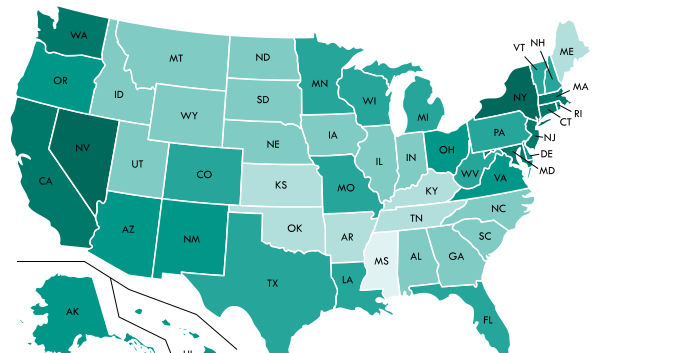
Most common states for city administrators
| Rank | State | Population | # of jobs | Employment/ 1000ppl |
|---|---|---|---|---|
| 1 | Colorado | 5,607,154 | 774 | 14% |
| 2 | Massachusetts | 6,859,819 | 881 | 13% |
| 3 | Alaska | 739,795 | 99 | 13% |
| 4 | Vermont | 623,657 | 77 | 12% |
| 5 | Utah | 3,101,833 | 355 | 11% |
| 6 | New Hampshire | 1,342,795 | 146 | 11% |
| 7 | Rhode Island | 1,059,639 | 114 | 11% |
| 8 | North Dakota | 755,393 | 82 | 11% |
| 9 | Oregon | 4,142,776 | 397 | 10% |
| 10 | Washington | 7,405,743 | 680 | 9% |
| 11 | Arizona | 7,016,270 | 662 | 9% |
| 12 | Minnesota | 5,576,606 | 520 | 9% |
| 13 | Kansas | 2,913,123 | 254 | 9% |
| 14 | New Mexico | 2,088,070 | 178 | 9% |
| 15 | Nebraska | 1,920,076 | 168 | 9% |
| 16 | Montana | 1,050,493 | 92 | 9% |
| 17 | Delaware | 961,939 | 89 | 9% |
| 18 | Wyoming | 579,315 | 50 | 9% |
| 19 | Alabama | 4,874,747 | 396 | 8% |
| 20 | Iowa | 3,145,711 | 264 | 8% |
Most common cities for city administrators
| Rank | City | # of jobs | Employment/ 1000ppl | Avg. salary |
|---|---|---|---|---|
| 1 | Chicago | 2 | 0% | $54,467 |
City Administrator job outlook: Expert opinions
Our panel of city administrator experts

Tarleton State University

DePaul University

Virginia Commonwealth University
International Association of Administrative Professionals

American College of Health Care Administrators
Dr. Jacqueline Abernathy
Assistant ProfessorTarleton State University
Public Administration
What general advice would you give to a City Administrator?
Dr. Jacqueline Abernathy: My advice to graduates would be this: do not sell yourself short by taking a job at a lower level than you have to or a job that does not fully utilize your education. Otherwise, why did you spend the time and money, and effort to get your degree? I think many graduates assume that having a degree in a job where it is not required (but preferred) makes them more valuable as employees. I think the opposite is true. I think it devalues their worth to an organization and just makes them cheaper and more replaceable, especially when employers know that they can pay someone less to do the same job if they run into a budget crunch.
If having a degree is considered a plus for a job rather than a necessity, it actually makes their degree less valuable as a perk than if it were a requirement. If a degree is necessary to do a job, then the time, effort, and expense obtaining it was worthwhile because it was necessary to do that job, and also, the employer knows that they have to compensate employees for those costs. There is nothing wrong with working your way up, paying your dues, etc. but starting at a lower rung just makes a longer, harder climb to the top. They may have upward mobility more than somebody without a degree, but they will be compensated less than they are worthwhile waiting for something better to manifest. I would exhort graduates to start as high as they can and not settle for underemployment. Find a job where your knowledge, skills, and abilities are put to complete use, and the degree you earned to get those assets is not wasted or unfairly compensated.
Are there any particularly good places in the United States for City Administrators to find work opportunities?
Dr. Anna Frank: This was on ZipRecruiter-outdoor jobs.
Try the Top Five
If location isn't a factor in your outdoor job search, then consider heading to one of the top five states who offer the most employment opportunities to be had under the sun (and stars). Those are:
1. California
2. Florida
3. Texas
4. New York
5. North Carolina
What skills stand out on City Administrator resumes?
Dr. Anna Frank: First, a degree from a highly respected university. Our graduates have been highly sought after. Experience working with a variety of individuals in a variety of settings is significant. Future professionals must then be committed to social justice, how are explicit in supporting the health and recreational needs of ALL individuals, not just those who can purchase a Peloton.
What general advice would you give to a City Administrator?
Dr. Richard Huff Ph.D.: I believe opportunities for employment will begin to open up with a transition in the federal government over the next year or two. While local government and nonprofits will continue to offer opportunities for MPA graduates, I believe the federal government will have urgent needs for talent, given its aging workforce, retirements, and its neglect over the past four years.
I advise graduates to begin considering federal careers, but for whatever sector they choose to shift from micro concerns about management, behavior and work outcomes, and organization structure and operations, and begin to look toward the macro or "big picture." A macro view concerns changes brought on by external environmental forces, which shape our institutions over time. With so many external forces at work today, such as a global pandemic, technological change, ongoing climate change, political trends, and social upheavals, the involvement of public administrators is critical to maintaining our institutions and steadying government response. I encourage students to think critically but also to think big and pursue their passions. Public service is a noble calling. Set your sights high and pursue opportunities that match them.
How would you rate the starting salaries for City Administrators, as well as the prospects for salary advancement?
Dr. Richard Huff Ph.D.: While MPA students are not drawn to public service by high salaries, it is reasonable to expect remuneration, which respects their credentials and experience. Many students are mid-level careerists and are likely to remain in their jobs where an advanced degree may improve their opportunities for advancement, and others may be looking for a career change. Also, a cohort of students moving from undergraduate to graduate degrees with internships is common.
These groups likely present varying degrees of salary requirements and qualifications. In the federal service, an MPA qualifies as one at the GS-9 entry-level. The Office of Personnel Management (OPM) publishes salary tables at Link The beginning salary varies by location from $53K to $61K, with the higher amount near large metropolitan areas. Higher salaries are common in overseas areas. Progression is based on performance with opportunities to achieve salaries of $150K and over at the executive levels. Overall, beginning salaries for the MPA considering nonprofits and government agencies is estimated at $53K.
Are there any particularly good places in the United States for City Administrators to find work opportunities?
Veronica Cochran: I would urge graduates to not simply focus on locations or organizations with the highest salary or most job or promotion opportunities. The key to remaining engaged and creating value is finding an organization that supports your core beliefs and values.
Second to that, I believe a support network is vital to one's professional development and success. That being said, I have had the opportunity to engage administrative professionals throughout the United States and across the globe. In particular, I came across larger networks in New York, D.C., Alabama, California, and Texas.
If they are looking for a place to start, I believe Zippia's list of Best States for an Administrative Assistant is a great starting point.
What type of skills will young City Administrators need?
Veronica Cochran: Those entering the administrative profession in the upcoming years will find it beneficial to understand what it means to be a strategic partner to their direct manager/supervisor, department, and organization at-large. As strategic partners, their role will extend beyond being a support person. It will involve strategically aligning oneself to fulfilling the organization's mission and vision while achieving business outcomes and success. The following skills will optimize both professional and organizational effectiveness:
1. Time management and organization
2. High EQ and interpersonal communication
3. Leadership effectiveness and accountability
4. Relationship management - (high inclusion capacity and high collaboration)
5. Problem-solving and innovation
6. Strategic planning and adaptability
What general advice would you give to a City Administrator?
Bill McGinley: LTC administrators should have at least a bachelor's degree in business or a healthcare-related field. A well-rounded internship that exposes the future administrator to all aspects of the operation is essential. Needed skills include business, marketing, finance, operations, management and leadership.
Post pandemic opportunities will be nationwide in this field with a greater need in rural areas.
Technology will continue to play a big role in the field. Computerized medical records, census management, and all clinical areas will continue to dominate. Online meetings are liable to continue as well, as employers realize that there is a savings to be gained by not having people travel to meetings and conferences.